Author: Kuli, Shenchao TechFlow
Original Title: Token Doesn't Need a Chinese Name, But the Business Behind It Does
Recently, you may have noticed something: people have started discussing what Token should be called.
Professor Yang Bin from Tsinghua University published an article titled "It's Already Urgent to Determine the Chinese Translation for Token"; on Zhihu, related translation questions have garnered 250,000 views, with comment sections buzzing with ideas.
Over the past two to three years, the domestic AI circle has been using the term Token directly without any issue. Why the sudden need for a Chinese name?
The immediate reason might be that, after this year's Spring Festival, the general public learned for the first time that Tokens cost money.
OpenClaw turned AI from chatting to working, with tasks burning through hundreds of thousands of Tokens, and bills skyrocketing; various cloud providers have also announced price increases, with Token as the billing unit.
At the same time, Token has begun appearing in places it never did before.
At the GTC conference, NVIDIA CEO Jensen Huang mentioned that in Silicon Valley, people are already asking in interviews, "How many Tokens does this job offer?" He suggested incorporating Tokens into engineers' compensation;
OpenAI founder Sam Altman took it even further, suggesting that Tokens will replace universal basic income, with everyone receiving computing power instead of money.
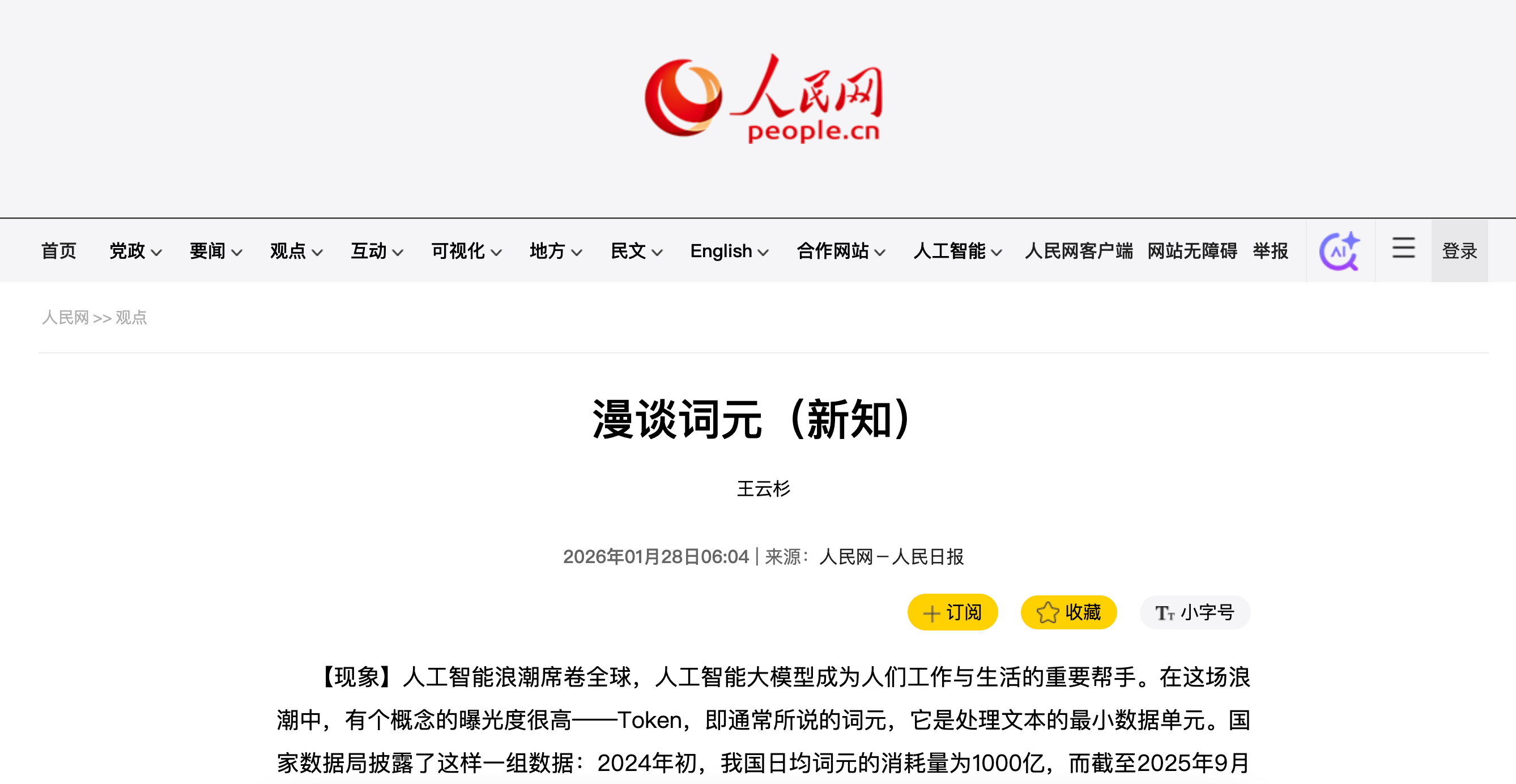
Data from the National Data Bureau shows that China's daily Token consumption surged from 100 billion in early 2024 to over 40 trillion by September 2025, reaching 180 trillion this February. At the beginning of the year, the People's Daily published an article titled "A Casual Talk on Ciyuan (词元)" to explain the term to readers.
Once a technical term enters cloud service bills, compensation packages, and official statistics, it can no longer remain in English.
The question is, what to call it?
If this were merely a translation issue, there would already be an answer. In 2021, the domestic academic community settled on a name for Token: 词元 (Ciyuan).
But no one paid attention because, back then, Token was just an internal term within technical circles.
Now, it's different.
The word Token itself is a universal container. People in the crypto world call it 代币 (daibi, token), those in security call it 令牌 (lingpai, token), and those in AI call it 词元 (ciyuan, lexeme). The same English word, depending on which direction the Chinese translation leans, determines whose territory it belongs to.
Thus, a battle over naming Token has begun.
Business Needs Discourse Power
How a word is translated is usually a matter for linguists. But this time, almost no linguists are involved in the naming.
The most prominent name currently is "智元" (Zhiyuan).
It's being pushed most vigorously by an AI media outlet called "新智元" (Xin Zhiyuan). If Token's Chinese name becomes "智元", this company's brand name would coincide with the industry's fundamental term, meaning every article discussing Token would provide free advertising for them.
Their own promotional article ends candidly: "We suggest translating Token as the industry's new consensus: 智元 (Zhiyuan), leaving the '新' (Xin, new) for us."
According to the same article, Baichuan Intelligent founder Wang Xiaochuan commented: "Calling it 智元 is quite good."
As a maker of large models, it's certainly good for him if Token is called 智元. Each operation of the model would then produce not just a billing unit, but a "basic unit of intelligence."
Selling Token is selling traffic; selling 智元 is selling intelligence—a completely different valuation story.
Professor Yang Bin from Tsinghua University proposed "模元" (Moyuan), with "模" (mo) corresponding to model. Whoever owns the large model holds the production rights to "模元". Leaning the term towards models directs pricing power to the model companies.
Some advocate for "符元" (Fuyuan), returning to the most fundamental definition in computer science—Token is simply a symbol processing unit, unrelated to intelligence or models.
Technically the purest, but the proposer is an independent technical writer without corporate backing or capital push, rendering this proposal almost inaudible in the discussion.
Which direction the name leans, the industry narrative moves in that direction, and money flows accordingly.
A distant example: the day Facebook renamed itself Meta, "metaverse" transformed from a sci-fi concept into a valuation story for a company. A recent example: China consumes 180 trillion Tokens daily, ranking first globally, but what to call this term, how to define it, and who defines it remain undecided...
The world's largest consumer of Tokens hasn't even decided what to call what it consumes.
However, this term actually already had a Chinese name.
In 2021, Professor Qiu Xipeng from Fudan University's School of Computer Science translated Token as "词元" (Ciyuan). The academic community accepted it and wrote it into textbooks. No one discussed it then because Token wasn't valuable at the time.
Now, Token is valuable.
It's the billing unit for cloud services, the revenue source for large model companies, and a core metric for measuring the scale of the AI industry at the national level. So the media arrived, the big shots arrived, the professors arrived, each bringing their preferred name and the rationale behind it.
Translation was never the issue. The issue is when this term started becoming valuable.
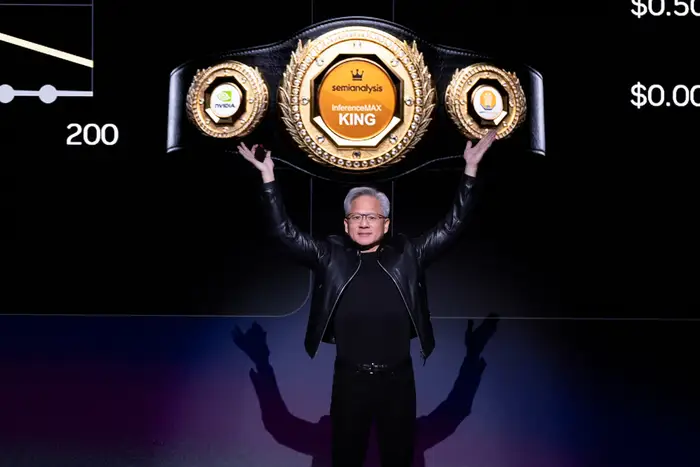
Jensen Huang didn't participate in the Chinese naming discussion at GTC. He did something simpler: held up a championship belt inscribed with "Token King" and declared that data centers are Token factories.
Whoever produces Tokens defines Tokens. He doesn't care about the name.
Token, Land Grabbing, and Minting
Therefore, the part truly worth serious thought isn't which translation is better.
After the term "calorie" was established, the entire food industry's pricing, labeling, and regulatory systems were built around it. After the definition of "流量" (liuliang, data traffic) was established in China's telecom industry, operators billed, competed, and designed packages based on it—the entire business model revolved around these two words for over a decade.
Token is now on the same path.
It's already the billing unit for cloud services, the revenue metric for large model companies, and a core indicator for measuring the AI industry at the national level. The VC circle is even discussing whether investment funds can be disbursed directly in Tokens.
Once a word becomes a measure of money, naming it is no longer translation—it's minting currency.
Call it "智元" (Zhiyuan), and the minting power goes to the AI narrative; whoever tells the story of intelligence benefits. Call it "模元" (Moyuan), and the minting power goes to the model companies; whoever has large models prints money. Call it "符元" (Fuyuan), and the minting power returns to the technology itself, but technology doesn't speak for itself.
The academic community's 2021 term "词元" (Ciyuan) was ignored not because the translation was poor, but because this "currency" wasn't valuable then.
Now it's valuable, and everyone wants to carve their name on it.
Twitter:https://twitter.com/BitpushNewsCN
Bitpush TG Discussion Group:https://t.me/BitPushCommunity
Bitpush TG Subscription: https://t.me/bitpush



















