Founder of Baixing.com: The Notion That Large Language Models Will Devour Everything, I Believe Half of It

marsbit發佈於 2026-07-07更新於 2026-07-07

文章摘要

Founder of Baixing.com: I Only Half-Believe the Saying “Large Language Models Will Devour Everything” Author: Wang Jianshuo, Founder of Baixing.com Many proclaim that large models are everything, but the author is skeptical. He argues that such sweeping claims often stem from a limited understanding of the future. Drawing parallels to past technologies like electricity and the internet—which were predicted to “devour everything” but didn’t—he suggests that large language models (LLMs) are better seen as a foundational base. Like electricity, this base is essential for modern development, but its real value emerges only when applied to specific scenarios through various “machines” or “tools” (e.g., Claude Code for programming, Claude Design for design). The author acknowledges that LLMs may indeed replace many existing software systems built on rigid rules, workflows, and forms (e.g., CRMs, SaaS tools), as these are precisely what LLMs excel at processing. However, he emphasizes that beyond software, elements like customer data, execution capabilities (e.g., booking a flight), trust, and physical-world interactions will not be “devoured.” Instead, he foresees that after streamlining existing software, LLMs will open up a larger space for innovative, next-generation applications. These new tools will likely feature fluid interfaces and rely less on fixed rules, unleashing greater creativity. The author cautions against short-sightedness, recalling how in 2004 many believed ...

Author: Wang Jianshuo, Founder of Baixing.com

Many people readily proclaim, "Large models are everything." I don't quite buy it.

Every time I hear phrases like "devour everything," I feel it's mostly because our understanding of the future hasn't reached that level, hence we casually throw out such a broad statement. Otherwise, how could one thing devour everything? Take the internet—it's been shouting about devouring everything for years, has it truly devoured everything now? So which one is it, the internet devours everything, or large models devour everything? Both are devouring, leaving nothing behind?

So I'd rather put it differently: it is a very important foundation. Without this foundation, the whole world can't develop, just like the internet without its underlying backbone network, or like using electricity without power plants. That, I acknowledge.

But after the foundation is in place, that's where the real excitement happens above.

Take electricity. As soon as electricity was generated, what was the first application people saw? The light bulb. Thomas Edison lit the first one, and it just kept shining, shining, shining. If the world stopped there, with only a light bulb, then I could completely say: the power plant is the core of the whole world, the power plant devours everything.

But that's not how things went. Later came motors, to drive machines; and then you find that once a fundamental thing like electricity exists, countless appliances grow on top of it to utilize it. Washing machines are for washing clothes, televisions are for watching TV, vacuum cleaners are for vacuuming—they are all applications of electricity. Without electricity, none of these things would exist. But if you say "electricity devours everything," I don't believe it.

It's the same with large models. They provide foundational intelligence. But this intelligence must be placed into a specific, scenario-oriented "machine" or "device" before it can play its role and truly change the world.
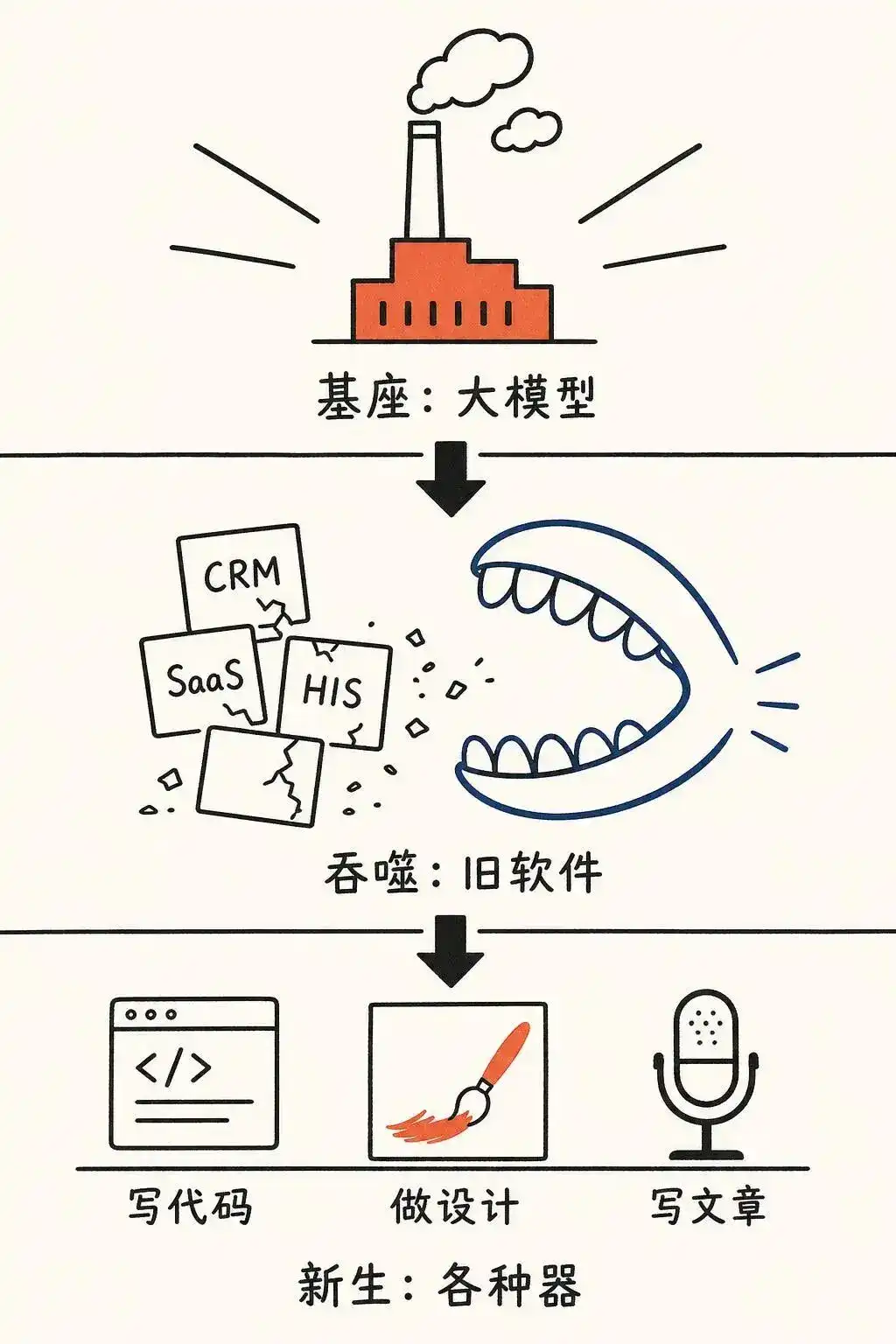
Claude Code is for writing code, Claude Design is for design, VoiceDrop is for writing articles. Using the same large model, placed into different devices, solves completely different problems.

With only electricity, only water, without a washing machine, clothes still can't be washed. Imagine, a power plant produces a massive amount of electricity, electricity is very powerful, and then what? Without a washing machine, can this pile of electricity wash clothes by itself?

Intelligence is great, but most things in the world require the combination of multiple elements to work, just as a washing machine needs to combine elements like electricity, water, and even a tub; large models might be able to replace a lot in the field of software, but application scenarios in the world that require only one element are not many.

Here's a current example. Now we have large models, but having just a large model isn't enough. There needs to be a layer above it called Harness—this layer has only recently emerged—it interacts with code, and finally forms something truly usable. A large model by itself can't write code. Of course, the core of Claude Code, frankly, I could write it with a little over fifty lines; a bit longer with a few more lines, and it can run and write programs. But you have to see: with only a large model and without this outer layer, it's still not easy to use—that is, the intelligence of a large model, if not combined with the code execution capabilities provided by the operating system, relying on the large model for calculations isn't economical, and sometimes even impossible.

The core value of this interface layer is to help us put that intelligence, which is like electricity or water, into a specific application scenario, turning it into a machine that can solve specific problems.

Now, of course, the logic behind "devour everything," I don't completely disbelieve it either.

What it primarily refers to is existing software. So far, we have built up a very, very large layer of software—things pieced together by many rules, forms, buttons, workflows, a lot of it. Massive numbers of filters, fixed templates, a bunch of backend operations, many SaaS detection features. And all the various things we used to know as "M" systems, whether CRM, or HIS (hospital information system), all sorts of so-called "systems," "software," and the like, a whole pile.

This layer, I believe large language models will indeed devour quite a bit of.

Why? Because these original software programs were, by nature, clear, computer-executable instructions, solidified and repeatedly executed—we call this software. And this is precisely what large language models are most adept at chewing through.

But.

Within this layer, besides software, there are many other things. Customer information. Execution capabilities—like when you book a flight ticket, the actual capability to move a plane, to transport a person from here to there. Also trust. Many things in the physical world. These, I don't think will be devoured.

After devouring that layer, it actually opens up a much larger space—the new type of software on top of it.

The interface of the new software will certainly be flow-based, it likely won't solidify as many rules as before. After handing all those rules to AI, think about it, the CRM we could achieve like Salesforce before, that was already the pinnacle of human effort, using all possible strength. But if this part becomes relatively easier to solve, then what everyone will do next is to unleash even more imagination and possibilities on top of it—and that part is precisely what we haven't seen yet.

This is where we often make mistakes. When a new technology arrives, because we can't see the bigger road beyond it, we can only stare at the part in front of us. The leaf blocks the view, obscuring the mountain.

Let alone this kind of trend judgment. I remember back in 2004, a group of friends were complaining, saying that the entire internet could no longer produce companies bigger than Sina, Sohu, and NetEase, that the internet was nearly over, and they would monopolize everything. And look how many years have passed since then? The world turned upside down. We would be crying at our own shortsightedness back then.

So my proposition is this: Are large models important? Yes, they are the foundation, the main driving force in recent times. But once they become stable, continuously provided things, then various kinds of "machines" and "devices" on top are needed to solve specific problems. That thick layer—where it's used, how it's used—is precisely the mainstream of the second wave of this trend.

The phrase "devour everything" is too imprecise. In this world, which thing, which social form, which technology has ever truly devoured everything?

Finding opportunities in the places it does devour—that's the truly important thing.

熱門幣種推薦

相關問答

QWhat is the core viewpoint of the author, the founder of Baixing.com, regarding the statement 'Large language models will devour everything'?

AHe believes it only half. He views large language models as a crucial foundational platform, like electricity or the internet, but argues that they alone cannot 'devour everything.' True value and transformation come from applying this foundational intelligence to specific scenarios through various 'machines' or applications built on top of it.

QHow does the author use the analogy of electricity to explain the role of large language models?

AThe author compares large language models to electricity. Electricity itself is a foundational utility (like a power plant), but it doesn't 'devour everything.' Its real-world impact comes from the diverse array of appliances (like washing machines, TVs) built on top of it to solve specific problems. Similarly, LLMs provide base intelligence, but they need to be integrated into specific applications (like Claude Code for programming) to be truly useful and transformative.

QAccording to the article, what specific layer of existing technology does the author believe large language models are likely to 'devour' or replace?

AThe author believes large language models are likely to replace a significant portion of existing, rule-based, fixed-template software systems, such as many CRM, HIS, and various SaaS applications. These systems are composed of clear, computer-executable instructions, which is precisely what LLMs are good at handling and generating.

QWhat does the author identify as elements that will NOT be 'devoured' by large language models, even as software systems change?

AThe author identifies several elements that will not be devoured: customer information, execution capabilities (like physically moving people or goods), trust, and many aspects of the physical world. These components are essential and exist alongside or beyond the software logic that LLMs might replace.

QWhat is the 'second wave' of the AI浪潮 (wave/tide) that the author predicts will follow the establishment of large language models as a stable foundation?

AThe author predicts the 'second wave' will be focused on the thick layer of applications built *on top* of the large language model foundation. This involves creating the various 'machines' and 'tools' that leverage the base intelligence to solve concrete, specific problems in different domains. This application layer is where the next major phase of innovation and opportunity lies.

你可能也喜歡

稳定币结算额创下1.79万亿美元历史新高——市场底部是否已现?

稳定币叙事正从流动性引擎转向实用框架。随着采用成熟,稳定币日益融入跨境支付、机构转账、DeFi应用和全天候全球结算网络,重点从链上流动性供给转向现实世界的金融效用。 6月数据显示了这一转变:调整后的稳定币交易量达到创纪录的1.79万亿美元,环比增长63%,同比增长125%。这表明稳定币正更多地被用作结算层,而不仅是加密市场内部的流动性工具。这一转变提升了Layer 1网络的战略重要性,例如Toncoin(TON)的稳定币供应在过去一周增长8%至超8.1亿美元,凸显了各网络争夺稳定币采用率的竞争。 然而,市场层面出现分化:6月稳定币交易量飙升的同时,市场整体下跌超18%,创下自2月以来最大月度资本流出。稳定币市场总市值下降超2%,出现近80亿美元的资金外流,尤其是USDT和USDC的合计市值在过去两个月缩水近110亿美元,表明使用量增加与流动性收缩并存。 从宏观角度看,美元指数(DXY)走强,6月上涨超2.25%,美元资产需求保持高位可能继续支撑稳定币的实用性。但若使用量与流动性的背离持续,可能成为下半年加密市场的关键看跌因素。 **核心要点**: * 稳定币活动增加,但USDT和USDC市值下降预示流动性减弱。 * 美元走强支撑需求,但流动性降低可能给加密市场带来风险。

ambcrypto16 分鐘前

稳定币结算额创下1.79万亿美元历史新高——市场底部是否已现?

ambcrypto16 分鐘前

百姓网创始人:大语言模型吞噬一切,这话我信一半

百姓网创始人王建硕对“大语言模型吞噬一切”的观点持保留态度。他认为这种说法过于笼统,类似于过去“互联网吞噬一切”的预言,但事实上任何技术都无法真正覆盖所有领域。他强调大模型更像是一个重要的“基座”,如同电力或互联网基础设施,为上层应用提供基础的智能能力。 然而,仅有基座是不够的。他以电力为例:电本身不能洗衣服,需要与洗衣机结合才能发挥作用。同样,大模型的智能必须嵌入到面向具体场景的应用(如代码生成、设计、写作等工具)中,通过与操作系统、其他能力(如代码执行、数据访问)结合,才能解决实际问题。当前出现的一层“接口”或“连接器”(如Harness),正是为了将通用智能适配到特定任务。 他承认大模型会深刻影响并可能取代大量现有软件,尤其是那些由固化规则、表单和工作流构成的系统(如CRM、HIS等),因为这正是大模型所擅长的。但这不意味着吞噬一切。客户信息、实际执行能力、信任关系和物理世界要素等不会被替代。更重要的是,在吞噬掉部分旧有软件层之后,反而会催生出全新的、界面更流式、规则更灵活的新型软件,开启更大的创新空间。 王建硕指出,人们常因视野局限而高估技术的短期影响,低估其长期潜力。他主张应聚焦于大模型作为基座稳定后,上层各种具体应用所带来的巨大机会,而非纠结于是否“吞噬一切”。在技术变革中找到其中真正的机会,才是关键。

链捕手2 小時前

百姓网创始人:大语言模型吞噬一切,这话我信一半

链捕手2 小時前

诺亚·多伊关于中本聪比特币所有权的声索会‘扰乱整个行业’吗?被告方表示……

十四年后,与比特币创始人中本聪早期相关的比特币再次成为一场诉讼的核心。7月6日,第二份法庭之友陈述书被提交,以反对“诺亚·杜伊”试图将中本聪的比特币主张为“被遗弃财产”并获得所有权。 此前在2026年5月,已有一份类似文件提交,当时“所罗门兄弟”公司曾主张对中本聪比特币的法律所有权。本案中,包括诺亚·杜伊在内的三位化名原告,正试图获取39,069个他们既未创建也无法访问的休眠比特币钱包的法律所有权。这些钱包总计涉及约380万枚比特币。 原告声称,他们通过比特币的OP_RETURN功能在区块链上发布了通知,给予钱包所有者90天回应期。通知期过后,约2900个钱包被移除(其中424个被激活),原告据此主张剩余的39,069个钱包已被遗弃。 然而,此案面临重大法律障碍。被告方(被列为被告的钱包地址)主张案件应被驳回。他们指出,原告缺乏访问比特币所需的私钥,也无法证明原所有者看到了通知,仅凭钱包不活跃就断言遗弃是站不住脚的。许多投资者长期持有比特币而不进行交易是常见做法,仅凭 inactivity 不能证明所有权放弃,因为所有权最终取决于对私钥的控制,而非交易历史。被告警告,若支持原告诉求,将破坏整个数字资产行业的产权预期。 案件的一个复杂点在于:被列为被告之一的、自2011年起持有35.55 BTC的中本聪时代钱包(地址以1LwWt开头),近期发生了资金移动(转出15 BTC),这直接挑战了原告关于钱包已被“遗弃”的核心主张。该钱包因未回应原告于2025年7月31日发出的通知而被列入最终被告名单。 银河研究主管亚历克斯·索恩对此评论指出,这一资金移动事件凸显了原告论证的缺陷。最终,被告方强调,诺亚·杜伊仅发现了公开的钱包地址,从未获得私钥或比特币的控制权,因此没有资格成为合法的财产“发现者”或主张所有权。

ambcrypto3 小時前

诺亚·多伊关于中本聪比特币所有权的声索会‘扰乱整个行业’吗?被告方表示……

ambcrypto3 小時前

交易

現貨

熱門文章

如何購買PEOPLE

歡迎來到HTX.com!在這裡,購買ConstitutionDAO (PEOPLE)變得簡單而便捷。跟隨我們的逐步指南,放心開始您的加密貨幣之旅。第一步:創建您的HTX帳戶使用您的 Email、手機號碼在HTX註冊一個免費帳戶。體驗無憂的註冊過程並解鎖所有平台功能。立即註冊第二步:前往買幣頁面,選擇您的支付方式信用卡/金融卡購買:使用您的Visa或Mastercard即時購買ConstitutionDAO (PEOPLE)。餘額購買:使用您HTX帳戶餘額中的資金進行無縫交易。第三方購買:探索諸如Google Pay或Apple Pay等流行支付方式以增加便利性。C2C購買:在HTX平台上直接與其他用戶交易。HTX 場外交易 (OTC) 購買:為大量交易者提供個性化服務和競爭性匯率。第三步:存儲您的ConstitutionDAO (PEOPLE)購買ConstitutionDAO (PEOPLE)後,將其存儲在您的HTX帳戶中。您也可以透過區塊鏈轉帳將其發送到其他地址或者用於交易其他加密貨幣。第四步:交易ConstitutionDAO (PEOPLE)在HTX的現貨市場輕鬆交易ConstitutionDAO (PEOPLE)。前往您的帳戶,選擇交易對,執行交易,並即時監控。HTX為初學者和經驗豐富的交易者提供了友好的用戶體驗。

866 人學過發佈於 2024.12.12更新於 2026.06.02

如何購買PEOPLE

相關討論

歡迎來到 HTX 社群。在這裡,您可以了解最新的平台發展動態並獲得專業的市場意見。 以下是用戶對 PEOPLE (PEOPLE)幣價的意見。

活动图片