Bitcoin Community in Uproar: Deciphering the New Scaling War Sparked by BIP-110

marsbit發佈於 2026-08-11更新於 2026-08-11

文章摘要

On August 10, Luke Dashjr, a long-time Bitcoin Improvement Proposal (BIP) editor and co-founder of Ocean mining pool, was removed from the BIP editing team for bypassing discussion protocols and preemptively assigning a number to BIP-110, a controversial soft fork proposal he helped draft. The conflict stems from Bitcoin Core's version 30 release in October 2025, which removed the default 83-byte limit on OP_RETURN, a field used for embedding non-transaction data. In response, BIP-110 aimed to enforce this limit as a consensus rule. It controversially lowered the activation threshold for miners to 55% and included a mandatory activation clause, causing significant community backlash. Major mining pools like Foundry USA and AntPool did not support it, with public criticism from figures like F2Pool's Wang Chun and Michael Saylor, who argued it compromised Bitcoin's neutrality. On August 8, at block height 961,632, nodes running the BIP-110 patch rejected the main chain block, causing a chain split. The minority chain, supported by only about 2.53% of the network's hash rate, produced just one additional block before stalling. The main chain quickly outpaced it by over 240 blocks. No major exchanges have supported the minority chain. The event highlighted Bitcoin's governance reality: while rules can be proposed by a few, ultimate authority lies with the economic majority—miners willing to expend hash power and users/exchanges recognizing a chain's validity. Following the fai...

On August 10, Luke Dashjr, a long-time Bitcoin Improvement Proposal (BIP) editor, co-founder and CTO of the Ocean mining pool, was removed from the editorial team and lost his editing permissions by his peers. This was due to his actions in pushing BIP-110 by bypassing the discussion process and pre-emptively assigning a proposal number, coupled with his minimal contributions to editorial work in recent years.

The immediate catalyst for this disciplinary action was the first genuine chain split in the Bitcoin network since the Bitcoin Cash hard fork of 2017, which occurred just days earlier. On August 8, the Bitcoin network split at block height 961,632: a subset of nodes refused to follow the main chain, insisting on enforcing BIP-110, a soft-fork proposal prohibiting non-transaction data in transactions, which Luke was deeply involved in drafting. The minority chain produced only one additional block before completely stalling, while the main chain continued operating normally and quickly outpaced it by dozens of blocks.

Who Should Decide the Use of Block Space?

Bitcoin produces a new block on average every ten minutes, packaging a period's transfer records. Once full, miners confirm and link it to the previous block. While blocks mostly contain transaction information, as long as one is willing to pay for the space, the rules do not prohibit including text, images, or even code.

The conflict began with the release of Bitcoin Core 30 in October 2025, the most widely used node software on the Bitcoin network. This version removed the previous 83-byte limit on the OP_RETURN field (used for attaching additional information). This limit was originally just a default recommendation in the software; its removal significantly lowered the cost of including non-transactional data.

However, a segment of the community disagreed with this relaxation. They instead switched to running another software, Bitcoin Knots, which is free and open-source but retains the old limit. Its user share grew from nearly zero in early 2024 to over 22% within two years.

It was against this backdrop that BIP-110 was proposed, aiming to codify Knots' restriction into Bitcoin's core consensus rules, making it mandatory for the entire network. Initially numbered BIP-444, the draft mentioned imposing "legal and moral consequences" on non-compliers, which sparked backlash and was later removed. In December 2025, it was renumbered to 110.

What started as a technical discussion thus escalated into a power struggle.

The Trust Gambled on a Low Threshold

For a Bitcoin soft fork to activate, it typically requires miners (individuals or organizations running specialized equipment to record transactions for the network and earn Bitcoin rewards) to vote by signaling: inserting a marker in their blocks. The new rule only activates once the signaled hash rate reaches a threshold. The historical convention is a high threshold of 95%, requiring near-unanimous miner approval to avoid a chain split.

BIP-110, however, lowered this threshold to 55% and added a forced activation clause: even if the support rate is not met, nodes running the patch will automatically reject blocks that do not comply with the new rule.

While the threshold can be written into code, whether miners will cooperate is not dictated by code.

Since entering the voting period on May 1, support never exceeded 3%; in the final statistical period nearing the forced activation deadline, support only climbed to about 2.53%.

Major mining pools like Foundry USA and AntPool did not signal support. Support votes came almost exclusively from the Ocean pool and some independent miners. F2Pool co-founder Wang Chun even publicly criticized Luke, sarcastically remarking he was "both financially and personally bankrupt" and suggesting he might as well switch to a different proof-of-work algorithm, with the results likely being no better.

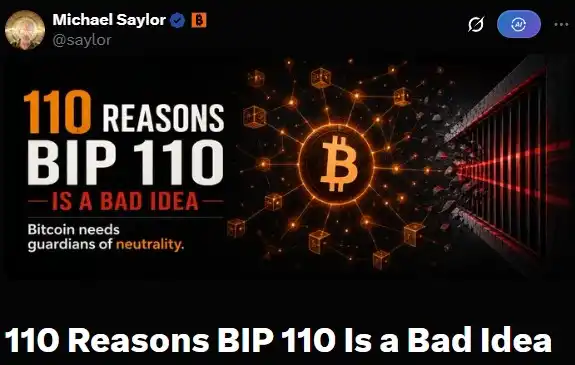
Strategy founder Michael Saylor listed "110 reasons" in opposition, arguing that once rules can filter transactions based on content, Bitcoin's neutrality is broken. Security expert Jameson Lopp was more direct, calling it "reckless" and "doomed to fail," noting that data could be encoded differently to bypass the restriction and that it could render certain transaction outputs permanently unspendable.
A Fork That Lasted Only One Block

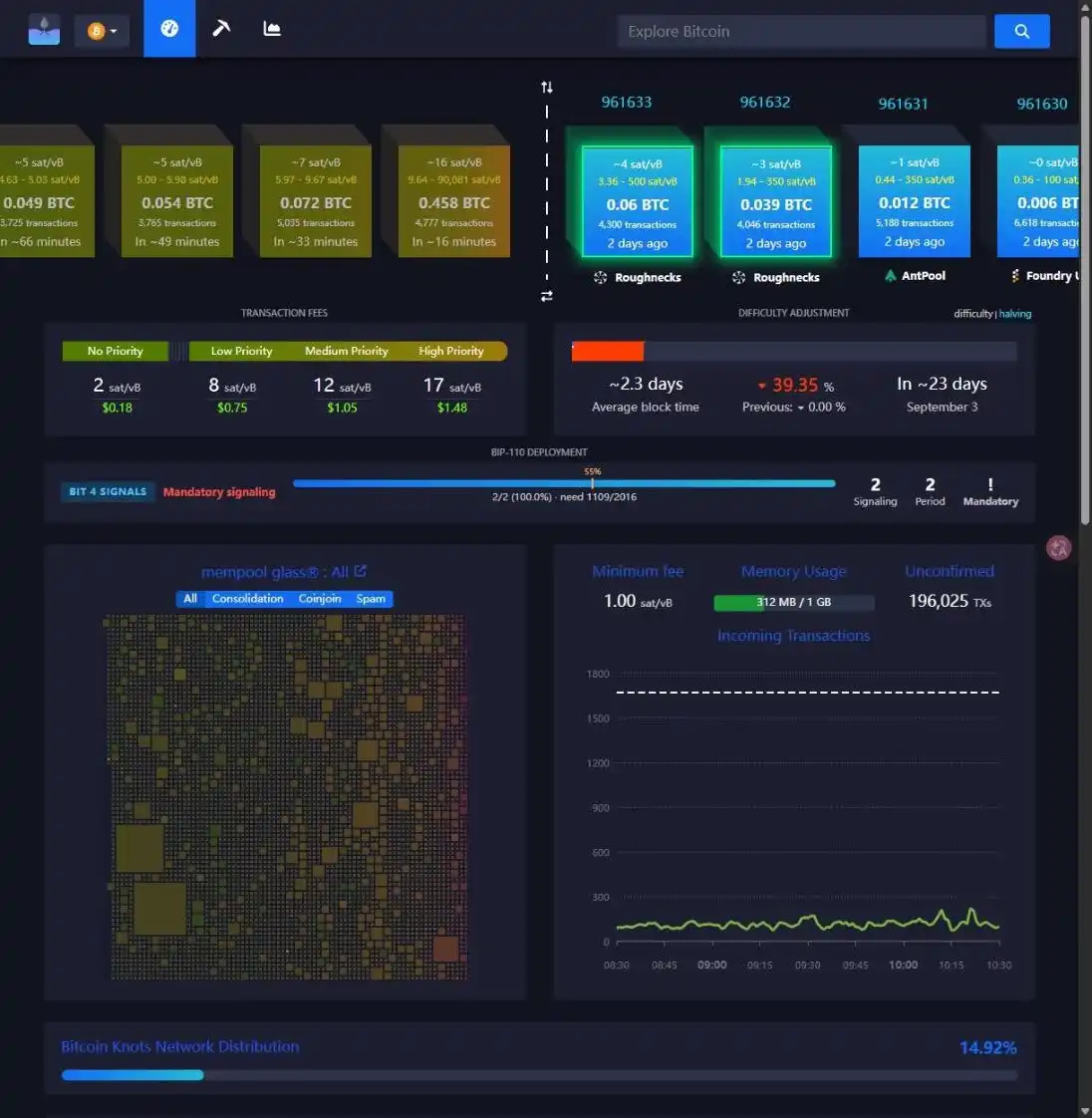
On August 8, when the chain reached block height 961,632, nodes running the BIP-110 patch rejected this block because it did not carry the signal required by the new rule. They instead created a new block according to their own rules, initiating the split. This new chain initially had the support of about 2.53% of the network's total hash rate—equivalent to roughly 1 out of every 40 mining machines worldwide being willing to mine on it.

However, the minority chain only produced one additional block before it stopped updating entirely. The chain with more hash rate moves faster and farther. The main chain consistently produced a block every ten minutes, leaving the minority chain behind by 243 blocks (data from bip110.mempool.guide).
Japanese exchange bitFlyer's announcement on August 10 merely stated they would continue monitoring the impact of BIP-110 without committing to a specific handling method. Furthermore, no major exchange expressed support for the minority chain, a stark contrast to the guides many issued ahead of the 2017 Bitcoin Cash fork.

Those who truly need to be cautious are self-custody nodes running Bitcoin Knots: BIP-110 lacks "replay protection," meaning the same transaction might be valid on both chains, potentially leading to accidental double-spending if not handled carefully.

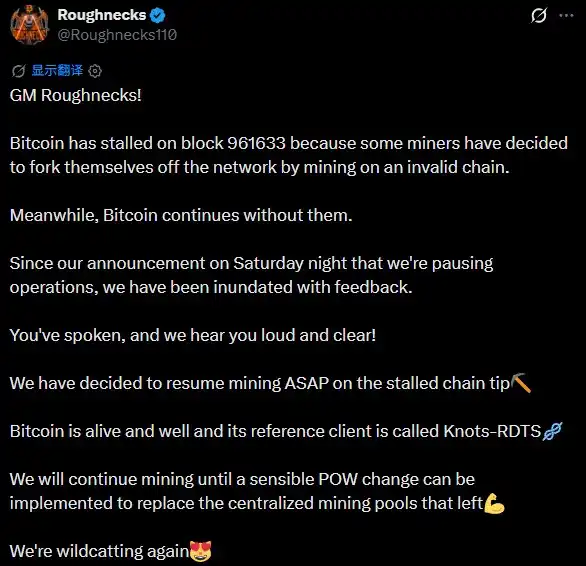
The miner "Roughnecks," who mined the block on the BIP-110 chain, initially stopped production but reversed course on August 10, announcing plans to resume mining. However, by then, their signaled hash rate had plummeted from over 15 EH/s to 1.16 EH/s, and no new blocks appeared on the chain. The economic cost of continuing to mine had already exceeded the potential rewards.
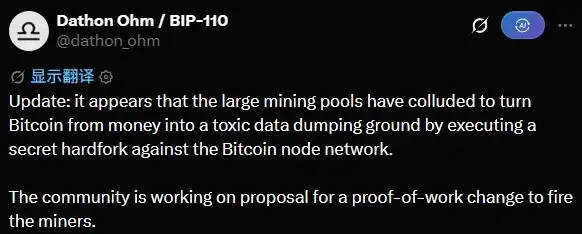
But supporters don't seem ready to concede. Proposal author Dathon Ohm and Luke, who just lost his editor status, have indeed begun discussing the path Wang Chun mocked. That is, changing the proof-of-work algorithm to shake off miners using specialized hardware (ASICs) and turning the minority chain into a separate new cryptocurrency. This currently remains in the discussion and code experimentation phase.
Regardless of the eventual outcome, this whole episode confirms the principle etched into Bitcoin from its inception: rules can be drafted by a few, and editing permissions can be granted by oneself, but the real decision-makers are the miners willing to keep burning electricity for a chain, and the exchanges and users who decide which chain counts.


熱門幣種推薦

相關問答

QWho is Luke Dashjr and why was he removed from the Bitcoin Improvement Proposal (BIP) editor team?

ALuke Dashjr is the long-time BIP editor and co-founder/CTO of the Ocean mining pool. He was removed from the BIP editor team for bypassing discussion protocols and preemptively assigning a number to the BIP-110 proposal, coupled with his minimal contributions to the editing work in recent years.

QWhat was the main cause of the Bitcoin chain split that occurred on August 8, and what is BIP-110?

AThe main cause was a divergence in consensus rules. On August 8, at block height 961,632, a portion of nodes, running a patch implementing BIP-110, rejected the main chain because it did not carry a signal required by the new rule. BIP-110 is a soft fork proposal that aims to ban embedding non-transaction data within Bitcoin transactions.

QWhy did the Bitcoin Core 30 release in October 2025 become a point of conflict?

AThe Bitcoin Core 30 release removed the default 83-byte limit on the `OP_RETURN` field. `OP_RETURN` is used to embed additional data in transactions. Removing this limit significantly lowered the cost of adding non-financial data, which was opposed by a segment of the community who preferred the old restriction.

QHow did BIP-110 attempt to enforce its rules, and why did it fail to gain support?

ABIP-110 attempted to enforce its rules by lowering the miner activation threshold for a soft fork to 55% (from the historical 95%) and including a forced activation clause where patched nodes would automatically reject blocks not following the new rules. It failed because it never gained significant miner support, with approval never exceeding 3%, and faced strong public criticism from major figures and pools who argued it compromised Bitcoin's neutrality and was technically flawed.

QWhat was the outcome of the chain split initiated by the BIP-110 nodes?

AThe minority chain, supported by only about 2.53% of the network's hashrate, produced just one block before stalling completely. The main chain continued normally, quickly outpacing it by hundreds of blocks. Major exchanges did not support the minority chain, and its economic viability collapsed as supporting miners' costs exceeded potential rewards.

你可能也喜歡

交易

現貨

熱門文章

什麼是 BITCOIN

理解 HarryPotterObamaSonic10Inu (ERC-20) 及其在加密空間中的地位 近年來,加密貨幣市場見證了迷因幣的流行激增,吸引了不僅是交易者的注意,還有尋求社區參與和娛樂價值的人士。在這些獨特的代幣中,有一個有趣的項目 HarryPotterObamaSonic10Inu (ERC-20),它將文化參考融入加密貨幣的織造中。本文深入探討 HarryPotterObamaSonic10Inu 的關鍵方面,探索其機制、以社區為驅動的精神,以及其與更廣泛的加密生態的互動。 HarryPotterObamaSonic10Inu (ERC-20) 是什麼? 正如其名所示,HarryPotterObamaSonic10Inu 是一種建立在以太坊區塊鏈上的迷因幣,按照 ERC-20 標準分類。與強調實用性或投資潛力的傳統加密貨幣不同,這項代幣依賴於娛樂價值和其社區的力量。該項目旨在促進一個讓互動用戶可以聚在一起、分享想法和參與受不同文化現象啟發的活動的環境。 HarryPotterObamaSonic10Inu 的一個顯著特點是其 交易零稅。這一引人注目的元素旨在鼓勵交易和社區參與,無需擔心可能會阻礙小型交易者的額外費用。該幣的總供應量定為十億個代幣,這一數字標示其意圖在社區內保持較大的流通量。 HarryPotterObamaSonic10Inu (ERC-20) 的創建者 HarryPotterObamaSonic10Inu 的起源有些神秘;對創建者的具體資訊尚不清楚。這個代幣的開發缺乏可識別的團隊或明確的藍圖,這在迷因幣領域並不罕見。相反,該項目是自然產生的,其進展主要依賴於社區的熱情和參與。 HarryPotterObamaSonic10Inu (ERC-20) 的投資者 關於外部投資和支持,HarryPotterObamaSonic10Inu 亦保持模稜兩可。該代幣並未列出任何已知的投資基金或顯著的組織支持。相反,該項目的生命力來自其草根社區,通過集體行動和參與在加密空間促進其增長和可持續性。 HarryPotterObamaSonic10Inu (ERC-20) 如何運作? 作為一種迷因幣,HarryPotterObamaSonic10Inu 主要在傳統的資產價值框架之外運作。以下是幾個定義該項目運作方式的獨特方面: 零稅交易:由於交易沒有稅費,使用者可以自由地買賣該代幣,而不必擔心隱藏成本。 社區參與:該項目依賴於社區互動,利用社交媒體平台創造話題並促進參與。討論、內容分享及互動是幫助擴展其影響力和加強支持者忠誠度的重要元素。 無實用性:需要指出的是,HarryPotterObamaSonic10Inu 在金融生態中並不提供具體的實用性。相反,它被定義為主要用於娛樂和社區活動的代幣。 文化參考:該代幣巧妙地融入了流行文化中的元素,以吸引興趣,與迷因愛好者和加密追隨者建立聯繫。 HarryPotterObamaSonic10Inu 範例展示了迷因幣如何與更傳統的加密貨幣項目運作不同,作為創新的社會構造進入市場,而非實用資產。 HarryPotterObamaSonic10Inu (ERC-20) 的時間線 HarryPotterObamaSonic10Inu 的歷史標誌著幾個值得注意的里程碑: 創建:這個代幣源於一個病毒式的迷因,捕捉了許多加密愛好者的想像力。具體的創建日期目前並不清楚,凸顯其自然興起。 上架交易所:HarryPotterObamaSonic10Inu 已經在多個交易所上架,使社區更容易存取和交易。 社區互動倡議:持續進行旨在增進社區互動的活動,包括比賽、社交媒體活動和來自粉絲和支持者的內容創作。 未來擴展計劃:該項目的路線圖包括推出 NFT 收藏品、周邊商品及相關電子商務網站,進一步與社區互動並嘗試為其生態系統增添更多維度。 關於 HarryPotterObamaSonic10Inu (ERC-20) 的關鍵點 以社區為驅動的特質:該項目優先考慮集體意見和創意,確保用戶參與在其發展過程中居於核心地位。 迷因幣分類:它代表了以娛樂為基礎的加密貨幣的典範,與傳統投資工具大相徑庭。 與比特幣無直接關聯:儘管在代碼名稱上有相似之處,HarryPotterObamaSonic10Inu 是獨特的,並不與比特幣或其他已建立的加密貨幣存在關係。 協作焦點:HarryPotterObamaSonic10Inu 旨在為持有者創造一個共享故事和協作的空間,提供創意和社區聯結的途徑。 未來前景:向超越其初步主題擴展至 NFT 和周邊商品的雄心,描繪了該項目潛在進入數字文化的更主流途徑。 隨著迷因幣繼續吸引加密貨幣社區的想像力,HarryPotterObamaSonic10Inu (ERC-20) 由於其文化聯繫和以社區為中心的方式而脫穎而出。儘管它可能不符合以實用性為導向的代幣的典型模式,其本質在於支持者間培育的快樂和友誼,突顯了在日益數字化的時代中,加密貨幣的演變特性。隨著該項目的持續發展,觀察社區動態如何影響其在不斷變化的區塊鏈技術格局中的軌跡將是重要的。

3.0k 人學過發佈於 2024.04.01更新於 2024.12.03

什麼是 BITCOIN

如何購買BTC

歡迎來到HTX.com!在這裡,購買Bitcoin (BTC)變得簡單而便捷。跟隨我們的逐步指南,放心開始您的加密貨幣之旅。第一步:創建您的HTX帳戶使用您的 Email、手機號碼在HTX註冊一個免費帳戶。體驗無憂的註冊過程並解鎖所有平台功能。立即註冊第二步:前往買幣頁面,選擇您的支付方式信用卡/金融卡購買:使用您的Visa或Mastercard即時購買Bitcoin (BTC)。餘額購買:使用您HTX帳戶餘額中的資金進行無縫交易。第三方購買:探索諸如Google Pay或Apple Pay等流行支付方式以增加便利性。C2C購買:在HTX平台上直接與其他用戶交易。HTX 場外交易 (OTC) 購買:為大量交易者提供個性化服務和競爭性匯率。第三步:存儲您的Bitcoin (BTC)購買Bitcoin (BTC)後,將其存儲在您的HTX帳戶中。您也可以透過區塊鏈轉帳將其發送到其他地址或者用於交易其他加密貨幣。第四步:交易Bitcoin (BTC)在HTX的現貨市場輕鬆交易Bitcoin (BTC)。前往您的帳戶,選擇交易對,執行交易,並即時監控。HTX為初學者和經驗豐富的交易者提供了友好的用戶體驗。

6.5k 人學過發佈於 2024.12.12更新於 2026.06.02

如何購買BTC

什麼是 $BITCOIN

數字黃金 ($BITCOIN):全面分析 數字黃金 ($BITCOIN) 介紹 數字黃金 ($BITCOIN) 是一個基於區塊鏈的項目,運行於 Solana 網絡,旨在將傳統貴金屬的特徵與去中心化技術的創新相結合。雖然它與比特幣同名,常被稱為「數字黃金」,因其被視為價值儲存工具,但數字黃金是一個獨立的代幣,旨在於 Web3 生態系統中創造一個獨特的生態系。其目標是將自己定位為一個可行的替代數字資產,儘管有關其應用和功能的具體細節仍在發展中。 什麼是數字黃金 ($BITCOIN)? 數字黃金 ($BITCOIN) 是一個專門為 Solana 區塊鏈設計的加密貨幣代幣。與比特幣提供廣泛認可的價值儲存角色不同,這個代幣似乎更專注於更廣泛的應用和特徵。值得注意的方面包括: 區塊鏈基礎設施:該代幣建立在 Solana 區塊鏈上,以其處理高速和低成本交易的能力而聞名。 供應動態:數字黃金的最大供應量上限為 100 萬兆代幣(100P $BITCOIN),儘管有關其流通供應的詳細信息目前尚未披露。 實用性:雖然具體功能尚未明確說明,但有跡象表明該代幣可能被用於各種應用,可能涉及去中心化應用(dApps)或資產代幣化策略。 誰是數字黃金 ($BITCOIN) 的創建者? 目前,數字黃金 ($BITCOIN) 的創建者和開發團隊的身份仍然是 未知 的。這種情況在許多創新項目中是典型的,特別是那些與去中心化金融和迷因幣現象相關的項目。雖然這種匿名性可能促進社區驅動的文化,但也加劇了對治理和問責制的擔憂。 誰是數字黃金 ($BITCOIN) 的投資者? 可用的信息顯示,數字黃金 ($BITCOIN) 沒有任何已知的機構支持者或知名的風險投資。該項目似乎運行在一個以社區支持和採用為重點的點對點模型上,而不是傳統的資金籌集途徑。其活動和流動性主要位於去中心化交易所(DEXs),如 PumpSwap,而不是已建立的集中交易平台,進一步突顯其草根方法。 數字黃金 ($BITCOIN) 如何運作 數字黃金 ($BITCOIN) 的運作機制可以根據其區塊鏈設計和網絡特徵進行詳細說明: 共識機制:通過利用 Solana 的獨特歷史證明(PoH)結合權益證明(PoS)模型,該項目確保高效的交易驗證,促進網絡的高性能。 代幣經濟學:雖然具體的通縮機制尚未詳細說明,但巨大的最大代幣供應量暗示它可能適合微交易或尚待定義的利基用例。 互操作性:存在與 Solana 更廣泛生態系統的整合潛力,包括各種去中心化金融(DeFi)平台。然而,關於具體整合的詳細信息仍未明確。 重要事件時間表 以下是關於數字黃金 ($BITCOIN) 的重要里程碑時間表: 2023:該代幣首次在 Solana 區塊鏈上部署,並以其合約地址為標誌。 2024:數字黃金獲得曝光,因其在去中心化交易所如 PumpSwap 上可供交易,允許用戶以 SOL 進行交易。 2025:該項目見證了零星的交易活動和社區主導參與的潛在興趣,儘管截至目前尚未記錄到任何顯著的合作夥伴關係或技術進展。 關鍵分析 優勢 可擴展性:基於 Solana 的基礎設施支持高交易量,這可能增強 $BITCOIN 在各種交易場景中的實用性。 可及性:每個代幣潛在的低交易價格可能吸引零售投資者,促進更廣泛的參與,因為存在分割所有權的機會。 風險 缺乏透明度:缺乏公眾已知的支持者、開發者或審計過程可能引發對該項目可持續性和可信度的懷疑。 市場波動性:交易活動在很大程度上依賴於投機行為,這可能導致價格波動和投資者的不確定性。 結論 數字黃金 ($BITCOIN) 在快速發展的 Solana 生態系統中,作為一個引人入勝但模糊的項目出現。雖然它試圖利用「數字黃金」的敘事,但其與比特幣作為價值儲存工具的既定角色的脫離,突顯了對其預期實用性和治理結構更清晰區分的需求。未來的接受度和採用率可能取決於解決當前的不透明性,並更明確地定義其運營和經濟策略。 注意:本報告涵蓋截至 2023 年 10 月的綜合信息,並且在研究期間可能發生了進展。

581 人學過發佈於 2025.05.13更新於 2025.05.13

什麼是 $BITCOIN

相關討論

歡迎來到 HTX 社群。在這裡,您可以了解最新的平台發展動態並獲得專業的市場意見。 以下是用戶對 BTC (BTC)幣價的意見。

活动图片