Qualcomm (QCOM.O) released its fiscal year 2026 third-quarter earnings report (ending June 2026) after the U.S. market closed on the morning of July 30, 2026, Beijing time. Key points are as follows:
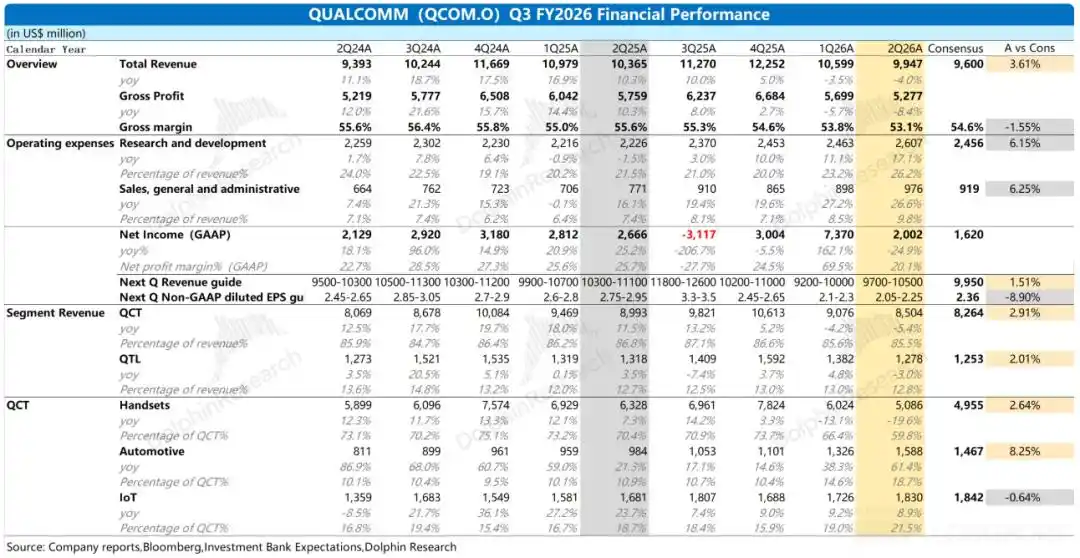
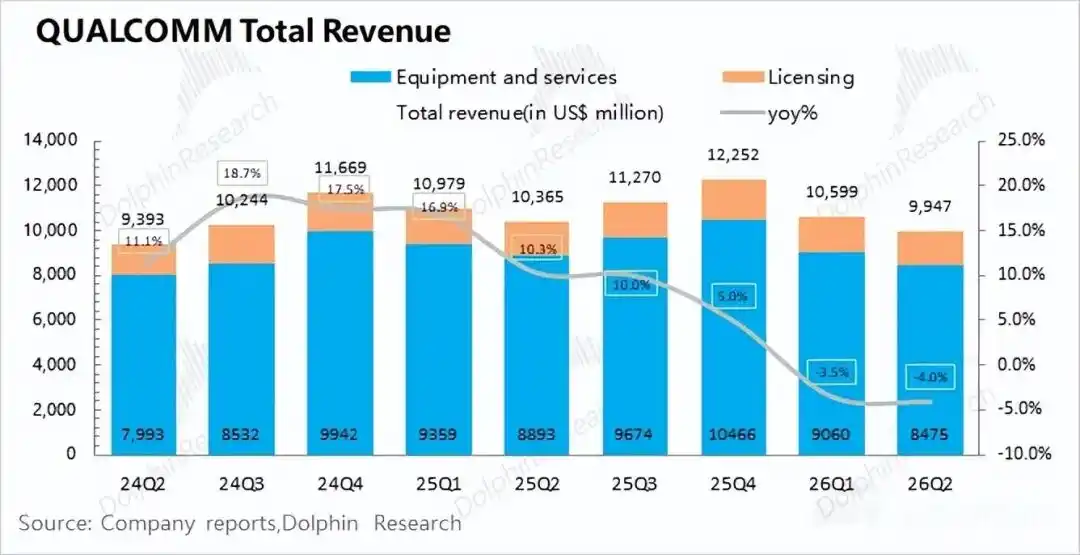
1. Core Data: Qualcomm's revenue for this quarter was $9.95 billion, down 4% year-over-year, better than market expectations ($9.6 billion). Despite significant growth in the automotive business, revenue was still dragged down by the decline in the handset business.
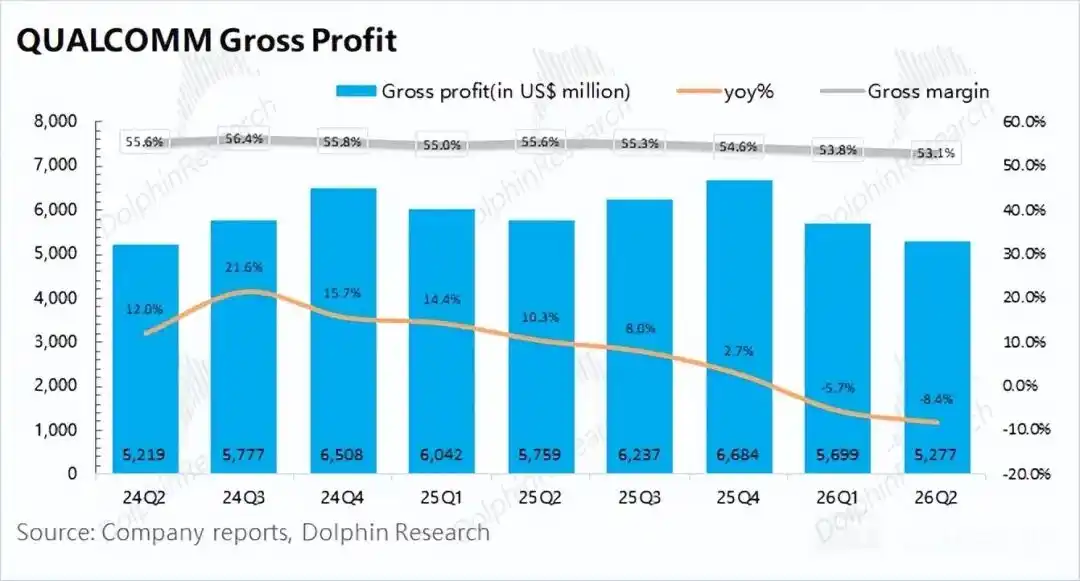
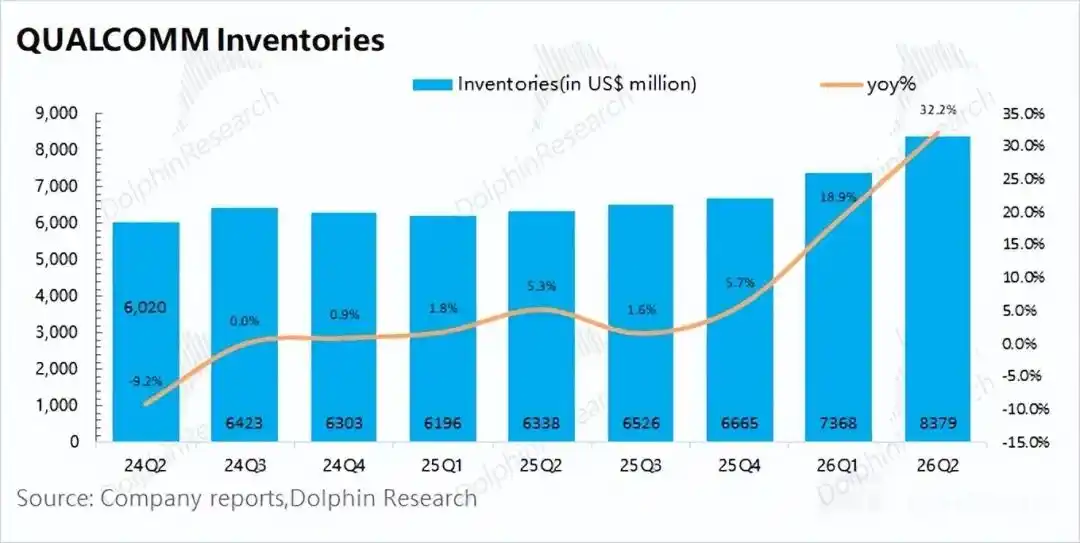
The company's gross margin for this quarter was 53.1%, down 2.5 percentage points year-over-year, below market expectations (54.6%). Increases in costs across wafer fabrication, packaging, testing, advanced packaging, memory, and other materials put significant pressure on the company's gross margin.
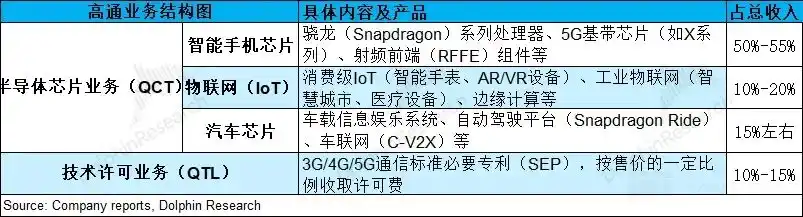
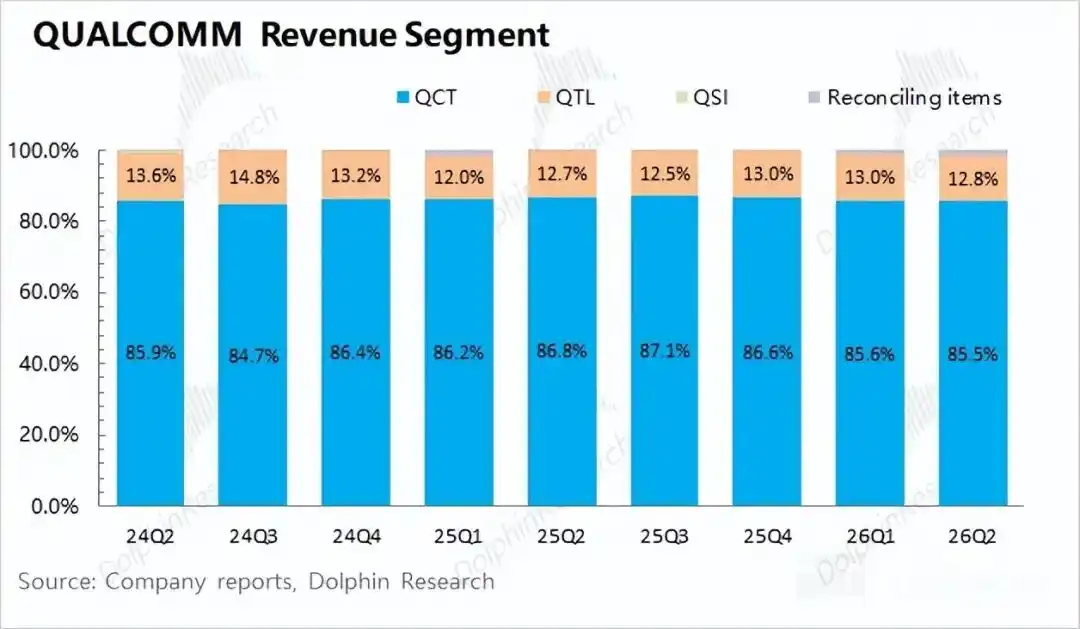
2. Business Segment Details: $Qualcomm's (QCOM.US) business is primarily divided into the Semiconductor Chip business (QCT) and the Technology Licensing business (QTL), with the Semiconductor Chip business being the largest revenue source, accounting for over 80%.
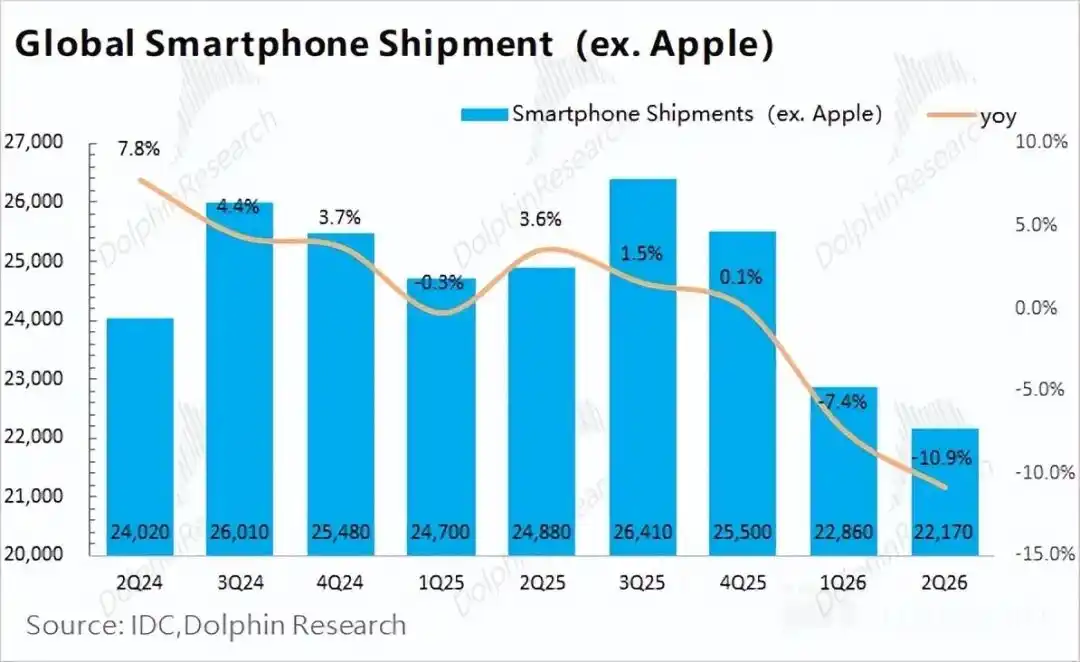
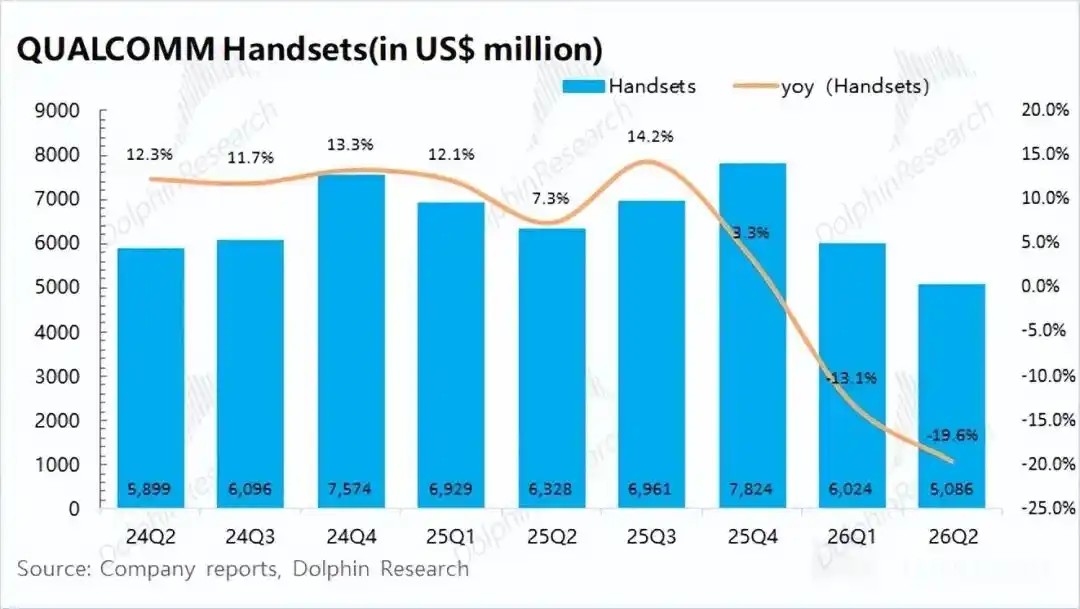
Within the Semiconductor Chip business: 1. Handset business this quarter was $5.09 billion, down 19.6% year-over-year. The decline in the company's handset business was mainly influenced by two factors: Firstly, industry-wide factors, as handset shipments (excluding Apple) fell 11% this quarter; secondly, a weakening internal mix towards premium models, with handset manufacturers tending to use previous-generation platforms to reduce costs.
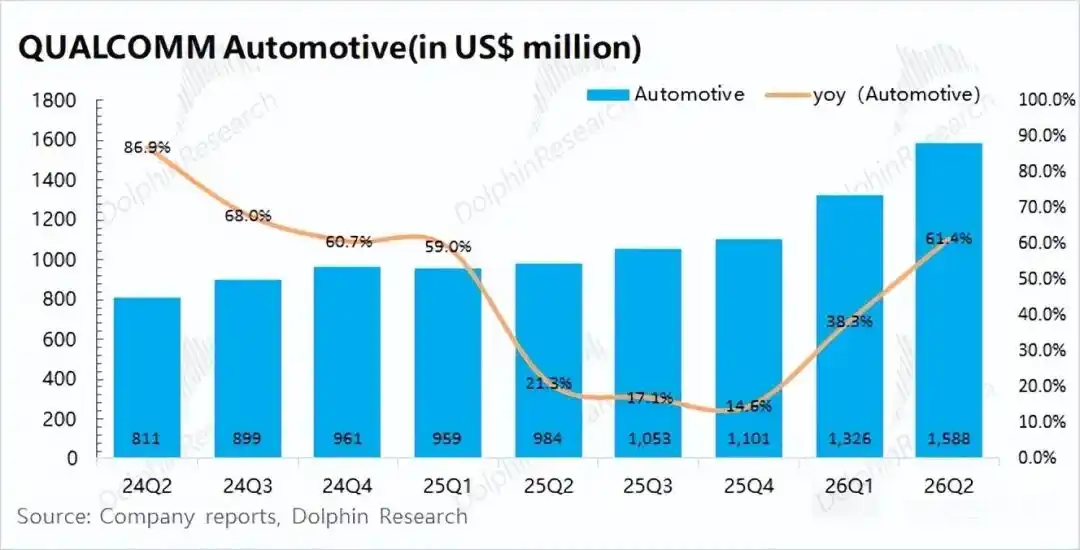
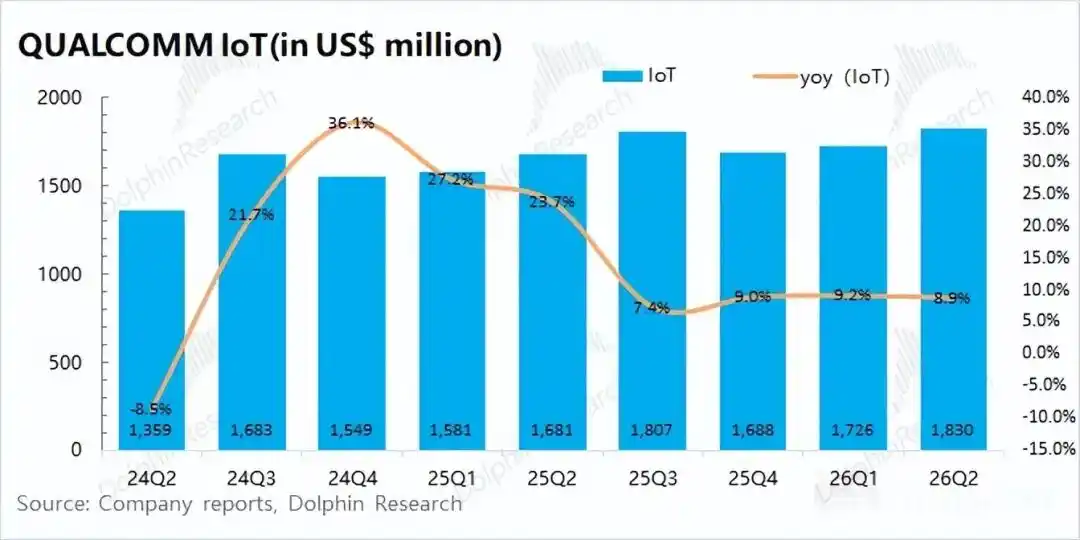
2. Automotive business this quarter was $1.59 billion, up 61% year-over-year, driven by shipments of the fourth-generation Snapdragon Digital Chassis. The company's fifth-generation Snapdragon Digital Chassis will ramp up production in September, with significantly higher value per vehicle. 3. IoT business this quarter was $1.83 billion, up 9% year-over-year, with growth driven by consumer and industrial product demand.
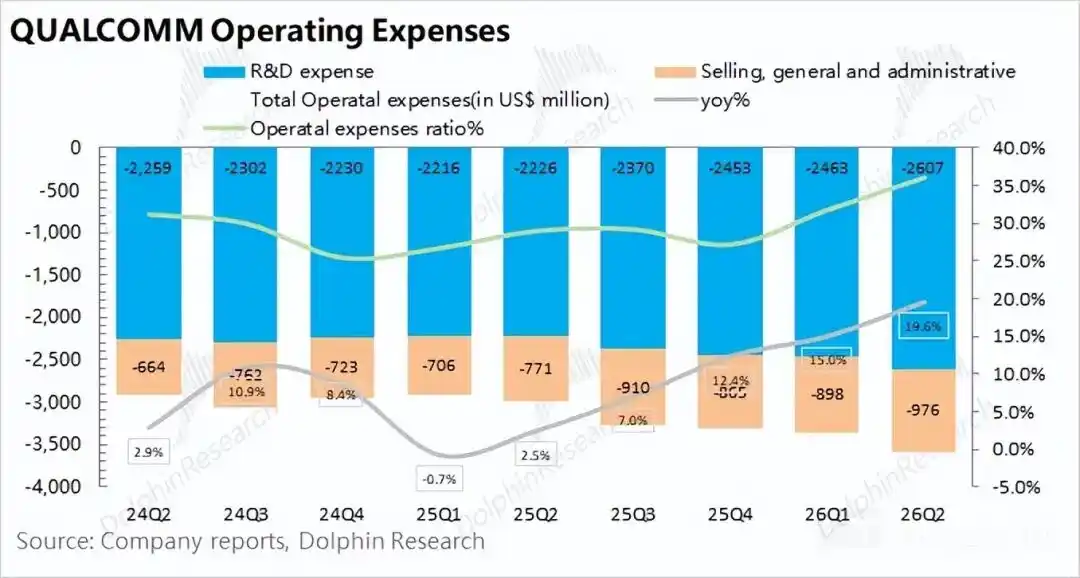
3. Operating Expenses: The company's core operating expenses increased to approximately $3.6 billion, with R&D expenses rising to $2.6 billion this quarter and SG&A expenses amounting to $980 million for the quarter.
The company reported net income of $2.0 billion for the quarter, following the release of a valuation allowance for deferred tax assets (approximately $5.7 billion) in the previous quarter. From an operational perspective, core operating profit for the quarter was $1.63 billion, down 41% year-over-year, primarily due to lower gross margin and increased expenses.
4. Next Quarter Guidance: Qualcomm expects fiscal Q4 2026 revenue of $9.7-$10.5 billion, in line with market expectations ($9.95 billion).; The company expects Non-GAAP EPS for the next quarter to be $2.05-$2.25, below market expectations ($2.36).
Dolphin Research's Overall View: Memory Weighs on Handsets, Data Center "Promises" Await Fulfillment
Qualcomm's earnings report this time remains tepid. While revenue met market expectations, it continues to show a declining trend. Gross margin continues to fall, primarily due to factors like memory price increases and weak demand, leading to higher costs.
Looking at the guidance for the next quarter, the company expects revenue of $9.7-$10.5 billion, showing no clear signs of recovery; while Non-GAAP EPS is expected to be $2.05-$2.25, below market expectations ($2.36). Demand in end markets like handsets remains weak, and factors like memory price increases will continue to pressure the company's costs.
While its traditional core business is sluggish, the company is actively seeking breakthroughs in the data center domain. It plans to focus on four areas: custom chips, commercial CPUs, AI accelerators, and connectivity products. This initially pushed the company's stock price above $250. As market concerns grew about the sustainability of AI Capex, the stock price fell back below $160, essentially erasing the gains brought by data center prospects.
Beyond this earnings report, the market is focusing on the following aspects of Qualcomm:
1) Traditional Domains: The Core Business, Bearing the Pressure of Memory
The handset business is Qualcomm's largest segment, accounting for over half of its business. Its weak performance amidst the overall sluggish handset market puts significant pressure on the company's results. Global handset shipments this quarter remained at 290 million units, down 6% year-over-year.
The handset market mainly consists of Apple and Android. Looking in detail, Apple's handset shipments grew nearly 20% year-over-year this quarter. Shipments for the rest of the Android camp fell approximately 11% year-over-year, directly impacting Qualcomm's handset business performance this quarter.
The company expects next quarter's handset business to be around $5.2 billion, down about 25% year-over-year, with Android sequential growth partially offset by declining Apple product revenue (seasonal uptick in the second half, the traditional peak season).
The recent pace of memory price increases has started to slow. As seen in OPPO and VIVO rejecting price hikes from memory suppliers, the "skyrocketing memory" has caused market discontent. If the memory cycle turns downward subsequently, pressure on the company's traditional core business may ease.
2) AI Domain: On-Device AI and Data Center, Potential Growth Markets
While traditional markets are weak, the company is also actively laying out in the AI field, hoping for new breakthroughs.
a) On-Device AI: The company views on-device AI as a core part of its Physical AI strategy, covering all end devices like smartphones, PCs, cars, XR, robots, and industrial IoT, areas where the company already has a presence.
The two main areas: 1. The potential replacement cycle driven by AI Phones, as AI Agents become the "new interface" for smartphones; 2. In the AI PC domain, the company has launched the Snapdragon C platform (for Windows laptops), with core advantages in: Oryon CPU, low-power AI inference, heterogeneous computing (CPU+GPU+NPU collaboration, supporting on-device AI Agent operation).
b) AI Data Center: Qualcomm ultimately couldn't resist entering the main AI arena, which is also the company's most notable strategic plan in the AI field.
At its investor day on June 24, 2026, Qualcomm disclosed that its AI data center strategy will cover four product lines:
1. AI Accelerators (HBC): Microsoft confirmed a multi-generation partnership.
Qualcomm's core differentiated technology, using LPDDR5X (vs. HBM) to enable Processing Near Memory, optimized for memory-capacity-intensive AI inference workloads.
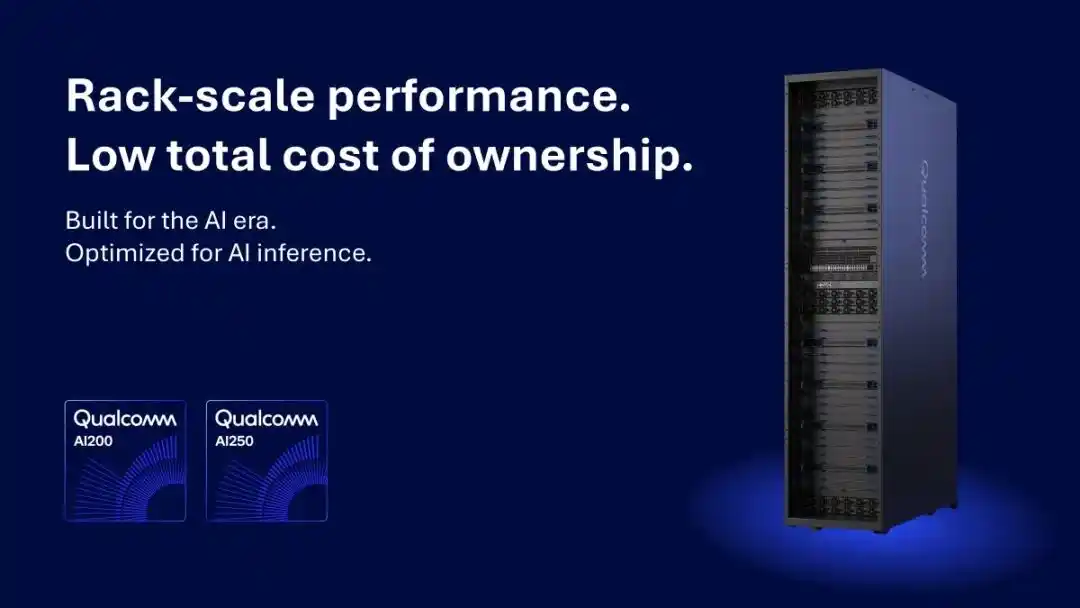
AI200 is currently ramping production; the next-gen AI250 is expected to sample in 2027. Subsequent AI300 will be based on UALink and ESUN for Scale-up network interconnection, with effective bandwidth 54 times that of AI200.
2. Commercial CPU (Dragonfly C1000): Meta confirmed a multi-generation partnership.
This is primarily based on Qualcomm's Oryon CPU architecture from smartphones and PCs, extended to the data center. Positioned as an "Agentic CPU," specifically for CPU-intensive workloads like agent orchestration, multi-step reasoning, and tool invocation.
3. Custom Silicon Business: Confirmed 2 hyperscale customers (each contributing $1 billion+ in FY2027)
This is based on capabilities acquired from Alphawave Semi (SerDes, Die-to-Die, PCIe/CXL, HBM PHY) and Ventana (Veyron V2 RISC-V CPU), primarily providing custom AI chip (XPU) design services to hyperscale customers.
4. Connectivity Business: Secured first hyperscale customer.
Based on Alphawave IP, offering products like 800G/1.6T optical modules, AOCs, AECs. The company currently has 800G LR2 modules, 800G optical modules/AOCs/AECs in production; 1.6T optical modules/AOCs/AECs expected in 2026-2027.
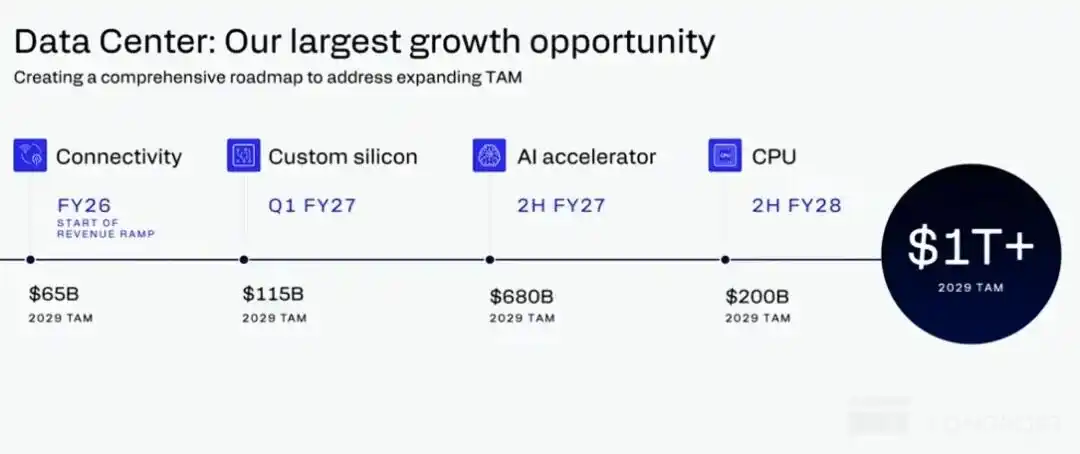
Previously, driven by AI hype, the company's move into the AI data center field once pushed its stock price above $250. Now, with concerns over AI Capex, the stock has fallen back to around $160, erasing the growth expectations from data centers.
Although the company estimates the AI data center business market opportunity at $1 trillion, its data center business currently doesn't contribute significant revenue. Looking back at the traditional business, with weak end markets like handsets, the company's current P/E multiple is actually relatively high.
As for the data center business, while management has set a $15 billion revenue target for FY2029, the focus should currently be on nearer-term performance. Based on the company's FY2027 data center revenue target of $5 billion, this could contribute about $1.2 billion in operating profit (referencing the company's OPM).
In the current fragile market environment, it's more prudent to look for Qualcomm's relatively safe bottom range. From a traditional business perspective, a further decline in the stock price is safer. Of course, this essentially treats the data center business as "an option."
If the company's FY2027 targets are met, they will inject valuation expectations for the data center segment.
Below are relevant charts from Dolphin Research regarding this Qualcomm earnings report:
This article is from the WeChat public account "Dolphin Investment Research" (ID: haituntouyan), author: Dolphin Research



















