Cathie Wood's June $77M Investment: Are Crypto Stocks a True 'Substitute' for Bitcoin?

marsbit發佈於 2026-07-06更新於 2026-07-06

文章摘要

In June, Cathie Wood's ARK Invest purchased $77 million worth of publicly traded crypto-related stocks, including Coinbase, Circle, and Bullish, during Bitcoin's worst monthly performance in four years. This aligns with the investment thesis that such stocks offer a compliant way to gain exposure to the crypto cycle without directly holding Bitcoin. However, data analysis reveals significant drawbacks. A group of nine U.S.-listed crypto companies showed 30-day annualized realized volatility between 68% and 90%, nearly double Bitcoin's 37.6%. Over 90 days, Circle's volatility reached 103.6% versus Bitcoin's 37.8%. Drawdowns were also more severe for stocks like Circle (-51.4%) and MicroStrategy (-48.6%) compared to Bitcoin's -36.4% from its January high. Correlation analysis shows most stocks share only a moderate link to Bitcoin. For example, Circle, Robinhood, and Bullish have a 90-day correlation coefficient of just 0.55–0.58 with BTC, meaning only about one-third of their price movement is explained by Bitcoin's action. The rest stems from company-specific risks: earnings, competition, fundraising, and equity dilution. MicroStrategy (MSTR) is the notable exception, acting as a leveraged Bitcoin proxy with a beta of 1.59 and 0.85 correlation. Coinbase offers relatively balanced exposure. Circle exemplifies "crypto-wrapped" corporate risk, with its recent crash tied to stablecoin competition, not Bitcoin. Robinhood's diversified business insulates it from crypto downturns...

Author: Andjela Radmilac, cryptoslate

Compiled by: Luffy, Foresight News

ARK Invest, led by Cathie Wood, purchased a total of $77 million worth of shares in crypto-related public companies in June. According to ARK's daily trading disclosures, during Bitcoin's worst monthly performance in four years, the fund increased its positions by $44 million in Coinbase, $25.25 million in Circle, and $8.2 million in Bullish.

Wood and several institutions have adhered to the same investment logic for years: crypto public companies provide investors with a compliant channel to participate in the crypto industry's cyclical gains without directly holding Bitcoin. However, an analysis of market data by CryptoSlate as of July 2 reveals the significant hidden costs of this stock investment path.

The 30-day annualized realized volatility for nine U.S.-listed crypto companies ranges from 68% to 90%, nearly double Bitcoin's 37.6% volatility. Over a 90-day period, Circle's volatility is as high as 103.6%, while Bitcoin's is only 37.8%. The gap in price drawdowns is also significant: Circle has fallen 51.4% from its high, MSTR is down 48.6%, and Bullish is down 43.6%; meanwhile, Bitcoin has retreated 36.4% from its near $97,000 peak in January, with all declines smaller than those of the aforementioned stocks.
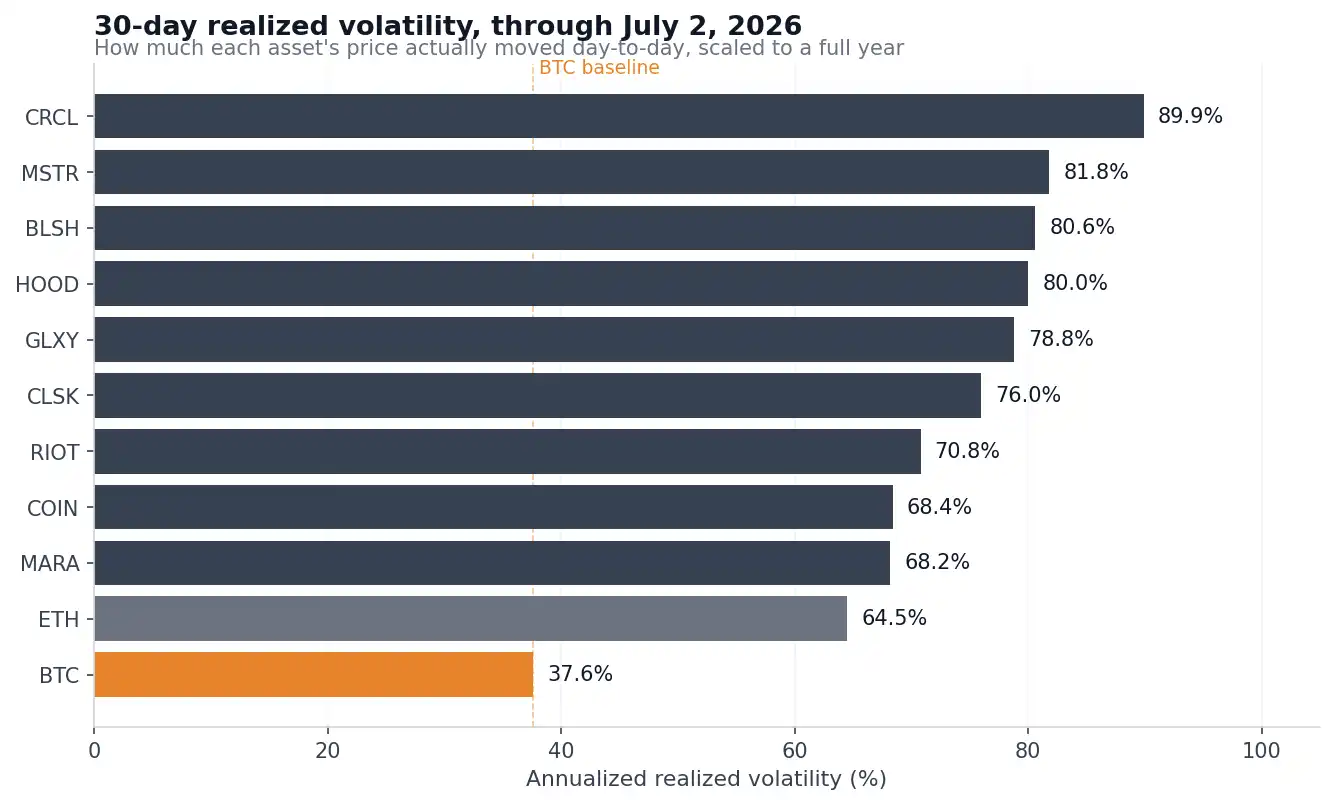
30-day annualized realized volatility of BTC, ETH, and nine U.S.-listed crypto company stocks from January 1, 2026, to July 2, 2026.

Judging by volatility alone, crypto stocks appear to be leveraged Bitcoin. However, correlation data reveals a completely different truth. Over the past 90 trading days, the correlation coefficients of Circle, Robinhood, and Bullish with Bitcoin are only 0.55–0.58 (the correlation range is 0 to 1, where 1 represents perfectly synchronized movements and 0 represents no correlation). This means Bitcoin price fluctuations can only explain about one-third of the volatility in crypto company stocks. The remaining volatility stems entirely from company-specific risks: quarterly earnings reports, industry competition, fundraising activities, share dilution, and more. Investors aiming to gain crypto industry exposure through stocks end up with only partial Bitcoin exposure while additionally bearing a full set of business risks unique to the stock market.

Only One Stock Truly Tracks Bitcoin

The table below shows the correlation of crypto company stocks with Bitcoin from the end of 2025 to the present. Beta represents the percentage change in a stock for every 1% move in Bitcoin.
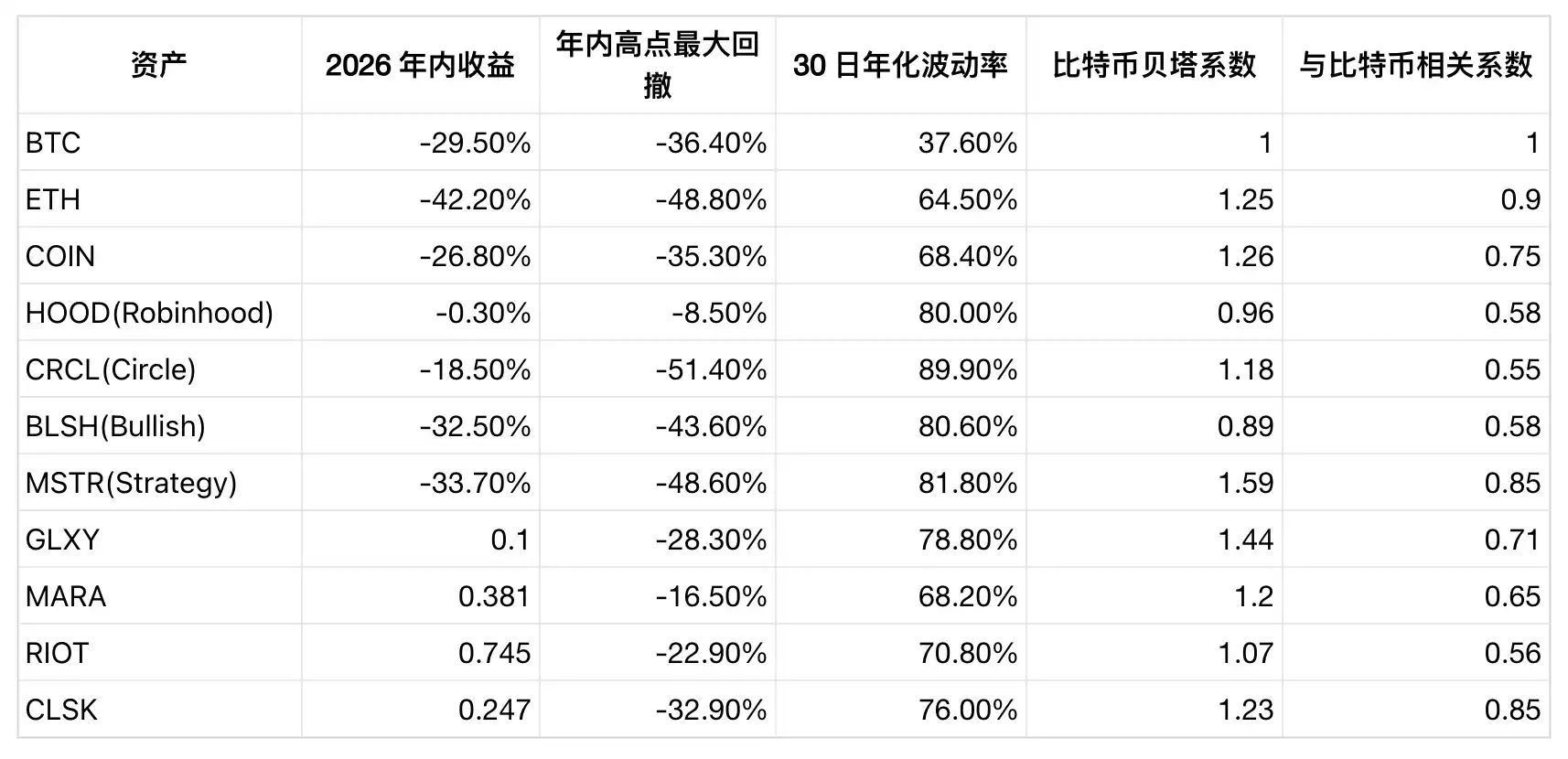
MSTR is the only stock in the entire market that can be considered a Bitcoin alternative. With a beta of 1.59 and a correlation of 0.85, it is essentially an equity tool for holding Bitcoin with leverage. In the recent downturn, its year-to-date decline and drawdown from highs have far exceeded Bitcoin's.

Coinbase is a relatively balanced choice, with a year-to-date decline of -26.8%, slightly less than BTC's. Its beta coefficient is 1.26, and its correlation coefficient is 0.75, making it the second-strongest correlated with Bitcoin within the sector. However, its volatility is still nearly double that of Bitcoin, and its stock price is down 60.6% from its all-time high of $419.78 in July 2025. Losses for investors who bought at that peak are far greater than for those who entered at Bitcoin's historical high in October 2025.

Circle perfectly illustrates 'business risk in crypto clothing.' It has the lowest correlation with Bitcoin in the sector and the highest 90-day volatility. The trigger occurred on June 30: with the official launch of the Open USD stablecoin, backed by a consortium of over 140 companies including Coinbase, Stripe, Visa, Mastercard, and BlackRock, CRCL plummeted 17.5% in a single day. This sharp drop was almost entirely unrelated to Bitcoin's performance, purely a company-specific negative driven by competition for market share in the stablecoin sector.

Robinhood is a counterexample, similarly demonstrating that individual stock performance can be independent of crypto trends. The stock has only declined slightly by 0.3% year-to-date, with a maximum drawdown of just 8.5%. Crypto business is just a small part of its overall brokerage portfolio, which includes stocks, options, and derivatives. Its diversified business has cushioned the decline; conversely, during a crypto bull market, it is unlikely to provide investors with substantial gains from crypto price movements.

Mining company trends are the most anomalous. While Bitcoin fell 29.5% year-to-date, RIOT surged 74.5%, MARA rose 38.1%, and CleanSpark gained 24.7%. The core logic is that mining companies are transforming into AI high-performance computing service providers, signing hundreds of billions in computing power leasing contracts while continuously selling their Bitcoin holdings. Although their daily price movements still follow Bitcoin (beta coefficients are all greater than 1), their annual returns are entirely driven by AI hosting business, decoupled from coin prices.
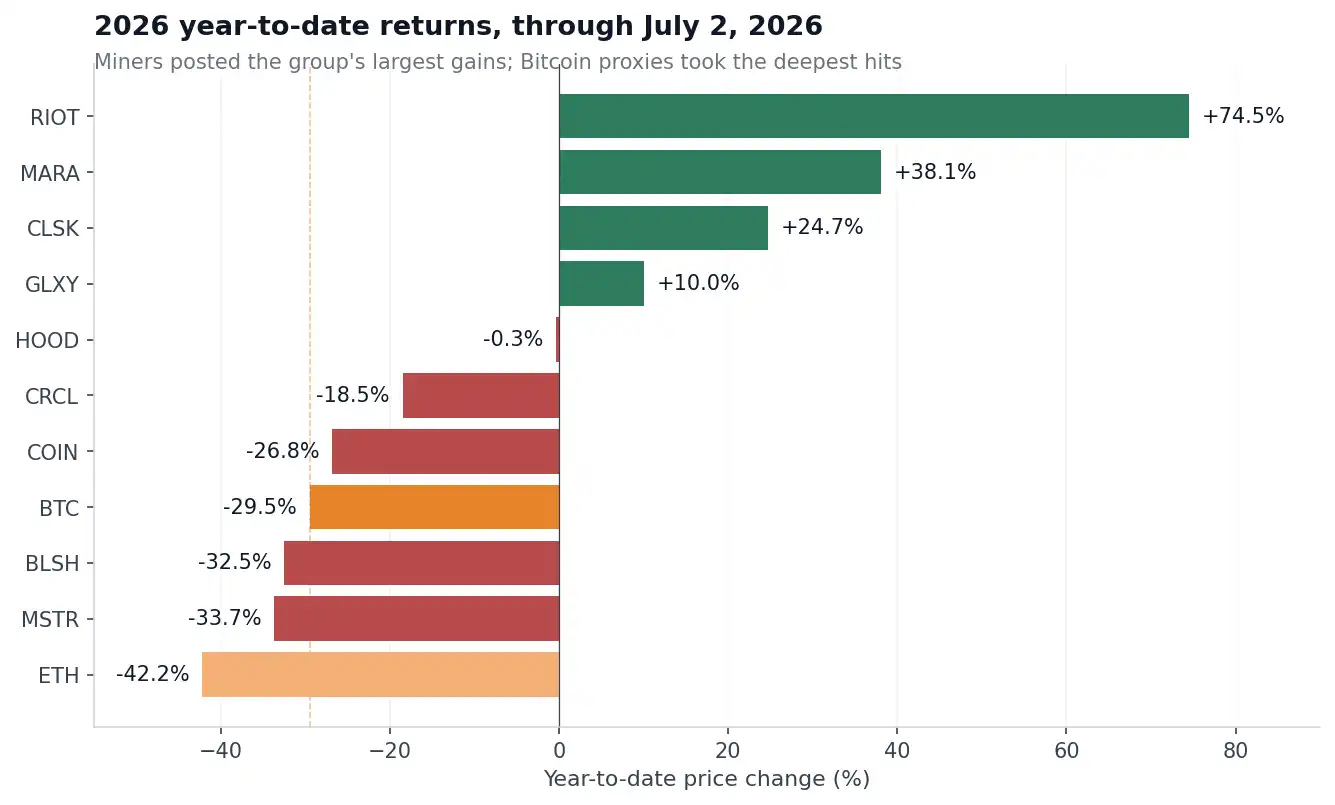
Year-to-date price changes of BTC, ETH, and nine U.S.-listed cryptocurrency stocks.

Bitcoin's own volatility is not insignificant. Volmex's Bitcoin 30-day Volatility Index dropped to a low of 24.5 in late May, peaked at 68.7 in early February, and rebounded to 41.6 in early July. Even so, the volatility of most crypto stocks remains nearly double.

Strategy Case Study: Equity Structure Adds Extra Risk

Holding Bitcoin only requires bearing the risk of price fluctuations; buying shares in crypto public companies adds multiple variables: business operations, equity dilution, disappearing valuation premiums, fundraising pressure, changes in capital structure, and more.

Strategy recently exposed all these risks in a concentrated manner over the past month. At the end of June, its price-to-book ratio (mNAV) fell below 1 for the first time. This metric measures the company's total valuation relative to its net assets. A ratio below 1 means the market values the entire company less than the cash and Bitcoin it holds. According to the June 22 disclosure, Strategy held 847,363 Bitcoins. On the day mNAV fell below 1, these Bitcoins were worth approximately $50 billion.

An mNAV greater than 1 is the foundation of Strategy's entire growth flywheel. In the past, the company could issue common and preferred shares at a premium, raise funds, and continue to acquire Bitcoin, increasing Bitcoin holdings per share. Once mNAV falls below 1, this cycle can reverse and erode shareholder value—issuing shares to raise funds for buying Bitcoin is equivalent to selling existing Bitcoin assets at a discount.

CryptoSlate reported as early as January that Bitcoin-holding companies are divided into those trading at a valuation premium and those at a discount. By the end of June, Strategy's total market capitalization was $29.54 billion, less than half of its peak of over $71 billion in 2024, with all four classes of preferred shares at historical lows.

Strategy announced countermeasures. On June 29, it unveiled a stock buyback plan of up to $1.25 billion and authorized the sale of Bitcoin to supplement liquidity, covering preferred stock dividends and debt interest. In the preceding weeks, on June 1, the company conducted its first Bitcoin sale since 2022, selling only 32 Bitcoins. After the announcement, the stock surged 12.6% in a single day, ending an eight-day losing streak. The world's largest Bitcoin holder needing to sell its holdings in a bear market to secure cash flow is a constraint not encountered when directly holding Bitcoin and is a risk unique to stocks.

This is precisely the backdrop for ARK's contrarian accumulation. On June 25, amidst a collective slump in crypto stocks, Wood's funds bought $3.27 million worth of Robinhood shares in a single day, simultaneously increasing positions in Coinbase, Circle, and Bullish. Wood believes Bitcoin's long-term target price is in the millions of dollars and is currently investing heavily at a discount in crypto public companies that have seen deep corrections since their 2025 highs.

The data reveals the true nature of these companies.

  • Strategy = Leveraged Bitcoin + Equity Dilution Risk;
  • Circle = Stablecoin sector payment company, deeply entangled in market share battles;
  • Robinhood = Comprehensive broker, crypto is just a side business.

Wood's basket purchase of these company stocks is essentially a bet on a combination of different business models, with vastly differing levels of crypto exposure.

Each individual stock has its own investment logic: Coinbase has outperformed Bitcoin year-to-date, Robinhood has maintained its price since the beginning of the year, and the mining sector has led in overall returns. But the core question remains: are crypto stocks really less risky than holding coins directly?

Data from the nine public companies shows that stocks either amplify Bitcoin's volatility or add company-specific operational risks unrelated to coin prices.

The truly strong-performing cryptocurrency stocks this year rely on independent growth businesses like AI computing power, brokerage traffic, and payment products, with Bitcoin being only a secondary influencing factor.


熱門幣種推薦

相關問答

QWhat is the main argument presented in the article regarding cryptocurrency stocks as a substitute for holding Bitcoin directly?

AThe article argues that cryptocurrency stocks are generally not a good substitute for direct Bitcoin exposure. They tend to have significantly higher volatility than Bitcoin and carry additional company-specific risks unrelated to Bitcoin's price movements, such as earnings reports, competition, and financing activities.

QWhich publicly traded company is cited as the most accurate proxy for Bitcoin investment, and what metrics support this?

AMicroStrategy (MSTR) is cited as the most accurate proxy. It has a high correlation of 0.85 with Bitcoin and a beta of 1.59, meaning it acts like a leveraged bet on Bitcoin's price.

QHow does Circle (CRCL) differ from being a simple Bitcoin investment according to the data?

ACircle shows the lowest correlation with Bitcoin among the studied stocks and the highest 90-day volatility. Its stock price is heavily influenced by company-specific factors like competition in the stablecoin market, as evidenced by a 17.5% single-day drop due to the launch of the Open USD stable币, which was largely independent of Bitcoin's price action.

QWhat unexpected trend is highlighted regarding major Bitcoin mining companies in 2026, and what is the driving factor?

ADespite Bitcoin's price decline in 2026, major mining companies like RIOT, MARA, and CleanSpark posted significant gains (e.g., RIOT up 74.5%). This is primarily driven by their successful pivot to becoming AI high-performance computing service providers, securing large compute rental contracts, which has decoupled their performance from Bitcoin's price.

QWhat unique financial risk did MicroStrategy (MSTR) face in June, according to the article, and how did it respond?

AMicroStrategy's market cap to net asset value (mNAV) ratio fell below 1, meaning the market valued the entire company for less than the value of the Bitcoin and cash it held. This threatened its growth model of issuing premium-priced shares to buy more Bitcoin. In response, it announced a $1.25 billion stock buyback plan and authorized selling some Bitcoin to cover obligations, a constraint not faced by direct Bitcoin holders.

你可能也喜歡

OUSD 假合作风波?稳定币与巨头背书的信用游戏

上周,Open Standard 推出美元稳定币 OpenUSD(OUSD),并公布了140多家企业组成的豪华背书名单,包括 Visa、万事达卡、Stripe、贝莱德、谷歌、三星、Coinbase 等巨头。此举一度引发市场震动,但名单很快遭到质疑。多家韩国企业如三星电子、新韩金融等出面澄清,称仅进行过初步接洽或表示会评估,并未正式同意加入,部分公司甚至是通过新闻才得知自己被列为成员。美国也有行业人士指出,名单存在误导性。 OUSD 宣称提供零手续费铸造赎回、无交易量上限,并将大部分储备收益分享给合作伙伴。然而,这种模式使得被列入名单具有实际商业和信誉含义,加剧了争议。文章指出,利用巨头名声造势是加密行业的常见营销手法,并引用了此前 Facebook 的 Libra(后更名 Diem)项目为例:该项目初期同样拥有全明星联盟,但在监管压力下,PayPal、Visa 等核心伙伴迅速退出,最终项目失败出售。 面对竞争,Circle CEO Jeremy Allaire 表示欢迎,但他指出稳定币市场具有网络效应,趋向赢家通吃。他认为联盟模式历史上协调困难、进度缓慢,且将收入全部分配会导致基础设施投入不足。目前稳定币市场由 USDT 和 USDC 主导,两者合计占据近90%市场份额。 文章总结道,稳定币的成功最终取决于真实的使用场景和用户,而非营销声势。OUSD 虽拥有部分真实背书和差异化模型,但其前景仍需市场检验。这场风波再次揭示了加密行业依赖“巨头站台”进行信用背书所伴随的风险。

链捕手35 分鐘前

OUSD 假合作风波?稳定币与巨头背书的信用游戏

链捕手35 分鐘前

交易

現貨

熱門文章

什麼是 $S$

理解 SPERO:全面概述 SPERO 簡介 隨著創新領域的不斷演變,web3 技術和加密貨幣項目的出現在塑造數字未來中扮演著關鍵角色。在這個動態領域中,SPERO(標記為 SPERO,$$s$)是一個引起關注的項目。本文旨在收集並呈現有關 SPERO 的詳細信息,以幫助愛好者和投資者理解其基礎、目標和在 web3 和加密領域內的創新。 SPERO,$$s$ 是什麼? SPERO,$$s$ 是加密空間中的一個獨特項目,旨在利用去中心化和區塊鏈技術的原則,創建一個促進參與、實用性和金融包容性的生態系統。該項目旨在以新的方式促進點對點互動,為用戶提供創新的金融解決方案和服務。 SPERO,$$s$ 的核心目標是通過提供增強用戶體驗的工具和平台來賦能個人。這包括使交易方式更加靈活、促進社區驅動的倡議,以及通過去中心化應用程序(dApps)創造金融機會的途徑。SPERO,$$s$ 的基本願景圍繞包容性展開,旨在彌合傳統金融中的差距,同時利用區塊鏈技術的優勢。 誰是 SPERO,$$s$ 的創建者? SPERO,$$s$ 的創建者身份仍然有些模糊,因為公開可用的資源對其創始人提供的詳細背景信息有限。這種缺乏透明度可能源於該項目對去中心化的承諾——這是一種許多 web3 項目所共享的精神,優先考慮集體貢獻而非個人認可。 通過將討論重心放在社區及其共同目標上,SPERO,$$s$ 體現了賦能的本質,而不特別突出某些個體。因此,理解 SPERO 的精神和使命比識別單一創建者更為重要。 誰是 SPERO,$$s$ 的投資者? SPERO,$$s$ 得到了來自風險投資家到天使投資者的多樣化投資者的支持,他們致力於促進加密領域的創新。這些投資者的關注點通常與 SPERO 的使命一致——優先考慮那些承諾社會技術進步、金融包容性和去中心化治理的項目。 這些投資者通常對不僅提供創新產品,還對區塊鏈社區及其生態系統做出積極貢獻的項目感興趣。這些投資者的支持強化了 SPERO,$$s$ 作為快速發展的加密項目領域中的一個重要競爭者。 SPERO,$$s$ 如何運作? SPERO,$$s$ 採用多面向的框架,使其與傳統的加密貨幣項目區別開來。以下是一些突顯其獨特性和創新的關鍵特徵: 去中心化治理:SPERO,$$s$ 整合了去中心化治理模型,賦予用戶積極參與決策過程的權力,關於項目的未來。這種方法促進了社區成員之間的擁有感和責任感。 代幣實用性:SPERO,$$s$ 使用其自己的加密貨幣代幣,旨在在生態系統內部提供多種功能。這些代幣使交易、獎勵和平台上提供的服務得以促進,增強了整體參與度和實用性。 分層架構:SPERO,$$s$ 的技術架構支持模塊化和可擴展性,允許在項目發展過程中無縫整合額外的功能和應用。這種適應性對於在不斷變化的加密環境中保持相關性至關重要。 社區參與:該項目強調社區驅動的倡議,採用激勵合作和反饋的機制。通過培養強大的社區,SPERO,$$s$ 能夠更好地滿足用戶需求並適應市場趨勢。 專注於包容性:通過提供低交易費用和用戶友好的界面,SPERO,$$s$ 旨在吸引多樣化的用戶群體,包括那些以前可能未曾參與加密領域的個體。這種對包容性的承諾與其通過可及性賦能的總體使命相一致。 SPERO,$$s$ 的時間線 理解一個項目的歷史提供了對其發展軌跡和里程碑的關鍵見解。以下是建議的時間線,映射 SPERO,$$s$ 演變中的重要事件: 概念化和構思階段:形成 SPERO,$$s$ 基礎的初步想法被提出,與區塊鏈行業內的去中心化和社區聚焦原則密切相關。 項目白皮書的發布:在概念階段之後,發布了一份全面的白皮書,詳細說明了 SPERO,$$s$ 的願景、目標和技術基礎設施,以吸引社區的興趣和反饋。 社區建設和早期參與:積極進行外展工作,建立早期採用者和潛在投資者的社區,促進圍繞項目目標的討論並獲得支持。 代幣生成事件:SPERO,$$s$ 進行了一次代幣生成事件(TGE),向早期支持者分發其原生代幣,並在生態系統內建立初步流動性。 首次 dApp 上線:與 SPERO,$$s$ 相關的第一個去中心化應用程序(dApp)上線,允許用戶參與平台的核心功能。 持續發展和夥伴關係:對項目產品的持續更新和增強,包括與區塊鏈領域其他參與者的戰略夥伴關係,使 SPERO,$$s$ 成為加密市場中一個具有競爭力和不斷演變的參與者。 結論 SPERO,$$s$ 是 web3 和加密貨幣潛力的見證,能夠徹底改變金融系統並賦能個人。憑藉對去中心化治理、社區參與和創新設計功能的承諾,它為更具包容性的金融環境鋪平了道路。 與任何在快速發展的加密領域中的投資一樣,潛在的投資者和用戶都被鼓勵進行徹底研究,並對 SPERO,$$s$ 的持續發展進行深思熟慮的參與。該項目展示了加密行業的創新精神,邀請人們進一步探索其無數可能性。儘管 SPERO,$$s$ 的旅程仍在展開,但其基礎原則確實可能影響我們在互聯網數字生態系統中如何與技術、金融和彼此互動的未來。

162 人學過發佈於 2024.12.17更新於 2024.12.17

什麼是 $S$

什麼是 AGENT S

Agent S:Web3中自主互動的未來 介紹 在不斷演變的Web3和加密貨幣領域,創新不斷重新定義個人如何與數字平台互動。Agent S是一個開創性的項目,承諾通過其開放的代理框架徹底改變人機互動。Agent S旨在簡化複雜任務,為人工智能(AI)提供變革性的應用,鋪平自主互動的道路。本詳細探索將深入研究該項目的複雜性、其獨特特徵以及對加密貨幣領域的影響。 什麼是Agent S? Agent S是一個突破性的開放代理框架,專門設計用來解決計算機任務自動化中的三個基本挑戰: 獲取特定領域知識:該框架智能地從各種外部知識來源和內部經驗中學習。這種雙重方法使其能夠建立豐富的特定領域知識庫,提升其在任務執行中的表現。 長期任務規劃:Agent S採用經驗增強的分層規劃,這是一種戰略方法,可以有效地分解和執行複雜任務。此特徵顯著提升了其高效和有效地管理多個子任務的能力。 處理動態、不均勻的界面:該項目引入了代理-計算機界面(ACI),這是一種創新的解決方案,增強了代理和用戶之間的互動。利用多模態大型語言模型(MLLMs),Agent S能夠無縫導航和操作各種圖形用戶界面。 通過這些開創性特徵,Agent S提供了一個強大的框架,解決了自動化人機互動中涉及的複雜性,為AI及其他領域的無數應用奠定了基礎。 誰是Agent S的創建者? 儘管Agent S的概念根本上是創新的,但有關其創建者的具體信息仍然難以捉摸。創建者目前尚不清楚,這突顯了該項目的初期階段或戰略選擇將創始成員保密。無論是否匿名,重點仍然在於框架的能力和潛力。 誰是Agent S的投資者? 由於Agent S在加密生態系統中相對較新,關於其投資者和財務支持者的詳細信息並未明確記錄。缺乏對支持該項目的投資基礎或組織的公開見解,引發了對其資金結構和發展路線圖的質疑。了解其支持背景對於評估該項目的可持續性和潛在市場影響至關重要。 Agent S如何運作? Agent S的核心是尖端技術,使其能夠在多種環境中有效運作。其運營模型圍繞幾個關鍵特徵構建: 類人計算機互動:該框架提供先進的AI規劃,力求使與計算機的互動更加直觀。通過模仿人類在任務執行中的行為,承諾提升用戶體驗。 敘事記憶:用於利用高級經驗,Agent S利用敘事記憶來跟蹤任務歷史,從而增強其決策過程。 情節記憶:此特徵為用戶提供逐步指導,使框架能夠在任務展開時提供上下文支持。 支持OpenACI:Agent S能夠在本地運行,使用戶能夠控制其互動和工作流程,與Web3的去中心化理念相一致。 與外部API的輕鬆集成:其多功能性和與各種AI平台的兼容性確保了Agent S能夠無縫融入現有技術生態系統,成為開發者和組織的理想選擇。 這些功能共同促成了Agent S在加密領域的獨特地位,因為它以最小的人類干預自動化複雜的多步任務。隨著項目的發展,其在Web3中的潛在應用可能重新定義數字互動的展開方式。 Agent S的時間線 Agent S的發展和里程碑可以用一個時間線來概括,突顯其重要事件: 2024年9月27日:Agent S的概念在一篇名為《一個像人類一樣使用計算機的開放代理框架》的綜合研究論文中推出,展示了該項目的基礎工作。 2024年10月10日:該研究論文在arXiv上公開,提供了對框架及其基於OSWorld基準的性能評估的深入探索。 2024年10月12日:發布了一個視頻演示,提供了對Agent S能力和特徵的視覺洞察,進一步吸引潛在用戶和投資者。 這些時間線上的標記不僅展示了Agent S的進展,還表明了其對透明度和社區參與的承諾。 有關Agent S的要點 隨著Agent S框架的持續演變,幾個關鍵特徵脫穎而出,強調其創新性和潛力: 創新框架:旨在提供類似人類互動的直觀計算機使用,Agent S為任務自動化帶來了新穎的方法。 自主互動:通過GUI自主與計算機互動的能力標誌著向更智能和高效的計算解決方案邁進了一步。 複雜任務自動化:憑藉其強大的方法論,能夠自動化複雜的多步任務,使過程更快且更少出錯。 持續改進:學習機制使Agent S能夠從過去的經驗中改進,不斷提升其性能和效率。 多功能性:其在OSWorld和WindowsAgentArena等不同操作環境中的適應性確保了它能夠服務於廣泛的應用。 隨著Agent S在Web3和加密領域中的定位,其增強互動能力和自動化過程的潛力標誌著AI技術的一次重大進步。通過其創新框架,Agent S展現了數字互動的未來,為各行各業的用戶承諾提供更無縫和高效的體驗。 結論 Agent S代表了AI與Web3結合的一次大膽飛躍,具有重新定義我們與技術互動方式的能力。儘管仍處於早期階段,但其應用的可能性廣泛且引人入勝。通過其全面的框架解決關鍵挑戰,Agent S旨在將自主互動帶到數字體驗的最前沿。隨著我們深入加密貨幣和去中心化的領域,像Agent S這樣的項目無疑將在塑造技術和人機協作的未來中發揮關鍵作用。

930 人學過發佈於 2025.01.14更新於 2025.01.14

什麼是 AGENT S

如何購買S

歡迎來到HTX.com!在這裡,購買Sonic (S)變得簡單而便捷。跟隨我們的逐步指南,放心開始您的加密貨幣之旅。第一步:創建您的HTX帳戶使用您的 Email、手機號碼在HTX註冊一個免費帳戶。體驗無憂的註冊過程並解鎖所有平台功能。立即註冊第二步:前往買幣頁面,選擇您的支付方式信用卡/金融卡購買:使用您的Visa或Mastercard即時購買Sonic (S)。餘額購買:使用您HTX帳戶餘額中的資金進行無縫交易。第三方購買:探索諸如Google Pay或Apple Pay等流行支付方式以增加便利性。C2C購買:在HTX平台上直接與其他用戶交易。HTX 場外交易 (OTC) 購買:為大量交易者提供個性化服務和競爭性匯率。第三步:存儲您的Sonic (S)購買Sonic (S)後,將其存儲在您的HTX帳戶中。您也可以透過區塊鏈轉帳將其發送到其他地址或者用於交易其他加密貨幣。第四步:交易Sonic (S)在HTX的現貨市場輕鬆交易Sonic (S)。前往您的帳戶,選擇交易對,執行交易,並即時監控。HTX為初學者和經驗豐富的交易者提供了友好的用戶體驗。

2.0k 人學過發佈於 2025.01.15更新於 2026.06.02

如何購買S

相關討論

歡迎來到 HTX 社群。在這裡,您可以了解最新的平台發展動態並獲得專業的市場意見。 以下是用戶對 S (S)幣價的意見。

活动图片