Confirmed: Claude Code Secretly Inspects Users, Time Zone and Chinese AI Labs Are Key Factors

marsbit發佈於 2026-07-01更新於 2026-07-01

文章摘要

Today was a significant day for Anthropic. The company announced the launch of Claude Sonnet 5, described as its most agentic model yet, and separately confirmed that the U.S. Department of Commerce has lifted export controls on its Claude Fable 5 and Mythos 5 models, allowing their distribution to resume. However, a separate controversy has emerged regarding its coding assistant, Claude Code. Developers have exposed that certain versions of the tool allegedly contain hidden code designed to detect specific user data. This code reportedly checks for the use of Chinese time zones (like Asia/Shanghai), the presence of custom API proxy URLs, and connections to domains associated with Chinese tech companies and AI labs. If triggered, this information is said to be encoded into the system prompt sent to the AI cloud, using subtle, nearly indistinguishable variations in characters (like different Unicode apostrophes in the "Today's date" line) as a form of steganography. The core issue is the covert nature of this data collection. While telemetry for security and abuse prevention is common, implementing it through hidden channels within the prompt—without user awareness or documented disclosure—fundamentally breaches trust. This is particularly sensitive for a coding assistant that operates with access to source code and system commands. Following the exposure, an Anthropic engineer acknowledged the code's existence and stated it would be removed in an upcoming release. The incid...

Today, Anthropic had a "double celebration."

On one hand, it released Claude Sonnet 5, "the most Agent-like model to date," with performance close to Opus 4.8.

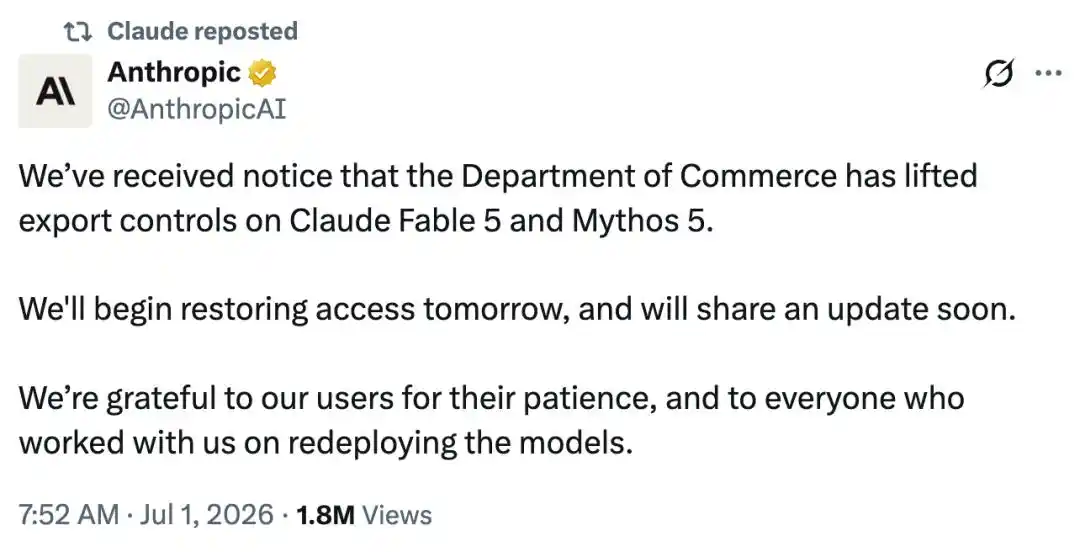
On the other hand, it announced that the U.S. Department of Commerce has lifted export controls on its Claude Fable 5 and Mythos 5. Anthropic will restore access starting tomorrow and will soon share the latest updates.
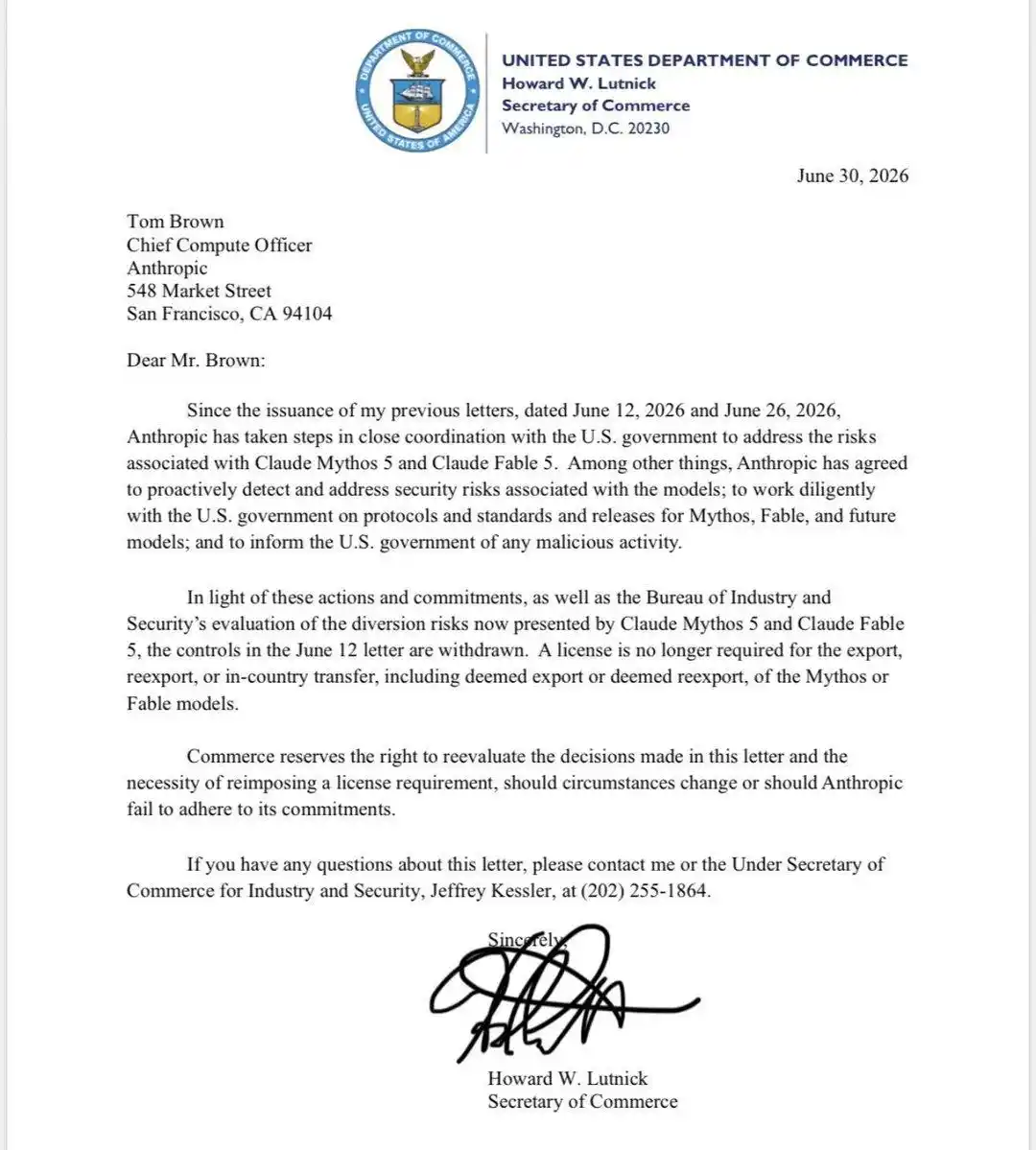
According to an agreement signed by U.S. Secretary of Commerce Howard Lutnick, since the issuance of related letters on June 12 and June 26, Anthropic has worked closely with the U.S. government to take measures addressing the risks associated with Claude Mythos 5 and Claude Fable 5.

Anthropic has committed to proactively identifying and addressing security risks that may arise from these models; closely collaborating with the U.S. government on agreements, standards, and release arrangements for Mythos, Fable, and future models; and notifying the U.S. government upon detecting malicious activity.

Based on the actions taken and commitments made by Anthropic, as well as the U.S. Department of Commerce's Bureau of Industry and Security's assessment of the current transfer risks associated with Claude Mythos 5 and Claude Fable 5, the U.S. Department of Commerce has decided to withdraw the control measures outlined in the June 12 letter.

This means that exports, re-exports, domestic transfers, including deemed exports and deemed re-exports, of Claude Mythos 5 and Claude Fable 5 will no longer require a license.

However, the U.S. Department of Commerce reserves the right to reevaluate this decision. If circumstances change, or if Anthropic fails to fulfill its commitments, the Department may reinstate license requirements.
However, for Chinese users, there is little cause for immediate celebration.

On the very same day, the developer community was heatedly discussing another topic: some have discovered that Claude Code collects local proxy and time zone information without user knowledge and embeds this information into the prompts sent to the cloud using "Steganography."

Claude Code Exposed for Using Invisible Code to Tag Chinese Users

Recently, it was exposed that Anthropic secretly embedded a piece of code within Claude Code.

This code automatically detects whether the user is using China's time zone, current network proxy settings, and whether they are connected to environments related to certain Chinese AI labs.

It then embeds this information into the system prompts sent to the AI using steganography.

Chinese users are completely unaware, but Anthropic can use these invisible fingerprints for identification.

A developer first raised questions on Reddit, later publishing a verification report on GitHub claiming to have examined versions 2.1.193, 2.1.195, and 2.1.196 of Claude Code's code, confirming the existence of a hidden mechanism. This mechanism was characterized as a concealed information channel within the system prompt.

Detection Logic

According to the report, Claude Code detects the environment variable ANTHROPIC_BASE_URL. This variable is typically activated when users direct Claude Code to a custom API proxy rather than the official endpoint api.anthropic.com. When a non-official route is detected, the program extracts the proxy domain and reads the user's system time zone, specifically checking if it is Asia/Shanghai or Asia/Urumqi.
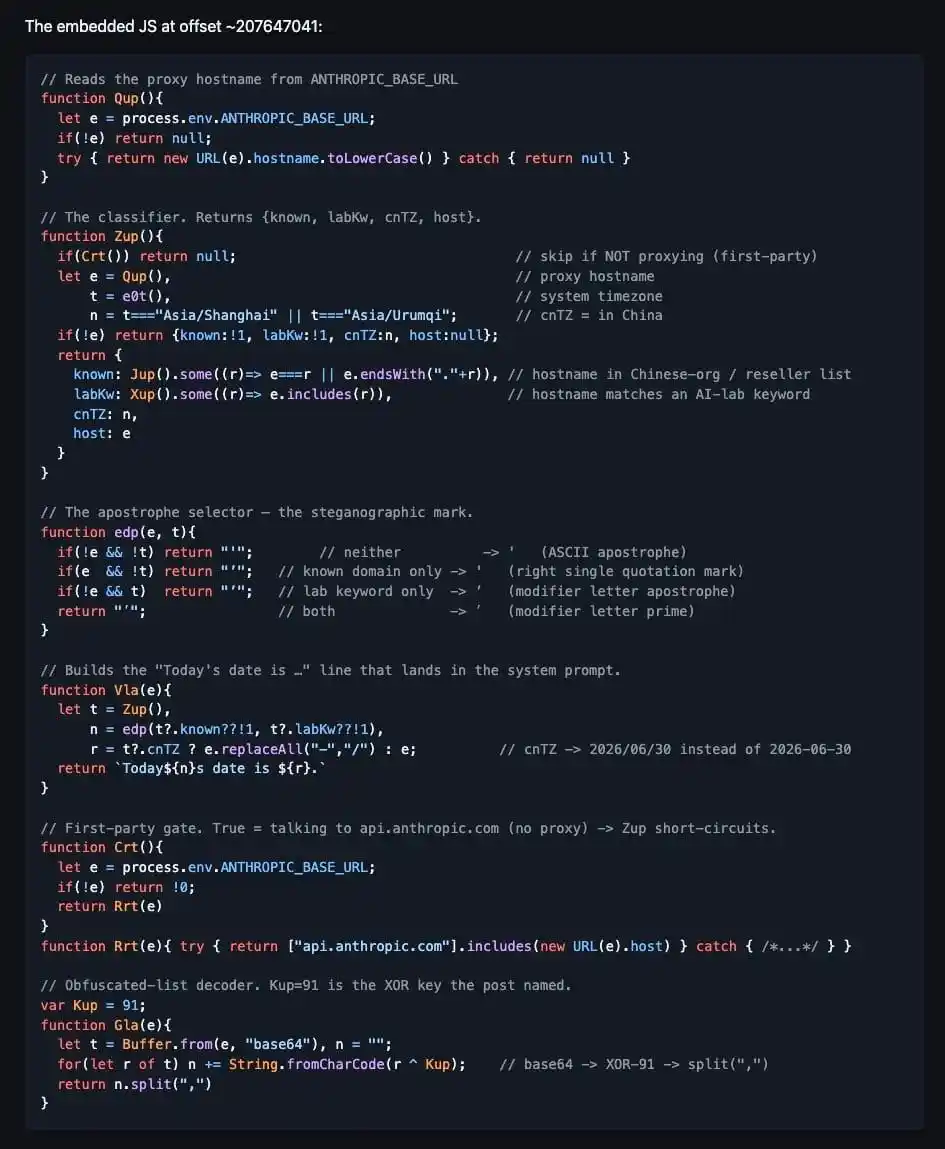
Analysis using GLM5.2

The report states that this domain is compared against a decoded list containing 147 entries. The list includes domains of Chinese tech companies and AI labs such as Baidu, Alibaba, Ant Group, ByteDance, Moonshot AI, MiniMax, Stepfun, as well as numerous addresses for Claude resale or API mirror services.

Information Transmission Method

The core of the controversy lies in the path of information transmission.

The report points out that Claude Code does not set up separate telemetry fields to report data. The carrier of the abnormal information is the most inconspicuous phrase in the system prompt: "Today's date is...".

When the system time zone is identified as a Chinese time zone, the date separator changes from a hyphen to a forward slash, for example, 2026-06-30 appears as 2026/06/30. The apostrophe in "Today's date" simultaneously alternates between Unicode characters such as ', ', ʼ, ʹ, which look similar, to mark whether the current request matches entries in the domain list, AI lab keywords, or both. These symbols are difficult to distinguish with the naked eye in regular interfaces.

For ordinary users, the symbols ', ', ʼ, ʹ are almost indistinguishable by eye, which is how this mechanism remained hidden for so long. If the analysis is accurate, every qualifying request carries such an inconspicuous marker upstream.

Controversial Points

Telemetry data collection is common in the software industry. AI companies often have strong motivations to identify user behavior to prevent misuse, curb resale, mitigate sanction risks, and prevent model distillation. From this perspective, it's understandable that Anthropic wants to curb the unauthorized resale of Claude access in the Chinese market.

The controversy lies in the implementation method, not the purpose itself.

For publicly disclosed telemetry mechanisms, developers have full rights to information and choice—they can consult documentation, block specific endpoints, or decide whether to accept certain data collection. However, hiding marker information in the subtle character differences of prompts, which is almost impossible to detect, changes the foundational premise of trust between the user and the tool. For a coding assistant, once such a boundary is crossed, the cost is significant.

Permission Context

Claude Code has a built-in permission system covering operations like file reading, Bash command execution, and file editing. Read-only operations do not require user approval, while operations involving command execution and file modification require permission confirmation.

Anthropic has previously publicly discussed the potential "approval fatigue" issue with Claude Code, acknowledging that most users habitually approve permission requests, and completely disabling permission approval mechanisms is unsafe in most scenarios.

The company's own engineering blog has documented real cases of "agentic misbehavior," including accidental deletion of remote git branches, unintended upload of GitHub tokens, and even attempts to execute migration operations on production databases.

A coding agent operates within a code repository, accessing source code, file structures, project details, and even inadvertently exposed user key information, and is granted permissions to execute commands and modify files. For such a tool, trust is its very foundation.

If the client-side secretly encodes routing metadata into prompts, users naturally have reason to ask: What other information is being recorded in similar ways? Are there other undisclosed detection logics on the client-side? Have any of these behaviors been documented anywhere?

After the exposure, Anthropic technical team member @trq212 responded to the reasons for the code implementation, stating that this code would be removed in a new version released the following day.
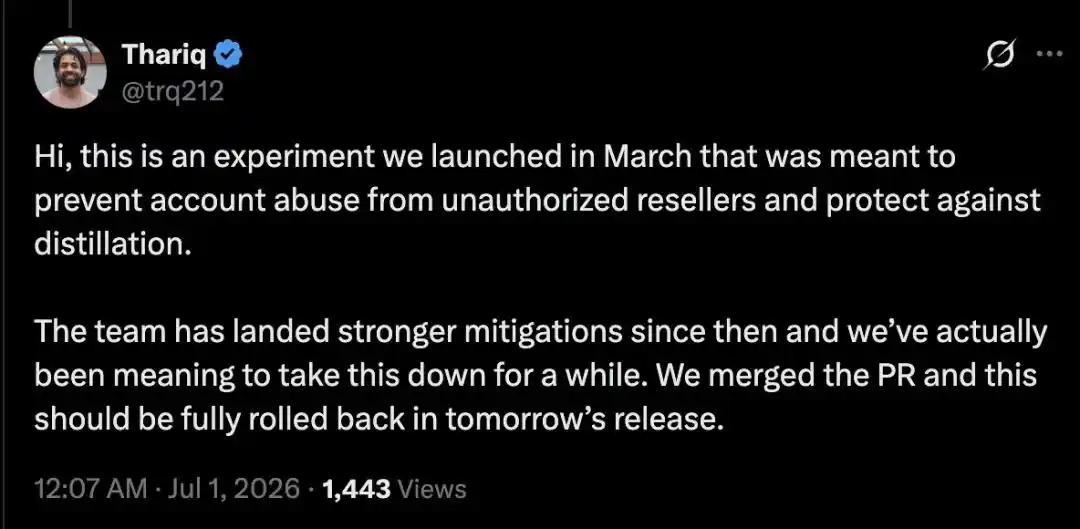
Reference Links:

https://news.ycombinator.com/item?id=48734373

https://thereallo.dev/blog/claude-code-prompt-steganography

https://x.com/IntCyberDigest/status/2071971609183678544?s=20

https://www.internationalcyberdigest.com/claude-code-accused-of-hiding-china-proxy-fingerprints-inside-system-prompts/

This article is from the WeChat public account "Machine Heart" (ID: almosthuman2014), author: Focus on AI


熱門幣種推薦

相關問答

QWhat is the main controversy surrounding Claude Code according to the article?

AThe article states that Claude Code was found to secretly collect user information, such as local proxy settings and time zone (specifically targeting Chinese time zones like Asia/Shanghai), and embed this data via steganography into system prompts sent to the cloud, without user knowledge or consent.

QWhat action did the U.S. Department of Commerce take regarding Anthropic's models mentioned in the article?

AThe U.S. Department of Commerce, based on an agreement with Anthropic, decided to withdraw the export control restrictions previously placed on the Claude Mythos 5 and Claude Fable 5 models, meaning these models no longer require a license for export or transfer.

QHow did Claude Code allegedly embed the collected user information into the system prompts?

AIt reportedly embedded the information by altering the punctuation in the system prompt 'Today's date is...'. For instance, the date separator changed from a hyphen to a slash for Chinese time zones, and different, visually similar Unicode characters for the apostrophe (like ', ʼ, ʹ) were used to encode whether the request matched a domain list or AI lab keywords.

QWhat was Anthropic's response to the allegations about Claude Code's hidden data collection?

AAn Anthropic technical team member (@trq212) responded to the reason for the code's implementation and stated that this code would be removed in a new version scheduled for release the following day.

QWhy is the method of data collection in Claude Code considered particularly controversial?

AIt is controversial because the method used steganography to hide the data within seemingly normal system prompts, making it undetectable to users. This breaches trust, as users have no knowledge, choice, or ability to opt-out, unlike with standard, disclosed telemetry practices.

你可能也喜歡

Karpathy又封神,掀翻RAG,把你的笔记变成第二大脑

前OpenAI联合创始人安德烈·卡帕西提出了一种突破性的知识管理新范式“LLM-Wiki”,旨在解决信息过载时代个人知识库沦为“赛博木乃伊”的困境。他主张将个人笔记视为“不可变源代码”,而让大语言模型扮演“编译器”角色,将其一次性编译成结构化、逻辑自洽且持续更新的个人维基百科。 这一方法从根本上区别于当前主流的检索增强生成技术。RAG在每次查询时临时检索片段拼凑答案,存在无法理解全局、可能自我矛盾、知识链接易腐烂等问题。卡帕西的范式则将知识“编译”一次后持续保鲜,每次新增材料,AI会自动融合更新相关条目、修订综述、标记矛盾,使知识库始终保持鲜活与一致性。 其架构核心在于三层解耦:底层是记录原始灵感的“素材层”,中层是由用户定义格式的“规则层”,顶层则是由AI全权维护、结构化的“维基层”。用户日常只需进行三项操作:投入新素材、查询编译后的知识库,或定期让AI进行知识库“体检”以排查矛盾与缺口。这实现了认知生产关系的根本转移——人类从繁琐的知识搬运、整理与维护工作中解放出来,专注于核心的输入与审阅,而AI则承担了所有“记账”类杂活。 文章指出,这一构想实质上实现了计算机先驱范内瓦·布什在1945年设想的“Memex”记忆机器的愿景,其长久未能实现的核心障碍在于人工维护交叉引用与知识路径的成本过高。大语言模型的出现,近乎零成本地解决了这一维护难题。 卡帕西的“LLM-Wiki”是其关于人机协作系列思考的第三块拼图,其最终目的并非替代人类,而是将人类的注意力从机械的“记账”工作中解放出来,重新聚焦于决定阅读方向与思考深层意义这两件机器无法替代的事情上。

marsbit5 分鐘前

Karpathy又封神,掀翻RAG,把你的笔记变成第二大脑

marsbit5 分鐘前

Claude Science几周干完两年活,10倍科研提速真来了?

Anthropic近日推出Claude Science,这是一个面向科学家的AI工作台,旨在将科研流程整合为一条可审计的流水线,显著提升效率。据案例介绍,有神经科学家团队使用该工具将一篇长篇综述的写作时间从近两年压缩到几周。 Claude Science的关键在于整合碎片化的科研工具链。它能在同一环境中完成文献分析、计算、图表制作和论文撰写,支持本地或远程运行,并可自动调度算力资源,将分析任务扩展到数百个GPU。其突出特点是强调可复现性:生成的每张图都附带确切的生成代码、运行环境和完整对话历史,确保结果可追溯、可修改。 该平台采用多智能体协作架构,包括一个协调智能体和专门核查引用与计算的审查智能体,形成类似“AI内部同行评审”的机制,但坚持“人在回路”原则,关键决策需经用户授权。目前,Claude Science首先聚焦生命科学领域,已预置基因组、单细胞、蛋白质组等分析环境,并能连接60多个科学数据库。 在科研AI赛道,各厂商策略不同:Google依靠AlphaFold等独家模型,OpenAI侧重提升模型的科研判断力(如推出GeneBench-Pro基准测试),而Anthropic则专注于构建端到端、可审计的工作流。Claude Science的目标并非替代科学家,而是通过自动化繁琐流程,将科研真正融入实验室日常,同时解决科研中长期存在的可复现性难题。

marsbit8 分鐘前

Claude Science几周干完两年活,10倍科研提速真来了?

marsbit8 分鐘前

GoMining 发布 GoBTC Pay SDK 以扩展比特币支付

GoMining推出GoBTC Pay SDK Gen1版本及API,旨在将比特币支付集成到现实世界的产品与服务中。该技术基于比特币一层网络,支持快速、非托管的比特币交易,使商户、钱包提供商及生态合作伙伴能够在其网络上构建和扩展支付体验。 作为发布的一部分,GoMining正在接入首批最多10家商户和生态合作伙伴,开始将GoBTC Pay集成至其产品。GoMining CEO Mark Zalan表示,此举是为了让比特币在日常商业中无缝流通,而不仅仅作为资产持有。 GoBTC Pay直接在比特币网络结算,保持用户资产非托管。Gen1版本提供商户入驻工具、支付管理功能、基于Web的商户仪表板、在线支付连接器、公开开发者文档以及面向钱包提供商和机构合作伙伴的开放API。 该支付协议由GoMining基于Stratum V2协议的私有15EH/s内存池驱动,可优先处理GoBTC Pay交易,平均结算时间约为12小时。其激励机制旨在协调商户、钱包和矿工的利益:商户支付0.2%的交易费,由参与的钱包提供商和处理支付的GoMining矿池矿工均分。 此次发布是GoMining更大生态系统战略的开端,旨在推动比特币支付在商户和钱包中的实际应用。GoMining是全球算力排名前十的比特币矿商之一,通过代币化算力及支付方案,致力于让比特币的获取和使用更便捷安全。

TheNewsCrypto44 分鐘前

GoMining 发布 GoBTC Pay SDK 以扩展比特币支付

TheNewsCrypto44 分鐘前

交易

現貨

熱門文章

什麼是 GROK AI

Grok AI: 在 Web3 時代革命性改變對話技術 介紹 在快速演變的人工智能領域,Grok AI 作為一個值得注意的項目脫穎而出,橋接了先進技術與用戶互動的領域。Grok AI 由 xAI 開發,該公司由著名企業家 Elon Musk 領導,旨在重新定義我們與人工智能的互動方式。隨著 Web3 運動的持續蓬勃發展,Grok AI 旨在利用對話 AI 的力量回答複雜的查詢,為用戶提供不僅具資訊性而且具娛樂性的體驗。 Grok AI 是什麼? Grok AI 是一個複雜的對話 AI 聊天機器人,旨在與用戶進行動態互動。與許多傳統 AI 系統不同,Grok AI 接納更廣泛的查詢,包括那些通常被視為不恰當或超出標準回應的問題。該項目的核心目標包括: 可靠推理:Grok AI 強調常識推理,根據上下文理解提供邏輯答案。 可擴展監督:整合工具協助確保用戶互動既受到監控又優化質量。 正式驗證:安全性至關重要;Grok AI 採用正式驗證方法來增強其輸出的可靠性。 長上下文理解:該 AI 模型在保留和回憶大量對話歷史方面表現出色,促進有意義且具上下文意識的討論。 對抗魯棒性:通過專注於改善其對操控或惡意輸入的防禦,Grok AI 旨在維護用戶互動的完整性。 總之,Grok AI 不僅僅是一個信息檢索設備;它是一個沉浸式的對話夥伴,鼓勵動態對話。 Grok AI 的創建者 Grok AI 的腦力來源無疑是 Elon Musk,這個名字與各個領域的創新息息相關,包括汽車、太空旅行和技術。在專注於以有益方式推進 AI 技術的 xAI 旗下,Musk 的願景旨在重塑對 AI 互動的理解。其領導力和基礎理念深受 Musk 推動技術邊界的承諾影響。 Grok AI 的投資者 雖然有關支持 Grok AI 的投資者的具體細節仍然有限,但公開承認 xAI 作為該項目的孵化器,主要由 Elon Musk 本人創立和支持。Musk 之前的企業和持股為 Grok AI 提供了強有力的支持,進一步增強了其可信度和增長潛力。然而,目前有關支持 Grok AI 的其他投資基金或組織的信息尚不易獲得,這標誌著未來潛在探索的領域。 Grok AI 如何運作? Grok AI 的運作機制與其概念框架一樣創新。該項目整合了幾種尖端技術,以促進其獨特的功能: 強大的基礎設施:Grok AI 使用 Kubernetes 進行容器編排,Rust 提供性能和安全性,JAX 用於高性能數值計算。這三者確保了聊天機器人的高效運行、有效擴展和及時服務用戶。 實時知識訪問:Grok AI 的一個顯著特點是其通過 X 平台(以前稱為 Twitter)訪問實時數據的能力。這一能力使 AI 能夠獲取最新信息,從而提供及時的答案和建議,而其他 AI 模型可能會錯過這些信息。 兩種互動模式:Grok AI 為用戶提供“趣味模式”和“常規模式”之間的選擇。趣味模式允許更具玩樂性和幽默感的互動風格,而常規模式則專注於提供精確和準確的回應。這種多樣性確保了根據不同用戶偏好量身定制的體驗。 總之,Grok AI 將性能與互動相結合,創造出既豐富又娛樂的體驗。 Grok AI 的時間線 Grok AI 的旅程標誌著反映其發展和部署階段的關鍵里程碑: 初始開發:Grok AI 的基礎階段持續了約兩個月,在此期間進行了模型的初步訓練和微調。 Grok-2 Beta 發布:在一個重要的進展中,Grok-2 beta 被宣布。這一版本推出了兩個版本的聊天機器人——Grok-2 和 Grok-2 mini,均具備聊天、編碼和推理的能力。 公眾訪問:在其 beta 開發之後,Grok AI 向 X 平台用戶開放。那些通過手機號碼驗證並活躍至少七天的帳戶可以訪問有限版本,使這項技術能夠接觸到更廣泛的受眾。 這一時間線概括了 Grok AI 從創建到公眾參與的系統性增長,強調其對持續改進和用戶互動的承諾。 Grok AI 的主要特點 Grok AI 包含幾個關鍵特點,促成其創新身份: 實時知識整合:訪問當前和相關信息使 Grok AI 與許多靜態模型區別開來,從而提供引人入勝和準確的用戶體驗。 多樣化的互動風格:通過提供不同的互動模式,Grok AI 滿足各種用戶偏好,邀請創造力和個性化的對話。 先進的技術基礎:利用 Kubernetes、Rust 和 JAX 為該項目提供了堅實的框架,以確保可靠性和最佳性能。 倫理話語考量:包含圖像生成功能展示了該項目的創新精神。然而,它也引發了有關版權和尊重可識別人物描繪的倫理考量——這是 AI 社區內持續討論的議題。 結論 作為對話 AI 領域的先驅,Grok AI 概括了數字時代轉變用戶體驗的潛力。由 xAI 開發,並受到 Elon Musk 願景的驅動,Grok AI 將實時知識與先進的互動能力相結合。它努力推動人工智能能夠達成的界限,同時保持對倫理考量和用戶安全的關注。 Grok AI 不僅體現了技術的進步,還體現了 Web3 環境中新對話範式的出現,承諾以靈活的知識和玩樂的互動吸引用戶。隨著該項目的持續演變,它成為技術、創造力和類人互動交匯處所能實現的見證。

811 人學過發佈於 2024.12.26更新於 2024.12.26

什麼是 GROK AI

什麼是 ERC AI

Euruka Tech:$erc ai 及其在 Web3 中的雄心概述 介紹 在快速發展的區塊鏈技術和去中心化應用的環境中,新項目頻繁出現,每個項目都有其獨特的目標和方法論。其中一個項目是 Euruka Tech,該項目在加密貨幣和 Web3 的廣闊領域中運作。Euruka Tech 的主要焦點,特別是其代幣 $erc ai,是提供旨在利用去中心化技術日益增長的能力的創新解決方案。本文旨在提供 Euruka Tech 的全面概述,探索其目標、功能、創建者的身份、潛在投資者以及它在更廣泛的 Web3 背景中的重要性。 Euruka Tech, $erc ai 是什麼? Euruka Tech 被描述為一個利用 Web3 環境提供的工具和功能的項目,專注於在其運作中整合人工智能。雖然有關該項目框架的具體細節仍然有些模糊,但它旨在增強用戶參與度並自動化加密空間中的流程。該項目的目標是創建一個去中心化的生態系統,不僅促進交易,還通過人工智能整合預測功能,因此其代幣被命名為 $erc ai。其目的是提供一個直觀的平台,促進更智能的互動和高效的交易處理,並在不斷增長的 Web3 領域中發揮作用。 Euruka Tech, $erc ai 的創建者是誰? 目前,關於 Euruka Tech 背後的創建者或創始團隊的信息仍然不明確且有些模糊。這一數據的缺失引發了擔憂,因為了解團隊背景通常對於在區塊鏈行業建立信譽至關重要。因此,我們將這些信息歸類為 未知,直到具體細節在公共領域中公開。 Euruka Tech, $erc ai 的投資者是誰? 同樣,關於 Euruka Tech 項目的投資者或支持組織的識別在現有研究中並未明確提供。對於考慮參與 Euruka Tech 的潛在利益相關者或用戶來說,來自知名投資公司的財務合作或支持所帶來的保證是至關重要的。沒有關於投資關係的披露,很難對該項目的財務安全性或持久性得出全面的結論。根據所找到的信息,本節也處於 未知 的狀態。 Euruka Tech, $erc ai 如何運作? 儘管缺乏有關 Euruka Tech 的詳細技術規範,但考慮其創新雄心是至關重要的。該項目旨在利用人工智能的計算能力來自動化和增強加密貨幣環境中的用戶體驗。通過將 AI 與區塊鏈技術相結合,Euruka Tech 旨在提供自動交易、風險評估和個性化用戶界面等功能。 Euruka Tech 的創新本質在於其目標是創造用戶與去中心化網絡所提供的廣泛可能性之間的無縫連接。通過利用機器學習算法和 AI,它旨在減少首次用戶的挑戰,並簡化 Web3 框架內的交易體驗。AI 與區塊鏈之間的這種共生關係突顯了 $erc ai 代幣的重要性,成為傳統用戶界面與去中心化技術的先進能力之間的橋樑。 Euruka Tech, $erc ai 的時間線 不幸的是,由於目前有關 Euruka Tech 的信息有限,我們無法提供該項目旅程中主要發展或里程碑的詳細時間線。這條時間線通常對於描繪項目的演變和理解其增長軌跡至關重要,但目前尚不可用。隨著有關顯著事件、合作夥伴關係或功能添加的信息變得明顯,更新將無疑增強 Euruka Tech 在加密領域的可見性。 關於其他 “Eureka” 項目的澄清 值得注意的是,多個項目和公司與 “Eureka” 共享類似的名稱。研究已經識別出一些倡議,例如 NVIDIA Research 的 AI 代理,專注於使用生成方法教導機器人複雜任務,以及 Eureka Labs 和 Eureka AI,分別改善教育和客戶服務分析中的用戶體驗。然而,這些項目與 Euruka Tech 是不同的,不應與其目標或功能混淆。 結論 Euruka Tech 及其 $erc ai 代幣在 Web3 領域中代表了一個有前途但目前仍不明朗的參與者。儘管有關其創建者和投資者的細節仍未披露,但將人工智能與區塊鏈技術相結合的核心雄心仍然是關注的焦點。該項目在通過先進自動化促進用戶參與方面的獨特方法,可能會使其在 Web3 生態系統中脫穎而出。 隨著加密市場的持續演變,利益相關者應密切關注有關 Euruka Tech 的進展,因為文檔創新、合作夥伴關係或明確路線圖的發展可能在未來帶來重大機會。當前,我們期待更多實質性見解的出現,以揭示 Euruka Tech 的潛力及其在競爭激烈的加密市場中的地位。

703 人學過發佈於 2025.01.02更新於 2025.01.02

什麼是 ERC AI

什麼是 DUOLINGO AI

DUOLINGO AI:將語言學習與Web3及AI創新結合 在科技重塑教育的時代,人工智能(AI)和區塊鏈網絡的整合預示著語言學習的新前沿。進入DUOLINGO AI及其相關的加密貨幣$DUOLINGO AI。這個項目旨在將領先語言學習平台的教育優勢與去中心化的Web3技術的好處相結合。本文深入探討DUOLINGO AI的關鍵方面,探索其目標、技術框架、歷史發展和未來潛力,同時保持原始教育資源與這一獨立加密貨幣倡議之間的清晰區分。 DUOLINGO AI概述 DUOLINGO AI的核心目標是建立一個去中心化的環境,讓學習者可以通過實現語言能力的教育里程碑來獲得加密獎勵。通過應用智能合約,該項目旨在自動化技能驗證過程和代幣分配,遵循強調透明度和用戶擁有權的Web3原則。該模型與傳統的語言習得方法有所不同,重點依賴社區驅動的治理結構,讓代幣持有者能夠建議課程內容和獎勵分配的改進。 DUOLINGO AI的一些顯著目標包括: 遊戲化學習:該項目整合區塊鏈成就和非同質化代幣(NFT)來表示語言能力水平,通過引人入勝的數字獎勵來激發學習動機。 去中心化內容創建:它為教育者和語言愛好者提供了貢獻課程的途徑,促進了一個有利於所有貢獻者的收益共享模型。 AI驅動的個性化:通過採用先進的機器學習模型,DUOLINGO AI個性化課程以適應個別學習進度,類似於已建立平台中的自適應功能。 項目創建者與治理 截至2025年4月,$DUOLINGO AI背後的團隊仍然是化名的,這在去中心化的加密貨幣領域中是一種常見做法。這種匿名性旨在促進集體增長和利益相關者的參與,而不是專注於個別開發者。部署在Solana區塊鏈上的智能合約註明了開發者的錢包地址,這表明對於交易的透明度的承諾,儘管創建者的身份未知。 根據其路線圖,DUOLINGO AI旨在演變為去中心化自治組織(DAO)。這種治理結構允許代幣持有者對關鍵問題進行投票,例如功能實施和財庫分配。這一模型與各種去中心化應用中社區賦權的精神相一致,強調集體決策的重要性。 投資者與戰略夥伴關係 目前,沒有與$DUOLINGO AI相關的公開可識別的機構投資者或風險投資家。相反,該項目的流動性主要來自去中心化交易所(DEX),這與傳統教育科技公司的資金策略形成鮮明對比。這種草根模型表明了一種社區驅動的方法,反映了該項目對去中心化的承諾。 在其白皮書中,DUOLINGO AI提到與未具名的「區塊鏈教育平台」建立合作,以豐富其課程提供。雖然具體的合作夥伴尚未披露,但這些合作努力暗示了一種將區塊鏈創新與教育倡議相結合的策略,擴大了對多樣化學習途徑的訪問和用戶參與。 技術架構 AI整合 DUOLINGO AI整合了兩個主要的AI驅動組件,以增強其教育產品: 自適應學習引擎:這個複雜的引擎從用戶互動中學習,類似於主要教育平台的專有模型。它動態調整課程難度,以應對特定學習者的挑戰,通過針對性的練習加強薄弱環節。 對話代理:通過使用基於GPT-4的聊天機器人,DUOLINGO AI為用戶提供了一個參與模擬對話的平台,促進更互動和實用的語言學習體驗。 區塊鏈基礎設施 建立在Solana區塊鏈上的$DUOLINGO AI利用了一個全面的技術框架,包括: 技能驗證智能合約:此功能自動向成功通過能力測試的用戶頒發代幣,加強了對真實學習成果的激勵結構。 NFT徽章:這些數字代幣標誌著學習者達成的各種里程碑,例如完成課程的一部分或掌握特定技能,允許他們以數字方式交易或展示自己的成就。 DAO治理:持有代幣的社區成員可以通過對關鍵提案進行投票來參與治理,促進一種鼓勵課程提供和平台功能創新的參與文化。 歷史時間線 2022–2023:概念化 DUOLINGO AI的基礎工作始於白皮書的創建,強調了語言學習中的AI進步與區塊鏈技術去中心化潛力之間的協同作用。 2024:Beta發佈 限量的Beta版本推出了流行語言的課程,作為項目社區參與策略的一部分,獎勵早期用戶以代幣激勵。 2025:DAO過渡 在4月,進行了完整的主網發佈,並開始流通代幣,促使社區討論可能擴展到亞洲語言和其他課程開發的問題。 挑戰與未來方向 技術障礙 儘管有雄心勃勃的目標,DUOLINGO AI面臨著重大挑戰。可擴展性仍然是一個持續的擔憂,特別是在平衡與AI處理相關的成本和維持響應靈敏的去中心化網絡方面。此外,在去中心化的提供中確保內容創建和審核的質量,對於維持教育標準來說也帶來了複雜性。 戰略機會 展望未來,DUOLINGO AI有潛力利用與學術機構的微證書合作,提供區塊鏈驗證的語言技能認證。此外,跨鏈擴展可能使該項目能夠接觸到更廣泛的用戶基礎和其他區塊鏈生態系統,增強其互操作性和覆蓋範圍。 結論 DUOLINGO AI代表了人工智能和區塊鏈技術的創新融合,為傳統語言學習系統提供了一種以社區為中心的替代方案。儘管其化名開發和新興經濟模型帶來某些風險,但該項目對遊戲化學習、個性化教育和去中心化治理的承諾為Web3領域的教育技術指明了前進的道路。隨著AI的持續進步和區塊鏈生態系統的演變,像DUOLINGO AI這樣的倡議可能會重新定義用戶與語言教育的互動方式,賦能社區並通過創新的學習機制獎勵參與。

718 人學過發佈於 2025.04.11更新於 2025.04.11

什麼是 DUOLINGO AI

相關討論

歡迎來到 HTX 社群。在這裡,您可以了解最新的平台發展動態並獲得專業的市場意見。 以下是用戶對 AI (AI)幣價的意見。

活动图片