Standard Chartered Bank’s 50-Fold Fantasy: Predicting AAVE to Reach $3,500

链捕手發佈於 2026-06-25更新於 2026-06-25

文章摘要

Standard Chartered Bank has issued an optimistic research report predicting that the AAVE token could surge 50-fold to $3,500 by 2030. This forecast is based on the projection that the total value locked (TVL) in DeFi will grow 37x to approximately $2.7 trillion, driven by stablecoin expansion and the tokenization of real-world assets (RWA). The bank's model links Aave's potential valuation directly to its protocol revenue, which is primarily driven by net interest margins. The report highlights Aave's current dominant position, noting it captures over 80% of the net earnings ("protocol retained earnings") in the lending sector while holding only about half of its TVL. It also points to the recent launch of the Aave V4 architecture and a healthy revenue stream of $142 million in 2025 as positive fundamentals. Grayscale's separate analysis, applying traditional valuation metrics like DCF, concluded AAVE is currently undervalued. However, the article notes significant challenges. Aave's peer-to-pool lending model suffers from inherent capital inefficiency, with an estimated $52 million annual "deadweight loss" due to idle funds needed for liquidity buffers. This structural flaw was exposed during the April KelpDAO exploit, which locked a WETH pool at 100% utilization for days. Emerging protocols like Morpho, with more efficient point-to-point models, are cited as growing competitive threats. In summary, while institutional forecasts paint a macro picture of massive growth fu...

Author: Jae, PANews

Following its bullish call on UNI, Standard Chartered Bank has made another bold statement to the crypto industry: AAVE could surge 50-fold by the end of 2030, reaching $3,500.

Related reading:Standard Chartered Opens 40x "Bet," Calls for UNI to Rise to $100

Aggressive rhetoric, exaggerated multiples, coupled with a familiar script: AAVE’s price surged past $80, with 24-hour gains once approaching 20%. The on-chain lending market is in an uproar—some cheer the traditional giant’s bullish stance on AAVE, while others mock Standard Chartered as another sell-side entity carried away by hype.

Aave’s next battle will unfold at the intersection of fantasy and reality.

Standard Chartered Uses Excel to Draw a 50x "Candlestick" for AAVE

If one were to condense Standard Chartered’s AAVE research report into one sentence, it would be:Deposit scale determines lending capacity, lending capacity drives fee income, and fee income ultimately translates into token market capitalization. Over the past 12 months, approximately 90% of Aave’s fee revenue came from the net interest spread between deposits and loans.

The traditional valuation framework based on linear mapping logic has been directly applied by Standard Chartered to the lending protocol. According to its pricing model, AAVE will follow a stepwise upward trajectory.
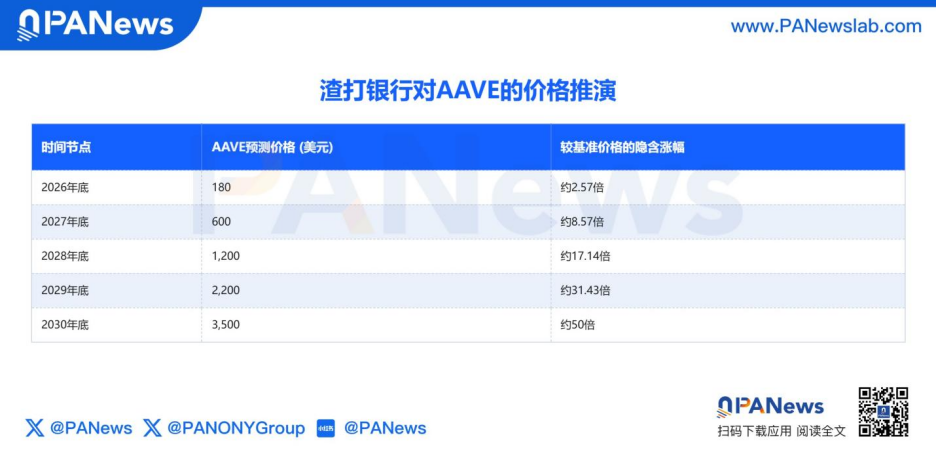
Standard Chartered’s assumptions stem from predictions about two major trends in the DeFi sector:

  • DeFi TVL (Total Value Locked) will grow 37-fold. Standard Chartered predicts that by 2030, the total value of active assets in DeFi will grow 37 times from current levels, reaching approximately $2.7 trillion. This will be driven by a $2 trillion expansion in stablecoin scale and the massive wave of on-chain migration of RWAs (Real World Assets).

  • RWA penetration in DeFi will increase from 3.5% to 30%. This means trillions of dollars in traditional assets will flow into on-chain lending protocols.

Looking back at its peak in October last year, Aave once managed deposits as high as $75 billion. If viewed as a traditional bank, this scale would place it among the top 35 banks in the United States.

Standard Chartered believes that Aave’s operational efficiency far surpasses that of traditional banks reliant on physical branches and redundant manpower. Once the tokenization wave arrives, Aave will leverage its Horizon permissioned lending market and the fee capture from its stablecoin GHO to convert the benefits of RWA on-chain into tangible protocol revenue.

Regarding the capital outflow triggered by the KelpDAO rsETH bridging security incident in April, Standard Chartered Bank characterizes it as a short-term fluctuation during the bottoming phase, not a collapse in the long-term protocol fundamentals.

Even setting aside the long-term narrative and focusing on a medium-to-short-term perspective, Aave’s fundamentals remain robust enough.

On June 18, Grayscale released an in-depth report on Aave, applying the traditional finance DCF (Discounted Cash Flow) model and P/E (Price-to-Earnings) ratio method to value a DeFi protocol for the first time.

Grayscale concluded:AAVE is a typical cash-flow-driven asset, currently trading at undervalued levels.
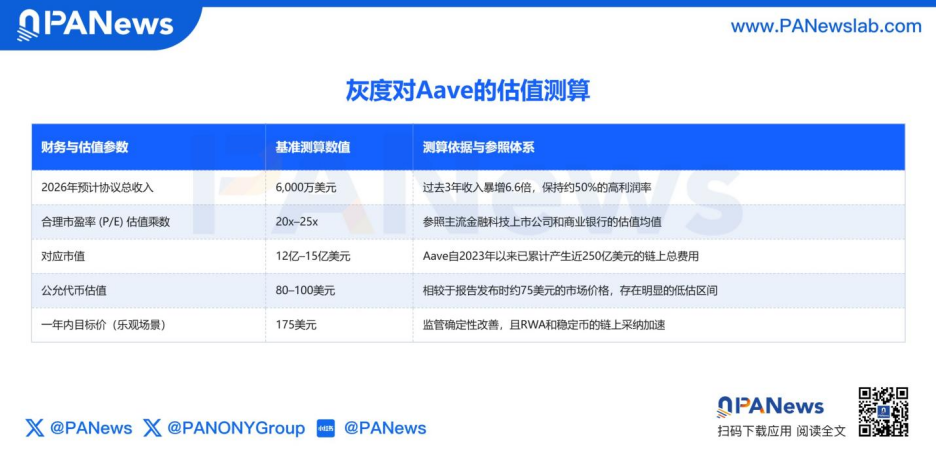
Grayscale emphasized that Aave’s full-year protocol revenue for 2025 was as high as $142 million, indicating healthy cash flow. More importantly, the token buyback and burn plan launched by Aave DAO in April last year, as well as the "Aave Will Win" proposal’s shift of product revenue to token holders, have institutionally established the transmission path from "protocol revenue generation → token value appreciation.”

Monopolizing 80% of Profits with Half the Sector's TVL, Idle Funds Remain Its Achilles' Heel

Beyond the macro vision painted by institutional capital, Aave has also built a deep moat at the micro level.

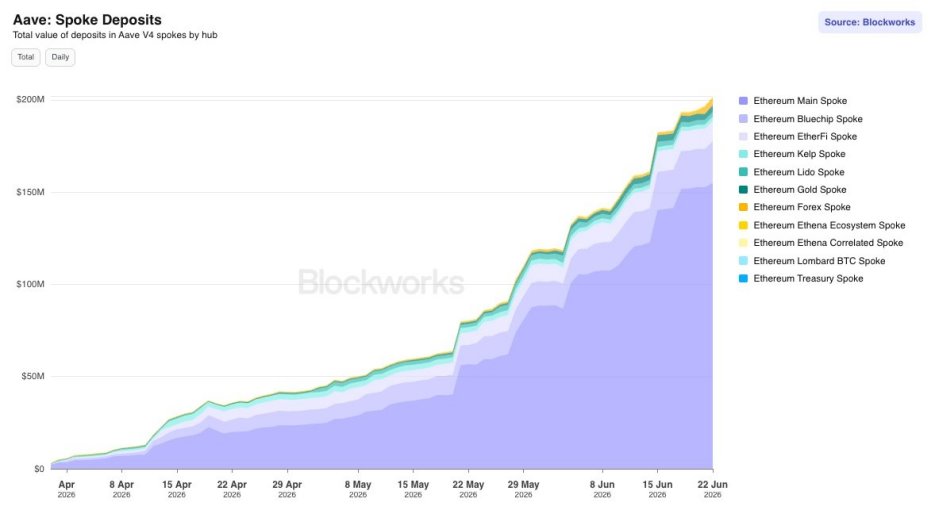
First, there is the breakthrough of the new-generation technical architecture, Aave V4. As the largest underlying architecture rewrite since the protocol’s inception in 2020, V4 employs a "liquidity hub-and-spoke" design to break the silo effect of single-chain liquidity. To date, V4’s total deposits have surpassed $200 million, with loan volumes nearing $60 million.
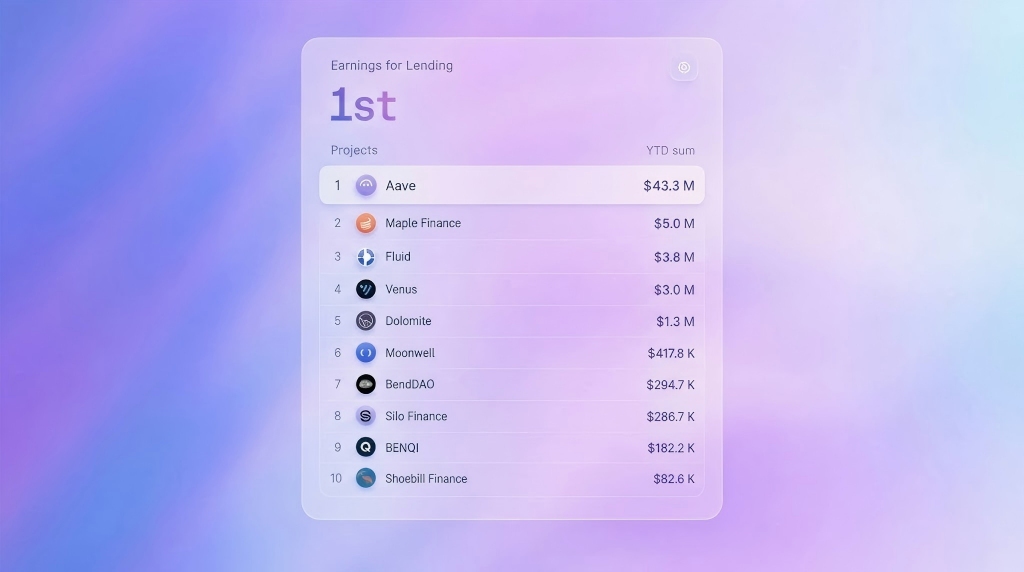
More remarkable is its profitability. On-chain data analytics firm MSB Intel pointed out that year-to-date, Aave has accumulated approximately $43.3 million in "protocol retained earnings" within the lending sector, accounting for 80.7% of the entire sector’s profits. Protocols like Maple Finance, Fluid, Venus, ranked behind it, each generating less than $5 million in profit, not on the same scale as Aave.

In the traditional business world, a company’s substance is often determined by net profit, not total assets. Retained earnings are an indicator that, after deducting relevant operational costs and token inflation incentives, truly reflects a protocol’s on-chain net revenue generation capability.

In other words, Aave uses roughly half of the sector’s TVL to capture over 80% of its net profit. This near-monopolistic profit structure is the hardest cornerstone in Standard Chartered’s 50-fold prediction.
On the flip side, the structural flaw once highlighted by crypto research firm Delphi Digital remains an unresolved challenge. The root of the problem lies within Aave’s peer-to-pool lending model.

According to Delphi Digital’s estimates, in the three primary markets of WETH, USDT, and USDC, Aave incurs an annual invisible loss (Deadweight Loss) of approximately $52 million due to idle funds, a scale almost equivalent to half of its annualized net revenue for Q1 2026.
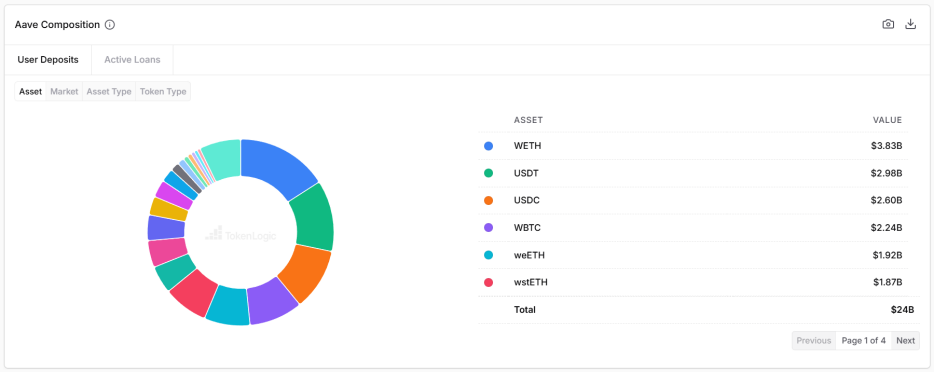
The systemic disconnect between deposit and borrowing rates is an inherent defect of the peer-to-pool model. To ensure depositors can redeem their funds at any time without loss, Aave must maintain a massive idle liquidity buffer within its pools. This results in depositors receiving rates typically 25% to 35% lower than what borrowers pay. The difference is the opportunity cost of idle funds. Even if the DAO governance layer sets the reserve factor to 0, the invisible loss from idle funds would still be as high as $36 million.

The KelpDAO incident in April further revealed the fragility of this model. After hackers drained nearly $200 million worth of WETH, the WETH pool utilization rate was locked at 100% for five days. Ordinary depositors could neither withdraw nor participate in liquidations, leaving a scar on Aave that has yet to fully heal.

This structural flaw makes Aave susceptible to "upstream risk" contagion. Coupled with the inherent shortcoming of low capital efficiency, it also gives latecomers an opportunity to break through. Emerging lending protocols like Morpho, focusing on modular isolation, peer-to-peer matching, and minimalist underlying design, are encroaching on Aave’s market share from an efficiency standpoint, becoming its most formidable challenger beneath the throne.

Looking back from the midpoint of 2026, Aave stands at the corner of fantasy and reality.

The "$3,500" pie chart drawn by Standard Chartered Bank reflects traditional finance’s ambition for asset tokenization. Beyond mere TVL growth, Aave’s future focus will be on finding a viable path to support a trillion-dollar asset scale.

The throne of DeFi lending remains, but the foundation beneath it still requires a process of reconstruction or reinforcement.


熱門幣種推薦

相關問答

QWhat is Standard Chartered Bank's price target for AAVE by the end of 2030, and what multiple increase does this represent from its current price?

AStandard Chartered Bank's price target for AAVE by the end of 2030 is $3,500, which represents a 50-fold (or 5,000%) increase from its price at the time of the report.

QWhat are the two major DeFi trends that Standard Chartered's prediction for AAVE is based on?

AStandard Chartered's prediction is based on two major DeFi trends: 1) DeFi TVL (Total Value Locked) growing 37-fold to approximately $2.7 trillion by 2030, driven by stablecoin expansion and the tokenization of real-world assets (RWA). 2) The penetration rate of RWA in DeFi increasing from 3.5% to 30%.

QAccording to Grayscale's report, what makes AAVE a 'cash flow-driven asset', and what valuation methods did they apply?

AGrayscale's report states that AAVE is a cash flow-driven asset because it generated substantial protocol revenue of $142 million in 2025 and has mechanisms like token buyback/burn plans that link protocol earnings to token value. They applied traditional financial valuation methods, specifically the DCF (Discounted Cash Flow) model and P/E (Price-to-Earnings) ratio, to value the DeFi protocol.

QWhat is AAVE's key competitive advantage in terms of profitability within the lending sector, as highlighted by MSB Intel?

AAccording to MSB Intel, AAVE's key competitive advantage is its dominant profitability. Year-to-date, it has generated approximately $43.3 million in 'Protocol Retained Earnings', accounting for 80.7% of the entire lending sector's profits, despite holding only about half of the sector's TVL.

QWhat is the fundamental structural flaw in Aave's peer-to-pool lending model identified by Delphi Digital, and what is its consequence?

AThe fundamental structural flaw identified by Delphi Digital is the systemic disconnect between deposit and borrowing rates, necessitating a large idle liquidity buffer in the pool. This leads to significant 'deadweight loss' or opportunity cost, estimated at $52 million annually for major markets, representing low capital efficiency. A consequence of this model was evident during the KelpDAO hack, where the WETH pool was locked at 100% utilization for days, preventing user withdrawals.

你可能也喜歡

Bitmine以太坊储备增至98亿美元:"加密货币最好的年份尚未到来"

比特浸入科技(Bitmine Immersion Technologies)近期再次成为头条,其在一周内增持了27,084枚以太坊(ETH)。这使得其以太坊总持有量达到5,700,040枚,按每枚1,569美元计算,价值约90.1亿美元,占以太坊总供应量的4.7%。此次增持发生在以太坊价格从约1780美元下跌至1578.54美元(撰稿时)的一周内。同时,根据SoSo Value数据,以太坊ETF在整个六月大部分时间出现资金外流,总额达5.0139亿美元。 针对疲软的市场状况,比特浸入科技董事长汤姆·李(Tom Lee)表示,近期市场对加密货币投资者颇具挑战,并指出临近季度末的“粉饰橱窗”行为导致投资者减持过去三个月表现不佳的资产是常见现象。此外,迈克尔·赛勒(Michael Saylor)的公司Strategy正面临持续审查,据报道其持有约140亿美元未实现亏损,而其普通股和优先股价格均跌破100美元水平,引发加密社区部分人士建议其停止扩张比特币持仓。 由于比特浸入科技常被称为“以太坊的Strategy”,市场担忧其持续的以太坊积累行为可能面临类似困境与批评。目前上市公司共持有价值约749.4亿美元的比特币和114.8亿美元的以太坊,Strategy是最大的比特币持仓上市公司。 然而,目前这些担忧仅是推测。比特浸入科技并非单纯积累以太坊,其每年质押收入估计达2.11亿美元,同时持有5.55亿美元现金及等价物以及488万枚质押的ETH。该公司还于6月26日被纳入罗素1000大型股指数。汤姆·李强调,公司计划稳步增长至2026年,并认为市场正开启新一轮牛市周期,代币化和人工智能的快速进展将推动区块链和去中心化加密领域的指数级需求增长。 最终摘要: * 新增持后,比特浸入科技持有5,700,040枚ETH,价值约90.1亿美元。 * 尽管以太坊价格疲软、ETF资金外流且Strategy面临批评,比特浸入科技仍持续购入以太坊。

ambcrypto2 小時前

Bitmine以太坊储备增至98亿美元:"加密货币最好的年份尚未到来"

ambcrypto2 小時前

你天天用的Claude和Codex,Meta内部不让随便用了

今年5月,Meta为其应用AI工程部门的工程师划定了红线:限制内部使用Claude Code和Codex这两款流行的AI编程工具,相关限制至今仍在生效。作为这些工具的主要客户之一,Meta此举并非因其不好用,而是恰恰相反——担心其过于强大和好用。 Meta正在自研名为MetaCode的AI编程助手,旨在替代外部模型以节省成本并掌握核心技术。限制使用外部模型的核心原因,是防止“蒸馏陷阱”:即担忧员工在构建MetaCode的训练数据、编程题库和评测标准时,过度依赖或掺入Claude/Codex的输出。这会导致自研模型在不知不觉中学习对手的“本事”和判断标准,使能力来源模糊,并可能违反与OpenAI、Anthropic等竞争对手的服务条款,引发法律风险。 内部指南明确禁止了可能让外部AI模型“定义能力”的三类任务:不能用其输出来生成测试题目、不能用其分析代码或设计测试点、其生成内容不得进入被测模型的访问环境。仅允许AI处理搭建工作流、整理文件等“打下手”的辅助性任务,且所有AI产出必须经过人工审核。 这一事件揭示了AI行业的一个普遍困境:在利用强大外部工具加速自身研发的同时,如何清晰界定并守护自身模型能力的原创性,避免陷入知识产权与合同风险。随着AI参与创造AI的循环加深,“本事究竟是谁的”这条界线正变得越来越模糊。

marsbit3 小時前

你天天用的Claude和Codex,Meta内部不让随便用了

marsbit3 小時前

交易

現貨

熱門文章

什麼是 $BANK

銀行人工智能:銀行未來的革命性步伐 介紹 在這個科技迅速進步的時代,銀行人工智能處於人工智能(AI)和銀行服務的交匯點。這個創新的項目旨在重新定義金融格局,通過人工智能的力量提高運營效率、安全措施和客戶體驗。在我們探索銀行人工智能的過程中,將深入探討這一項目的內涵、運作動態、歷史背景以及重要里程碑。 銀行人工智能是什麼? 從本質上講,銀行人工智能代表了一項變革性倡議,旨在將人工智能整合進各種銀行運營中。這個項目利用人工智能的能力來自動化流程、改善風險管理協議,並通過個性化服務增強客戶互動。 銀行人工智能的主要目標包括: 銀行功能自動化:通過利用人工智能技術,銀行人工智能旨在自動化日常任務,減輕人力資源的負擔並提高效率。 加強風險管理:該項目利用人工智能算法來預測和識別風險,從而強化針對欺詐和其他威脅的安全措施。 銀行服務個性化:銀行人工智能專注於通過分析客戶數據和行為提供量身定制的金融產品和服務。 改善客戶體驗:實施由人工智能驅動的解決方案,如聊天機器人和虛擬助手,旨在為用戶提供更接近人類的互動,徹底改變客戶與銀行的互動方式。 有了這些目標,銀行人工智能將自己定位為在提高銀行效率、安全性和以用戶為中心的關鍵角色。 銀行人工智能的創造者是誰? 關於銀行人工智能的創造者的具體細節尚不清楚。因此,在可用信息中尚未確定具體的個人或組織。圍繞該項目創建的匿名性引發了問題,但並未減少其雄心壯志的願景和目標。 銀行人工智能的投資者是誰? 與項目的創造者類似,關於銀行人工智能的投資者或支持組織的具體信息尚未披露。沒有這些信息,很難概述可能推動該項目向前發展的財務支持和機構支持。儘管如此,擁有堅實的投資基礎對於在這樣一個創新領域中保持發展至關重要。 銀行人工智能是如何運作的? 銀行人工智能在幾個創新領域運作,專注於使其與傳統銀行框架區分開來的獨特因素。以下是主要的運作特點: 自動化:通過應用機器學習算法,銀行人工智能自動化銀行內的各種手動流程。這樣不僅減少了運營成本,還使人力工作者能夠將精力轉向更具戰略性的活動。 先進的風險管理:將人工智能整合到風險管理實踐中,使銀行獲得準確預測潛在威脅(如欺詐)的工具,確保客戶信息和資產的安全。 量身定制的財務建議:通過持續學習客戶互動,人工智能系統發展出對用戶需求的細緻理解,能夠對財務決策提供量身定制的建議。 增強的客戶互動:利用由人工智能驅動的聊天機器人和虛擬助手,銀行人工智能提供了更具吸引力的客戶體驗,使用戶能夠快速解決問題,從而減少等待時間並提高滿意度。 這些運作特徵使銀行人工智能成為銀行業的先驅,建立服務交付和運營卓越的新標準。 銀行人工智能的時間線 了解銀行人工智能的發展軌跡需要看其歷史背景。以下是突顯重要里程碑和發展的時間線: 2010年代早期:對人工智能整合到銀行服務的概念開始引起關注,隨著銀行機構認識到潛在利益。 2018年:隨著銀行開始使用聊天機器人等人工智能工具進行基本客戶服務和風險管理系統以改善安全處理,人工智能技術的實施顯著增加。 2023年:人工智能的技術不斷進步,生成式人工智能被引入進行更複雜的任務,如文件處理和實時投資分析。今年標誌著人工智能技術為銀行提供能力的重要飛躍。 2024-當前狀態:截至今年,銀行人工智能正處於上升軌道,持續的研究和開發預示著將進一步提升銀行業務的能力。對人工智能應用的持續探索暗示著未來令人興奮的發展。 銀行人工智能的關鍵點 人工智能在銀行中的整合:銀行人工智能專注於採用人工智能來簡化銀行流程並改善用戶體驗。 自動化和風險管理的聚焦:該項目強烈關注這些領域,旨在減輕例行任務的負擔,同時通過預測分析增強安全框架。 個性化的銀行解決方案:通過利用客戶數據,銀行人工智能提供滿足個別用戶需求的量身定制銀行服務。 對發展的承諾:銀行人工智能致力於持續的研究和開發,確保其隨著技術的持續演變而保持適應性和持續相關性。 結論 總結來說,銀行人工智能展現了銀行業的一個重要進步,利用人工智能重塑運營範式、提高安全性,並促進客戶滿意度。儘管有關創造者和投資者的信息仍有缺口,但銀行人工智能的明確目標和功能機制為其持續發展提供了堅實基礎。隨著人工智能技術的不斷進步和與銀行業的融合,銀行人工智能在金融服務未來的影響力將十分顯著,改善我們對銀行的理解和互動方式。

148 人學過發佈於 2024.04.06更新於 2024.12.03

什麼是 $BANK

如何購買BANK

歡迎來到HTX.com!在這裡,購買Lorenzo Protocol (BANK)變得簡單而便捷。跟隨我們的逐步指南,放心開始您的加密貨幣之旅。第一步:創建您的HTX帳戶使用您的 Email、手機號碼在HTX註冊一個免費帳戶。體驗無憂的註冊過程並解鎖所有平台功能。立即註冊第二步:前往買幣頁面,選擇您的支付方式信用卡/金融卡購買:使用您的Visa或Mastercard即時購買Lorenzo Protocol (BANK)。餘額購買:使用您HTX帳戶餘額中的資金進行無縫交易。第三方購買:探索諸如Google Pay或Apple Pay等流行支付方式以增加便利性。C2C購買:在HTX平台上直接與其他用戶交易。HTX 場外交易 (OTC) 購買:為大量交易者提供個性化服務和競爭性匯率。第三步:存儲您的Lorenzo Protocol (BANK)購買Lorenzo Protocol (BANK)後,將其存儲在您的HTX帳戶中。您也可以透過區塊鏈轉帳將其發送到其他地址或者用於交易其他加密貨幣。第四步:交易Lorenzo Protocol (BANK)在HTX的現貨市場輕鬆交易Lorenzo Protocol (BANK)。前往您的帳戶,選擇交易對,執行交易,並即時監控。HTX為初學者和經驗豐富的交易者提供了友好的用戶體驗。

1.1k 人學過發佈於 2025.05.09更新於 2026.06.02

如何購買BANK

相關討論

歡迎來到 HTX 社群。在這裡,您可以了解最新的平台發展動態並獲得專業的市場意見。 以下是用戶對 BANK (BANK)幣價的意見。

活动图片