He Kaiming's Team's New Work: After Deleting VAE and Private Data, Text-to-Image Generation Becomes Even Stronger

marsbit發佈於 2026-06-22更新於 2026-06-22

文章摘要

KaiMing He's team introduces **MiniT2I**, a minimalist text-to-image (T2I) model that challenges the complexity of mainstream approaches. It eliminates components commonly considered essential: the VAE encoder-decoder, AdaLN conditioning mechanisms, auxiliary losses, private training data, and post-training alignment stages like RL/DPO. Instead, it uses a pure flow-matching objective trained directly on RGB pixels. The model employs a simplified **MM-JiT** Transformer architecture. It removes AdaLN blocks for conditioning and instead prepends two lightweight text adapter blocks to a standard pre-norm Transformer, allowing frozen T5 text features to adapt to the denoiser. Training follows a two-stage, LLM-like paradigm using only public datasets: pre-training on LLaVA-recaptioned CC12M for coverage, followed by fine-tuning on ~120k high-quality image-text pairs. With just 258M parameters (B/16), MiniT2I achieves competitive scores (0.87 on GenEval, 84.2 on DPG-Bench), outperforming larger pixel-space models. Scaling to 912M parameters (L/16) yields results comparable to SD3-Medium (~2B parameters) in style, composition, and imagination, though it lags in text rendering and named entities due to public data limitations. Key advantages include lower computational cost (~570 GFLOPs vs. ~1379 for latent models) and architectural simplicity. Acknowledged limitations include patch boundary artifacts in pixel space, side effects of high CFG scales, resolution ceilings for sequence...

The field of text-to-image generation has long been a fiercely competitive red ocean, seemingly with no room left to innovate.

What do you need to train a powerful text-to-image model today?

Following the current mainstream approach, you would need: a pre-trained VAE encoder-decoder, concatenated text encoders, meticulously designed conditional injection mechanisms, massive datasets, RL or DPO alignment phases...

Overall, there seems to be a consensus: text-to-image generation must be this complex.

He Kaiming's team, however, takes a contrarian approach, offering a new perspective in the field of text-to-image models. They have released MiniT2I — a minimalist, pixel-space text-to-image model that deliberately pursues simplicity.

No VAE encoder-decoder, no AdaLN conditional injection, no auxiliary loss functions, no private data, no RL/DPO alignment, just pure flow matching trained directly on pixels. The 258M-parameter B/16 version achieves 0.87 on GenEval and 84.2 on DPG-Bench, surpassing pixel-space models several times its size.
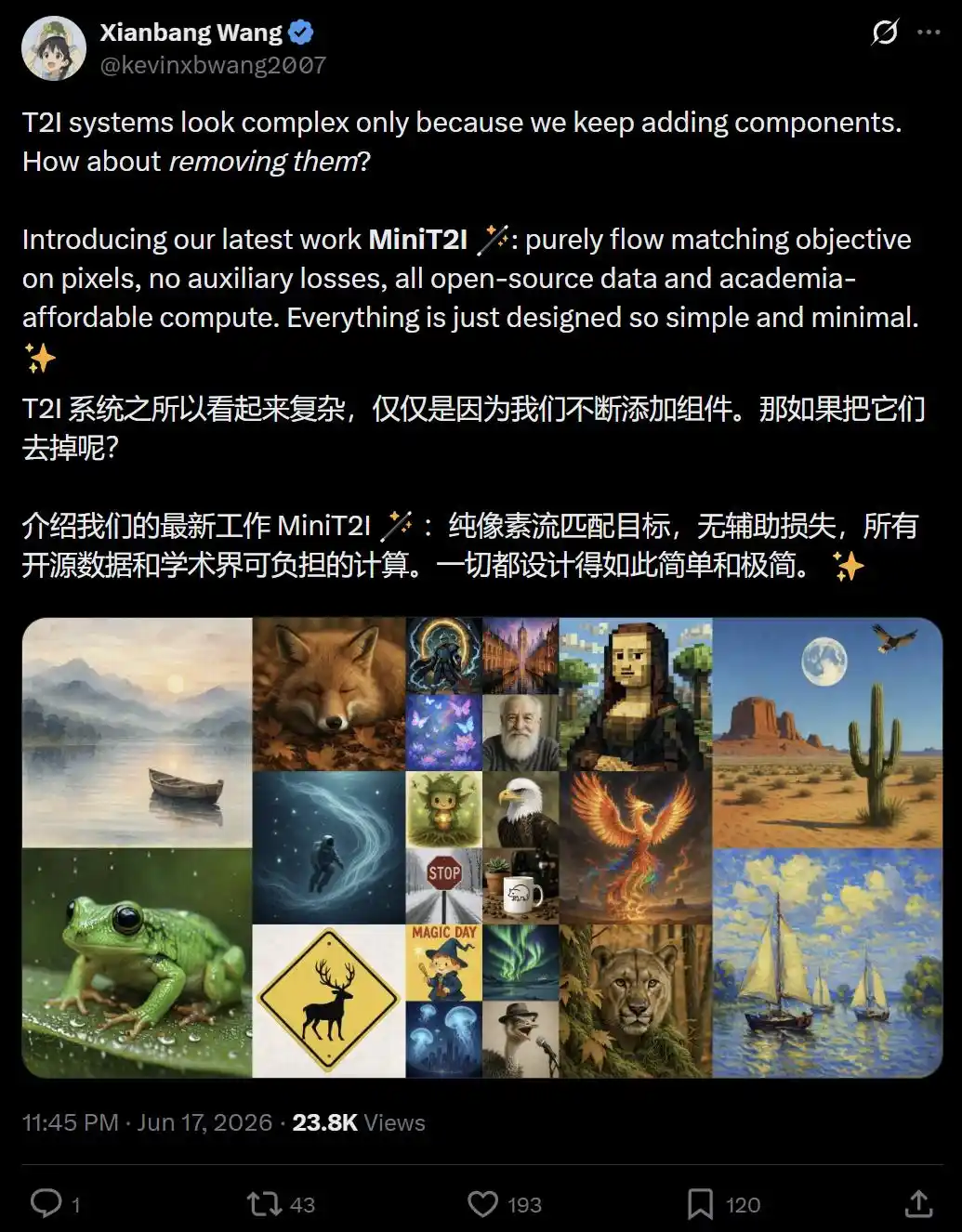
The core proposition of MiniT2I is: If text conditioning is treated as 'context tokens with semantic information' and injected into the model, text-to-image generation and class-conditional ImageNet generation are not fundamentally that different — the architecture can be similar, computational requirements comparable, and even the scale of data can be aligned.
  • Paper Title: A Minimalist Baseline for Text-to-Image Generation
  • Technical Blog: https://peppaking8.github.io/#/post/minit2i
  • Open Source Repo: https://github.com/PeppaKing8/minit2i-jax

Technical Approach: Subtraction at Every Step

Direct Pixel-Space Output, No VAE

MiniT2I's first design choice is radical: discard the VAE, perform denoising directly on RGB pixels.

Latent Diffusion Models are the current mainstream paradigm, first compressing images into a low-dimensional latent space using an autoencoder before diffusion. This makes high-resolution generation feasible, but at the cost of introducing reconstruction error, an extra training phase, and misalignment between the encoder and denoiser objectives.

MiniT2I's choice of pixel space is pragmatic: For 512×512 resolution, using 16×16 patches to divide the image into 1024 tokens keeps the sequence length well within the Transformer's comfort zone. Removing the VAE reduces single-step forward computation from ~1379 GFLOPs to ~570 GFLOPs (B/16 setting), and eliminates the ceiling on reconstruction accuracy — the output quality is only limited by the denoiser's capability.

Experiments confirm this: Under the same parameter budget, pixel models achieve FID on par with latent space models (18.7 vs 19.0), but with a 5x lower per-step cost.

MM-JiT Architecture: Returning to a Simple Transformer

SD3's MM-DiT uses AdaLN (Adaptive Layer Normalization) within each block to inject timestep and pooled text embeddings into the network — each sub-block needs to compute scale, shift, and gate parameters generated by an extra MLP from the conditioning vectors. This is an elaborate modulation mechanism, but MiniT2I finds it non-essential.
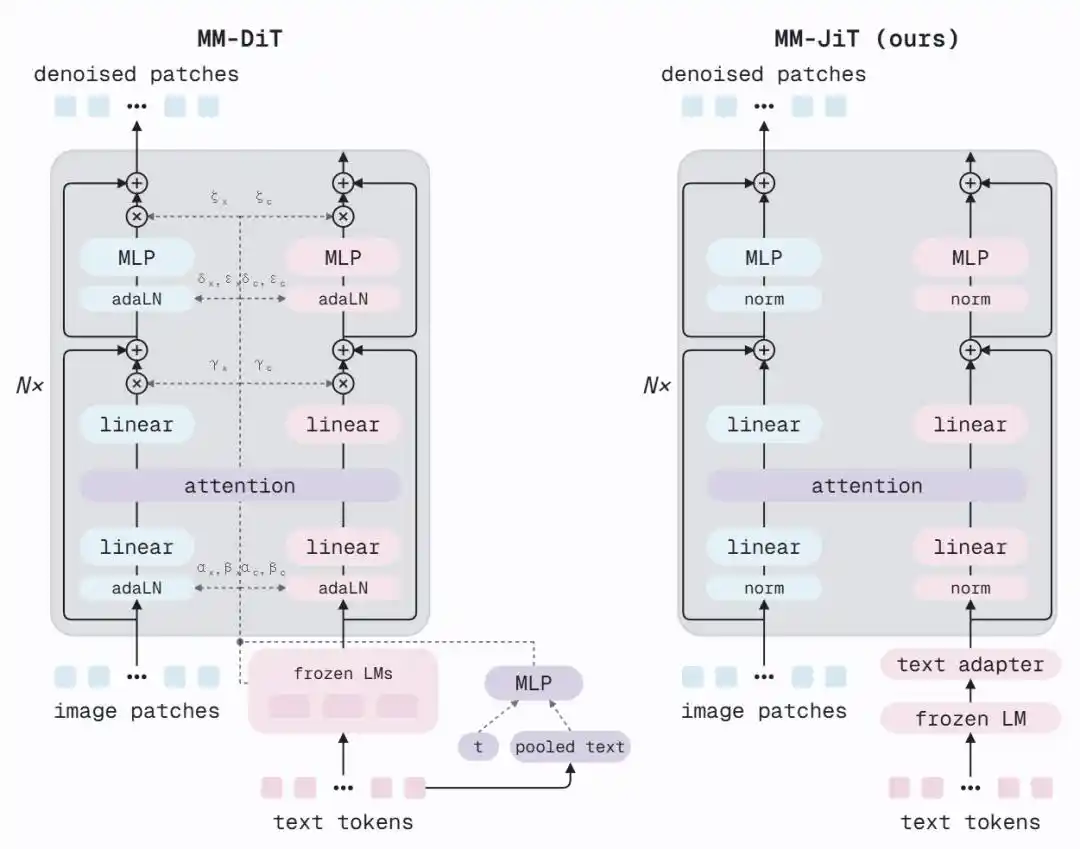
The proposed MM-JiT architecture does two things:

1. Add Two Text Adapter Layers: Insert two lightweight Transformer blocks before joint attention, allowing the frozen T5 features to first 'adapt' to the denoiser's needs.

2. Remove the AdaLN Branch: No longer inject timestep and global text information through an additional path. The model can still perceive noise levels — because the noise-corrupted image itself carries timestep information.

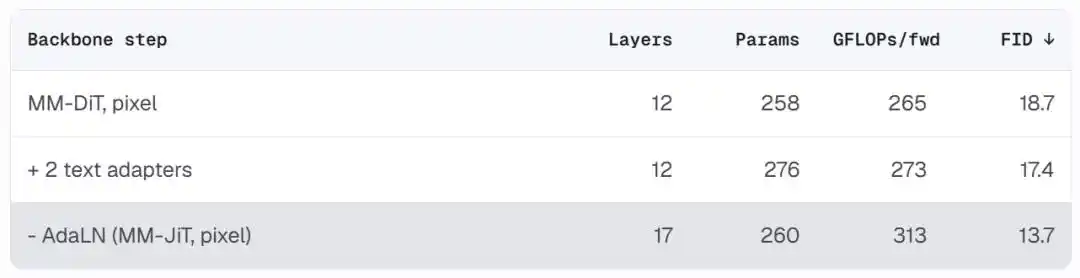
The result is a clean architecture nearly identical to a standard pre-normalization Transformer. Removing AdaLN reduces parameters, allowing for more layers within the same compute budget (12 layers → 17 layers). FID drops from 18.7 to 13.7, and the architecture itself is easier to understand and modify.
Training Data: Fully Public, Two-Phase

MiniT2I's training data also pursues minimalism:

  • Pre-training: LLaVA-recaptioned CC12M (publicly available VLM re-captioned dataset), 250K steps
  • Fine-tuning: ~120K high-quality image-text pairs (BLIP3o-60K + LAION DALL・E 3 Discord set + ShareGPT-4o-Image), 40K steps

This 'pre-train then fine-tune' two-stage pattern directly mirrors LLM training paradigms: pre-training buys coverage, fine-tuning teaches the model what a good answer is. Ablations show both are indispensable — pre-training alone yields acceptable image quality but poor prompt following; fine-tuning alone makes the model's world too narrow, causing generative diversity to collapse.

Results: Small Model, Big Performance

In comparisons among pixel-space text-to-image models, MiniT2I offers exceptional value:
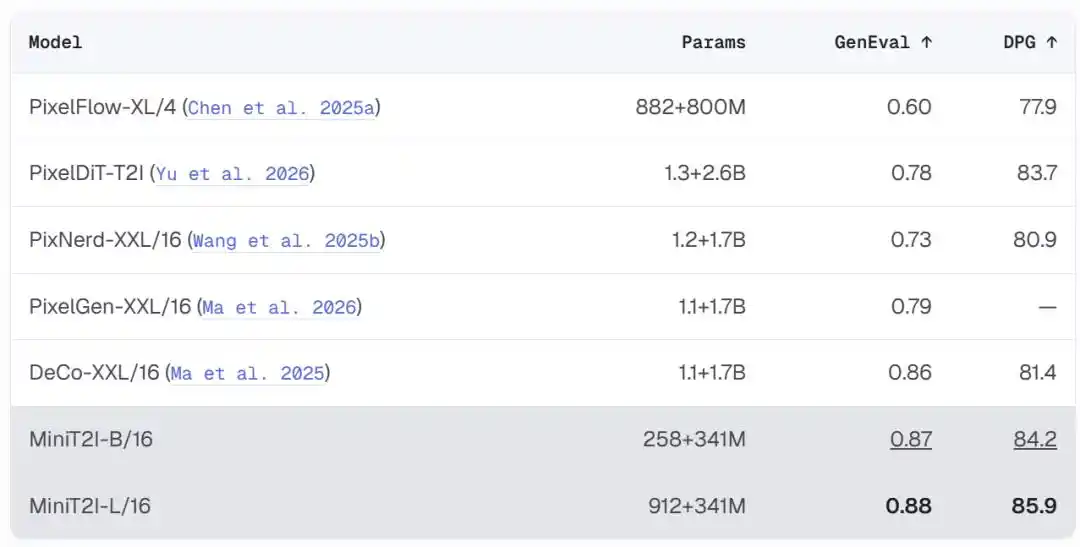
MiniT2I-B/16, with only ~600M total parameters (including text encoder), surpasses models 3-4 times its size on GenEval and DPG-Bench. Moreover, training cost is extremely low: the B/32 ablation model required only about 3 days on 8 H100s, with total training FLOPs comparable to a standard 200-epoch ImageNet experiment.
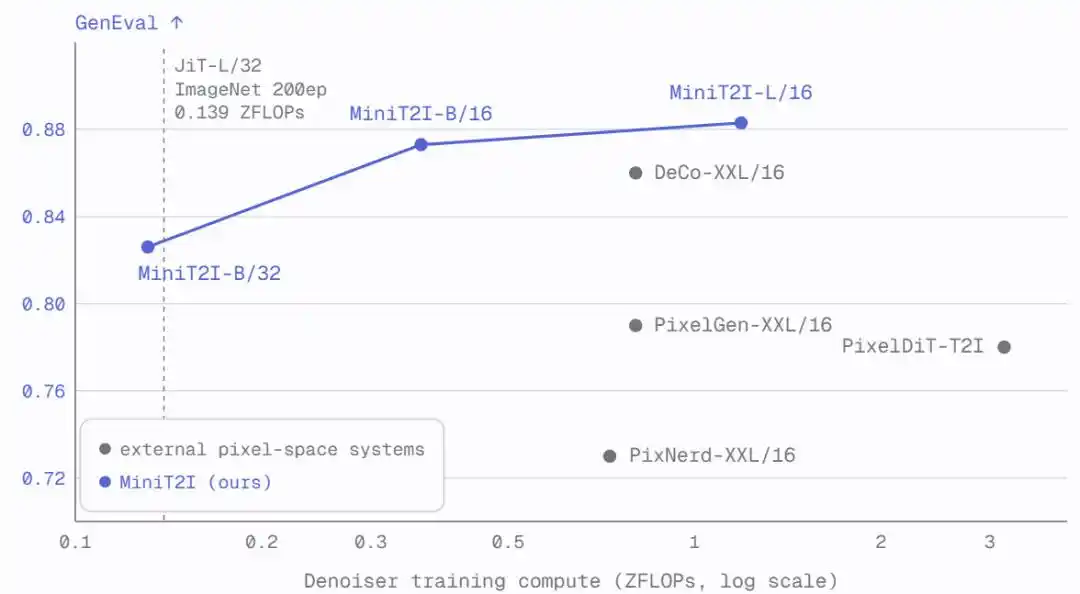
Scaling to L/16 (912M parameters) yields noticeable improvements in style diversity, spatial relationships, and text rendering, achieving quality on imaginative scenes comparable to or even better than SD3-Medium (~2B parameters).

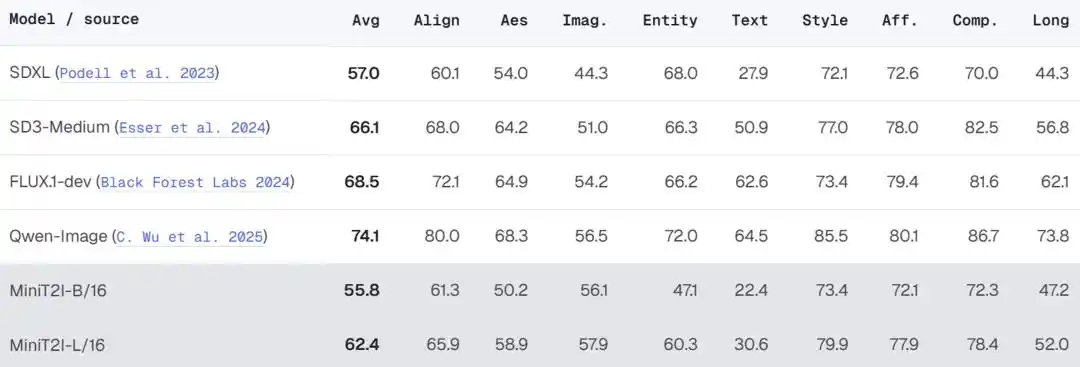
In the more comprehensive PRISM-Bench evaluation, MiniT2I-L/16 performs well in style, composition, and imagination dimensions (79.9, 78.4, 57.9), approaching SD3-Medium levels. However, gaps remain in text rendering (30.6 vs SD3's 50.9) and named entities (60.3 vs 66.3) — the team acknowledges these are inherent limitations of the public data recipe, requiring targeted data to bridge.
Limitations and Outlook

MiniT2I is a proof of concept for a technical path, not a final product. The team honestly points out several unresolved issues:

  • Patch artifacts in pixel space: Measurable discontinuities exist at patch boundaries (gradients 17-22% higher at boundaries than elsewhere), a problem latent-space models do not have.
  • Side effects of CFG in pixel space: High guidance scales (~6) push local tokens away from the data manifold, directly exposing visual artifacts without a decoder's 'smoothing' effect.
  • Resolution ceiling: Works well at 512×512 currently; pushing to 4K+ requires longer sequences or more efficient attention mechanisms.
  • Data bottleneck: Text rendering and named entities remain weaker than industrial systems, requiring specialized data augmentation.

MiniT2I demonstrates that state-of-the-art text-to-image generation is no longer a game only for top industrial labs.

When a 258M-parameter model, trained on purely public data with academic-level compute for just 3 days, can defeat opponents orders of magnitude larger, perhaps text-to-image is undergoing a paradigm shift from 'brute force' to 'distillation'.

"T2I is no longer an insurmountable wall. Welcome to use and improve it, to build a simpler baseline."

This article is from the WeChat public account "机器之心" (Almost Human)

熱門幣種推薦

相關問答

QWhat is the main contribution or innovation of the MiniT2I model proposed by He Kaiming's team?

AThe main contribution is proposing MiniT2I, a minimalist text-to-image baseline model. It removes numerous complex components standard in current models—such as the VAE encoder-decoder, the AdaLN conditional injection mechanism, auxiliary loss functions, and private training data—and relies solely on flow matching objectives trained directly on pixel space. It demonstrates that with a simpler architecture and public data, it can achieve competitive performance against much larger models.

QHow does the architectural design of MiniT2I's MM-JiT differ from the commonly used MM-DiT in models like SD3?

AThe MM-JiT architecture in MiniT2I differs from MM-DiT by performing simplification in two key ways. First, it adds two lightweight text adapter Transformer blocks before joint attention to help frozen T5 features adapt to the denoiser. Second, and more importantly, it deletes the complex AdaLN (Adaptive Layer Normalization) branches used to inject timestep and text conditioning. This results in a cleaner, near-standard pre-norm Transformer architecture, reducing parameters and allowing for more layers within the same compute budget.

QWhat is the core argument for MiniT2I's choice to operate directly in pixel space instead of a latent space like most models?

AThe core argument is simplicity and alignment. Removing the VAE eliminates several issues: reconstruction error, extra training stages, and misalignment between encoder and denoiser objectives. For 512x512 images, patchifying into 1024 16x16 tokens keeps the sequence length manageable for Transformers. This direct approach reduces computational cost per forward pass significantly (~570 vs ~1379 GFLOPs for the B/16 configuration) and removes the upper bound of reconstruction accuracy, meaning the output quality depends directly on the denoiser's capability.

QWhat were the two stages of data used to train MiniT2I, and why was this two-stage approach necessary?

AMiniT2I was trained in two stages using only public data: 1) Pre-training on LLaVA-recaptioned CC12M (a VLM-recaptioned dataset) for 250K steps. 2) Fine-tuning on a combined set of ~120K high-quality image-text pairs from sources like BLIP3o-60K, LAION DALL・E 3 Discord set, and ShareGPT-4o-Image for 40K steps. This 'pre-train then fine-tune' paradigm mirrors LLM training. Ablation studies showed both stages are essential: pre-training alone gives good image quality but poor prompt following, while fine-tuning alone causes a collapse in generation diversity due to a limited worldview.

QAccording to the article, what are some of the key limitations or unsolved problems with the MiniT2I approach?

AThe key limitations highlighted include: 1) Patch boundary artifacts in pixel space, leading to measurable discontinuities not present in latent models. 2) Negative side effects of high CFG (Classifier-Free Guidance) scales in pixel space, which push local tokens off the data manifold and manifest as visual flaws. 3) A resolution ceiling, as scaling to 4K+ would require longer sequences or more efficient attention. 4) Data bottlenecks, particularly in text rendering and named entity accuracy, which lag behind industrial systems and would require specialized data to improve.

你可能也喜歡

SpaceX交易权限现已开放:WEEX上线SPCXON交易对

2026年6月,SpaceX完成了史上最大规模的IPO,但大量投资者因券商限制、开户障碍和地域壁垒而无法参与。加密货币交易所WEEX推出了解决方案SPCXON/USDT现货交易对。SPCXON是一种基于Ondo代币化股票框架构建的产品,旨在为美国以外的合格交易者提供追踪SpaceX经济收益的途径,以USDT结算,交易便捷,无传统券商门槛。 SpaceX IPO定价为135美元,首日收盘接近161美元,随后一度冲高至225美元,公司估值约1.75万亿美元。看涨理由基于星链收入增长、无可匹敌的发射频率以及星舰里程碑。看跌观点则认为,其估值已达营收的90-110倍,且存在流通股稀少和即将到来的内部持股解锁等风险。 需注意,SPCXON提供的是价格敞口,而非股票所有权,不包含投票权和直接股息。其价格可能相对净资产价值出现溢价或折价,交易者需关注价差。 WEEX平台整合了包括SpaceX、MicroStrategy和Micron在内的多种代币化股权产品,用户可在统一账户内交易加密货币和股权敞口。平台还提供高达400倍杠杆的加密货币期货交易。 WEEX成立于2018年,全球用户超过620万,提供超过1200个现货交易对,并设有1000 BTC保护基金。平台亦提供跟单交易和AI工具等功能。 免责声明:本文内容不构成投资建议。

TheNewsCrypto12 小時前

SpaceX交易权限现已开放:WEEX上线SPCXON交易对

TheNewsCrypto12 小時前

Gate 研究院:加密金融产品掀起“华尔街化”浪潮,是竞争还是融合?

2009年比特币的创世区块暗含对传统金融体系的批判,其理想是建立去中心化、去中介、去银行的点对点金融系统。然而十七年后,比特币现货ETF获批、贝莱德等巨头发行相关产品、CME推出受监管衍生品、RWA(真实世界资产)和代币化国债市场快速增长等现象,显示传统金融正系统性地介入加密资产的发行、定价、托管和分销环节,引发了加密市场是否“华尔街化”的讨论。 文章认为,这并非单方面的吞并,而是加密体系与传统金融的双向融合与互补。加密领域提供无许可开放性、24小时交易和可编程结算,但缺乏合规通道、机构级托管和主流分销网络;传统金融则拥有牌照、信任、资金和渠道,但受限于交易时间、跨境门槛和结算效率。双方正朝彼此的核心优势靠拢。 这种融合体现为两条路径:一是以Gate为代表的加密交易所,逐步从提供代币化美股、CFD差价合约,发展到接入真实股票、港股、韩股交易,成为连接加密账户与传统券商基础设施的前端入口;二是以Robinhood为代表的传统券商,通过收购加密交易所、推出股票代币和建设自有Layer 2,将加密资产和链上代币化产品整合进其平台。两者的共同目标是争夺下一代综合金融账户的入口,让用户在一个界面内交易多种资产。 同时,RWA和链上国债作为资产层的融合正在加速。尽管规模尚小,但代币化国债等产品为链上提供了低波动收益资产,并吸引JP摩根、贝莱德等传统机构参与,测试未来资本市场的底层结算方式。 最终,加密与华尔街并非谁征服谁,而是在共同塑造一个更高效、全球化的统一资本市场。用户未来或将在同一个账户中自由交易比特币、股票、ETF、链上国债等多种资产,体验无缝的跨资产配置。去中心化的理想仍在底层协议中延续,而在应用层,一个融合了双方优势的新金融形态正在形成。

marsbit13 小時前

Gate 研究院:加密金融产品掀起“华尔街化”浪潮,是竞争还是融合?

marsbit13 小時前

交易

現貨

熱門文章

什麼是 ₿O₿

比特幣鮑勃 ($₿o₿):透過混合層-2創新開創以比特幣為中心的去中心化金融 在數字經濟快速演變的時代,比特幣鮑勃 ($₿o₿) 作為一個革命性項目出現,旨在提升比特幣在去中心化金融 (DeFi) 領域的實用性。比特幣鮑勃於2024年5月正式推出,也被稱為「基於比特幣的建設」(Build on Bitcoin, BOB),代表了一種混合層-2區塊鏈解決方案,將比特幣著名的安全性和不可變性與以太坊的可編程性相結合。這一倡議旨在填補比特幣生態系統中的一個關鍵空白,通過促進智能合約和去中心化應用的整合,同時保持比特幣固有的信任和安全核心原則。在著名風險投資家的大力支持下,比特幣鮑勃有望重新定義比特幣在DeFi領域的角色,使其成為全球去中心化金融運作的基石。 比特幣鮑勃是什麼,$₿o₿? 比特幣鮑勃的核心是一種混合區塊鏈解決方案,旨在增強比特幣的功能。該項目的主要目標是使比特幣上的去中心化金融成為可能,促進快速和無縫的交易,同時確保高水平的安全性。 比特幣鮑勃採用了先進技術,特別是一種混合層-2架構,將比特幣的安全屬性與以太坊虛擬機 (EVM) 的可編程性和靈活性相結合。這一務實的做法使項目能夠有效運行,而不妥協比特幣的基本價值,這使其成為彌合傳統比特幣持有者與新興DeFi生態系統之間差距的重大步驟。 比特幣鮑勃的一個突出特點是其通過創新機制提供信任最小化環境的角色,例如最初依賴以太坊的樂觀滾動,最終過渡到完全的比特幣整合。這一混合系統旨在確保比特幣中存在的龐大流動性不僅得以保留,還能有效地在各種DeFi協議中利用。 比特幣鮑勃的創始人是誰,$₿o₿? 比特幣鮑勃的創意力量是聯合創始人兼首席執行官 Alexei Zamyatin,他在加密貨幣領域擁有豐富的經驗和知識。Zamyatin 擁有計算機科學博士學位,自2015年以來一直積極參與比特幣的開發。他對比特幣和以太坊生態系統的深刻理解在塑造比特幣鮑勃的願景和技術基礎方面發揮了關鍵作用。 與Zamyatin一起的是聯合創始人 Dominik Harz,他擔任首席技術官 (CTO)。這對搭檔培養了一支充滿才華的團隊,大家共同熱衷於推動區塊鏈技術的邊界,確保比特幣鮑勃在市場上的創新地位。 比特幣鮑勃的投資者是誰,$₿o₿? 比特幣鮑勃成功獲得了一系列知名投資者和風險投資公司的支持,他們認識到該項目改變比特幣格局的潛力。在2024年3月,該項目完成了一輪強勁的 1000萬美元種子融資,由Castle Island Ventures主導,Coinbase Ventures和Bankless Ventures等公司也有顯著參與。 不久之後,在2024年7月,比特幣鮑勃獲得了額外的 160萬美元戰略資金。這一輪融資由Ledger Ventures共同主導,並有來自BlackRock、Aave和Curve等多家知名公司的天使投資者參與。強大的財務支持反映了整個行業對比特幣鮑勃在解鎖比特幣在DeFi領域潛力的創新方法的認可。 這筆資金對於項目的持續發展至關重要,同時也用於建立一個孵化器,以促進專門滿足不斷增長的用戶基礎需求的比特幣原生去中心化應用 (dApps)。 比特幣鮑勃是如何運作的,$₿o₿? 比特幣鮑勃的運作機制根植於其 混合滾動架構,旨在結合比特幣的安全性和以太坊EVM的多樣性。該項目採用分階段的安全模型,概述其與用戶和開發者的互動方式如下: 第一階段 – 初始階段作為以太坊上的樂觀滾動運行,其中交易以有效性的樂觀預期進行處理,為未來在比特幣上的發展鋪平道路。 第二階段 – 隨著項目的過渡,將通過比特幣質押整合 比特幣最終性,利用巴比倫網絡增強安全性。這一機制要求驗證者鎖定比特幣,從而驗證BOB交易,這不僅增強了安全性,還為參與者創造了收益機會。 第三階段 – 比特幣鮑勃的前瞻性願景是完全整合比特幣,使用創新技術如BitVM和零知識證明來促進鏈下計算,同時保持比特幣的安全完整性。 關鍵創新如 BitVM2,這是一種由Zamyatin共同編寫的信任最小化橋接協議,對項目的功能至關重要,允許比特幣存款和取款而無需依賴廣泛的網絡。這使生態系統能夠有效地與以太坊和其他兼容鏈連接,為用戶和開發者創造一個流暢而有效的互動模型。 比特幣鮑勃的時間表,$₿o₿ 了解比特幣鮑勃的演變需要追蹤其重要里程碑: 2019年:Alexei Zamyatin和Dominik Harz成立了一家專注於區塊鏈解決方案的研究公司,為未來項目奠定基礎。 2024年3月:比特幣鮑勃成功籌集 1000萬美元 的種子融資,標誌著其進入競爭激烈的區塊鏈市場。 2024年5月1日:官方主網啟動,展示項目的能力,並獲得顯著的用戶採用和總鎖倉價值 (TVL)。 2024年7月:該項目吸引了額外的 160萬美元 戰略資金,用於建立其孵化器,旨在促進比特幣驅動的創新。 2024年10月:比特幣鮑勃發布了「願景文件」,詳細說明其混合層-2設計和前瞻性策略。 2025年:預計推出第二階段功能,重點是比特幣最終性和BitVM橋接,旨在增強整體功能性。 結論:重新定義比特幣在去中心化金融中的角色 比特幣鮑勃 ($₿o₿) 不僅僅是另一個區塊鏈項目;它代表了比特幣與更廣泛金融應用互動方式的範式轉變。通過精心結合比特幣的安全性和以太坊的靈活性,比特幣鮑勃旨在重塑DeFi格局,彌合數字貨幣與去中心化應用之間的差距。 憑藉強大的技術框架、卓越的領導力和戰略資金,比特幣鮑勃有望在加密貨幣生態系統中建立起基礎性角色,為比特幣解鎖新的流動性和實用性維度。隨著項目的持續演變和擴展,它承諾將迎來創新的新時代,證明比特幣的潛力遠不止於作為一種單純的價值儲存,而是作為未來金融格局的基石。 隨著項目在預期階段中的推進,所有目光都將集中在比特幣鮑勃身上,特別是關於其致力於融入去中心化原則,確保用戶能夠享受基於比特幣的DeFi的全部好處。

122 人學過發佈於 2025.06.30更新於 2025.06.30

什麼是 ₿O₿

如何購買O

歡迎來到HTX.com!在這裡,購買O1 exchange (O)變得簡單而便捷。跟隨我們的逐步指南,放心開始您的加密貨幣之旅。第一步:創建您的HTX帳戶使用您的 Email、手機號碼在HTX註冊一個免費帳戶。體驗無憂的註冊過程並解鎖所有平台功能。立即註冊第二步:前往買幣頁面,選擇您的支付方式信用卡/金融卡購買:使用您的Visa或Mastercard即時購買O1 exchange (O)。餘額購買:使用您HTX帳戶餘額中的資金進行無縫交易。第三方購買:探索諸如Google Pay或Apple Pay等流行支付方式以增加便利性。C2C購買:在HTX平台上直接與其他用戶交易。HTX 場外交易 (OTC) 購買:為大量交易者提供個性化服務和競爭性匯率。第三步:存儲您的O1 exchange (O)購買O1 exchange (O)後,將其存儲在您的HTX帳戶中。您也可以透過區塊鏈轉帳將其發送到其他地址或者用於交易其他加密貨幣。第四步:交易O1 exchange (O)在HTX的現貨市場輕鬆交易O1 exchange (O)。前往您的帳戶,選擇交易對,執行交易,並即時監控。HTX為初學者和經驗豐富的交易者提供了友好的用戶體驗。

348 人學過發佈於 2026.06.19更新於 2026.06.29

如何購買O

相關討論

歡迎來到 HTX 社群。在這裡,您可以了解最新的平台發展動態並獲得專業的市場意見。 以下是用戶對 O (O)幣價的意見。

活动图片














