3 People with 100 AI Programmers, Burning Through $1.3 Million a Month! OpenAI: I'll Foot the Bill

marsbit發佈於 2026-05-17更新於 2026-05-17

文章摘要

In a striking demonstration of AI-powered development, Peter Steinberger (creator of OpenClaw) shared that his three-person team spent $1.3 million in one month to run approximately 100 AI agents (primarily Codex instances). OpenAI covered the cost. The expenditure consumed 6.03 trillion tokens across 7.6 million requests. Steinberger argues that, with "fast mode" disabled, the cost falls below that of a single engineer while providing significantly greater output. This "cloud programmer army" handles core but tedious software engineering tasks: reviewing pull requests, finding security vulnerabilities, deduplicating issues, fixing bugs, monitoring benchmarks, and even generating PRs after meetings. This shifts AI's role from merely writing code to maintaining the entire collaborative fabric of a project. Steinberger's tool, CodexBar (a macOS menu bar app), tracks usage and costs across various AI coding services, highlighting how token consumption is becoming a key metric—a new "means of production." The experiment poses a profound question: if token cost ceases to be a barrier, how will software development transform? As model prices fall, the capability for small teams to leverage large numbers of AI agents could become commonplace, fundamentally altering the scale and speed of development. The future, Steinberger suggests, is arriving rapidly.

Peter Steinberger

Editor: Solomon

[New Zhiyuan Report] 3 people, 100 AI agents, burning through $1.3 million a month — The father of OpenClaw has turned software development into an "AI assembly line," with OpenAI picking up the tab.

While others show off their pay stubs, he shows off the bill — $1.3 million a month!

That's nearly 9 million RMB per month. It's left netizens utterly dumbfounded.

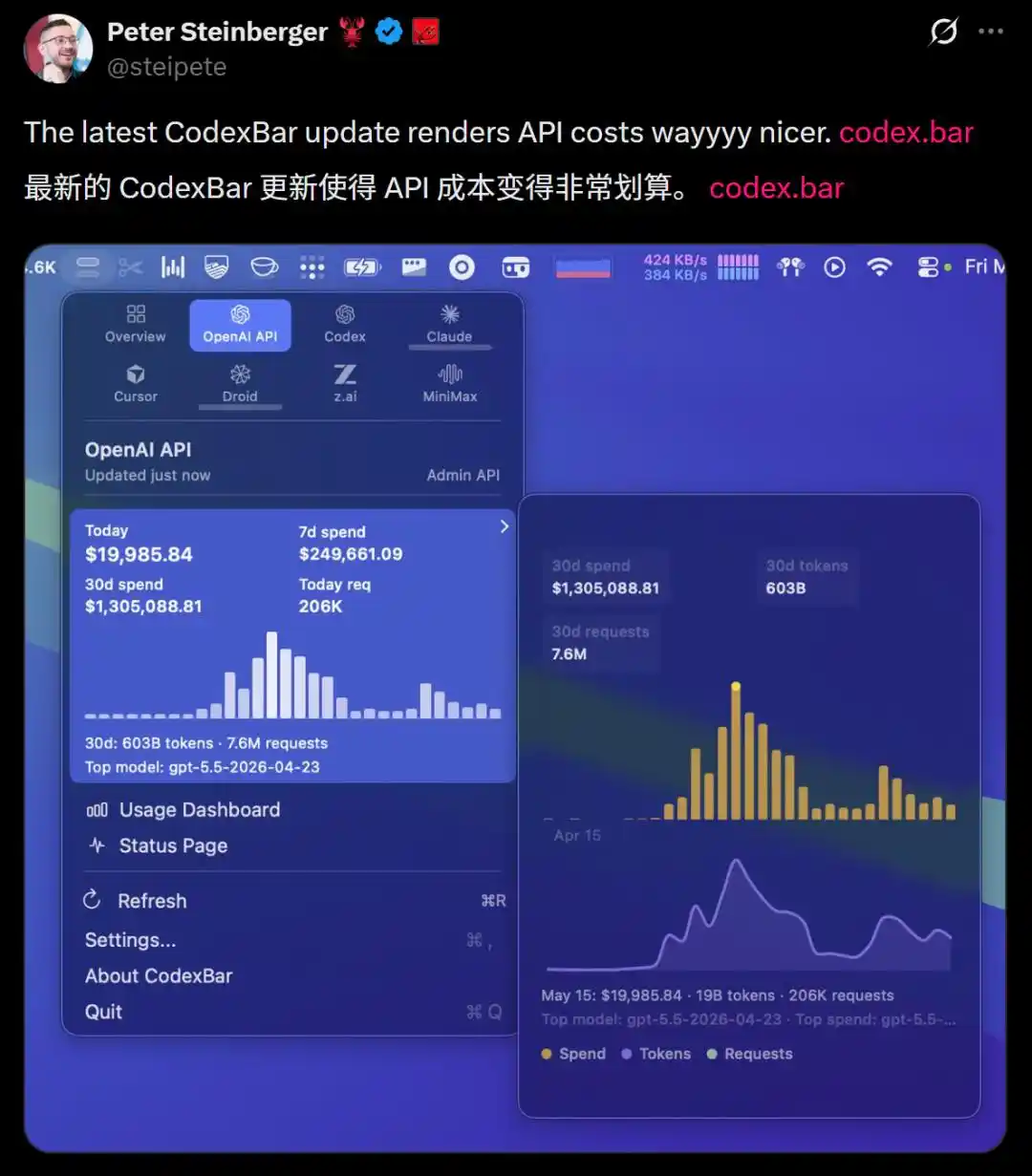
OpenClaw father Peter Steinberger casually posted a screenshot on X.
Peter Steinberger

But the numbers on the screenshot were anything but casual:

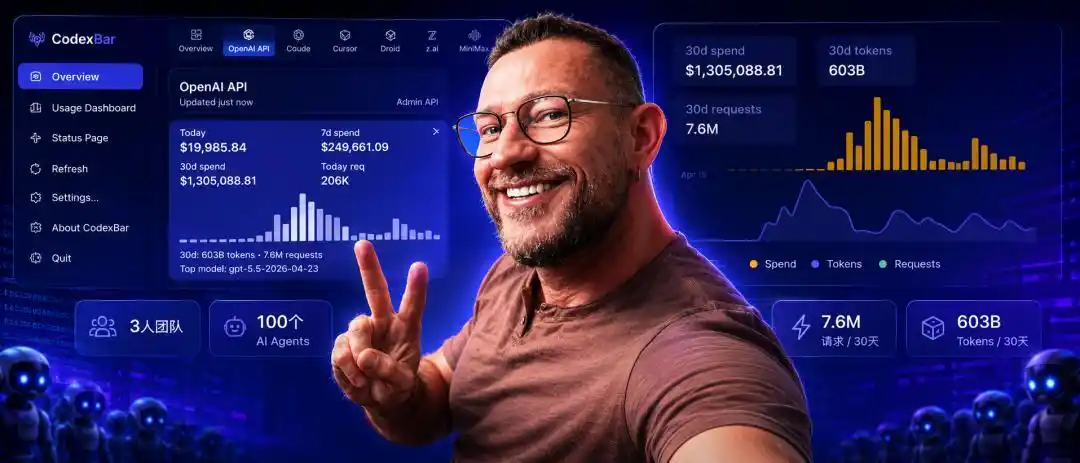
30-day spend: $1,305,088.81. Consumed 603 billion tokens. Made 7.6 million requests.

You read that right, 1.3 million U.S. dollars. And it's not a quarterly AI budget for some big tech company — it's the monthly usage of a three-person team.

Even more explosive: OpenAI is reimbursing this cost.

The comment section instantly went wild.

Some were amazed, some skeptical, some whipped out their calculators to figure out "how many programmers this equals."

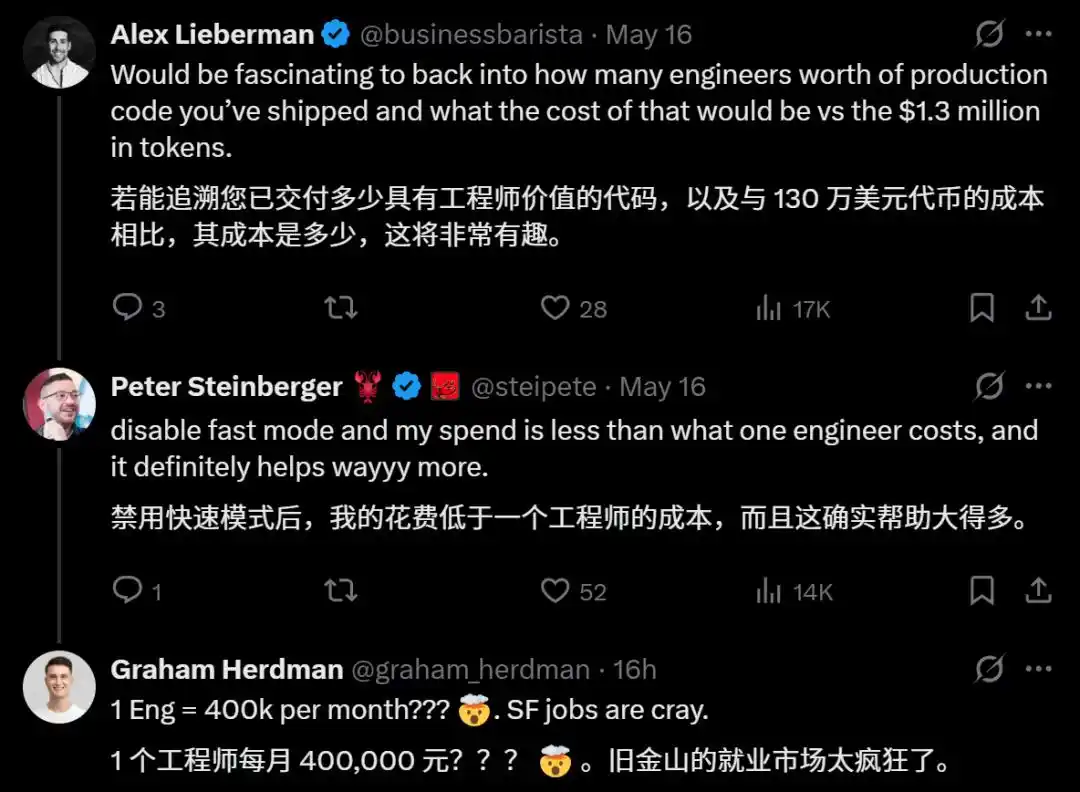
Steinberger himself calmly responded: "With fast mode off, my cost is less than an engineer, and it really helps a lot more."

Translation: — It's genuinely cost-effective!

Other netizens were shocked by the $400k/month engineer — "The San Francisco job market is insane."
Netizen comment
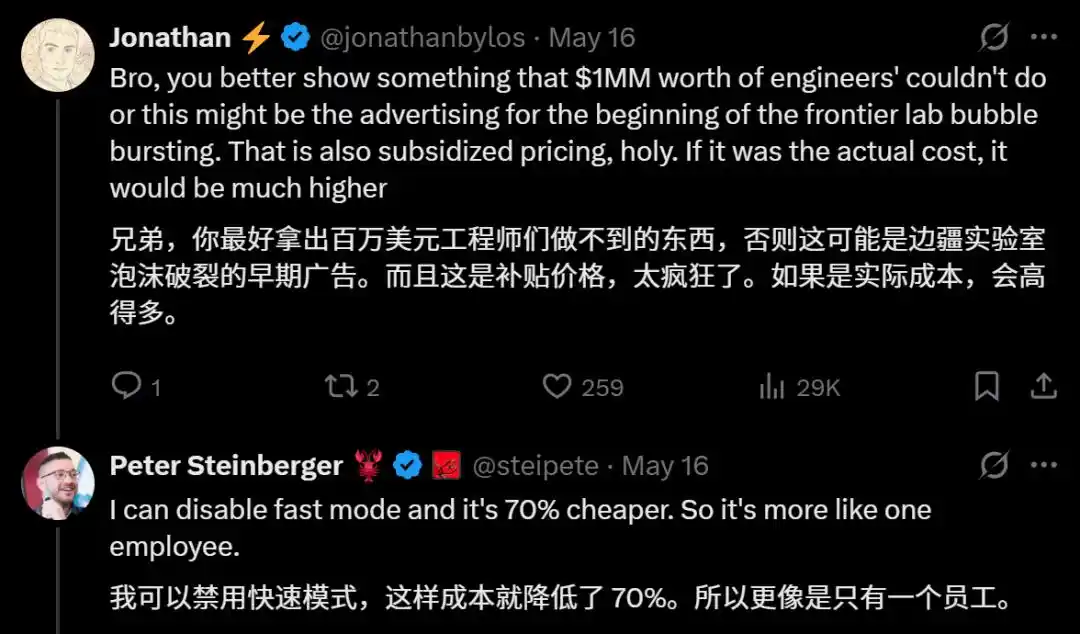
Netizen comment

Others were curious about where this massive token usage went.

Peter responded that most was used for OpenClaw development.
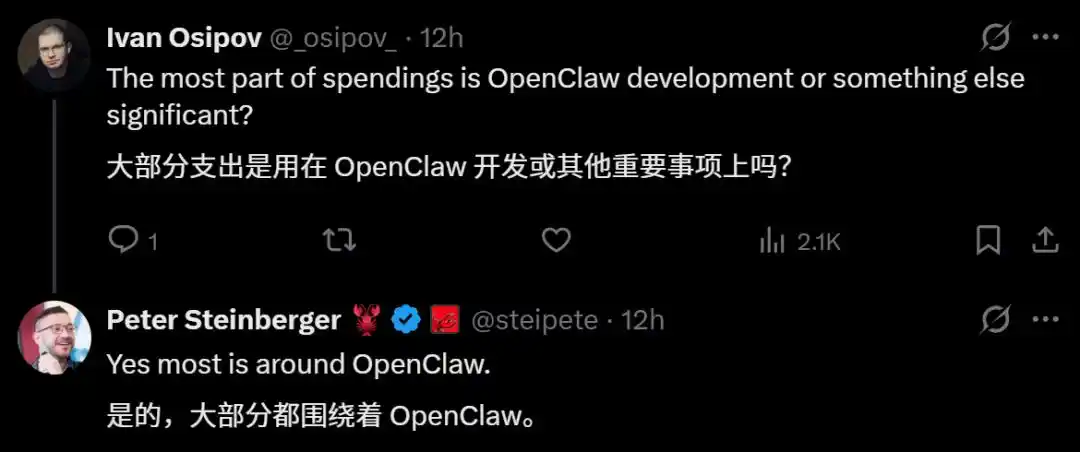
Netizen comment

A Cloud-Based Programmer Army

The most outrageous thing is that Pete's small team only has 3 people.

They have about 100 Codex instances running long-term in the cloud, handling the dirtiest, most grueling, most mind-numbing work in software engineering —

Reviewing PRs, finding security vulnerabilities, deduplicating issues, fixing bugs, monitoring benchmarks, posting to Discord upon discovering regressions, even opening PRs directly after listening to meetings.

Thus, AI isn't just "helping you write code," but is infiltrating every crevice of software collaboration.

This is terrifying.

Because what's truly expensive in software development is communication, comprehension, context switching, review, regression, fixes, waiting, and repetitive tasks.

In the past, a team spent a huge amount of time each day on these things that don't seem like "creation" but without which the project would rot.

Now, Peter has tossed all these processes to a bunch of AI agents at once.

This is AI starting to maintain the nervous system of an organization for you.

Illustration

There's another important detail in this screenshot: it's not the OpenAI backend, but CodexBar made by Peter.

CodexBar is a macOS menu bar tool for tracking usage windows, credits, costs, and reset times for various AI programming tools.

It supports a bunch of services like Codex, Claude, Cursor, Gemini, Copilot, etc.

What used to be in a programmer's menu bar? CPU, memory, battery, network speed.

Now there's one more thing: tokens. Tokens are becoming a new "means of production."

CodexBar

A Final Word

$1.3 million a month, 3 people, 100 AI agents.

Ponder this set of numbers — three living humans, leading a hundred digital employees who don't eat, sleep, or demand raises, doing the work of an entire engineering team.

Some felt invigorated after reading this: AI finally isn't just a decorative vase for chatting! Others felt a chill down their spine: Wait, so what do we coders do in the future?

But honestly, what keeps me up at night is Steinberger's casual remark: "I'm exploring what software development would look like if token cost wasn't an issue."
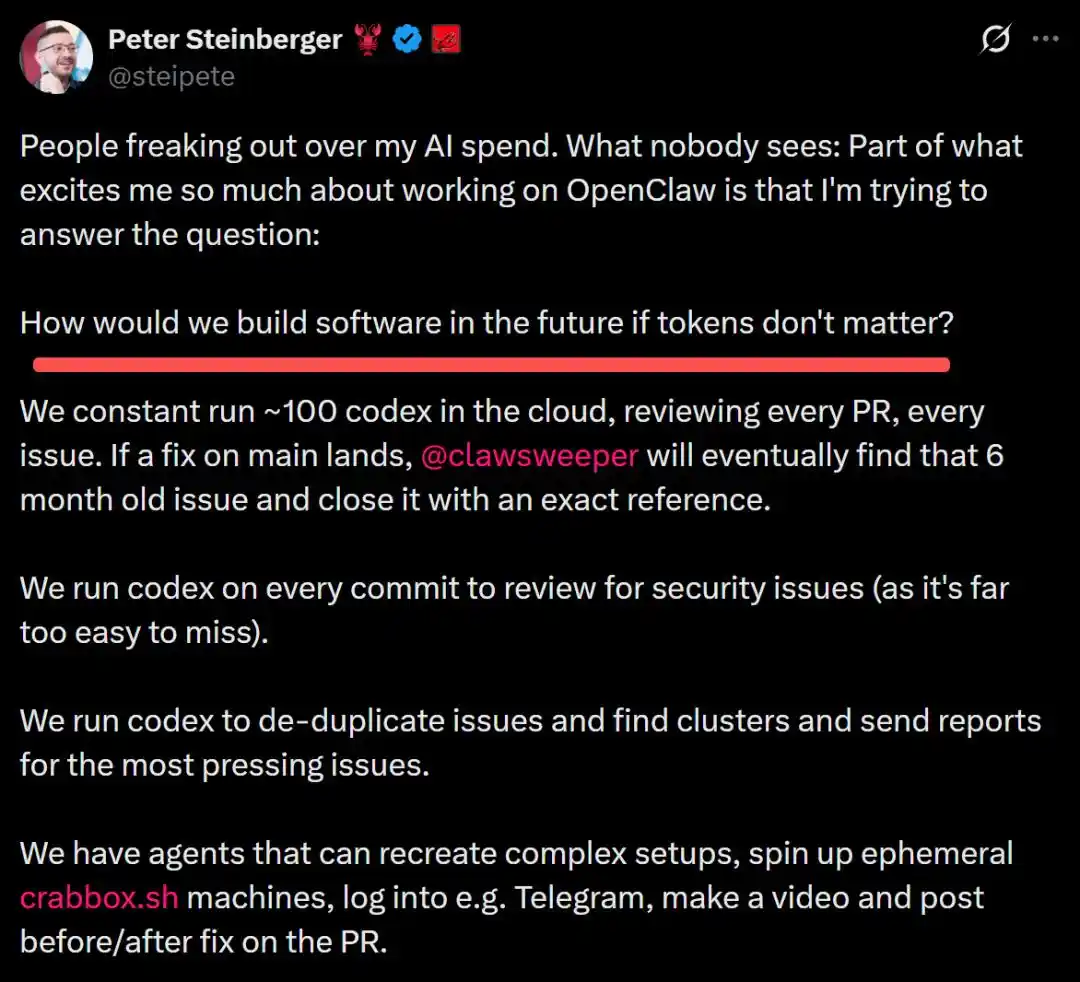
Peter Steinberger

Everyone, he said "if."

The problem is, this "if" is visibly turning into "when" at an astonishing speed.

The work that costs $1.3 million today, after one price cut for models, becomes $130k. Another cut, $13k.

On that day, having 100 AI agents working simultaneously is no longer a game exclusive to Silicon Valley big shots, but a basic operation for any three-person startup team.

Three young people in a garage, holding a hundred tireless AI programmers — this image, just thinking about it is absurd.

Peter Steinberger has revealed the bottom card.

On the card it says: The future is already knocking, and it doesn't plan to wait for you to be ready.

References:

https://the-decoder.com/for-1-3-million-a-month-openclaw-founder-peter-steinberger-runs-100-ai-agents-that-code-review-prs-and-find-bugs/

https://x.com/steipete/status/2055346265869721905

https://developers.openai.com/codex/speed

This article comes from the WeChat public account "New Zhiyuan", author: New Zhiyuan

相關問答

QHow much money did the three-person team spend on AI development in one month, and who covered the cost?

AThe three-person team spent $1,305,088.81 (approximately 1.3 million USD) in one month on AI development, and the cost was covered by OpenAI.

QWhat is the name of the tool Peter Steinberger created to track AI development costs and usage?

APeter Steinberger created a tool called CodexBar, a macOS menu bar application that tracks usage windows, credits, costs, and reset times for various AI programming tools like Codex, Claude, Cursor, Gemini, and Copilot.

QApproximately how many AI agents (instances) does Peter Steinberger's team run for development tasks?

APeter Steinberger's team runs approximately 100 AI Codex instances to perform various development tasks.

QWhat kinds of software development tasks do the AI agents in the article handle?

AThe AI agents handle tasks such as reviewing pull requests (PRs), finding security vulnerabilities, deduplicating issues, fixing bugs, monitoring benchmarks, reporting regressions to Discord, and even opening PRs after listening to meetings.

QWhat is the core implication Peter Steinberger highlights regarding the future of software development with AI?

APeter Steinberger highlights that the core implication is exploring what software development would look like if token cost were not a limiting factor, suggesting a future where small teams can leverage large numbers of AI agents as a standard practice, dramatically changing the development landscape.

你可能也喜歡

链上数据暗示,比特币底部可能还需两个月才会到来

过去一周,比特币在7万美元高位区间横盘整理,未能收复自5月中旬以来市场多头屡攻不下的关键心理价位82,000美元。值得注意的是,76,000美元价位已连续三周经受考验并成功守住,形成了一个实质支撑区。然而,一项链上指标可能正在发出比特币历史上最清晰的底部信号。 关键看跌信号源于投资者成本基础数据。5月22日,分析师CryptoChan分享了一个历史上可靠的底部指标数据,该指标基于两个已实现价格带构建:代表长期持有者平均成本的6个月至10年已实现价格(目前为60,316美元),以及代表更广泛市场平均成本基础的0至10年已实现价格(目前为64,412美元)。这两个价格带之间的比率反映了长期持有者相对于整体市场所承受的压力程度。历史上,当该比率跌破0.936并随后回升至1.0时,每次都精准标记了比特币前几个周期的底部时刻。当比率触及1.0,意味着即使是最坚定的长期持有者也处于亏损状态,此时抛压已完全耗尽,市场情绪陷入极度恐慌。 历史数据显示,在2015年熊市底部,该比率从0.936回升至1.0用了59天;在2018-2019年熊市底部用了66天;在2022年11月FTX崩溃引发的底部则用了50天。目前该比率再次位于0.936。如果当前读数保持不变且历史数据重演,比特币的明确底部窗口可能会在2026年7月中下旬左右开启。 截至撰写本文时,比特币价格为75,269美元,过去一周下跌2.84%,周线和月线图也分别下跌4.65%和3.55。市场恐惧与贪婪指数为28,显示恐惧情绪显著影响市场。不过,有分析师预测未来五天内可能因空头挤压反弹至83,354美元,一个月后目标为77,741美元,而三个月目标价看至90,529美元,暗示潜在16%的涨幅。

bitcoinist2 小時前

链上数据暗示,比特币底部可能还需两个月才会到来

bitcoinist2 小時前

比特币交易迈入新时代:美国证券交易委员会批准纳斯达克比特币指数期权

美国证券交易委员会(SEC)已批准纳斯达克在费城证券交易所(Phlx)上市比特币指数期权,交易代码为QBTC。该期权为欧式现金结算合约,到期时买方将获得比特币现货价与行权价之间的差额,不涉及实物比特币交割,也消除了早期行权风险。合约价格最小变动单位为0.01美元,单边持仓上限为24,000张合约,约占比特币总流通量的0.12%。其标的指数为纳斯达克比特币指数,该指数追踪CME CF BTC实时指数的百分之一。 然而,交易并未立即开始。由于比特币被归类为商品,受美国商品期货交易委员会(CFTC)管辖,在交易所进行任何合约交易前,还需获得CFTC的豁免救济。此前CME集团曾主张此类合约应独家归CFTC管辖,但SEC援引《多德-弗兰克法案》第717条,认为双方共享管辖权已有先例。 此次批准符合SEC主席保罗·阿特金斯任内的政策转向。SEC已放弃多起上届政府发起的对加密公司的执法案件,并公开呼吁制定更清晰的支持创新的规则。有报道称,SEC还在准备一项“创新豁免”,可能允许在去中心化加密平台上对上市公司股票进行代币化交易。 待SEC与CFTC均批准后,QBTC合约将在费城证券交易所上市,这标志着华尔街在接纳比特币相关金融产品方面又迈出了一步。

bitcoinist3 小時前

比特币交易迈入新时代:美国证券交易委员会批准纳斯达克比特币指数期权

bitcoinist3 小時前

交易

現貨
合約

熱門文章

如何購買BILL

歡迎來到HTX.com!在這裡,購買Billions Network (BILL)變得簡單而便捷。跟隨我們的逐步指南,放心開始您的加密貨幣之旅。第一步:創建您的HTX帳戶使用您的 Email、手機號碼在HTX註冊一個免費帳戶。體驗無憂的註冊過程並解鎖所有平台功能。立即註冊第二步:前往買幣頁面,選擇您的支付方式信用卡/金融卡購買:使用您的Visa或Mastercard即時購買Billions Network (BILL)。餘額購買:使用您HTX帳戶餘額中的資金進行無縫交易。第三方購買:探索諸如Google Pay或Apple Pay等流行支付方式以增加便利性。C2C購買:在HTX平台上直接與其他用戶交易。HTX 場外交易 (OTC) 購買:為大量交易者提供個性化服務和競爭性匯率。第三步:存儲您的Billions Network (BILL)購買Billions Network (BILL)後,將其存儲在您的HTX帳戶中。您也可以透過區塊鏈轉帳將其發送到其他地址或者用於交易其他加密貨幣。第四步:交易Billions Network (BILL)在HTX的現貨市場輕鬆交易Billions Network (BILL)。前往您的帳戶,選擇交易對,執行交易,並即時監控。HTX為初學者和經驗豐富的交易者提供了友好的用戶體驗。

211 人學過發佈於 2026.05.07更新於 2026.05.12

如何購買BILL

相關討論

歡迎來到 HTX 社群。在這裡,您可以了解最新的平台發展動態並獲得專業的市場意見。 以下是用戶對 BILL (BILL)幣價的意見。

活动图片