David Schwartz, Ripple’s former CTO and one of the original architects of the XRP Ledger, poured cold water on the idea of returning to Bitcoin development this week, calling Bitcoin “largely a technological dead end” in a reply that quickly ricocheted through crypto’s never-ending decentralization debates.
The exchange started as a fight over history and governance. On Feb. 9, X user Bram Kanstein argued that XRP’s early “genesis reset” — often described as treating the 32,750th XRP block as a kind of starting point — illustrates crypto’s centralized tendencies. Kanstein wrote that the milestone “may be thought of as the genesis,” before adding: “Except it is not. The XRP Genesis reset is a prime example of the centralized nature of ‘CrYpTO’.”
Ex-Ripple CTO Schwartz Calls Bitcoin A ‘Tech Dead End’
Schwartz jumped in with a comparison that redirected the argument toward Bitcoin. “Bitcoin had at least two incidents that showed way more centralization than this incident did,” he wrote, “especially since the decision in this incident was not to make any coordinated changes and just live with it.”
That claim drew a follow-up from X user, who floated SegWit as a candidate for what Schwartz meant, an example of coordinated protocol change. The ex-Ripple CTO pushed back on that framing: “I wasn’t because I don’t really think of adding new features as showing centralization,” he replied. “But I think you could make a good argument that it does. The biggest one I was thinking of was the coordinated 2010 rollback.”
The thread’s tone shifted on Feb. 10 when X user Khaled Elawadi asked the question that put Schwartz’s own priorities in the spotlight: since co-creating the XRPL, had he worked on or even considered developing Bitcoin again?
“Not really,” Schwartz answered. Then he went further, sketching an argument that Bitcoin’s dominance owes less to the evolution of its base-layer tech than to social and monetary inertia. “I think bitcoin is largely a technological dead end for the same reason the dollar is,” he wrote. “The technology just doesn’t seem to matter all that much to its success, at least not at the blockchain layer.”
For XRP supporters, Schwartz’s comments served two purposes at once: a defense against charges that XRPL’s early history implies unique centralization, and a reminder that Bitcoin’s “hands-off” mythology also has had real-world exceptions in its early days.
What’s hard to miss is where the ex-Ripple CTO draws the line. Bitcoin’s success can persist even if base-layer technical progress slows, because the network’s strength increasingly behaves like a monetary standard rather than an engineering project. Schwartz is pursuing a different strategy for the XRP Ledger. After stepping down as Ripple CTO, he announced that he would pursue his own projects on the XRP Ledger.
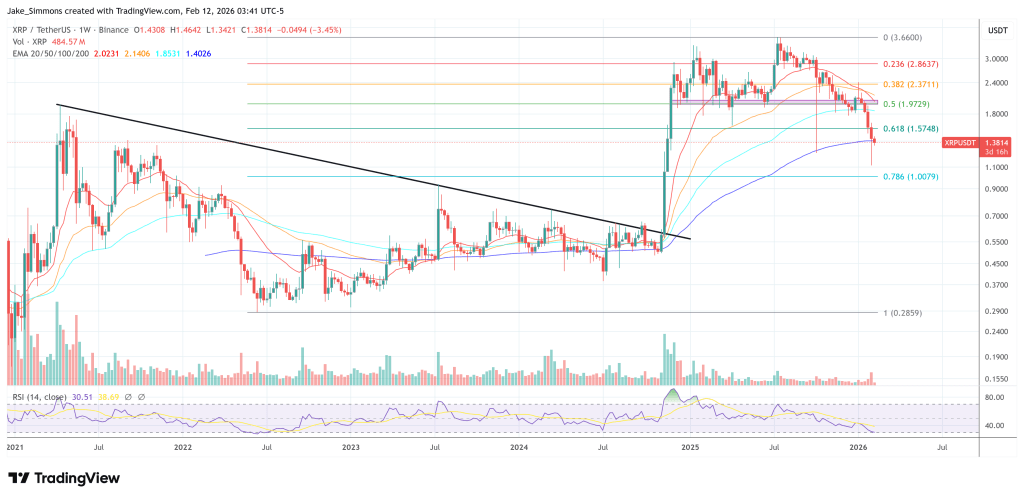
At press time, XRP traded at $1.38.