Will $307B in stablecoins save Bitcoin? Decoding the ‘idle’ liquidity narrative

ambcrypto发布于2026-01-20更新于2026-01-20

文章摘要

Stablecoins have reached a record combined market cap of $307.7 billion, a pattern often observed near market bottoms. Alongside this, tokenized funds and real-world assets (RWAs) have also hit all-time highs, indicating significant liquidity is waiting on-chain but not yet deployed into volatile assets like Bitcoin. The Stablecoin Supply Ratio (SSR) has experienced its steepest drop this cycle, suggesting Bitcoin's market cap declined faster than stablecoin supply, leaving substantial buying power idle. This typically occurs near local market bottoms, with liquidity poised to re-enter Bitcoin once risk indicators improve. However, macroeconomic uncertainty and global tensions may delay this rotation. As long as stablecoin supply remains near record levels, the potential for capital flow into Bitcoin remains, though timing is uncertain.

Even as Bitcoin pulled back from recent highs, the stablecoin market cap has climbed to record levels! This is a pattern that has often appeared near market bottoms.

At the same time, tokenized funds and RWAs are also at all-time highs, so liquidity is in wait.

The money is piling up!

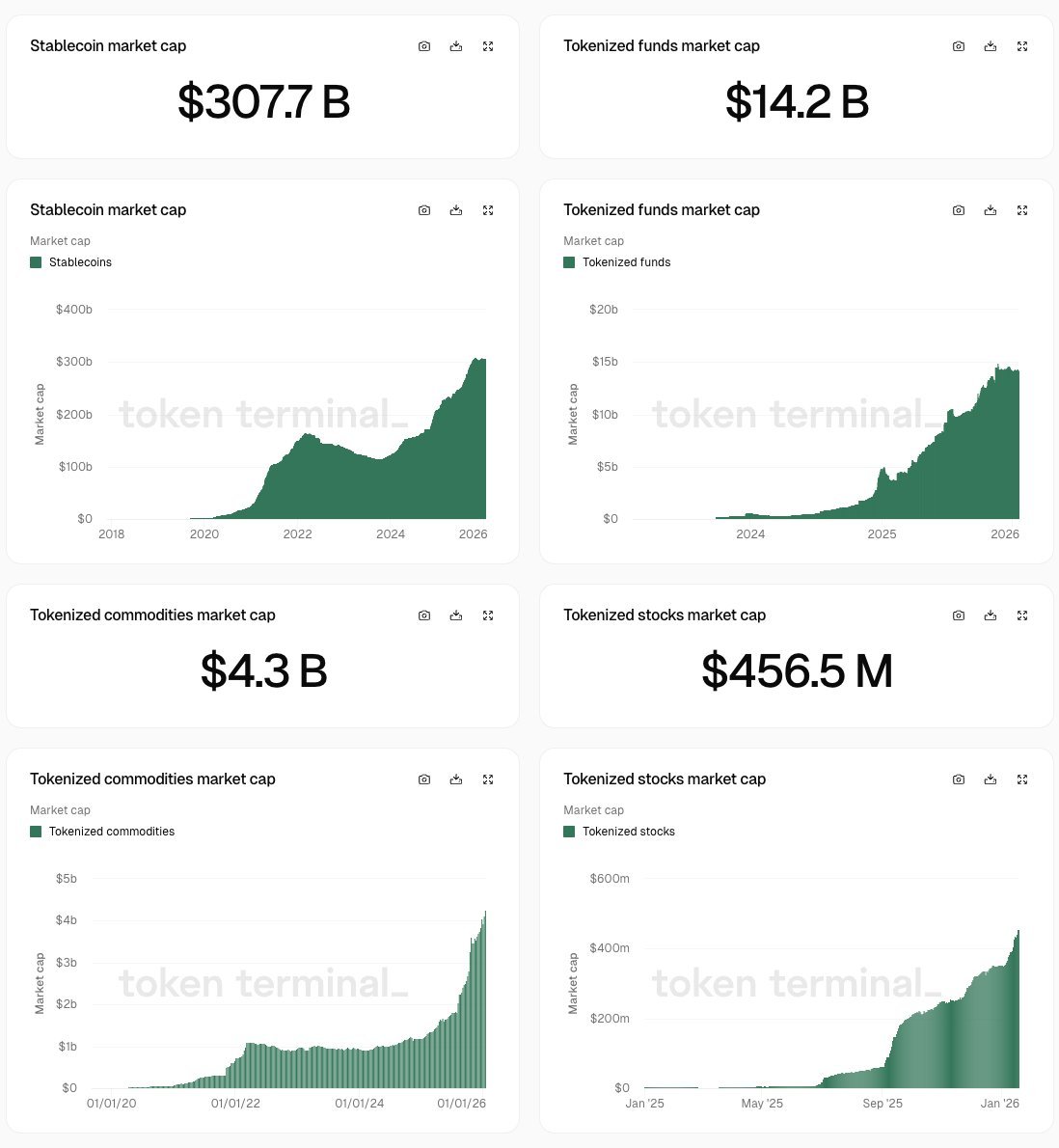
Stablecoins are now at a combined market cap of $307.7 billion, the highest level on record. Alongside this, tokenized funds have grown to $14.2 billion, so there’s institutional and treasury-type of positioning.

Source: X

The trend goes beyond cash equivalents.

Tokenized commodities have reached $4.3 billion, while tokenized stocks are at $456.5 million, both at all-time highs.

Liquidity is on-chain, but not yet in volatile assets. This usually happens during market pauses, when it is considered better to wait for risk indicators before re-entering the market.

Source: Token Terminal

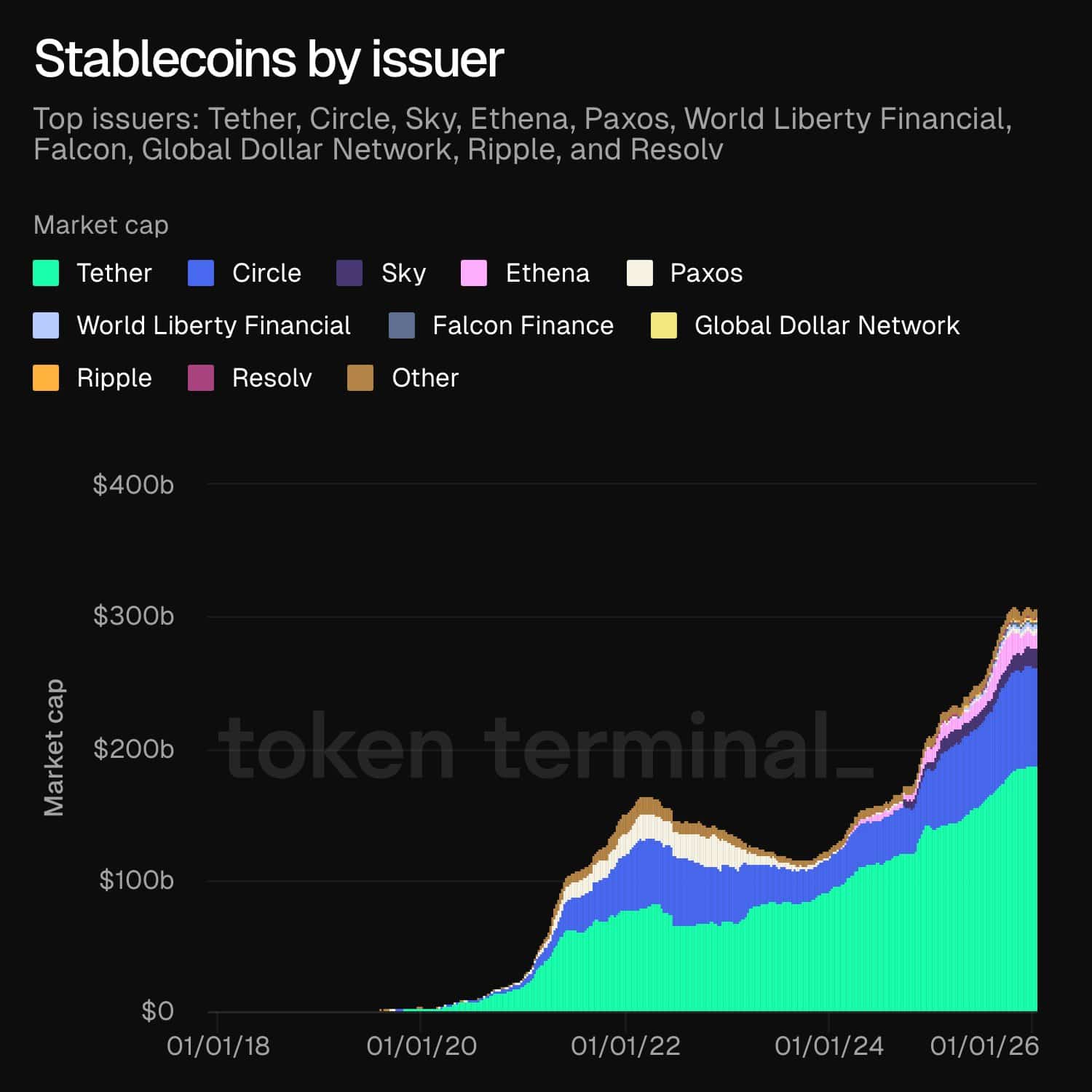
Most stablecoin money is sitting with just a few big players. Tether [USDT] and Circle [USDC] still make up the largest share of the $307.7B  supply, while newer names like Ethena [ENA] and Sky [SKY] are slowly growing.

And while all that money is in wait…

…here’s what you need to look at.

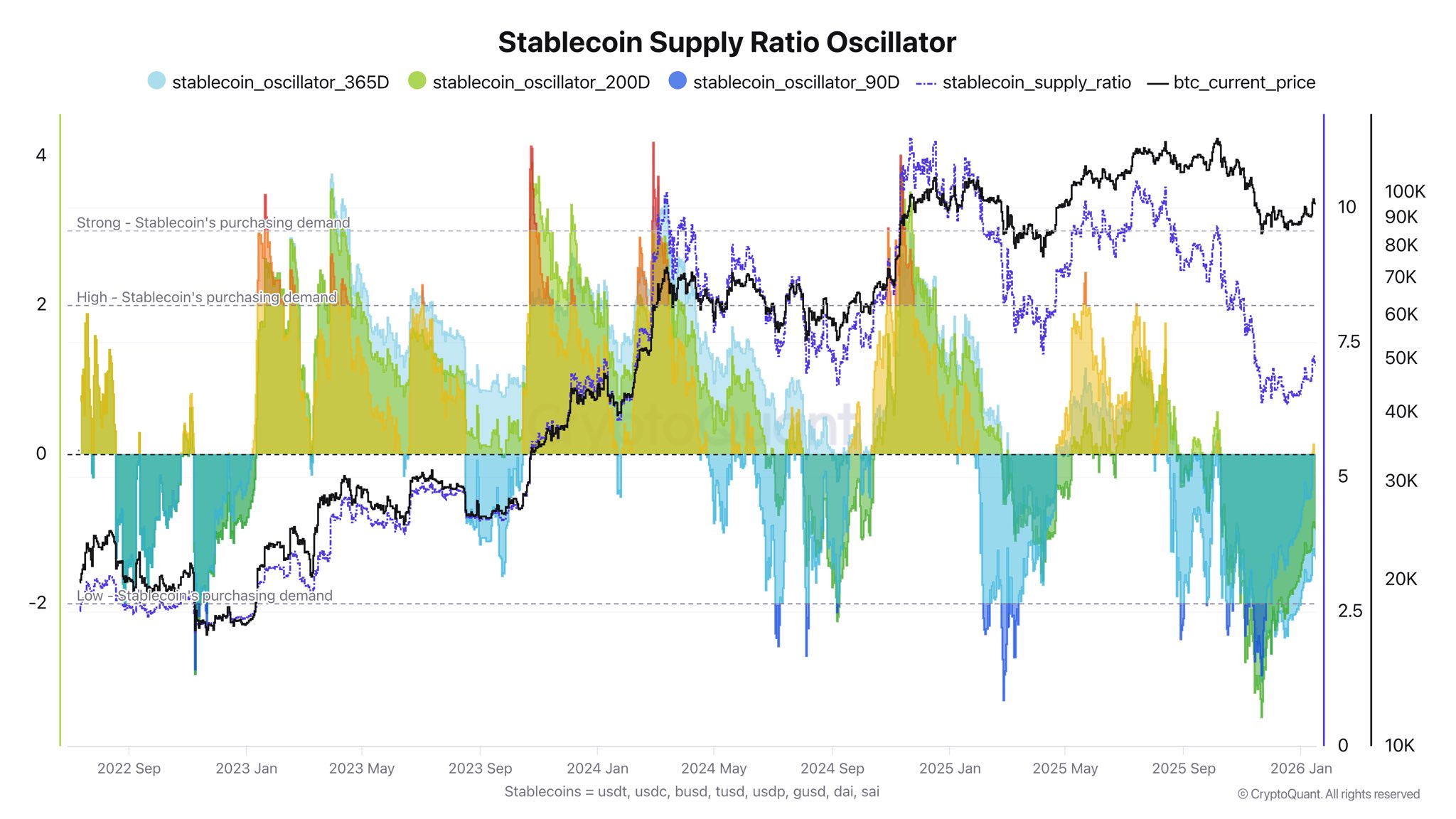
After Bitcoin’s recent correction, the Stablecoin Supply Ratio (SSR) fell. This is its steepest drop this cycle.

The inference is that Bitcoin’s [BTC] market cap fell much faster than stablecoin supply, leaving unusually high buying power with nothing to do.

This often happens when near local market bottoms. Liquidity is already in the system, but it hasn’t rotated back into Bitcoin yet. For that move to happen, the SSR would need to move higher, which would mean stablecoins actually being deployed.

Source: CryptoQuant

The risk is the timing. With macro conditions uncertain and global tensions still high, it’s not a stretch to assume that those with money may remain hesitant.

Still, as long as stablecoin supply holds near record levels, the cards will remain on the table.


Final Thoughts

  • Stablecoins are at levels usually seen near market bottoms.
  • With RWAs and tokenized funds at ATHs, capital is in wait before any rotation.
Next: Bitcoin drops below $90k as $708.9m crypto liquidations hit leveraged longs
Share
  • Share
  • Tweet

热门币种推荐

相关问答

QWhat is the current total market cap of stablecoins and why is it significant?

AThe current total market cap of stablecoins is $307.7 billion, which is the highest level on record. This is significant because such high levels of stablecoin liquidity, often seen near market bottoms, represent substantial buying power that could potentially flow back into volatile assets like Bitcoin.

QWhat does the recent sharp drop in the Stablecoin Supply Ratio (SSR) indicate?

AThe recent sharp drop in the Stablecoin Supply Ratio (SSR) indicates that Bitcoin's market capitalization fell much faster than the stablecoin supply. This leaves an unusually high amount of buying power idle, a condition that often occurs near local market bottoms before liquidity rotates back into Bitcoin.

QBesides stablecoins, what other on-chain assets have reached all-time highs in value?

ABesides stablecoins, tokenized funds have reached an all-time high of $14.2 billion, tokenized commodities have hit $4.3 billion, and tokenized stocks have reached $456.5 million. This shows that liquidity is on-chain but is currently positioned in less volatile, cash-equivalent assets.

QWhich stablecoin issuers dominate the current market supply?

ATether (USDT) and Circle (USDC) dominate the current $307.7 billion stablecoin supply, making up the largest share. Newer entrants like Ethena (ENA) and Sky (SKY) are also growing but represent a smaller portion of the market.

QWhat is the main risk associated with the current high level of stablecoin liquidity?

AThe main risk is timing. Despite the high level of on-chain liquidity, uncertain macro conditions and high global tensions could cause holders of this capital to remain hesitant and delay deploying it into volatile assets like Bitcoin, potentially prolonging the market pause.
你可能也喜欢

从韩国到美国:多亏了AI,蓝领越来越吃香了

人工智能正在重塑劳动力市场,传统四年制大学学位的吸引力下降,而电工、焊工等技术型蓝领职业的需求和薪酬显著上升。数据显示,美国职业学校收入大幅增长,同时AI导致的白领裁员创下新高。供需两端变化推动年轻人重新规划职业路径,调查显示多数Z世代认为蓝领工作在AI时代更具就业保障。 职业教育热度近半年急剧攀升,年轻人主动寻求不易被AI替代且有实际用工需求的职业,技术岗位招聘甚至比程序员更困难。专家指出,这既是经济计算,也源于对高额学位债务和纯屏幕工作的反思。技术职业薪资中位数已追平或超越许多需要学位的工作,且提供边学边赚的学徒路径及创业可能。韩国半导体高中毕业生就业率极高,进入三星等企业可获得丰厚薪酬。 美国面临结构性技术工人短缺:大量婴儿潮一代即将退休,而新一代劳动力数量不足,缺口达数百万。同时,数据中心等基建扩张推高了相关技术工种需求。为此,摩根大通、Meta等企业正投资巨额资金开展培训项目。 尽管市场信号明确,但社会对职业教育的传统偏见仍构成“认知差距”。产业界需主动推广,让公众认识到技术职业不仅收入稳定,还是通向创业的快速路径,以真正缓解人才短缺。

marsbit20分钟前

从韩国到美国:多亏了AI,蓝领越来越吃香了

marsbit20分钟前

交易

现货

热门文章

加密市场宏观研报:《GENIUS Act》法案取得重大进展,BTC突破历史新高,后市全新展望

2025年5月22日,比特币价格正式突破11万美元大关,创下历史新高。在政策面、宏观经济、资金面与投资者结构共同作用下,一场结构性牛市浪潮正在展开。而此轮上涨背后的核心驱动,是美国《GENIUS稳定币法案》的实质性进展以及多项利好的叠加。本文将从政策端突破、宏观环境转向、链上与ETF资金结构、交易行为演化,以及重点受益赛道五大维度,全面解析此轮BTC再创新高的深层逻辑,并前瞻下半年市场的潜在趋势。

1.8k人学过发布于 2025.05.22更新于 2025.05.22

加密市场宏观研报:《GENIUS Act》法案取得重大进展,BTC突破历史新高,后市全新展望

相关讨论

欢迎来到HTX社区。在这里,您可以了解最新的平台发展动态并获得专业的市场意见。以下是用户对BTC(BTC)币价的意见。

活动图片