Violent Attacks On Crypto Holders Escalate Worldwide, Data Shows

bitcoinist发布于2026-01-06更新于2026-01-06

文章摘要

Data shows a significant escalation in violent "wrench attacks" – physical robberies and kidnappings targeting cryptocurrency holders to force asset transfers – both in frequency and severity worldwide. Security researcher Haseeb Qureshi analyzed an incident database maintained by Jameson Lopp, finding 269 categorized attacks, with over half classified as "Serious" and 5% as "Fatal." The data indicates attacks are becoming more violent over time, with 2025 showing the highest incident count. Approximately 45% of the variation in attacks is explained by crypto market capitalization, meaning higher prices correlate with more incidents. However, when normalized per user (using Coinbase active users as a proxy), attack rates spiked in earlier market cycles, fell after 2019, and have recently risen again toward 2021 levels. Geographically, Western Europe and North America have the most incidents, but Latin America and Africa have significantly higher fatality rates. Notably, zero fatal attacks have occurred in North America. Researchers warn these events are transitioning from rare occurrences to a recurring risk for crypto participants.

Violent “wrench attacks” against crypto holders, physical robberies and kidnappings meant to force victims to hand over coins, appear to be rising in absolute terms and trending more severe, according to a new visualization built from a long-running incident database maintained by security researcher Jameson Lopp.

Dragonfly partner Haseeb Qureshi said he analyzed Lopp’s dataset and built an interactive dashboard to stress-test a question many traders and builders have been asking quietly for years: is simply holding crypto becoming physically more dangerous? “You’re not imagining it: the number of attacks has been increasing over time,” Qureshi wrote on X. “Not only that, the attacks are getting more violent.”
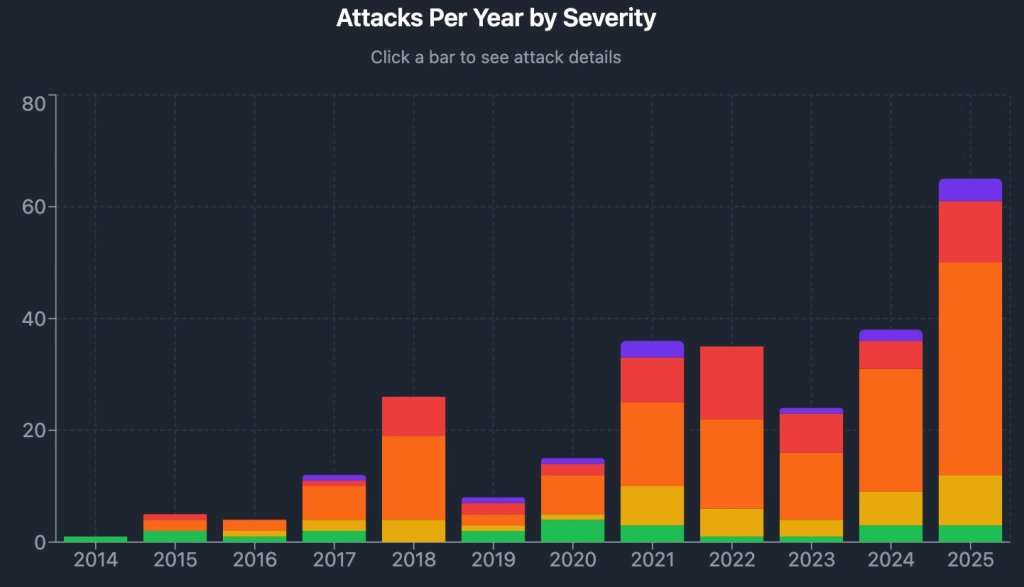
Attacks per year by severity | Source: X @hosseeb

The dashboard breaks reported incidents into five severity bands — Minor, Moderate, Serious, Severe, and Fatal and the distribution skews heavily toward the sharp end of the spectrum. Of 269 categorized incidents shown, 137 (51%) were labeled “Serious,” 57 (21%) “Severe,” and 13 (5%) “Fatal,” with the remainder split between 39 (14%) “Moderate” and 23 (9%) “Minor.”

The year-by-year bars show the later years carrying a larger share of “Severe” and “Fatal” outcomes than the early history of the dataset, with 2025 appearing as the highest-incident year on the chart.
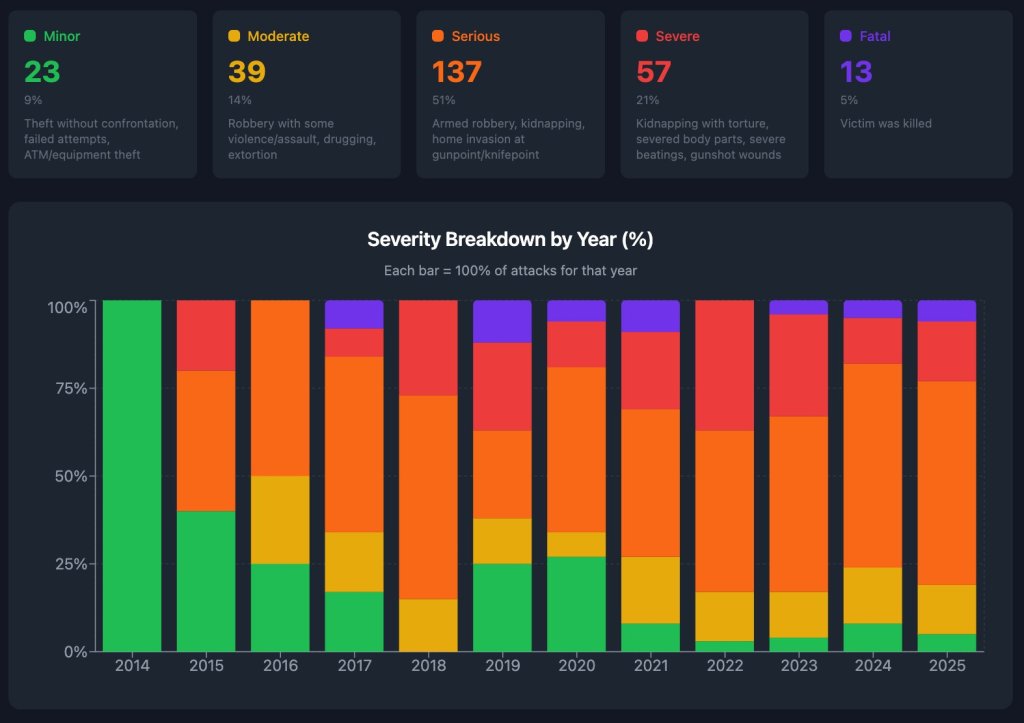
Severity breakdown by year | Source: X @hosseeb

Qureshi’s analysis also puts a number on the most intuitive driver: price. Charting incidents against total crypto market capitalization, he reported a simple regression with an R2 of 0.45 — implying roughly 45% of the variation in reported violence is explained by market cap alone. In plain terms, higher prices coincide with more attacks.

But the more consequential question for everyday holders is not raw counts; it’s risk per person. Because comprehensive “number of crypto users” data is hard to pin down, Qureshi used Coinbase monthly active users as a proxy, and separately normalized incidents by market cap to approximate attacks per dollar of wealth.

The resulting “normalized attack rates” chart tells a less linear story: per-user attack rates spiked in earlier market eras (notably around 2015 and again in 2018), then fell sharply after 2019, before ticking higher in the most recent observations. “So is that it?” Qureshi asked. “Proof crypto is becoming more physically dangerous?”
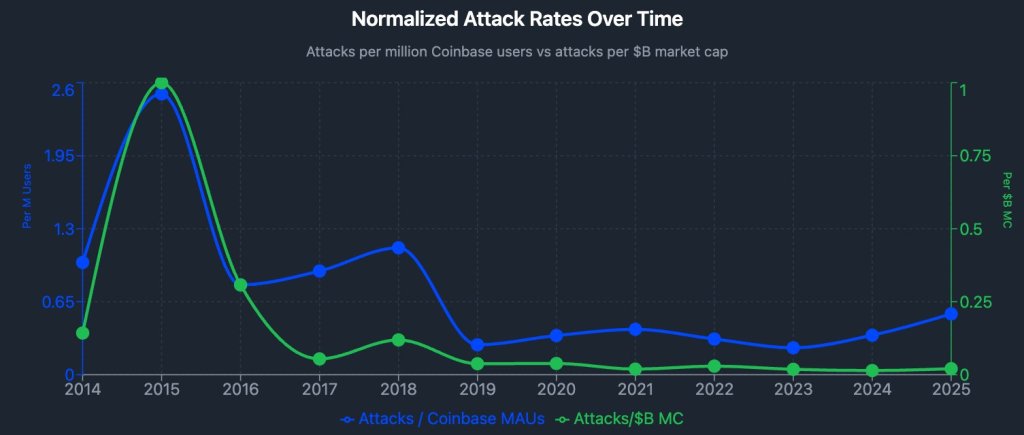
Normalized attack rate over time | Source: X @hosseeb

On his telling, not quite. Coinbase MAUs, he noted, expanded dramatically over the decade, while normalized attack rates did not rise proportionally, suggesting a meaningful “population effect” behind the higher headline totals. Still, the per-user line has moved up from its post-2019 lows, roughly back toward the levels seen during the 2021 cycle, even as the “attacks per $ of market cap” line remains comparatively flat in recent years.

Geography adds another uncomfortable layer. A regional table in the dashboard shows Western Europe (73 attacks) and North America (64) as the two largest buckets by incident count, with Asia-Pacific also substantial (53). But the most lethal outcomes cluster elsewhere: Latin America shows a 21% fatality rate and Africa 17%, versus 0% in North America. Qureshi underscored that point directly: “Notably, there have been 0 fatalities in North America ever,” he wrote, adding that the “lion’s share” of fatalities are in Latin America and Africa.
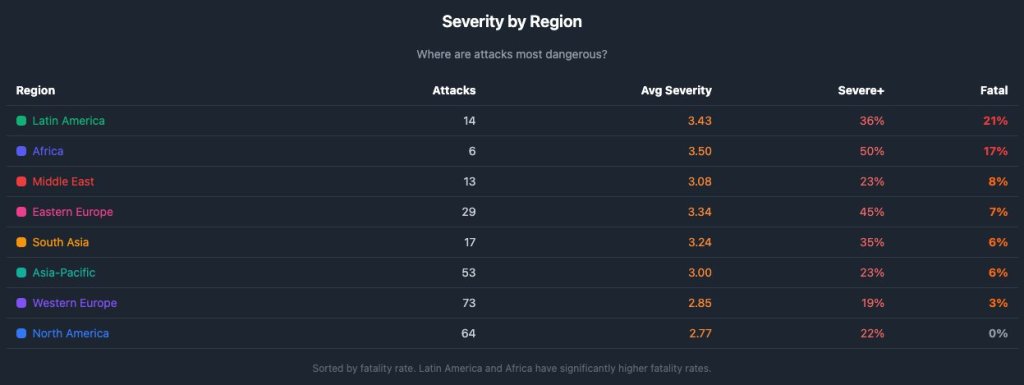
Severity by region | Source: X @hosseeb

Lopp, who has maintained the underlying “Bitcoin Wrench Attack” archive for years, has warned the workload and frequency are becoming harder to treat as isolated incidents. “When an event goes from being rare to happening every few days, it’s no longer newsworthy — it’s just a fact of life,” he wrote in a Dec. 21 post cited in the thread, while inviting others to help maintain the database.

At press time, the total crypto market cap stood at $3.12 trillion.
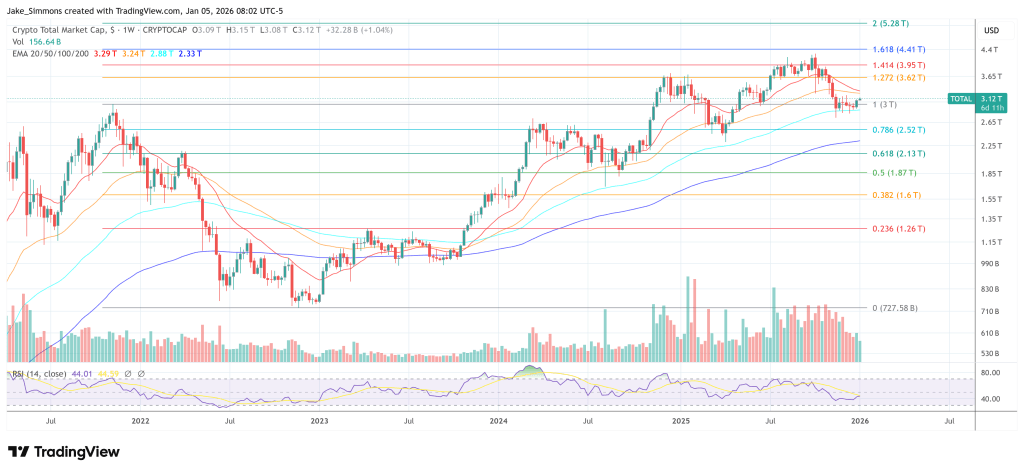
Total crypto market cap recovers above the 2021 high, 1-week chart | Source: TOTAL on TradingView.com

相关问答

QAccording to the analysis, what is the relationship between crypto market capitalization and violent attacks?

AThe analysis shows a correlation between higher crypto prices and increased attacks, with a regression R2 of 0.45 indicating that approximately 45% of the variation in reported violence is explained by market cap alone.

QWhich regions have the highest fatality rates in crypto-related attacks, according to the data?

ALatin America has a 21% fatality rate and Africa has a 17% fatality rate in crypto-related attacks, while North America has recorded 0% fatalities.

QWhat does the normalized attack rate analysis reveal about per-user risk over time?

AThe normalized attack rate shows that risk per user spiked in earlier market eras (2015 and 2018), fell sharply after 2019, but has recently ticked higher toward 2021 levels, though it didn't rise proportionally to the dramatic expansion of crypto users.

QHow are the severity of attacks distributed across the 269 incidents analyzed?

AThe severity distribution is heavily skewed toward serious outcomes: 51% were 'Serious', 21% 'Severe', 5% 'Fatal', 14% 'Moderate', and 9% 'Minor'.

QWhat trend does Jameson Lopp observe regarding the frequency of these attacks?

AJameson Lopp notes that attacks have moved from being rare events to happening every few days, making them 'no longer newsworthy' but rather 'a fact of life' in the crypto space.

你可能也喜欢

博弈关键周:BTC回抽确认与HYPE支撑争夺 | 特邀分析

本周市场进入关键博弈阶段。宏观上,美联储政策预期变化主导风险资产节奏;加密市场经历震荡后,多空分歧在关键价位显现。本文对BTC和HYPE进行技术分析,制定中短线操作预案,所有内容仅为个人记录,不构成投资建议。 **BTC分析:** 4小时图显示,币价自6月5日低点反弹后呈现短期上升通道,当前已跌破通道下轨,正进行回抽确认。若无法重新站上下轨,可能回测59,100美元支撑。本周关注对通道下轨的回抽结果:站稳则可能挑战69,500~70,500美元压力区;跌破则下探59,000~60,000美元支撑区。 核心压力位:64,500~65,000美元(通道下轨附近),69,500~70,500美元。 核心支撑位:59,000~60,000美元,55,000美元附近。 操作策略:中线已按计划在64,500美元附近布局20%空单。短线利用30%仓位,依据支撑压力位寻找价差机会,并制定了A/B/C三套预案: A. 反弹至64,500~65,000美元滞涨时试空。 B. 反弹至69,500~70,500美元承压时加空。 C. 有效跌破59,000~60,000美元支撑后顺势加空。 **HYPE分析:** 4小时图显示,HYPE自6月2日高点调整后强势上涨创出新高,当前回落至64~66美元关键支撑区域。若在此获得支撑,上涨趋势可能延续;若失守,可能测试52~54美元支撑带。 核心压力位:77美元附近,80~82美元区域。 核心支撑位:64~66美元区域,52~54美元区域。 本周核心观点:观察64~66美元区域的多空争夺结果。 操作策略:短线遵循“逢低布局”,当价格回测64~66美元或52~54美元支撑区域出现企稳信号时,可轻仓试多,仓位控制在30%以下,并严守止损纪律。 **特别提示:** 开仓立即设止损;盈利1%时止损移至成本价;盈利2%时止损移至盈利1%处;此后每盈利1%,止损同步上移1%,动态锁定利润。 市场瞬息万变,本文所有内容仅为个人技术分析记录,不构成任何投资建议。市场有风险,投资需谨慎。

Odaily星球日报1小时前

博弈关键周:BTC回抽确认与HYPE支撑争夺 | 特邀分析

Odaily星球日报1小时前

交易

现货
合约
活动图片