Bitwise CIO Matt Hougan says crypto’s near-term trajectory is being pulled by two very different macro forces: a breakout in gold that signals a deeper institutional trust problem, and a suddenly uncertain path for the Clarity Act that could determine whether the current pro-crypto regulatory posture becomes durable US law.
In a Jan. 26 memo titled “Gold Rising, Clarity in Suspense,” Hougan framed the moment as a split-screen. On one side is a traditional store of value repricing violently higher. On the other is a legislative process that—if it stalls—could shift crypto from expectation-driven markets to an adoption-driven proving ground.
Gold Above $5,000, And Crypto?
Hougan called gold’s move “staggering.” After rising 65% in 2025, gold is up another 16% in 2026 and is now trading above $5,000, he wrote, adding that it’s “pretty wild” to consider that gold “has gained half of its value (in dollar terms) in the last 20 months.”
For Hougan, the price action is less about commodity cycles and more about confidence. “I think the spiking price of gold says something profound about the world,” he wrote. “First, it says that years of money printing, debt, and debasement is catching up with fiat currencies. And second, it shows that people no longer want to keep all of their wealth in a format that relies on the good graces of others.”
That second point is the hinge to crypto. Hougan argued that the last few years have accelerated a global shift in how institutions think about sovereign risk and custody, tracing the inflection to 2022 when the US seized Russian treasury assets after Russia’s invasion of Ukraine. Central banks, he said, “doubled their annual purchases of gold” after that event, effectively deciding that some reserves need to sit outside any single power’s reach.
He pointed to recent examples as evidence the trend is widening: German economists publicly urging the government to withdraw gold stored at the New York Federal Reserve and bring it back to Germany, and a warning from a Norwegian government panel that its sovereign wealth fund may be “subject to increased taxation, regulatory intervention and even confiscation” in today’s geopolitical climate. “There is a global breakdown in trust among institutions, and it is accelerating,” Hougan wrote.
Crypto’s pitch, in this framing, is straightforward: systems designed to minimize reliance on centralized intermediaries. “To own bitcoin or other crypto assets, you don’t have to trust anyone,” he wrote, adding that “no single person can change the rules for how platforms like Ethereum and Solana operate.” The industry’s usual vocabulary—self-custody, censorship resistance, trustless—can sound abstract, Hougan acknowledged, but he argued it starts to look more concrete in a world that is increasingly skeptical about who ultimately controls assets and rules.
The Clarity Act’s Wobble
Hougan’s second focus was the Clarity Act, which he described as critical because it would “cement the current pro-crypto regulatory environment into law.” Without it, he argued, a future administration could reverse course—he illustrated the stakes by asking readers to “picture Senator Elizabeth Warren as the next chair of the SEC.”
Earlier this month, he wrote, prediction markets were confident: Polymarket had the odds of passage around 80% in early January. After recent setbacks, including Coinbase CEO Brian Armstrong calling the current version “unworkable”, Hougan said those odds have fallen closer to 50%.
If Clarity fails, Hougan expects a multi-year reset in how markets price the sector. “If the bill fails, I believe crypto will enter a ‘show me’ period,” he wrote. “That means it will have three years to make crypto indispensable to the everyday lives of regular Americans and the traditional financial industry. If it succeeds, regulations will take care of themselves. If it fails, there could be real challenges.”
He compared the dynamic to technologies that forced legal accommodation by becoming unavoidable, citing Uber and Airbnb operating “on the edge of regulations” until usage made the old framework untenable. In crypto’s case, the proof would be unmistakable penetration into mainstream rails—Hougan’s examples were Americans “using stablecoins and trading tokenized stocks.” If that happens, he argued, supportive legislation becomes politically resilient regardless of who holds power. If it doesn’t, a shift in Washington could become “a huge setback.”
Hougan tied the legislative outcome directly to market structure. If a version of Clarity passes that the industry can support, he expects investors to treat stablecoin and tokenization growth as effectively guaranteed—and to price that future in quickly. If Clarity fails, the market may demand real-world adoption before rewarding valuations, because otherwise crypto would be “built on a regulatory foundation of sand.”
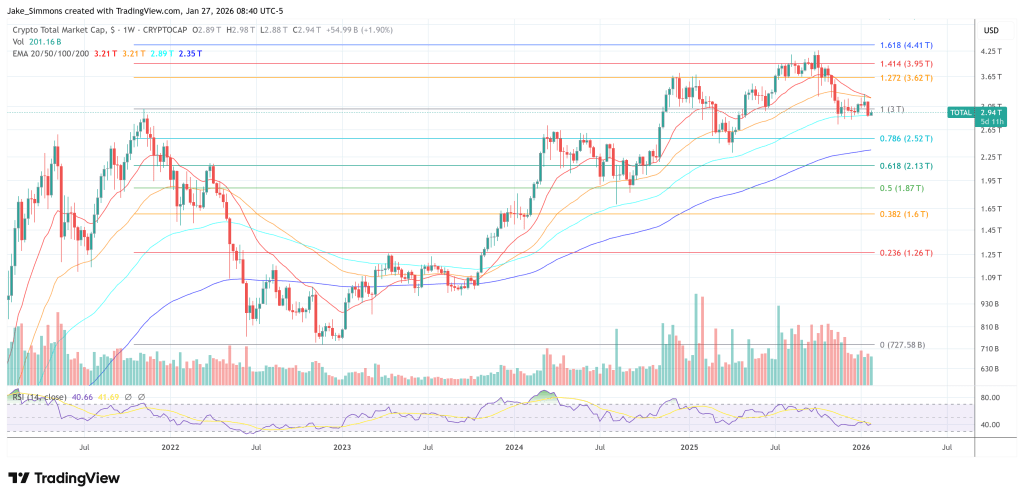
At press time, the total crypto market cap stood at $2.94 trillion.