Solana co-founder Anatoly Yakovenko has warned that the most pressing risk around post-quantum cryptography may not be quantum computers themselves, but the possibility that AI could expose weaknesses in the signature schemes designed to defend against them. His comments add a sharper edge to Solana’s recent quantum-readiness push, which has centered on Falcon signatures, migration planning and wallet-level resilience.
The exchange began after developer Dean Little highlighted progress on a Solana Falcon implementation, saying version “0.1.2 now costs just ~173–183k CUs to verify,” with Lean and Kani proofs expected next. That prompted Yakovenko to suggest deeper native support inside Solana’s transaction architecture, writing: “Syscall to lift PDA is_signer to the transaction processor, charge fees to valid signers at the end of the block. Make it so, pls.”
Solana’s Post-Quantum Plan Gets New Scrutiny
The more consequential remark came shortly after, when Yakovenko framed the problem less as a simple migration from today’s cryptography to post-quantum signatures, and more as a security-design issue with unresolved unknowns.
“I think the biggest risk is that pqc signature schemes will get broken by ai,” Yakovenko wrote. “We don’t know all the implementation footguns even, let alone the math footguns. So we need to support 2/3 wallets for them. @fusewallet or ideally natively with PDAs in the tx processor.”
The point is notable because Solana’s official messaging on quantum readiness has been broadly confident. In an April 27 developer post, Solana said quantum computing remains “years away” and that, if the threat materializes, migration work is “well-researched, understood, and ready to deploy.” The post described a roadmap built around continued research, adoption of a post-quantum scheme for new wallets if needed, and migration of existing wallets to the selected scheme.
Solana’s current research track has converged around Falcon, a post-quantum digital signature scheme identified independently by Anza and Firedancer, two major validator client developers in the Solana ecosystem. According to Solana, both teams reached the same conclusion: the network would need a compact post-quantum signature format suited to high-throughput blockchain use. Initial implementations are already available through Firedancer and Anza repositories, while Solana argues that the transition would be manageable and should not create a meaningful performance hit.
Yakovenko’s warning does not directly contradict that roadmap. It narrows the focus. Rather than questioning whether Solana can migrate to post-quantum cryptography when necessary, he is pointing to the fragility of assuming any single new cryptographic scheme will remain safe once both implementation details and mathematical assumptions are exposed to increasingly powerful AI-assisted analysis.
That distinction matters for builders. The quantum-readiness debate often treats post-quantum signatures as the endpoint: once a chain can verify Falcon or a similar scheme efficiently, the network has a path forward.
Yakovenko’s comments suggest the safer architecture may be one that avoids dependence on one scheme, even after migration. His preference for “2/3 different signature schemes” indicates a defense-in-depth model, where wallets or transaction processors could require threshold approval across multiple cryptographic primitives.
Michael Egorov, founder of Curve Finance, asked whether “proper formal verification” might help address the concern. Yakovenko’s reply was cautious: “If we know exactly what to verify. I’d still like 2/3 different signature schemes.”
That response captures the unresolved part of the debate. Formal verification can reduce implementation risk when the target properties are precisely defined. Yakovenko’s concern is that the industry may not yet know all the relevant failure modes, especially if AI systems become better at finding edge cases, deployment flaws or deeper mathematical weaknesses in post-quantum constructions.
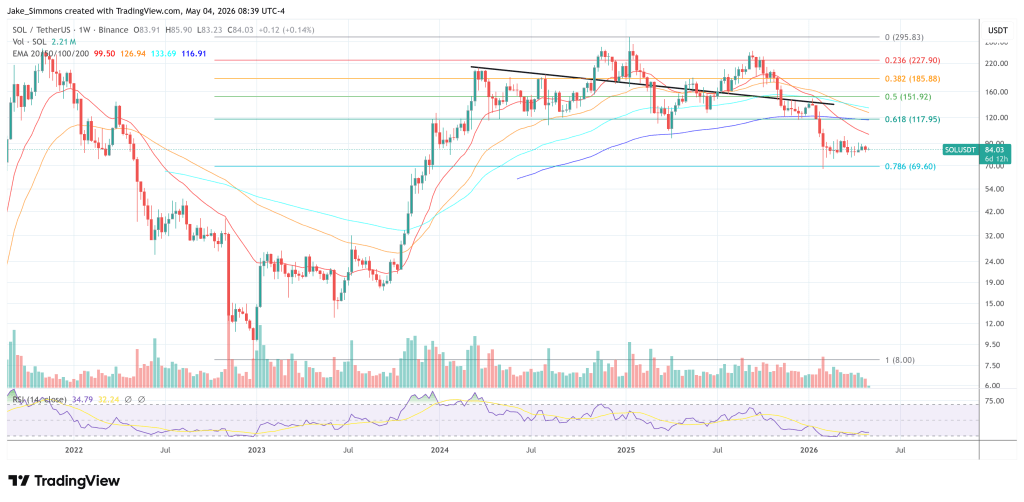
At press time, SOL traded at $84.03.