Solana Foundation and Google Cloud have introduced Pay.sh, a Solana-based gateway designed to let AI agents discover, access and pay for APIs on a per-request basis using stablecoins. The launch positions Solana as payment infrastructure for agentic software workflows, with Google Cloud APIs including Gemini, BigQuery, Vertex AI, BigTable and Cloud Run among the first enterprise services supported.
The product addresses a bottleneck that has become more visible as AI agents move from passive assistants to autonomous software operators. Even when an agent can search, code, query data and execute tasks, access to premium APIs still typically requires a human to create accounts, manage billing, handle credentials and maintain subscriptions. Pay.sh attempts to collapse that process into a wallet-based payment flow.
“Agents can now instantly discover, access, and pay-per-request for any API autonomously, for the first time supporting APIs from Google Cloud including Gemini, BigQuery, Vertex AI, and more using stablecoins on Solana,” the Solana Foundation said in its announcement. “No accounts. No API keys. No subscriptions needed.”
Pay.sh begins with a Solana wallet connected to an AI interface, including Gemini, Claude Code, Codex, Openclaw and Hermes, according to the announcement. Developers can fund the wallet with a credit card or stablecoin, after which an agent can browse a unified marketplace of API endpoints, receive live pricing and pay directly from its balance.
The core design is simple: the payment functions as the credential. Rather than requiring every API provider to establish a direct billing relationship with each user or agent, Pay.sh acts as a gateway layer between agents and service providers.
The Foundation said Pay.sh runs as an API proxy built on Google Cloud Platform, sitting in front of Google Cloud services such as BigQuery, Gemini, Cloud Run and others. The user’s Solana wallet acts as the agent’s identity, while the gateway authorizes requests through verified endpoints and applies rate limits, quotas and access controls.
That distinction matters for enterprise APIs. The product is not framed as a way to bypass compliance or security controls, but as a mechanism for handling high-frequency, low-friction payments while still preserving provider-side access management.
Solana Powered-Stablecoin Settlement For Agent Commerce
Payments are processed in stablecoins on Solana and then reconciled with providers, with the announcement emphasizing settlement “in seconds.” Developers pay only for what they consume, while providers avoid manual billing overhead for small or irregular usage patterns.
Solana Foundation Chief Product Officer Vibhu Norby, who announced the launch on X, described Pay.sh as “our pay-as-you-go product for every API,” adding that the collaboration with Google brings micropayments to APIs including “Gemini, BigQuery, YouTube, and Maps.”
“For the first time, developers can access and pay on individual API calls without a billing account or KYC,” Vibhu wrote. “Pay.sh gives your terminal a wallet and financial superpowers with digital dollars on Solana at the root. We’re starting with GCP but you can access 75 other integrations through our open marketplace.”
The marketplace component is broader than Google Cloud. Solana Foundation said Pay.sh also includes more than 50 community API facilitators across ecommerce, market data, communications and onchain infrastructure. Named services include Rye, BigCommerce, Exa, Dune Analytics, Nansen, AgentMail, StablePhone, Helius, Alchemy, QuickNode, Allium and The Graph.
Pay.sh is built on x402 and MPP, which the Foundation described as machine-native payment protocols for agent-to-API commerce. The registry is open-source, and service providers can submit endpoints through GitHub or apply to become official Pay.sh API providers.
Launch partners powering community-sourced endpoints include PayAI, Crossmint, Merit Systems, Corbits, MoonPay, Sponge Wallet, ATXP and Tektonic Company.
For Solana, the launch gives stablecoin payments another concrete enterprise-facing use case beyond trading, remittances and consumer transfers.
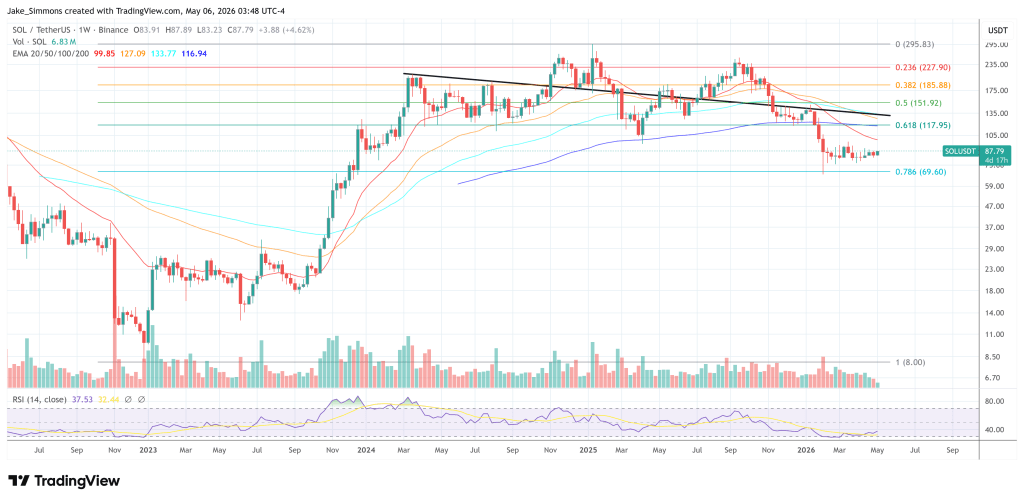
At press time, SOL traded at $87.79.