Revenue Hits Record High, Why Hasn't AAOI's Profit Kept Pace?

marsbit发布于2026-08-07更新于2026-08-07

文章摘要

US optical communication equipment maker Applied Optoelectronics (AAOI) reported its Q2 earnings on August 6th, marking its fifth consecutive quarter of record revenue. However, a closer look reveals a more complex picture: alongside the revenue surge, GAAP gross margin hit a near six-quarter low, and GAAP net loss persisted despite non-GAAP profit turning positive. The report depicts a company in rapid expansion mode. While revenue is flowing in, costs related to materials, equipment, and extended payment terms are pulling down profits and cash flow. The analysis focuses on three key drivers: revenue sources, the quality of reported profits, and funding for the expansion. Revenue growth was driven by two segments: data center business (up 140% year-over-year) and CATV/cable broadband (up 44%). This diversification means growth isn't solely dependent on the volatile AI supply chain. However, a significant portion of revenue and accounts receivable is concentrated with a single CATV customer, Digicomm, which receives extended payment terms, creating a timing gap between booked revenue and actual cash collection. Despite increasing scale, GAAP gross margin fell to 27.7%, while non-GAAP was 29.8%. The gap includes costs like expenses for discontinued products, which are excluded from the non-GAAP measure. Management highlighted a more-than-doubling of 800G product shipments and ongoing capacity expansion for next-gen modules, indicating that scaling new, high-speed production...

On August 6th, Applied Optoelectronics, Inc. (AAOI), a U.S. optical communication equipment supplier, announced its second-quarter results. According to the company's earnings release, this marks AAOI's fifth consecutive quarter of record revenue.

It's easy to read this as yet another piece of good news about AI optical module demand. However, when the income statement and cash flow statement are viewed together, the picture becomes less straightforward. In the same quarter that revenue surged to a new high, GAAP gross margin fell to its lowest point in nearly six quarters, and the GAAP net loss did not disappear even as non-GAAP profit turned positive, based on the company's quarterly earnings releases.

AAOI's earnings report more closely resembles a production line undergoing rapid facility expansion. Revenue has already entered the financial statements, and the machines are running, but materials, equipment, and payment terms are still pulling cash and profits in the opposite direction. To understand this company, one must first dissect three things: what is driving the revenue, how substantial the reported profitability is, and where the money for expansion is coming from.

What's Actually Driving the Revenue?
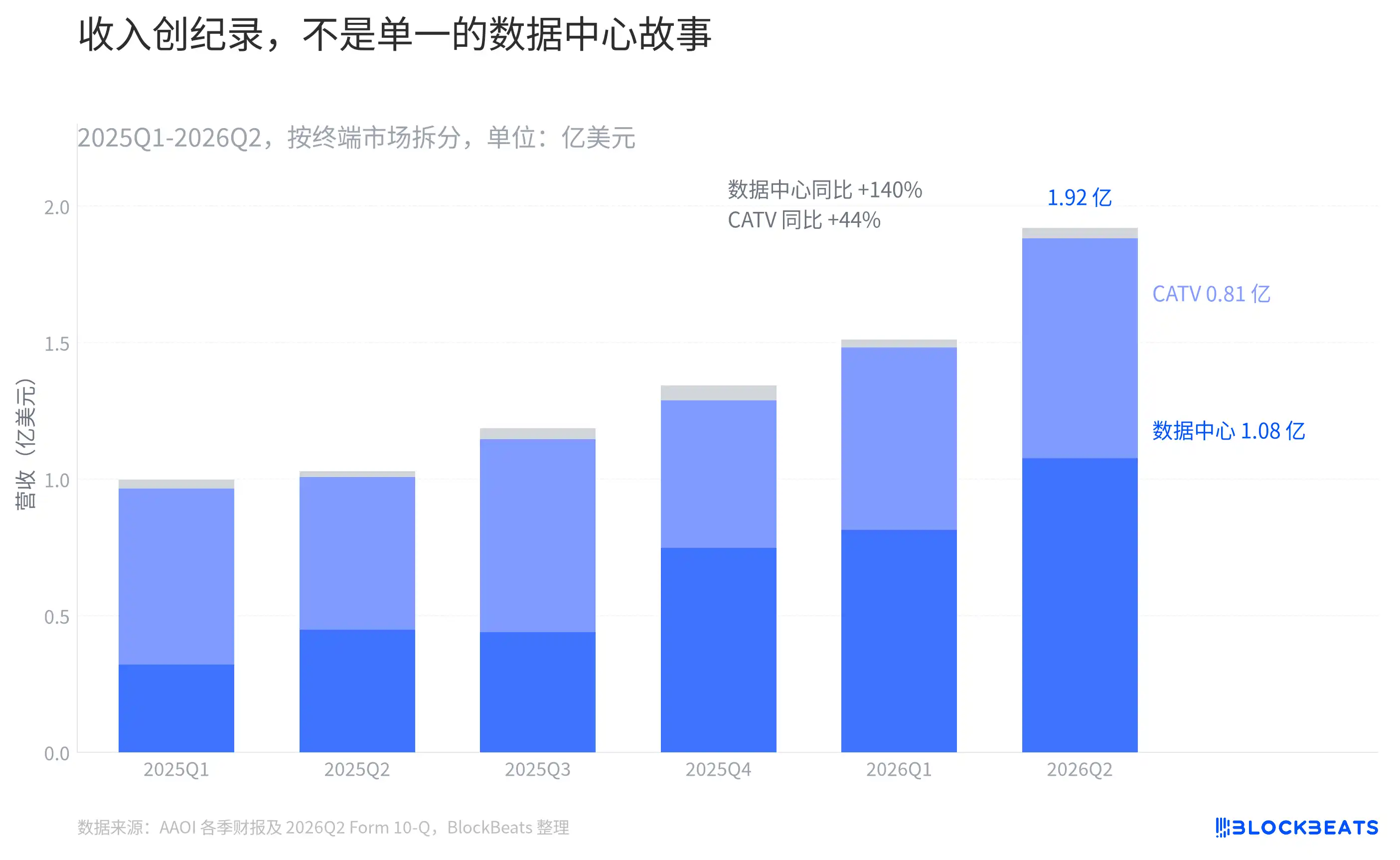
In the first chart, the most crucial thing to watch isn't the bars getting taller, but both shades of blue becoming thicker simultaneously. The data center business is the most conspicuous part of this growth cycle, increasing 140% year-over-year in Q2. The CATV, i.e., cable TV broadband business, also increased 44% during the same period, according to the company announcement.

This means AAOI's revenue is not solely riding on one AI-related chain. Data center modules push the company toward higher-speed network demands, while CATV keeps the company anchored in another, more mature broadband upgrade cycle. Both lines lifting revenue together means this growth cycle is not entirely dependent on the procurement rhythm of a single end market.

However, end markets are not the same as customer lists. According to AAOI's quarterly report, CATV product customer Digicomm contributed 42.8% of consolidated revenue in the first half of the year. According to the same document, this customer accounted for approximately 67.2% of accounts receivable at the period-end.

The company's quarterly report shows that AAOI provided extended payment terms to Digicomm to facilitate its advance inventory building for network construction. The payment terms themselves do not indicate asset quality but will create a timing difference between revenue recognition and cash collection. For a company currently buying equipment and expanding facilities, book revenue and cash on hand cannot be treated as the same thing.

Why Did GAAP Gross Margin Fall as Scale Increased?
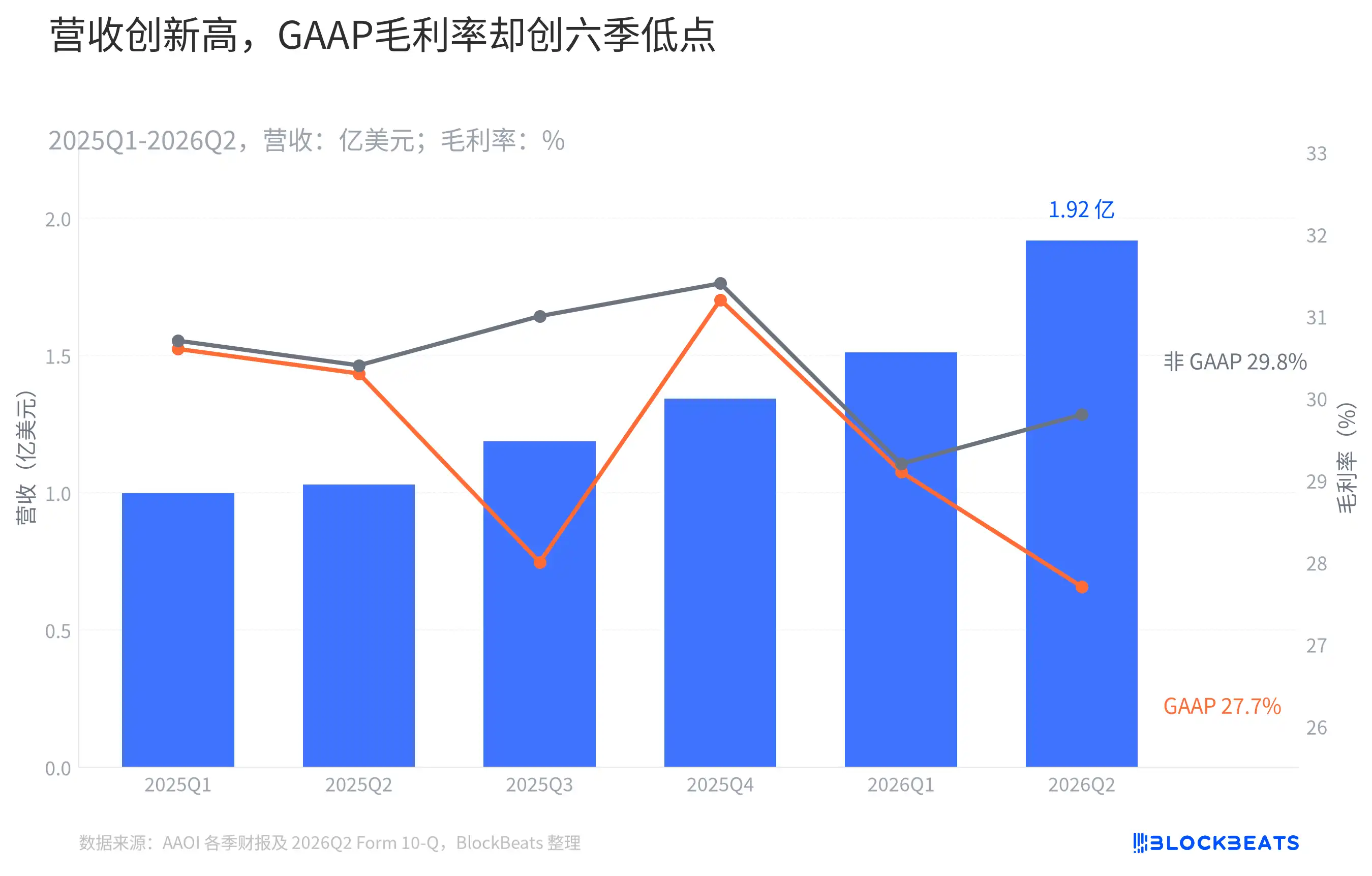
Typically, one would expect expanding scale to reduce unit costs. AAOI's Q2 GAAP gross margin was 27.7%, while its non-GAAP gross margin was 29.8%, according to the company announcement. The gap between the two lines indicates that the current GAAP report still includes several costs excluded by the company in its non-GAAP presentation.

The company's reconciliation table shows that non-GAAP gross margin excludes expenses related to discontinued products. This metric is useful for observing the company's defined ongoing operational performance but cannot replace the GAAP metric.

Management stated that shipments of 800G products more than doubled sequentially this quarter and that they are advancing capacity for next-generation modules. Mass production of high-speed modules isn't about running old production lines faster; it's about pushing equipment, processes, and yield rates over a new threshold. Management expects demand to continue to outpace their available supply capacity, according to the company announcement.

This is also the most easily overlooked point in the charts. Revenue growth first indicates products are shipping, while gross margin records whether expansion has translated into more efficient manufacturing. The two follow different timelines.

What Exactly Did Non-GAAP Turning Profitable Turn?
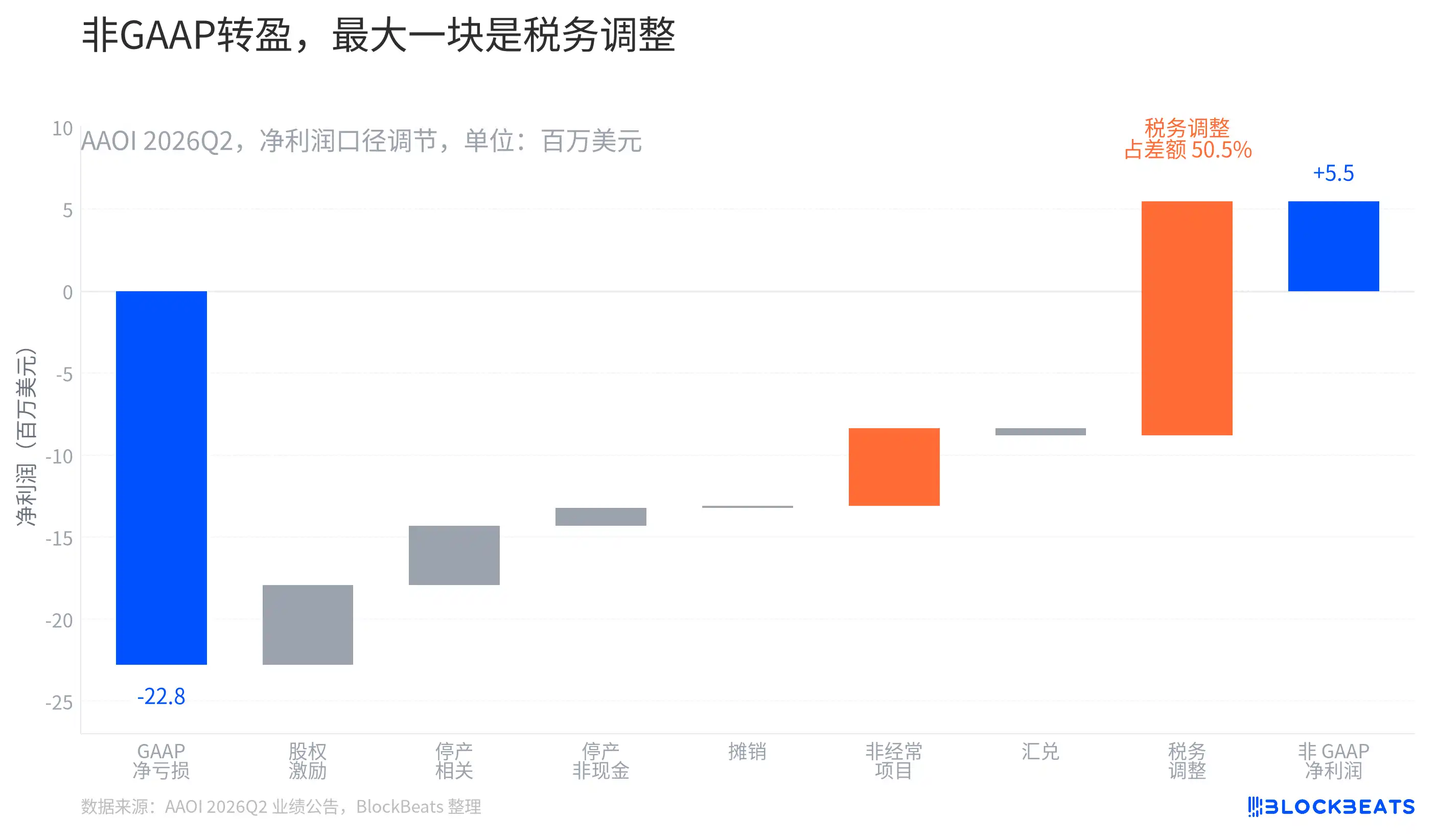
In Q2, the largest single item in AAOI's reconciliation from GAAP net loss to non-GAAP net income was a tax adjustment related to the aforementioned adjustment items, amounting to $14.26 million. According to the company announcement, this item accounted for approximately 50.5% of the total bridging difference.

The chart also includes items such as stock-based compensation, discontinued product-related expenses, amortization, non-recurring expenses, and foreign exchange. These items do not simply vanish; they are excluded under the company's defined non-GAAP presentation. This presentation is useful for viewing the ongoing business but cannot replace the GAAP income statement.

A more conservative piece of corroborating evidence is that AAOI's adjusted EBITDA for the quarter remained negative at -$0.543 million, according to the company announcement. The positive non-GAAP net income indicates improvement under the company's defined adjusted metrics but cannot be directly equated with the expansion being self-funding.

Who Is Funding This Round of Expansion?
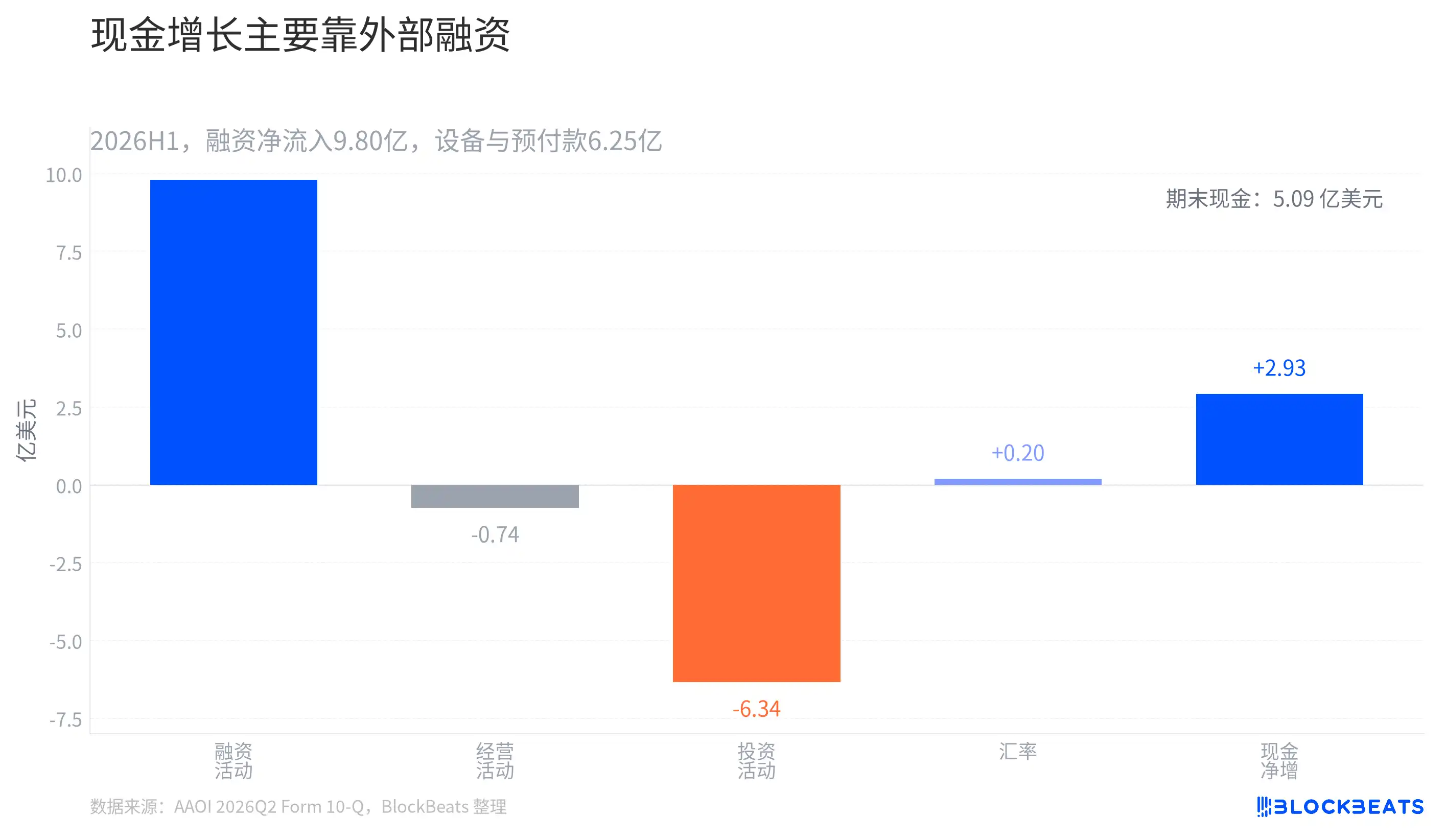
The cash flow statement in the company's quarterly report provides a more direct answer. In the first half of the year, AAOI's net cash outflow from operating and investing activities combined was $707 million, according to the quarterly report. Funds were tied up in the growth of receivables and inventory, as well as in property, plant, equipment, and prepayments.

On the other hand, net cash inflow from financing activities reached $980 million, of which net proceeds from common stock offerings amounted to $1.028 billion, according to the quarterly report.

The total of cash, cash equivalents, and restricted cash at the period-end rose to $509 million. According to the quarterly report, the primary source of this increase was equity financing, not operating cash flow turning comprehensively positive.

The company's quarterly report shows that receivables, inventory, and equipment prepayments continue to tie up funds. Revenue growth has already occurred, yet the funds for expansion primarily come from financing.


热门币种推荐

相关问答

QWhat were the main factors driving AAOI's record revenue growth in Q2?

AThe main drivers were two business lines growing simultaneously: Data Center business revenue increased 140% year-over-year, and CATV (cable TV broadband) business revenue increased 44% year-over-year. This diversification meant the growth was not solely dependent on the AI supply chain.

QWhy did AAOI's GAAP gross margin decline to a six-quarter low despite increasing revenue?

AThe GAAP gross margin declined to 27.7% because the costs associated with ramping up production for new, higher-speed modules like 800G products are captured under GAAP. Scaling production involves investments in new equipment, processes, and achieving higher yields, which are costly upfront before efficiency gains are realized.

QWhat was the largest adjustment made to AAOI's GAAP net loss to arrive at a positive non-GAAP net profit?

AThe largest adjustment was a tax adjustment related to excluded non-GAAP items, amounting to $14.26 million. This single item accounted for approximately 50.5% of the total bridge between GAAP net loss and non-GAAP net income.

QHow is AAOI funding its current period of rapid expansion and capacity build-out?

AAAOI is primarily funding its expansion through equity financing, not operating cash flow. In the first half of the year, financing activities provided a net inflow of $980 million, with $1.028 billion in net proceeds from common stock offerings. Operating and investing activities were a combined net cash outflow of $707 million.

QWhat does the significant concentration of accounts receivable from client Digicomm indicate about AAOI's financials?

AIt indicates a potential timing gap between revenue recognition and cash collection. Digicomm contributed 42.8% of H1 revenue and represented about 67.2% of ending accounts receivable. AAOI provided Digicomm with extended payment terms to support its network build-out inventory, meaning recorded revenue does not immediately translate into available cash for the company's own expansion needs.

你可能也喜欢

2万亿美元,AI史上最大IPO进入倒计时

AI公司Anthropic预计将于今年十月进行IPO,估值可能突破2万亿美元,这将是史上最大规模的AI公司上市。其估值由六位投资人根据模型推算得出,其中有人甚至预估超过3万亿美元。公司内部对此并未设定明确目标。 Anthropic在短短五年内实现了惊人增长,从初创公司迅速跻身巨头行列。2025年底年化收入约90亿美元,到2026年5月已飙升至470亿美元,第二季度营收达115亿美元,同比激增14倍。内部预测,到2028年营收可能达到1900亿至2000亿美元。 公司收入主要依靠API和企业合同,按调用量计费,其中编程辅助工具Claude Code是增长核心,贡献近两成收入,在企业和开发者中广泛使用。 然而,公司内部正面临文化撕裂。CEO达里奥·阿莫代伊及其核心团队带有强烈的“拯救人类”使命感,被部分员工形容为“祭司阶层”,其管理风格引发基层员工不满,甚至出现了秘密的吐槽网络。员工在即将到来的财富自由与压抑的工作环境之间陷入挣扎。 Anthropic目前处境微妙:追求最安全的AI需要巨额算力投入,而这又依赖于资本市场支持,迫使公司在理想与商业现实间寻找平衡。其IPO前景虽被看好,但SpaceX上市后股价大跌的前例,以及监管、成本和内部治理等挑战,都为其未来增添了不确定性。

marsbit2小时前

2万亿美元,AI史上最大IPO进入倒计时

marsbit2小时前

降本增效的AI,让VC越来越烧钱

《降本增效的AI,让VC越来越烧钱》一文指出,尽管AI技术降低了创业公司的部分运营和开发成本,却推高了风险投资(VC)获取优质AI公司股权的价格。AI领域融资呈现“杠铃型”结构:一方面,普通初创企业融资规模趋于小额化;另一方面,顶尖团队(如来自OpenAI、Google DeepMind的核心人员)的早期项目估值急剧膨胀,数亿甚至上百亿美元的融资与估值在成立初期便已出现。 这种趋势导致VC持股成本显著上升。早期估值飙升的同时,创始人让渡的股权比例并未同步增加,使得VC为维持相同持股比例所需投入的资金大幅增加。为此,大型风投机构(如Accel、a16z)纷纷募集更大规模的基金,以覆盖从早期进入到后期跟投的全周期,确保在头部项目竞争中不落下风。 资金进一步向少数头部AI项目集中。2026年上半年,全球超70%的创业融资流向AI公司,其中OpenAI和Anthropic两家就占据了全球创业融资总额的43%。这种集中化加剧了VC行业的马太效应,大型基金凭借资金优势持续加码潜在赢家,而小型基金参与热门项目的能力受到削弱。 然而,高估值已提前计入了未来增长预期。若企业最终无法实现与估值匹配的商业化规模,投资回报将面临压缩。目前,许多基金的账面收益仍依赖后续融资的估值重估,而非实际退出。对大型VC而言,当下的核心策略已转变为:在技术“超级周期”中尽早押注潜在龙头,并为伴随估值飙升的持续跟投储备充足弹药。AI降低了创业门槛,却让投资优质AI公司的成本变得愈发昂贵。

marsbit3小时前

降本增效的AI,让VC越来越烧钱

marsbit3小时前

八年投入急转弯,以太坊为何突然放弃Poseidon?

以太坊基金会研究员Justin Drake近日宣布,以太坊将在Layer 1层放弃已研发八年的SNARK友好型哈希算法Poseidon,转而采用SHA2或BLAKE2等传统哈希函数。这一重大转向源于后量子密码学研究的突破性进展。 Poseidon自2019年起因其在零知识证明电路中的高效性,被广泛用于zkRollup等应用。但其算法历史较短,密码学分析时间不足。而随着后量子安全成为硬性要求,其局限性显现。最新的SNARK设计,特别是基于“二进制域”的证明系统(如Binius和Flock),已能高效处理传统哈希函数的布尔运算,使得SHA2等成熟算法在证明性能上可媲美甚至超越Poseidon,消除了采用后者的主要优势。 另一关键因素是应对量子计算威胁的时间表正在加速。报告预测“量子破译日”可能在本世纪30年代初到来,将对区块链资产构成巨大风险。以太坊因此需要尽快采用经过长期密码分析验证的、抗量子攻击能力更强的哈希方案。其后续量子路线图计划于2027年推出核心构件leanVM,并在2028年完成共识层、执行层和数据层的部署。 与此同时,其他公链如Solana已选定后量子签名方案Falcon,而StarkNet也计划采用BLAKE2等算法。以太坊此次转向,标志着技术重点从“设计SNARK友好型哈希”转变为“设计哈希友好型SNARK”,是在后量子时代选择更成熟、更稳健的密码学基元的战略调整。

marsbit4小时前

八年投入急转弯,以太坊为何突然放弃Poseidon?

marsbit4小时前

交易

现货

热门文章

如何购买S

欢迎来到HTX.com!我们已经让购买Sonic(S)变得简单而便捷。跟随我们的逐步指南,放心开始您的加密货币之旅。第一步:创建您的HTX账户使用您的电子邮件、手机号码注册一个免费账户在HTX上。体验无忧的注册过程并解锁所有平台功能。立即注册第二步:前往买币页面,选择您的支付方式信用卡/借记卡购买:使用您的Visa或Mastercard即时购买Sonic(S)。余额购买:使用您HTX账户余额中的资金进行无缝交易。第三方购买:探索诸如Google Pay或Apple Pay等流行支付方法以增加便利性。C2C购买:在HTX平台上直接与其他用户交易。HTX场外交易台(OTC)购买:为大量交易者提供个性化服务和竞争性汇率。第三步:存储您的Sonic(S)购买完您的Sonic(S)后,将其存储在您的HTX账户钱包中。您也可以通过区块链转账将其发送到其他地方或者用于交易其他加密货币。第四步:交易Sonic(S)在HTX的现货市场轻松交易Sonic(S)。访问您的账户,选择您的交易对,执行您的交易,并实时监控。HTX为初学者和经验丰富的交易者提供了友好的用户体验。

3.6k人学过发布于 2025.01.15更新于 2026.08.06

如何购买S

相关讨论

欢迎来到HTX社区。在这里,您可以了解最新的平台发展动态并获得专业的市场意见。以下是用户对S(S)币价的意见。

活动图片