Raoul Pal: Bitcoin's 87% Correlation with Global Liquidity Outweighs Financial Results and News

cryptonews.ru发布于2026-07-28更新于2026-07-28

文章摘要

Raoul Pal, founder of Real Vision and former Goldman Sachs hedge fund manager, asserts that Bitcoin and major indices like the Nasdaq trade primarily based on global liquidity conditions, not fundamentals like earnings or news. He claims an 87% correlation between Bitcoin and global liquidity, with Nasdaq showing a 97% correlation. Global liquidity is measured by central bank balance sheets, the M2 money supply, and bank lending growth. Analysts at crypto market maker Keyrock developed a model supporting Pal's correlation claim, noting an eight-month lag between Treasury bill issuance and Bitcoin's price response. Pal's theory, which he detailed earlier this year, posits that central banks are forced to inject liquidity in a recurring cycle to manage global debt refinancing every four years. This forms the basis for his $450,000 Bitcoin price target, contingent on continued liquidity expansion. The high correlation suggests Bitcoin and tech stocks are trading as similar liquidity indicators rather than distinct asset classes. This view challenges narratives centered on Bitcoin's own supply dynamics, halving cycles, or adoption news. Michael Saylor of MicroStrategy has expressed a similar sentiment, downplaying the halving cycle's dominance in favor of capital flows from ETFs, corporate treasuries, and sovereign reserves. It's noted that Pal's post does not include the original datasets or methodology. Furthermore, the correlation's strength has fluctuated in 2026, and Keyr...

Pal, the founder of the financial media platform Real Vision and a former Goldman Sachs hedge fund manager, is one of the most authoritative macroeconomics experts in the cryptocurrency sphere, closely followed by many. For the past seven months, he has primarily argued that digital asset prices are determined by liquidity conditions, not fundamentals. In his post on X, Pal explained:

"Bitcoin is 87% correlated with global liquidity. The Nasdaq index is 97%. This reveals something most people never realize. These assets aren't actually trading based on earnings, news, or some event of the week. They are tracking the amount of money in the system."
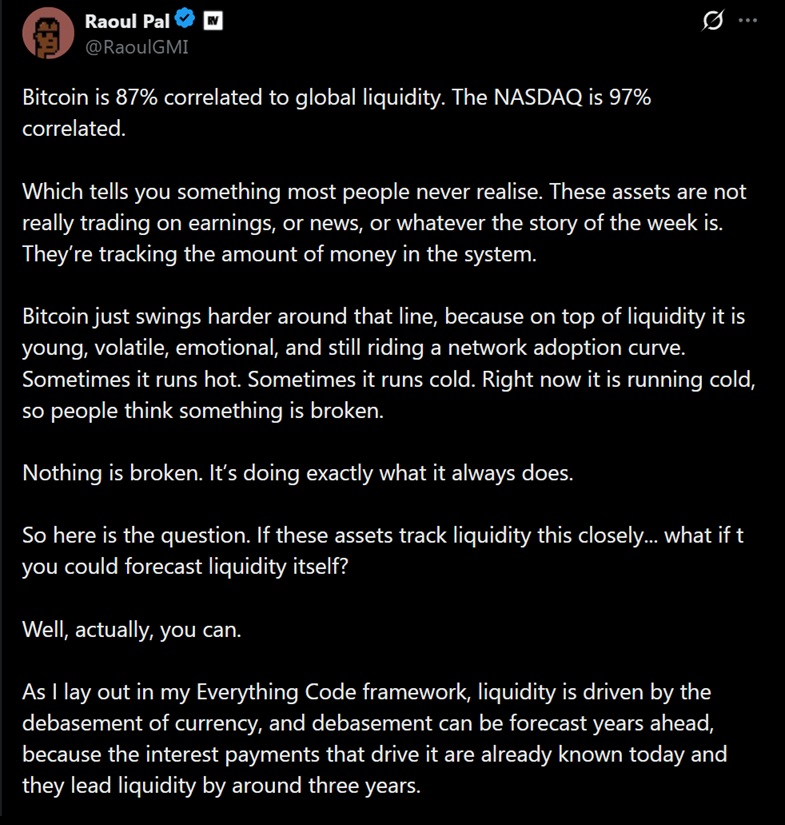
Global liquidity refers to the total volume of funds available for injection into financial markets, typically measured by central bank balance sheets, the global M2 indicator (broad money supply), and growth in bank lending.

Analysts at crypto market maker Keyrock developed an eight-month lag model tracking how Treasury bill issuance affects Bitcoin's yield—this model supports Pal's claim of a correlation. The firm's net liquidity indicator, defined as the Federal Reserve's balance sheet minus Treasury cash balances and reverse repo operation balances, aims to isolate the amount of spending power actually entering markets at a given time.

A Familiar Theory, Updated Data

The figures cited by Pal build upon a position he elaborated on in May, when he told Real Vision viewers that Bitcoin maintains approximately a 90% correlation with the global money supply, arguing that governments' reliance on issuing short-term debt forces central banks to inject liquidity in a recurring cycle.

"Every four years there is a rollover of global debt, and central banks are forced to inject liquidity to avoid systemic collapse," Pal stated then. This thesis underpins his $450,000 Bitcoin price target, which he says is contingent on whether central banks can significantly expand liquidity by year-end.

An Even Tighter Correlation with the Nasdaq

An even more striking figure in Pal's post may be the 97% correlation he assigned to the Nasdaq—the U.S. stock index dominated by technology companies. Such a tight correlation suggests Bitcoin and mega-cap tech stocks are now trading as near-identical indicators of the same liquidity conditions, rather than distinct asset classes reacting to different catalysts. This stance contradicts the notion that Bitcoin trades primarily driven by its own supply dynamics, halving cycles, or adoption news.

Pal is not alone in making this argument: MicroStrategy (Nasdaq: MSTR) Executive Chairman Michael Saylor stated earlier this month that the traditional four-year Bitcoin cycle defined by halving "is no longer the dominant model," pointing instead to ETF inflows, corporate treasury Bitcoin accumulation, sovereign reserves, and global liquidity conditions as more significant drivers. He added:

Over the next decade, Bitcoin's trajectory will be less determined by miner issuance and more by capital flows.

That said, neither Pal nor the correlation data cited in his post are accompanied by an original dataset or published methodology, and the strength of the relationship between Bitcoin and liquidity has fluctuated throughout 2026 as liquidity impulses have waxed and waned. Keyrock's own tracking shows Bitcoin's reaction to Treasury issuance lags by about eight months, meaning any current correlation metrics likely reflect liquidity conditions from several months ago, not in real-time.

The next major factor that could challenge the Real Vision founder's thesis will be whether central banks continue the balance sheet expansion he says is necessary to sustain his $450,000 target.


热门币种推荐

相关问答

QAccording to Raoul Pal, what does an 87% correlation between Bitcoin and global liquidity indicate about its price drivers?

AIt indicates that Bitcoin's price is predominantly driven by the amount of money available in the financial system (global liquidity) rather than by fundamentals, earnings, or news.

QWhat is meant by 'global liquidity' in the context of this article?

AGlobal liquidity refers to the total amount of cash available to flow into financial markets, typically measured by central bank balance sheets, the global M2 money supply, and growth in bank lending.

QHow does Michael Saylor's view on Bitcoin's price drivers relate to or differ from Raoul Pal's thesis?

AMichael Saylor's view aligns with Pal's thesis, as he also downplays the traditional four-year halving cycle. Saylor points to capital flows from ETFs, corporate treasury accumulation, sovereign reserves, and global liquidity conditions as more significant drivers, shifting focus from miner issuance.

QWhat is the significance of the 97% correlation figure Pal attributes to the Nasdaq index?

AIt suggests that Bitcoin and mega-cap tech stocks (represented by Nasdaq) are currently trading as almost identical indicators of the same liquidity conditions, not as separate asset classes reacting to different catalysts.

QWhat potential development does the article mention could undermine Raoul Pal's $450,000 Bitcoin price target?

AHis target depends on central banks significantly expanding liquidity. Therefore, if central banks do not continue expanding their balance sheets as he expects, it could undermine his price thesis.

你可能也喜欢

如何让自己变得让人工智能永远也无法取代

面对人工智能的冲击,许多人担心工作被取代。然而,真正的威胁在于个人对他人和系统的依赖,以及由此产生的“薪资奴役”——即为生存而从事无意义、枯燥的工作。摆脱这种困境的关键,不是抵制技术,而是成为拥有高自主性的“不可受雇”个体。 文章提出了成功抵御AI替代的五个核心要素:自主性(主动行动的能力)、品味(判断事物价值的经验)、说服力(让他人关注你工作的能力)、毅力(坚持并从错误中学习)和迭代(根据反馈持续改进)。这些能力无法仅通过理论学习获得,必须通过实践来培养。 要启动转变,首先要彻底改变环境,重塑身份认同。其次,应选择一个能获得真实、快速反馈的实践领域,例如创业。在众多技能中,内容创作(媒体)比编写代码更具优势,因为其价值是主观的,需要独特的审美和判断力,这正是AI目前难以完全复制的。 具体行动上,可以从三个步骤开始: 1. **挖掘原始素材**:反思自己长期痴迷的知识领域、轻松解决的难题或童年被压抑的兴趣,找到独特的个人经验。 2. **确立反向思考主轴**:找出你坚信但主流观点错误的地方,或行业内普遍忽视的“皇帝新衣”,形成独特的批判性视角。 3. **立即发布**:将前两步的思考融合,撰写并发布第一个核心内容(如帖子、视频),勇敢接受真实世界的反馈,并在此基础上持续学习和迭代。 最终,抵御AI的关键在于构建一份与自身身份深度契合的毕生事业,通过持续的内容创作和真实互动,建立无法被自动化取代的独特价值和影响力。行动,从今天发布第一个想法开始。

marsbit1小时前

如何让自己变得让人工智能永远也无法取代

marsbit1小时前

通过掷骰子离线保管比特币密钥:并非人人愿意为之

文章探讨了通过投掷骰子生成比特币钱包种子短语的安全方法及其现实挑战。核心观点如下: **1. 骰子提供物理熵源** 骰子结果由众多微小变量决定,理论上虽可预测,但实践中无法被攻击者复制或计算,从而提供高质量的随机性。每个六面骰子投掷约产生2.585比特熵,50次投掷即可满足典型12词助记词(128比特熵)的安全需求。 **2. Coldcard漏洞事件凸显手工熵源的价值** 近期Coldcard硬件钱包因固件漏洞导致其内部随机数生成器存在缺陷,致使约1128枚比特币被盗。但那些**完全**通过足量骰子投掷生成种子短语的用户未受此漏洞影响,因为他们的主密钥未使用有缺陷的生成器。 **3. 重要警示:手工种子并非万能保护** 安全研究员指出,即使用户使用骰子生成了安全的种子,若他们使用了Coldcard的其他功能(如生成纸钱包、克隆密钥、共享签名密钥、密码等),这些**衍生密钥**仍可能调用有漏洞的随机数生成器,从而存在风险。安全种子不保证设备生成的所有秘密都安全。 **4. 手工生成熵源的现实局限性** 尽管数学上可靠,但该方法对大多数用户并不友好: * **过程繁琐易错**:需投掷50-99次,精确记录,任何输入错误都会导致钱包完全不同。 * **引入新风险**:用户可能在记录、转换过程中泄露信息,或使用有偏的骰子/投掷方式。 * **用户体验差**:难以想象大规模推广需要用户手动投掷近百次骰子。安全措施需适应现实生活场景和普通用户的知识水平。 **5. 给用户的建议** 受影响的Coldcard用户应: * 更新固件至最新版。 * 检查是否使用过有漏洞的功能生成了次级密钥或密码,如有则需立即更换。 * 考虑采用多签方案,使用不同厂商的设备分散风险。 **结论**:手工投掷骰子生成熵源是技术娴熟用户的一个有效安全选项,但其过程复杂、容易出错,不适合作为主流用户的默认方法。长远目标是依赖安全、透明且无需专业知识的硬件/软件随机数生成方案。

cryptonews.ru4小时前

通过掷骰子离线保管比特币密钥:并非人人愿意为之

cryptonews.ru4小时前

交易

现货

热门文章

加密市场宏观研报:《GENIUS Act》法案取得重大进展,BTC突破历史新高,后市全新展望

2025年5月22日,比特币价格正式突破11万美元大关,创下历史新高。在政策面、宏观经济、资金面与投资者结构共同作用下,一场结构性牛市浪潮正在展开。而此轮上涨背后的核心驱动,是美国《GENIUS稳定币法案》的实质性进展以及多项利好的叠加。本文将从政策端突破、宏观环境转向、链上与ETF资金结构、交易行为演化,以及重点受益赛道五大维度,全面解析此轮BTC再创新高的深层逻辑,并前瞻下半年市场的潜在趋势。

1.8k人学过发布于 2025.05.22更新于 2025.05.22

加密市场宏观研报:《GENIUS Act》法案取得重大进展,BTC突破历史新高,后市全新展望

相关讨论

欢迎来到HTX社区。在这里,您可以了解最新的平台发展动态并获得专业的市场意见。以下是用户对BTC(BTC)币价的意见。

活动图片