According to foreign media reports, OpenAI's Chief Revenue Officer Denise Dresser sent a four-page memo to employees, addressing competition with Anthropic, insufficient computing power, and product strategy.
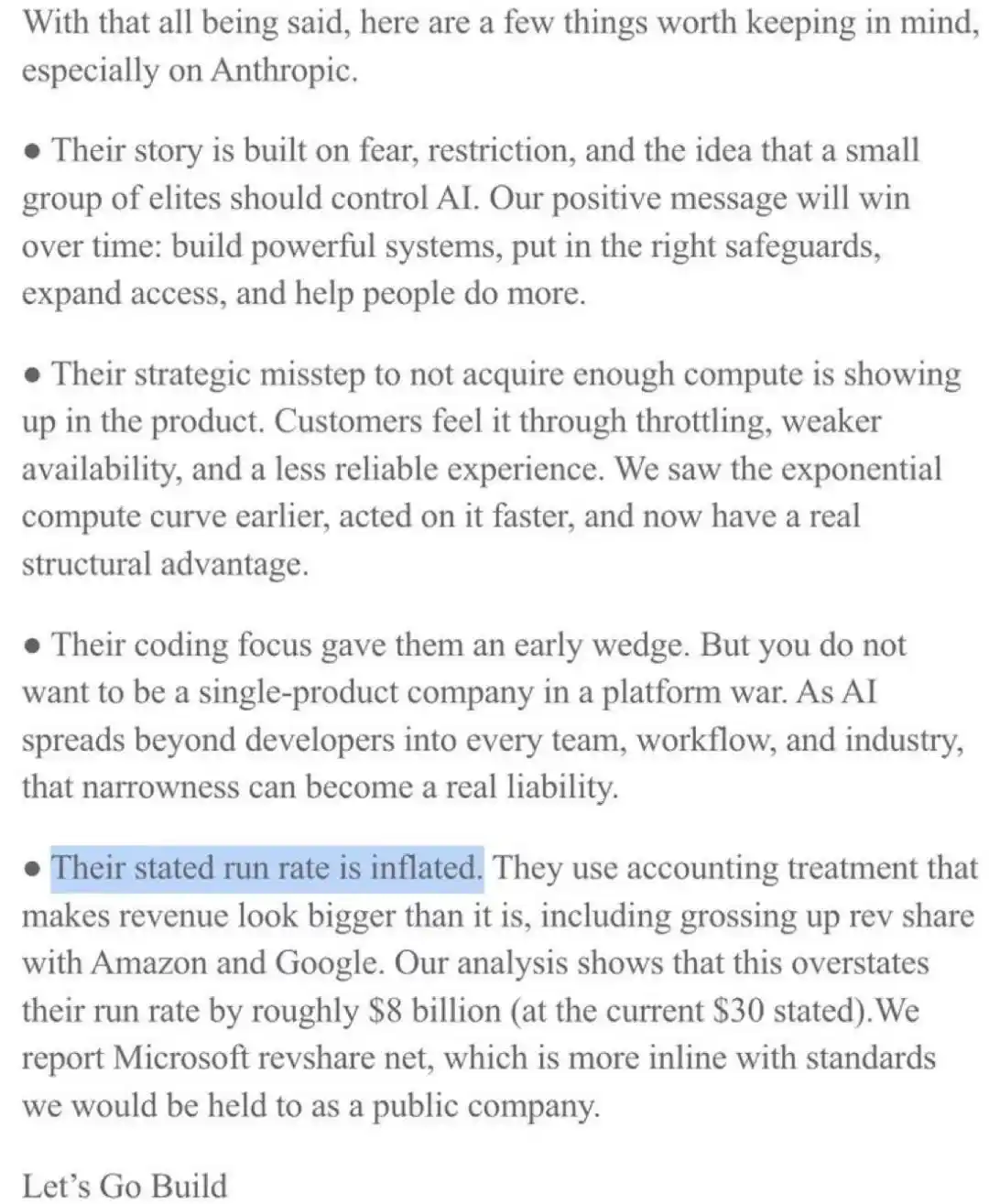
The memo also mentioned that Anthropic includes the commissions given to Amazon and Google in its total revenue, thereby inflating the revenue figure on the books.
The incident originated a week ago on April 7, when Anthropic proudly announced its annualized revenue had reached $30 billion, successfully surpassing OpenAI's $25 billion.
In terms of growth rate, it surged by 233% compared to the $9 billion at the end of 2025.
However, the memo states that $8 billion of Anthropic's annualized revenue was "inflated" through accounting practices, meaning their actual annualized revenue should be $22 billion, not exceeding OpenAI's $25 billion.
OpenAI's accusation is not baseless but targets a technical yet crucial accounting issue.
According to the memo, Anthropic uses the "gross basis" method to report revenue sharing with cloud service providers.
Specifically, when customers purchase Anthropic's services through cloud platforms like AWS, Google Cloud, or Azure, Anthropic records the entire amount paid by the customer as its own revenue, including the portion that must be shared with the cloud service provider.
In contrast, OpenAI uses the "net basis" method to report revenue sharing with Microsoft, only including the net revenue after deducting Microsoft's share.
The memo emphasizes that this net basis method is "more aligned with the standards that public companies should follow."
According to OpenAI's analysis, if the same accounting standard were applied, Anthropic's true annualized revenue should be around $22 billion, not the $30 billion it claims. The aforementioned "inflated $8 billion revenue" is derived from this.
This $8 billion difference is precisely the commission taken by the cloud service providers.
In the cloud service distribution model, platforms like AWS and Google Cloud take a certain percentage of commission from the fees paid by customers.
For a company like Anthropic, which heavily relies on cloud platforms for distribution, this amount is indeed quite substantial.
The memo also has a broader context: Anthropic's private market valuation has reached approximately $600 billion, representing a premium of over 50% compared to its last funding round. Meanwhile, OpenAI's secondary market trading valuation is about $765 billion, a discount of approximately 10% from its last funding round.
Against this backdrop, OpenAI's release of this strongly worded internal memo at this time is clearly intended to stabilize internal morale and influence external market perception by questioning the credibility of a competitor's data.
Wait, there's more. The memo has many other interesting points.
The memo states that Anthropic's "failure to secure sufficient computing power is a strategic mistake," leading to issues like rate limiting, weaker availability, and less reliable experiences for customers using Claude.
In contrast, OpenAI claims it "saw the exponential growth curve of computing power demand earlier, acted faster, and now possesses a true structural advantage."
OpenAI claims that by 2030, it will have 30 gigawatts of computing power, while Anthropic is expected to have only 7 to 8 gigawatts by the end of 2027.
Regarding product strategy, the memo mentions that Anthropic is too focused on programming scenarios.
While this helped it gain an early market foothold, this product cannot help Anthropic win the platform war.
The memo mentions that OpenAI is building a complete enterprise AI system, including ChatGPT for Work, Codex, API, Frontier agent platform, and integration with Amazon's chip environment, capable of meeting enterprises' needs to enter from different access points and scale to a full stack.
After finance and strategy, it's time for ideology.
The memo writes: "Their story is built on fear, restrictions, and the idea that a small elite should control AI."
Back in February, Altman commented on Anthropic, saying the company provides expensive products to the wealthy. OpenAI, on the other hand, is an advocate for "democratizing AI," making AI accessible to everyone.
On the same day this war of words began, OpenAI did another interesting thing.
On the very same day, OpenAI acquired the AI finance application company Hiro Finance.
According to Hiro Finance's own statement, the company's initial vision was to create an "AI personal CFO."
Simply put, it's not just an ordinary bookkeeping software but aims to integrate users' financial information scattered across bank accounts, investment accounts, budgeting tools, and spreadsheets, then use AI to help users with financial planning, net worth forecasting, cash flow analysis, and major decision simulation.
For example, buying a house, changing jobs, taking a year off, or deciding whether to keep more cash. In the past, you might have needed a financial advisor and反复 calculations in Excel to get an uncertain answer.
Hiro Finance hopes to turn this complex and tedious process into a service that can provide answers through a single conversation. Its website mentions that it has already helped clients plan and manage over $1 billion in assets.
After joining OpenAI, Hiro is no longer accepting new user registrations, and the product will cease operation on April 20. Existing users can export their data until May 13, after which personal data on Hiro's servers will be permanently deleted. Hiro also specifically emphasized that user personal data will not be shared with OpenAI.
The amount of the transaction was not disclosed, and OpenAI has not yet specified which specific product line the Hiro team will join.
OpenAI is essentially bolstering its "life scenarios." ChatGPT already has chat, search, programming, office, and enterprise entry points, but if it is to become a true personal assistant, it cannot just answer questions; it must also understand people's long-term goals, asset status, risk preferences, and real-world constraints.
Finance is恰好 a testing ground for this capability. It requires natural language interaction, verifiable calculations, strong privacy protection, and a sufficiently high trust threshold.
More importantly, personal finance comes with a clear willingness to pay. Users might pay for chatting or programming, but if AI can genuinely help people decide how to spend money and manage assets, then it's not just a "smarter search box" but is approaching the role of a private advisor.
OpenAI's acquisition of Hiro Finance is not necessarily about inserting this product, unchanged, into ChatGPT.
They are likely acquiring expertise in financial products, user trust, and verifiable computation. While Anthropic is stuck in enterprise and programming, OpenAI aims to be a universal entry point covering work, life, and wealth management.
However, financial scenarios are most afraid of miscalculations and overstepping boundaries. Accuracy, compliance, and trust are the real challenges of this small acquisition.
This article is from the WeChat public account "Letter AI", author: Miao Zheng