Move, as a language that Web3 developers cannot afford to ignore, is particularly "hardcore" in its strong type system and resource semantics, especially regarding asset ownership, illegal transfers, and data races. Ecosystems like Sui and Aptos place increasingly important assets and core protocols on Move precisely because of its core language features, which enable the creation of more secure and lower-risk smart contracts.
However, the reality we've observed through long-term auditing and offensive/defensive practices is that a significant portion of thorny issues often do not occur in obvious places like "syntax errors" or "type mismatches," but rather at more complex, real-world levels—cross-module interactions, permission assumptions, state machine boundaries, and those call sequences that seem reasonable step-by-step but can be exploited when combined. Precisely because of this, even though the Move language has more robust security paradigms, there have still been significant attack incidents within its ecosystem. Clearly, security research for Move needs to go further.
We identified a core problem: the lack of an effective fuzzing tool for the Move language. Because Move has stronger constraints, traditional smart contract fuzzing faces a tricky pain point in the Move context: generating transaction sequences that are both "type-correct" and "semantically reachable" is very complex. If the input isn't precise enough, the call cannot be completed; if the call cannot be made, it fails to cover deep branches and reach critical states, making it easier to miss the paths that can truly trigger vulnerabilities.
Based on this long-standing pain point, we collaborated with a university research team to jointly complete and publish our research findings:
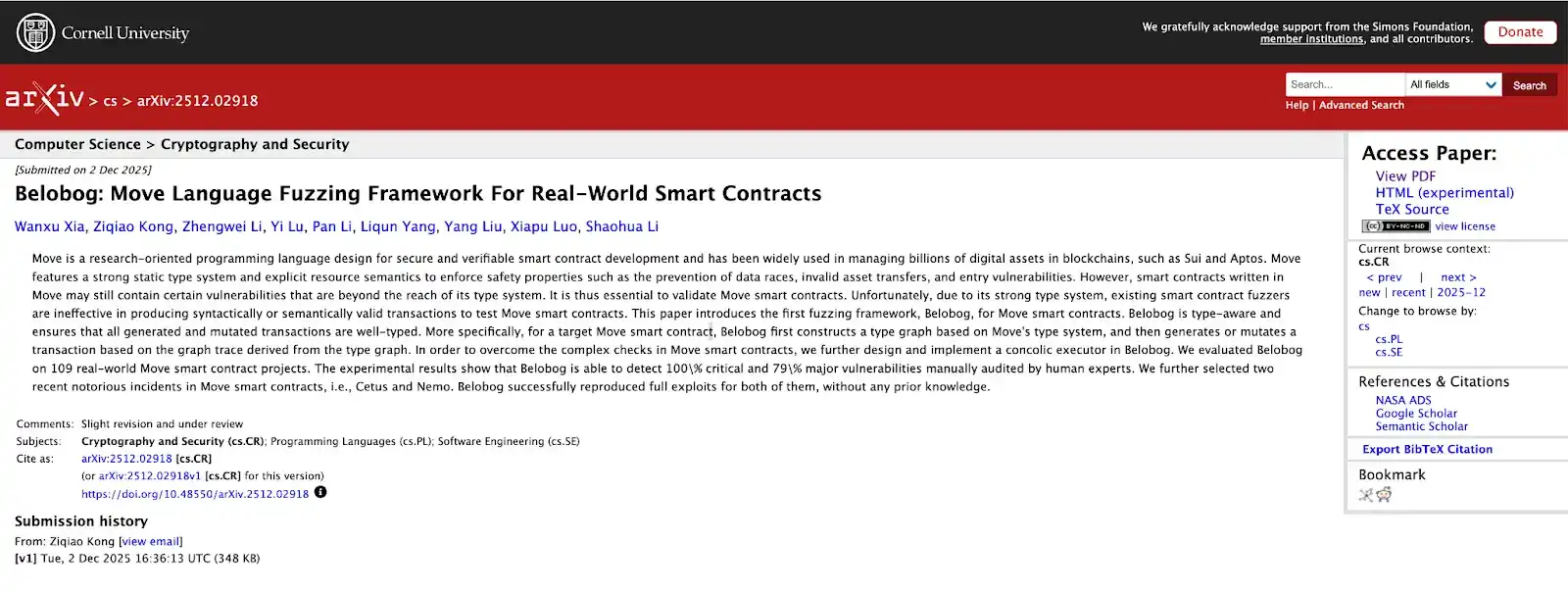
《Belobog: Move Language Fuzzing Framework For Real-World Smart Contracts》
arXiv:2512.02918 (Preprint)
Paper Link:https://arxiv.org/abs/2512.02918
This paper is currently published on arXiv as a preprint, its significance is to allow the community to see research progress faster and receive feedback. We are submitting this work to PLDI’26 and awaiting the peer review process. After the submission result is confirmed and peer review is completed, we will also share relevant updates promptly.
Making Fuzzing Truly "Run Into" Move: From Random Trial and Error to Type-Guided Exploration
Belobog's core idea is straightforward: since Move's type system is its fundamental constraint, fuzzing should use types as a guide, not an obstacle.

Traditional approaches often rely on random generation and mutation, but on Move, this quickly produces a large number of invalid samples: type mismatches, unreachable resources, parameters that cannot be correctly constructed, call chains with blocking points—what you end up with is not test coverage, but a pile of "failures at the starting line."
Belobog's method is more like giving the Fuzzer a "map." It starts from Move's type system, constructs a type graph based on type semantics for the target contract, and then uses this graph to generate or mutate transaction sequences. In other words, it doesn't blindly stitch calls together but constructs more reasonable, more executable, and更容易深入状态空间的调用组合 (easier to深入 state space call combinations) along type relationships.
For security research, the benefit this change brings is not a "fancier algorithm," but a very simple yet crucial gain:
Higher proportion of valid samples, higher exploration efficiency, and a better chance of reaching the deep paths where real vulnerabilities often appear.
Facing Complex Constraints: Belobog Introduces Concolic Execution to "Push Open the Door"
In real Move contracts, critical logic is often surrounded by layers of checks, assertions, and constraints. If you only rely on traditional mutation, you easily keep bumping at the door: the conditions are never met, the branches are never entered, the state is never reached.
To solve this problem, Belobog further designed and implemented concolic execution (a hybrid of concrete execution + symbolic reasoning). Simply put:
It maintains concrete execution that "can run," while on the other hand, it uses symbolic reasoning to more directionally approximate those branch conditions, thereby more effectively penetrating complex checks and advancing coverage depth.
This is particularly important for the Move ecosystem because the "sense of security" in Move contracts is often built on multiple layers of constraints, and the real problems often hide in the gaps after these constraints intersect. What Belobog wants to do is push testing near these gaps.
Aligning with the Real World: Not Just Running Demos, But Approaching Real Attack Paths
We don't want this kind of work to stop at "being able to run demos." Belobog's evaluation directly targets real projects and real vulnerability findings. According to the experimental results in the paper: Belobog was evaluated on 109 real-world Move smart contract projects. The experimental results show that Belobog was able to detect 100% of the Critical vulnerabilities and 79% of the Major vulnerabilities confirmed by manual security expert audits.
More notably: Without relying on prior vulnerability knowledge, Belobog was able to reproduce full exploits in real on-chain incidents. The value of this capability lies in the fact that it更接近我们在现实攻防里面对的情况 (closer to the situations we face in real-world offense/defense): attackers succeed not through "single-point function errors" but through complete paths and state evolution.
What This Work Aims to Express is Not Just "Making a Tool"
This paper is worth reading not only because it proposes a new framework, but because it represents a more pragmatic direction: abstracting frontline security experience into reusable methods and落地 (grounding) it with verifiable engineering implementations.
We believe the significance of Belobog lies not in being "yet another Fuzzer," but in making Fuzzing on Move closer to reality—able to run in, go deep, and align more closely with real attack paths. Belobog is not a closed tool designed for a few security experts, but a developer-friendly framework: it strives to lower the barrier to entry, allowing developers to continuously integrate security testing into their familiar development workflow, rather than making Fuzzing a one-time, after-the-fact task.
We will also release Belobog as open source, hoping it becomes infrastructure that the community can collectively use, extend, and evolve, rather than remaining an experimental project at the "tool level."
Paper (Preprint):https://arxiv.org/abs/2512.02918
(This work is also currently submitted to PLDI’26, awaiting peer review.)
About MoveBit
MoveBit (Mobi Security), a sub-brand under BitsLab, is a blockchain security company focused on the Move ecosystem, aiming to make the Move ecosystem the most secure Web3 ecosystem by pioneering the use of formal verification. MoveBit has successively cooperated with many well-known global projects and provided partners with comprehensive security audit services. The MoveBit team consists of security experts from academia and industry leaders with 10 years of security experience, having published security research results at top international security academic conferences such as NDSS and CCS. Moreover, they are early contributors to the Move ecosystem, working with Move developers to establish standards for secure Move applications.