KBank Signals Major Crypto Push With Stablecoin Wallet Trademarks as $SUBBD Reshapes Creator Economy

bitcoinist发布于2026-02-03更新于2026-02-03

文章摘要

Thailand's Kasikornbank (KBank) is strengthening its digital asset infrastructure by filing trademarks for digital wallets and stablecoin solutions, signaling a major institutional push into blockchain. This move aims to modernize payments and capture digital capital flows in Southeast Asia. Simultaneously, the $85 billion creator economy is shifting toward decentralization. SUBBD Token ($SUBBD) is highlighted as an AI-powered platform built on Ethereum that reduces fees and gives creators more control. It integrates AI tools for content generation and community management, alongside a staking system offering 20% APY to incentivize holders. The project has raised over $1.4 million in its presale, reflecting strong demand for utility-driven Web3 applications.

Thailand’s second-largest lender, Kasikornbank (KBank), is quietly fortifying its digital asset infrastructure.

The banking giant isn’t just tinkering; trademark filings show they are securing IP rights for digital wallets and stablecoin solutions right before the anticipated IPO of their asset management arm. This isn’t just a technical upgrade; it’s a signal that institutional banking is finally getting serious about integrating blockchain rails.

KBank seems to be prepping for a future where crypto is a daily medium of exchange, not just a speculative toy. By locking down these trademarks now, the bank is effectively hedging against the slow death of legacy SWIFT systems to capture digital capital flows across Southeast Asia.

Why does that matter? Simple: institutional validation usually precedes mass utility. When banks build the wallet infrastructure, they’re essentially rolling out the red carpet for the applications built on top of it.

But while banks focus on the ‘rails’, the actual movement of money, the real innovation is happening at the application layer. Specifically, where AI meets decentralized finance. The $85B content creation industry is undergoing a similar overhaul.

Just as KBank wants to bypass legacy payment friction, new ecosystems are cutting out the restrictive fee structures of Web2 platforms. This shift from centralized control to decentralized utility is bridging the gap between institutional adoption and retail use. That’s why investors are looking closely at AI-powered challengers like SUBBD Token ($SUBBD).

AI-Driven Platforms Decentralize The $85B Creator Economy

While giants like KBank modernize the back end, the front-end user experience is shifting toward creator sovereignty. Frankly, the current model looks predatory. Legacy platforms often extract fees ranging from 20% to 70% of a creator’s earnings while retaining the right to de-platform users on a whim. The inefficiency is glaring: intermediaries are extracting massive value without contributing proportional utility.

SUBBD Token ($SUBBD) tackles this by merging the Ethereum blockchain with advanced AI tools. The goal?

Return control to the creators. By using an ERC-20 token for transactions, the ecosystem cuts out high banking fees and payment processor delays—the very friction points KBank’s stablecoin initiatives aim to solve institutionally.

But SUBBD goes beyond payments. It integrates proprietary AI models for content generation (think AI Voice Cloning and AI Influencer Creation), allowing creators to scale their output without exploding their labor costs.

The addition of an AI Personal Assistant for automated interactions signals a major shift in how influencers manage community engagement. Instead of manual replies, AI tools handle the grunt work, optimizing revenue streams through subscriptions, pay-per-view (PPV), and NFT sales. (For creators, this means transforming a passive audience into an active, token-gated economy.)

Governance rights further distinguish this model. Token holders vote on feature rollouts and community events, ensuring the platform evolves based on user needs rather than shareholder mandates.

LEARN MORE ABOUT $SUBBD WITH OUR ‘WHAT IS SUBBD TOKEN?’ GUIDE.

$SUBBD Presale Momentum Highlights Demand For Yield-Bearing Web3 Utilities

The market’s appetite for utility-driven AI projects is obvious in recent capital inflows. Smart money is watching early-stage valuations closely, hunting for assets that offer both technological innovation and incentives for long-term holding. SUBBD has already secured over $1.4M in its ongoing presale, a figure that suggests robust confidence in the roadmap, even with broader market volatility.

Currently priced at $0.05749, the token offers an entry point that contrasts sharply with the saturated valuations of established AI cryptos. The project’s economic model is built for retention.

To mitigate the volatility often seen with new utility tokens, SUBBD offers a staking protocol with a fixed 20% APY for the first year. This high-yield structure does double duty: it rewards early adopters for locking liquidity and stabilizes the token’s circulating supply during the critical initial growth phase.
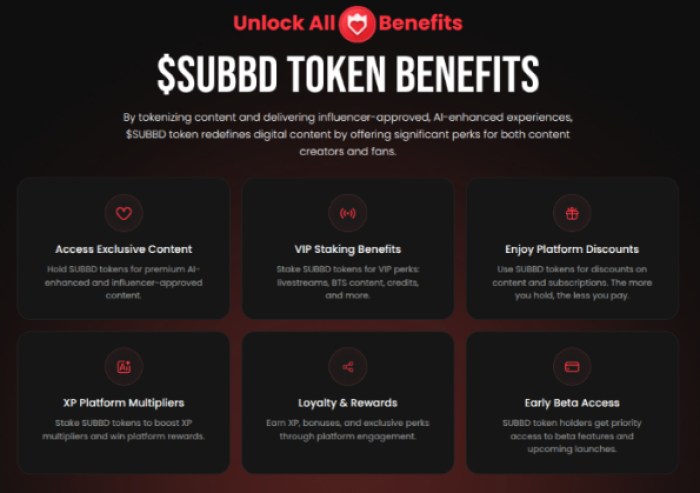
Source: SUBBD Token

But it’s not just about yield. For fans, staking unlocks tiered platform benefits, including access to exclusive livestreams and ‘HoneyHive’ membership. This gamification of finance, where holding a token grants both interest and experiential access, is fast becoming the standard for successful Web3 launches.

As institutional giants like KBank build the stablecoin highways, projects like SUBBD are building the high-speed vehicles that give users a reason to drive on them.

VISIT THE OFFICIAL $SUBBD PRESALE SITE.

This article is not financial advice. Cryptocurrency investments, including presales and AI tokens, carry inherent risks. Always conduct independent research before making investment decisions.


相关问答

QWhat is Kasikornbank (KBank) doing to strengthen its position in the digital asset space according to the article?

AKasikornbank (KBank) is fortifying its digital asset infrastructure by filing trademarks for digital wallets and stablecoin solutions, signaling a serious institutional push to integrate blockchain technology and capture digital capital flows in Southeast Asia.

QHow does the SUBBD Token ($SUBBD) aim to benefit content creators?

ASUBBD Token ($SUBBD) aims to return control to creators by using an ERC-20 token to cut out high banking fees and payment processor delays. It also integrates AI tools for content generation and community management, and allows token holders to participate in governance.

QWhat specific AI tools does the SUBBD ecosystem integrate for creators?

AThe SUBBD ecosystem integrates proprietary AI models for AI Voice Cloning and AI Influencer Creation, as well as an AI Personal Assistant for automated interactions to help creators scale their output and manage community engagement.

QWhat financial incentive does SUBBD offer to early token holders?

ASUBBD offers a staking protocol with a fixed 20% APY for the first year to reward early adopters, lock liquidity, and stabilize the token's circulating supply during its initial growth phase.

QHow much funding has SUBBD secured in its ongoing presale, and what does this indicate?

ASUBBD has secured over $1.4 million in its ongoing presale, indicating robust market confidence in its roadmap and demand for utility-driven AI projects despite broader market volatility.

你可能也喜欢

Solana 基金会与 Google 合作推出 Pay.sh,能否打通智能体经济中 Web2 与 Web3 的支付链路?

随着AI智能体能力的增强,面向智能体构建支付系统成为必要,但现有方案存在局限:传统支付系统(如信用卡)不适合智能体;新兴链上支付协议(如x402、MPP)则需额外搭建系统,门槛较高。两者未能融合,限制了智能体服务的范围。 为此,Solana基金会与Google Cloud联合推出Pay.sh,定位为“智能体与企业级服务之间的支付网关”,旨在打通智能体调用服务的支付环节。用户可通过信用卡或稳定币为Solana钱包充值,该钱包即可作为智能体的身份和支付代理。智能体无需注册或输入API密钥,即可通过Pay.sh使用Google Cloud、阿里云等服务。 Pay.sh兼容x402和MPP协议:当服务器返回402状态码(需要支付)时,Pay.sh能根据服务类型(一次性付费或持续计费)自动选择合适的支付方式。它支持一次性转账或会话授权凭证,以降低使用成本。同时,Pay.sh确保钱包本地存储,仅在支付时请求用户确认,并过滤服务商返回的指令以防止恶意攻击。 对服务商而言,Pay.sh提供易于集成的网关,只需声明支付参数即可支持复杂场景(如阶梯收费、自动分账)。服务商还可将API发布至Pay Skill Registry,供智能体发现和使用。 Pay.sh的优势在于打通Web2与Web3支付生态,为智能体提供合规身份和支付能力。通过与Google合作,其流量调度和日志合规可在Google Cloud上完成,有助于规范智能体行为。此外,Pay.sh补全了智能体商业协议(如A2A、AP2)的支付环节,促进了价值流动,也为Solana生态带来更多流量。 但Pay.sh仍面临挑战:服务商注册表缺乏准入和去中心化验证机制,可能导致智能体接入冒牌服务;其安全性依赖底层协议,存在外部风险;同时,各国API供应商可能因合规顾虑而限制使用。 总体而言,Pay.sh标志着智能体支付基础设施向Web2与Web3融合迈出关键一步,链上钱包有望成为智能体参与多样化任务的背书,其后续发展值得关注。

marsbit17分钟前

Solana 基金会与 Google 合作推出 Pay.sh,能否打通智能体经济中 Web2 与 Web3 的支付链路?

marsbit17分钟前

如何用Claude Skills自动化任何工作流(完整教程)

本文是一份全面的Claude Skills实战教程,旨在帮助用户通过构建自定义Skills(技能),将AI深度、稳定地融入日常工作流,实现任务的标准化与自动化。 **核心概念:** Claude Skill并非简单的预设提示词,而是一个包含详细工作流指令的永久性文件(SKILL.md)。它像一个训练有素的“员工”,能确保每次执行相同任务时,流程、标准和输出格式都保持一致,从而获得远超一次性Prompt的稳定高质量结果。 **教程分为四个阶段:** 1. **快速上手(5分钟):** 了解Skills以文件夹形式存放,学会从官方或社区平台查找、安装现有Skill,并应用于真实任务进行初步体验。 2. **从零构建:** 在创建自定义Skill前,需明确回答三个问题:技能的具体用途、至少五个触发短语、完美输出的具体示例。随后编写SKILL.md文件,其结构包括:顶部的YAML元数据(含名称和具体触发描述)和下方用自然语言编写的一步步工作流说明(需包含示例、边界情况及明确标准)。 3. **测试与优化:** 通过“三场景测试”确保Skill达到生产级水平:常规场景(80%常用情况)、边界场景(处理异常或信息缺失)、压力场景(应对最复杂情况)。每次不理想的输出都应触发对SKILL.md的即时优化,通过持续迭代使输出媲美专业人士。 4. **搭建技能库:** 为工作流中各项重复任务构建专属Skill,例如内容创作、数据分析、邮件起草等。一个月可积累十个生产级Skill,三个月可形成覆盖主要工作的完整技能库,从而将AI转化为高效的“团队”,让使用者更专注于策略而非执行。 **文章强调,** 持续构建和优化Skill库能带来显著的时间复利(例如十个技能每年可节省260小时),是从“使用AI”转向“用AI系统工作”的关键。

marsbit45分钟前

如何用Claude Skills自动化任何工作流(完整教程)

marsbit45分钟前

交易

现货
合约

热门文章

如何购买PUSH

欢迎来到HTX.com!我们已经让购买Push Protocol(PUSH)变得简单而便捷。跟随我们的逐步指南,放心开始您的加密货币之旅。第一步:创建您的HTX账户使用您的电子邮件、手机号码注册一个免费账户在HTX上。体验无忧的注册过程并解锁所有平台功能。立即注册第二步:前往买币页面,选择您的支付方式信用卡/借记卡购买:使用您的Visa或Mastercard即时购买Push Protocol(PUSH)。余额购买:使用您HTX账户余额中的资金进行无缝交易。第三方购买:探索诸如Google Pay或Apple Pay等流行支付方法以增加便利性。C2C购买:在HTX平台上直接与其他用户交易。HTX场外交易台(OTC)购买:为大量交易者提供个性化服务和竞争性汇率。第三步:存储您的Push Protocol(PUSH)购买完您的Push Protocol(PUSH)后,将其存储在您的HTX账户钱包中。您也可以通过区块链转账将其发送到其他地方或者用于交易其他加密货币。第四步:交易Push Protocol(PUSH)在HTX的现货市场轻松交易Push Protocol(PUSH)。访问您的账户,选择您的交易对,执行您的交易,并实时监控。HTX为初学者和经验丰富的交易者提供了友好的用户体验。

941人学过发布于 2024.03.29更新于 2025.04.02

如何购买PUSH

相关讨论

欢迎来到HTX社区。在这里,您可以了解最新的平台发展动态并获得专业的市场意见。以下是用户对PUSH(PUSH)币价的意见。

活动图片