The European Central Bank (ECB) has reportedly endorsed the European Union’s (EU) plan to shift oversight of key financial markets, including crypto, from national authorities to a centralized supervisory authority.
ECB Greenlights Crypto Oversight Centralization
On Friday, the European Central Bank backed the EU’s proposal to integrate the bloc’s capital market through a centralized entity, seeking to boost the region’s competitiveness and harmonize regulation, Reuters reported.
The financial regulator expressed its full support for enhanced EU-level oversight of systemically important, cross-border financial market participants, including major trading platforms, central counterparties, central securities depositories, and crypto asset service providers (CASPs).
“The ECB fully supports the Commission proposals, which constitute an ambitious step towards deeper integration of capital markets and financial market supervision within the Union,” it said in an opinion. It’s worth noting that the opinion is required by the Commission’s legislative process, but is not binding for lawmakers.
The plan, led by France and Germany, was initially suggested during the development of the Markets in Crypto-Assets Regulation (MiCA). It proposes transferring the power to authorize new businesses and supervise all crypto asset service providers to the bloc’s market watchdog, the European Securities and Markets Authority (ESMA).
In October, ESMA’s Chair, Verena Ross, disclosed that the EU’s executive branch was in the process of formulating regulations to grant enhanced authority to the regional regulatory authority and push for a “more integrated and globally competitive” capital market within Europe.
She argued that nation-level regulation takes significant effort to build up specific new resources and expertise 27 times in different national supervisors, which “could have been done more efficiently once at a European level.”
The ECB’s Friday opinion noted that ESMA will need adequate resources and staffing to handle the increased responsibilities. Furthermore, it suggested a gradual transition from national to EU-level supervision to minimize disruption.
Now, the Commission’s proposal will be negotiated between EU governments and the European Parliament, with discussions expected to last several months before the law is finalized.
EU’s Proposal Could Undermine MiCA’s Credibility
Despite the ECB’s support, some EU countries and crypto industry participants have opposed the EU’s proposal, arguing that it could undermine the efforts of national watchdogs and businesses over the past few years to regulate the industry and implement the bloc’s comprehensive framework for crypto assets.
Smaller EU nations, including Luxembourg, Ireland, and Malta, have expressed concerns about the proposal and ESMA’s ability to oversee the crypto market, arguing it could weaken their financial sectors.
Notably, ESMA questioned Malta’s process for approving pan-EU licenses for crypto companies last year, finding the national regulator only “partially met expectations,” despite having adequate staffing and technical infrastructure.
As reported by Bitcoinist, Robert Kopitsch, secretary general of Blockchain for Europe, said in November that reopening MiCA at this stage could introduce legal uncertainties, potentially delaying the authorization process and diverting attention and resources from the practical task of consistent implementation.
Kopitsch believed that a shift towards a more centralized supervisory model should occur based on “concrete experience and evidence gathered from MiCA’s initial years of implementation.” He also pointed out that local regulators have had more direct and frequent interactions with firms.
Andrew Whitworth, the founder of Global Policy Ltd., confirmed that transferring oversight would require additional resources to manage the current workload handled by local regulators. He acknowledged that this change could be challenging at the moment, considering the current implementation status and the need to adjust the goalposts
Judith Arnal, associate senior research fellow at the Centre for European Credit Research Institute (ECRI) and board member at the Bank of Spain, has also said that the recent attempts to amend the bloc’s crypto rules, particularly in the stablecoins sector, risk “undermining MiCA’s credibility as a coherent and globally influential regulatory framework.”
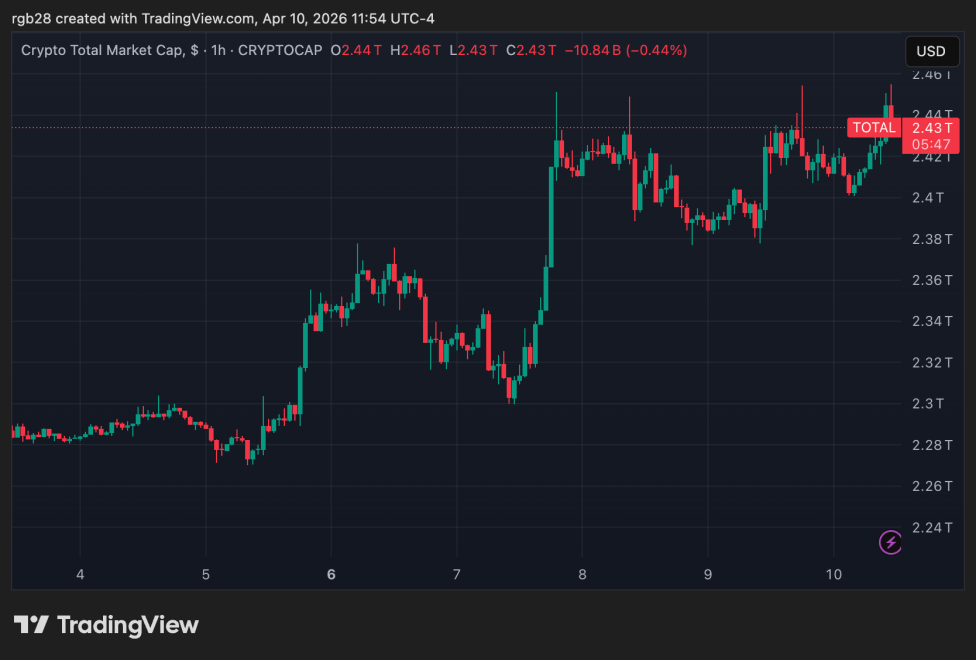
The total crypto market capitalization is at $2.43 trillion in the one-week chart. Source. TOTAL on TradingView