Author: Azuma
Original Title: Circle's Acquisition of Axelar Sparks Controversy: Giant Wants the People, Not the Coin
In the early hours of December 16th, stablecoin giant Circle officially announced it had signed an agreement to acquire the core talent and technology of Interop Labs, the initial development team behind the cross-chain protocol Axelar Network. This move aims to advance Circle's cross-chain infrastructure strategy and help achieve seamless, scalable interoperability for core Circle products like Arc and CCTP.
This seemed like another classic case of an industry giant acquiring a quality team, appearing to be a win-win situation. However, the crucial point is that Circle explicitly stated in its acquisition announcement that the deal only involves the Interop Labs team and its proprietary intellectual property. The Axelar Network, the Axelar Foundation, and the AXL token will continue to operate independently under community governance, with another contributing team, Common Prefix, taking over Interop Labs' original related activities.
In simple terms, Circle took the original development team of Axelar Network but explicitly discarded the Axelar Network project itself and its AXL token.
Affected by this sudden news, AXL plummeted sharply. As of around 10:00 AM today, it was temporarily quoted at $0.115, a 24-hour drop of 15%.
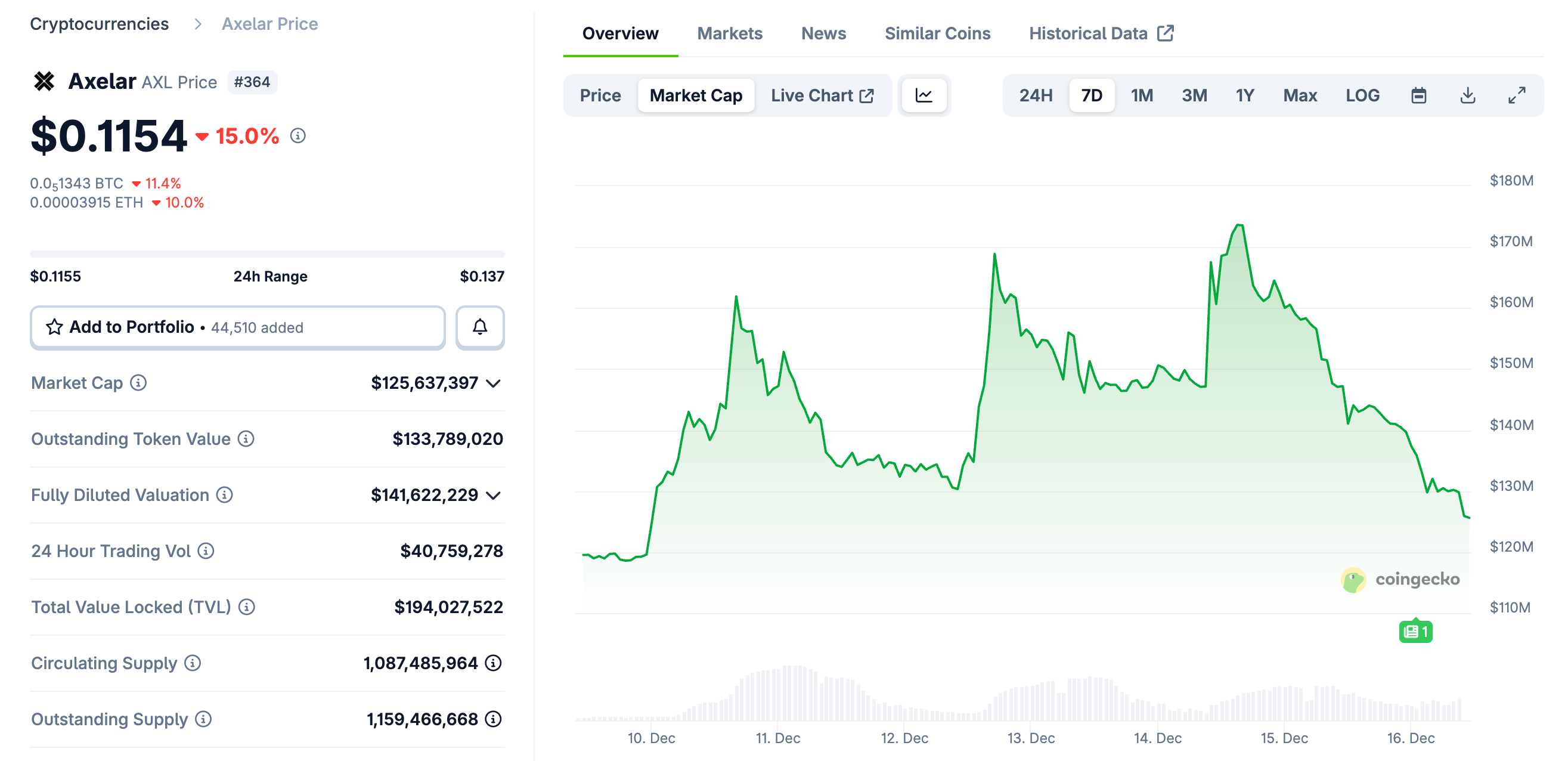
Simultaneously, the unique "acquire the team, discard the token" nature of the acquisition and the衍生出的 "equity vs. token" issue have sparked extensive discussion within the community. Supporters and opponents of this acquisition model are locked in debate, each holding their own views.
Opposing Viewpoint: A disguised RUG, Circle is out of line, only token holders are getting hurt......
The core strength of the opposition consists of some VCs, which is understandable — "I invested real money in the project's token equity, holding a bunch of tokens. Now you've taken the key developers away, what use do I have for these tokens?"
Moonrock Capital founder Simon Dedic commented on this: "Another acquisition, another RUG. Circle acquiring Axelar but explicitly excluding the Foundation and the AXL token is practically criminal. Even if it doesn't break the law, it violates ethics. If you are a founder wanting to issue a token: either treat it like equity, or please get lost."
The Block co-founder and 6MV founder Mike Dudas commented: "For everyone thinking this is a token vs. equity issue, I can tell you clearly, this is entirely Circle causing trouble. Rumors suggest that Circle's VP of Corporate Development once told an Axelar co-founder 'I don't care about your investors,' and 'bought' the CEO and IP out from under the investors' noses without paying them any consideration, even though this IP and team were crucial for Arc's launch."
Lombard Finance founder posted AXL's price chart and predicted: "Axelar's core team was bought by Circle, AXL might be worthless now. It's been over three years since the token issuance, the team's equity has long been fully vested. But this outcome feels very uncomfortable: the team and/or investors sell tokens for profit, while token holders can only pin their hopes on a distant dream."
ChainLink community figurehead Zach Rynes stated: "This again exposes the token vs. equity利益冲突 problem plaguing the crypto industry. The development team behind the protocol gets successfully acquired, while the token holders who funded this team get nothing. The so-called continued independent operation under community governance is no different than the development team abandoning its users for better prospects. If we want to attract real capital, this is the primary issue the industry urgently needs to solve."
SOAR Ecosystem Lead Nicholas Wenzel said: "Axelar token is heading to zero, thanks for playing everyone. Another acquisition where token holders get nothing and equity holders make a fortune."
Supporting Viewpoint: Normal market behavior, tokens are naturally at the bottom of the capital structure
If the opposition focuses more on the unfair treatment of token holders, the supporters focus more on the rules of financing and mergers and acquisitions.
Arca Chief Investment Officer Jeff Dorman believes Circle's approach is not problematic and wrote a long explanation about the capital structure of corporate financing and the天然劣势 position tokens occupy.
Companies raise capital through different tiers of the capital structure, and these tiers have a clear order of priority—some tiers are naturally senior to others: Secured Debt > Unsecured Senior Debt > Subordinated Debt > Preferred Stock > Common Stock > Tokens.
History is filled with examples where gains for one type of investor came at the expense of another.
-
In bankruptcies, creditors win at the expense of equity investors;
-
In Leveraged Buyouts (LBOs), equity holders often profit at the expense of creditors;
-
In take-unders, creditors are usually prioritized over equity holders;
-
In strategic acquisitions, usually both creditors and equity holders benefit (but not always);
-
And tokens are often at the very bottom of the capital structure......
This doesn't mean tokens have no value, nor does it mean tokens necessarily need some kind of "protection mechanism," but the market needs to recognize the reality: when someone acquires a company whose value isn't high to begin with, and the token issued by that company is also nearly worthless, token holders won't magically receive a "magical dividend." In such cases, gains for equity often come at the expense of losses for the token.
Electric Capital co-founder Avichal Garg also commented: "This is normal. If all future value is created by the team, no company will want to pay returns to investors."
Core Contradiction: What exactly is a Token?
Surrounding the "acquire the team, discard the token" acquisition storm involving Axelar and Circle, both sides of the debate seem to have their points.
The anger of the opposition is real: Token holders bore the risk during the project's most difficult times, when it most needed liquidity and narrative support, yet were completely excluded at the critical juncture of value realization. From the result, the core team and intellectual property achieved value monetization, while the token was left in the vacuum narrative of "community governance." The market voted most directly with the price, which is indeed deeply frustrating for all who believed in the token's value.
The judgment of the supporters is also reasonable in a practical sense: From a strict capital structure perspective, tokens are neither debt nor equity and naturally lack priority in the context of M&A and liquidation. Circle did not violate existing commercial rules; it just冷静地 chose the assets most valuable to itself.
The true core of the contradiction is not whether Circle acted morally, but rather a question the industry has long刻意回避: What exactly is a token in the legal and economic structure?
When prospects are bright, tokens are默认为 "quasi-equity," imbued with the imagination of claiming future success; but in practical scenarios like acquisitions, bankruptcies, and liquidations, they are quickly reduced to their original form of "rights-less certificates." This narrative equity-ization coupled with structural subordination is the root cause of recurring conflicts.
The Axelar acquisition might not be the last similar controversy, but hopefully it can serve as an opportunity for the industry to further contemplate the positioning and meaning of tokens — tokens do not naturally possess rights; only institutionalized, structured rights are acknowledged at critical moments. The specific form of implementation still requires all practitioners to explore and practice together.
Twitter:https://twitter.com/BitpushNewsCN
Bitpush TG Discussion Group:https://t.me/BitPushCommunity
Bitpush TG Subscription: https://t.me/bitpush