CFTC changes guard as Selig takes reins, Pham departs

cointelegraph发布于2025-12-23更新于2025-12-23

文章摘要

The US Commodity Futures Trading Commission (CFTC) has undergone a leadership transition, with Mike Selig sworn in as the new chairman, replacing acting chair Caroline Pham, who has departed. Selig, confirmed by the Senate after being nominated by President Trump, is now the agency's sole commissioner. He is widely viewed as pro-crypto and has pledged to support innovation in technologies like blockchain by avoiding a "regulation by enforcement" approach. Meanwhile, Pham, who had led the CFTC since January, is moving to crypto fintech company MoonPay. Both expressed support for balanced regulatory frameworks that foster innovation while ensuring market integrity.

The US Commodity Futures Trading Commission has officially undergone a change of leadership, with acting chair Caroline Pham saying she will leave the agency on Monday, while Mike Selig was sworn in as chair.

Pham, who had been serving as the CFTC’s acting chair since January and its sole commissioner since August, said on Monday that it would be her last day at the agency.

Meanwhile, the CFTC confirmed that Selig was sworn in as the agency’s 16th chairman on Monday after being nominated for the role by President Donald Trump on Oct. 27 and confirmed by the Senate on Thursday.

Pham’s departure leaves Selig as the CFTC’s sole commissioner. He is widely seen as pro-crypto and previously served as the chief counsel of the Securities and Exchange Commission’s Crypto Task Force.
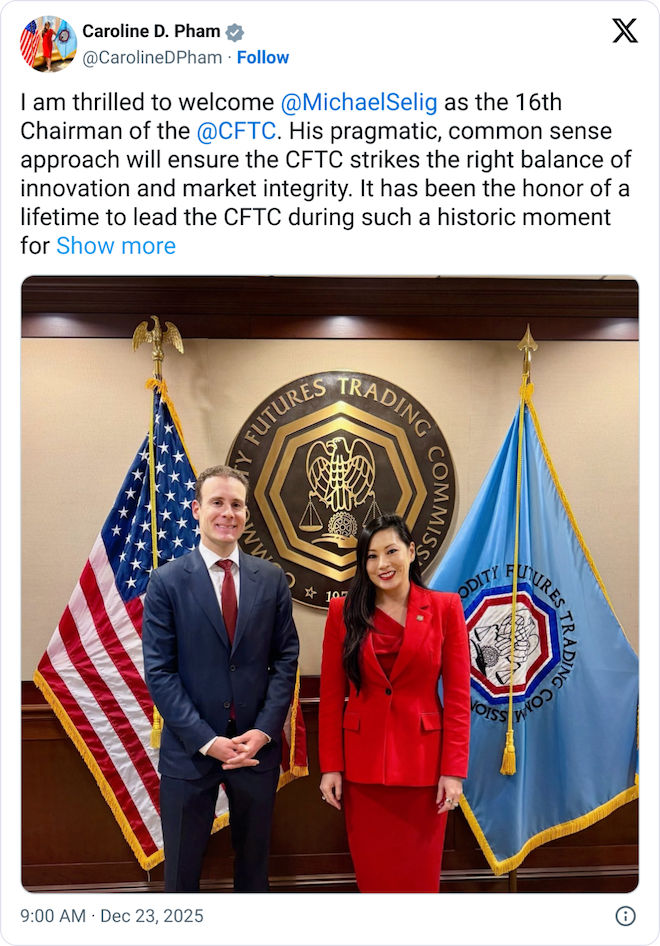
Source: Caroline Pham

Selig to continue positive momentum in crypto oversight

Selig will now serve a term that will expire in April 2029, and has previously vowed to support growth in innovative technologies such as crypto and blockchain by avoiding a so-called “regulation by enforcement” approach.

“I’m grateful for the confidence President Trump has placed in me and for the opportunity to lead the CFTC at this pivotal time,” Selig said.

“We are at a unique moment as a wide range of novel technologies, products, and platforms are emerging, retail participation in the commodity markets is at an all-time high, and Congress is poised to send digital asset market structure legislation to the President’s desk, cementing the US as the Crypto Capital of the World.”

On Monday, White House crypto czar David Sacks said Selig and SEC chair Paul Atkins were a “dream team to define clear regulatory guidelines.”

Pham shifts to crypto after steering CFTC

Pham has long said she would leave the CFTC once Congress confirmed someone to lead the agency, and on Wednesday, MoonPay confirmed earlier reports that Pham was headed to the crypto fintech company.

Pham’s time as acting chair saw her take a proactive approach to supporting crypto regulation.

Related: Wall Street’s bid on crypto dominated 2025 but what’s the demand outlook for 2026?

Pham said in her departing statement that the CFTC had “refocused on our mandate to promote responsible innovation and fair competition as the CFTC prepares to take on expanded oversight of new markets and new products like digital assets, crypto, and prediction markets.”

“I am thrilled to welcome Michael Selig as the 16th Chairman of the CFTC. His pragmatic, common-sense approach will ensure the CFTC strikes the right balance of innovation and market integrity,” she added.

Magazine: Meet the onchain crypto detectives fighting crime better than the cops

相关问答

QWho is the new chairman of the CFTC and when was he sworn in?

AMike Selig is the new chairman of the CFTC. He was sworn in on Monday after being nominated by President Donald Trump on Oct. 27 and confirmed by the Senate.

QWhat is Mike Selig's stance on cryptocurrency regulation and what is the length of his term?

AMike Selig is widely seen as pro-crypto and has vowed to support growth in innovative technologies by avoiding a 'regulation by enforcement' approach. His term will expire in April 2029.

QWhy did Caroline Pham leave the CFTC and what is her new role?

ACaroline Pham left the CFTC once a new chair was confirmed by Congress. She is headed to the crypto fintech company MoonPay.

QWhat did White House crypto czar David Sacks say about the new regulatory leadership?

ADavid Sacks said that Selig and SEC chair Paul Atkins were a 'dream team to define clear regulatory guidelines'.

QWhat was Caroline Pham's approach to crypto regulation during her time as acting chair?

AAs acting chair, Caroline Pham took a proactive approach to supporting crypto regulation, refocusing the CFTC on its mandate to promote responsible innovation and fair competition for new markets like digital assets.

你可能也喜欢

杨歌 Gary:Agent 经济与 AI 亚微观经济学

本文探讨了AI Agent经济与AI亚微观经济学的前沿趋势。文章指出,自“奇点”爆发以来,全球AI发展迅速,形成了新的“文明代际”。当前,硅谷等前沿地区已从单机AI(Claws & Agents)的瓶颈,进入到关注“Agent经济”(由自主AI智能体参与价值创造与交换的体系)和A2A(Agent间交互)生态构建的新维度。 文章围绕几个核心要点展开: 1. **AI支付(AI Payment)的竞争与H2A经济的瓶颈**:尽管Q2涌现了大量AI支付协议,但多数仍围绕H2A(人对Agent)场景,这本质上是非AI原生的。AI Agent的核心决策能力未得到充分发挥,H2A模式很快遇到瓶颈。聪明的企业开始以AI-Native思维反推,为A2A经济做准备。 2. **Agent经济与A2A生态的必然趋势**:由自主AI Agent作为经济主体直接参与价值活动的Agent经济,以及A2A生态的构建,被视为下一个关键投资方向。其发展范式类似互联网、移动互联网和DeFi的酝酿期,但速度更快、视角更抽象(非纯人类中心),且面临更大的共识挑战。 3. **AI协议与Crypto协议的关联与鸿沟**:AI协议是Agent经济活动的基础规则,目前形态多样(如文件、API),侧重信息与能力交换。而Crypto协议更侧重资产确权。两者虽有融合为统一数字协议的趋势,但目前存在明显鸿沟,部分原因在于当前AI经济仍受制于传统金融法律框架(如KYC)等政治经济因素。然而,AI Agent遵循第一性原理和效率优先原则,将挑战现有金融法律体系。 4. **AI Agent亚微观经济学特点与生物学类比**:AI Agent经济行为具有高频小额、能量驱动、效率导向、任务导向、组织与沟通成本趋近于零等特点。文章用生物学细胞结构类比AI Agent系统(LLM如细胞核,Agent Harness如细胞质,协议栈如细胞膜),描绘了一个类似生物机体的、正在形成的亚微观经济学环境。 5. **AIFi的必然与金融芯片(FinChip)**:随着AI Agent成为价值发现的主体,AI原生金融(AIFi)应运而生,其价值核心在AI,金融是表现形式,这与DeFi/TradFi相反。作者提出的“金融芯片”(FinChip)概念,旨在构建融合AI自主性与Crypto协议、兼容H2A与A2A的AIFi基础设施。 6. **AI-Native是范式升级**:AI+的产业升级远复杂于互联网+。AI发展快速、形式抽象、与业务深度耦合,短期内难以形成通用升级方法论。构建未来商业范式需要彻底的“AI原生思维”,即遵循第一性原理和效率最高原则,这对于所有从业者都是持续的巨大挑战。

链捕手4分钟前

杨歌 Gary:Agent 经济与 AI 亚微观经济学

链捕手4分钟前

从《大空头》到旧金山:AI泡沫里的狂欢与眩晕

《从〈大空头〉到旧金山:AI泡沫里的狂欢与眩晕》一文以电影《大空头》中“闻到了钱的味道”为引,描述了作者从纽约搬到旧金山后对当前AI热潮中心地带的观察。文章指出,旧金山密集的技术公司、风险资本与狂热氛围共同构成了真实的“泡沫”现场,信息不对称与财富创造在此同时上演。 作者总结了在旧金山的几点核心感受:首先,城市中弥漫着一种“发抖”般的焦虑能量,人们被“逃离永久底层”的心态驱动,体现出“大泡沫行为”。其次,旧金山几乎只有“科技”这一种地位游戏,人们通过融资轮次、估值等虚荣指标相互比较,攀比氛围浓厚。再者,城市中充斥着关于AGI(通用人工智能)的“末日论”情绪,研究者的悲观与市场团队的乐观形成反差。最后,投资界对数学竞赛天才出身的创始人有着近乎迷恋的追捧,将其视为获取超额回报的“门票”。 文章并未简单判断泡沫是否会破裂,而是聚焦于呈现泡沫中的众生相:人们如何在亢奋、比较、投机与恐惧中寻找自己的位置。文末引用投资人的建议提醒读者:可以参与这场派对(“跳舞”),但需保持清醒(“别喝醉”),避免被泡沫行为扭曲判断。整体而言,这是一份对AI热潮中心地带的生动现场记录,描绘了技术创新、金融投机与人性交织的复杂图景。

marsbit6分钟前

从《大空头》到旧金山:AI泡沫里的狂欢与眩晕

marsbit6分钟前

黄仁勋「拯救」韩国股市:锁定SK海力士内存,芯片短缺还将持续

6月5日,韩国股市经历“黑色星期五”,KOSPI指数暴跌。6月8日盘中跌幅一度超8%,触发熔断,三星与SK海力士股价重挫。在此市场动荡之际,英伟达CEO黄仁勋的访韩起到了“救市”作用。 6月7日晚,黄仁勋与SK集团及SK海力士高层共进晚餐。餐后,他确认英伟达新款Vera CPU将采用SK海力士的DRAM,双方正为下半年及明年的“超大规模合作”做准备,并预计当前的内存芯片短缺将持续数年。随后,双方官宣了一份多年期技术合作协议,涉及AI超级计算机、机器人、数字孪生和半导体制造等领域。黄仁勋更公开表示,当前AI公司股价极具吸引力。 合作具体包括:英伟达将Vera CPU等产品线的内存供应锚定SK海力士,共同开发下一代内存以支持AI基础设施。同时,SK海力士将利用英伟达的CUDA-X库和AI技术加速其芯片设计与制造流程,如计算光刻和构建晶圆厂数字孪生,目标是实现完全自主的工厂运营。 此次合作早有铺垫。2025年10月,双方曾宣布在韩国合作建设大型AI工厂。尽管与SK海力士深化绑定,但英伟达在下一代HBM4内存上并未独家采购,三星、SK海力士和美光均已获得认证并将共同供货。黄仁勋指出,由于AI工厂建设导致需求激增,从晶圆到封装等整个半导体供应链的短缺状况预计将持续数年。 黄仁勋此行还会见了现代、LG、三星等韩国企业,表明英伟达正系统性深化与韩国科技产业的联系,SK集团是其中的关键一环。

marsbit1小时前

黄仁勋「拯救」韩国股市:锁定SK海力士内存,芯片短缺还将持续

marsbit1小时前

纳指单日跌幅4.2%,“黑色星期五”戳破美股泡沫?

2026年6月5日,美股遭遇剧烈回调,纳指重挫4.18%,创一年多最大单日跌幅,标普500指数结束九周连涨,半导体板块领跌。直接导火索是远超预期的5月非农就业数据,引发市场对经济过热和美联储推迟降息的担忧,美债收益率跳升,高估值的科技股首当其冲。 此次暴跌暴露出AI板块积聚的脆弱性。过去18个月推动股市上涨的AI叙事出现裂痕,部分云服务商削减芯片订单,企业端AI应用变现不及预期,导致前期拥挤的交易出现踩踏式平仓。 市场估值处于历史高位,多项指标(如席勒市盈率、巴菲特指标)显示美股已进入高估区间。同时,散户情绪乐观、杠杆水平高,而“聪明钱”如巴菲特的公司已囤积大量现金。技术面上,标普500指数关键支撑位被击穿,面临进一步调整压力。 华尔街对此看法分化:空方认为这可能是泡沫调整的开始,经济存在滞胀风险;多方则认为这是牛市中的健康回调,经济基本面依然稳固,企业盈利增长仍有支撑。未来走势关键取决于即将公布的5月CPI数据和6月的美联储议息会议,其结果将重塑市场对利率路径的预期。 总而言之,支撑美股高估值的核心支柱——降息预期发生动摇,AI叙事面临现实检验。市场正进入由宏观数据和盈利基本面主导的敏感阶段,投资者需保持谨慎,密切关注通胀数据与美联储政策信号。

marsbit1小时前

纳指单日跌幅4.2%,“黑色星期五”戳破美股泡沫?

marsbit1小时前

交易

现货
合约
活动图片