Cardano’s ‘ghost chain’ label debunked? Why ADA’s 34 dApps don’t tell the full story

ambcrypto发布于2026-06-30更新于2026-06-30

文章摘要

The article examines and refutes the "ghost chain" label sometimes applied to Cardano (ADA). While Cardano has significantly fewer dApps and lower transaction/user counts compared to leading Layer 1 chains like Ethereum and Solana, this is partly due to its unique Extended Unspent Transaction Output (EUTXO) model. This model batches transactions, improving security and determinism but potentially underrepresenting true on-chain activity. The piece acknowledges recent ecosystem challenges but highlights Cardano's strong development activity and its distinct focus on peer-reviewed research, security, and sustainability for institutional use. It concludes that while various chains occupy different niches, low activity metrics alone are insufficient to deem Cardano a "ghost chain."

A ghost chain is a blockchain that is technically running but has very little on-chain activity and development activity.

Over the past decade, there have been many shiny new blockchains that have burst onto the scene. They managed to capture the public’s attention, attracting capital inflows, but have fizzled away eventually.

This fizzle can be due to a lack of funding, community conviction, or the failure to address real issues.

A decline in upgrades and communication regarding the future vision, a failure to keep hold of the influx of initial users due to questionable utility, or a security mishap that leads to a significant loss due to hacks and exploits can devastate investor sentiment.

Compounded over time, a steady decline in usage and trading volume can see a functional chain that is hardly being used at scale.

The chains that have stood the test of time are the ones high up in the crypto assets list. None of the dozens of so-called Ethereum killers that seized the public imagination have managed to knock Ethereum off its pedestal in the crypto ecosystem.

A closer look at the current top Layer 1 tokens

Owing to its reliability and security, and combined with Layer-2 solutions that address speed, Ethereum is the dominant base layer blockchain. It dominates the DeFi sectors due to liquidity and security and also processes over half of all stablecoin activity.

XRP is optimized to be a cross-border settlement layer by using its On-Demand Liquidity network to convert fiat into XRP, send it globally, and convert it back to fiat within seconds.

Solana has exceptional throughput and is a hub for trading. Low-cost, high-speed settlements mean that Solana is a leader in real-world asset tokenization.

TRON is the primary Tether [USDT] settlement layer, with over 75% of USDT transfers occurring on this network. TRON’s high throughput also makes it a highly active DeFi chain by transaction volume.

And of course, the Bitcoin network has the strongest security among them all. The asset itself is primarily used as a store of value and a hedge against inflation and also acts as institutional-grade collateral.

Cardano has a more unique role in the crypto ecosystem. Its focus is on sustainability, security, and rigorous, peer-reviewed development methodology. As a result, it is well-suited for institutional compliance and enterprise requirements.

Factors critics point at to throw “ghost chain” shade at Cardano

Earlier in June, TapTools, the Cardano ecosystem’s primary blockchain explorer, began shutting down. The exit of senior executives took valuable technical know-how away.

This knowledge could not be replaced quickly enough to allow the platform to continue to be operated responsibly. It was worrisome.

Founder Charles Hoskinson warned that more dApps and DeFi on Cardano would die in the second half of the year. Treasury and community governance systems were unable to react fast enough to help save struggling projects.

Amid worsening market sentiment, the pressure on smaller projects with limited revenue could add to the concerns swirling around the Cardano ecosystem.
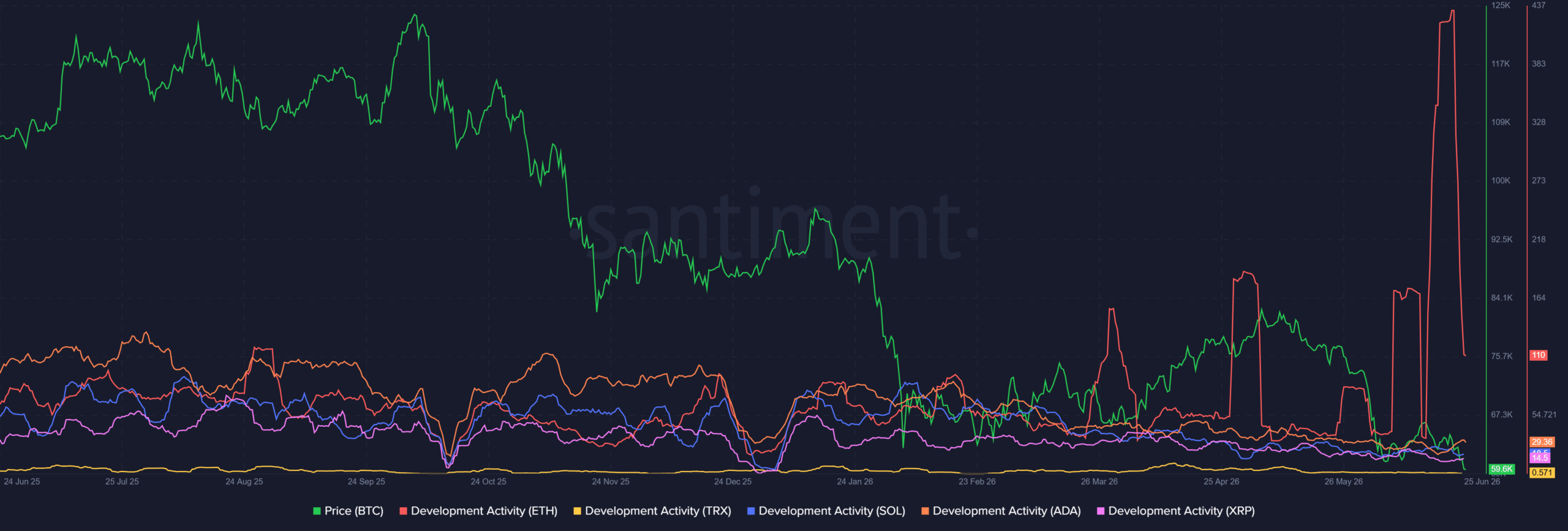
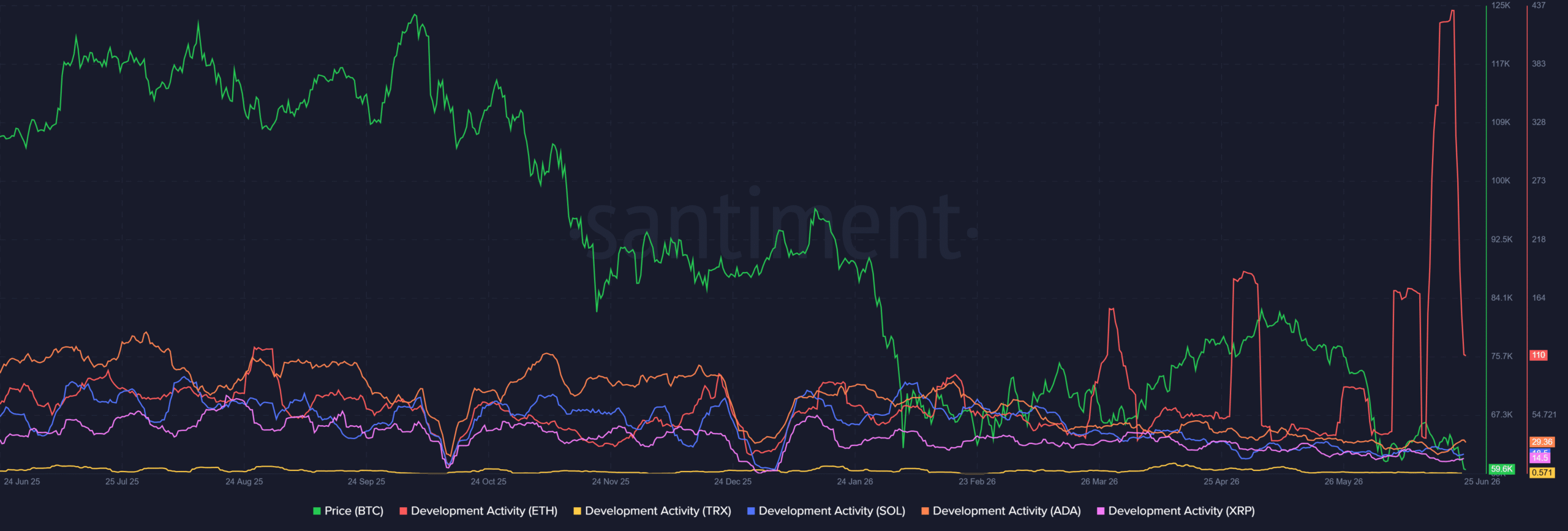
Source: Santiment

On the bright side, the developmental activity statistics for Cardano were strong. Santiment data showed that it was only second on the list of the prominent Layer 1 networks discussed earlier, in terms of developmental activity.

Yet, Cardano has far fewer dApps, numbering only 34, compared to Solana’s 442 and Ethereum’s 1564, according to blockchain data platform Moralis.
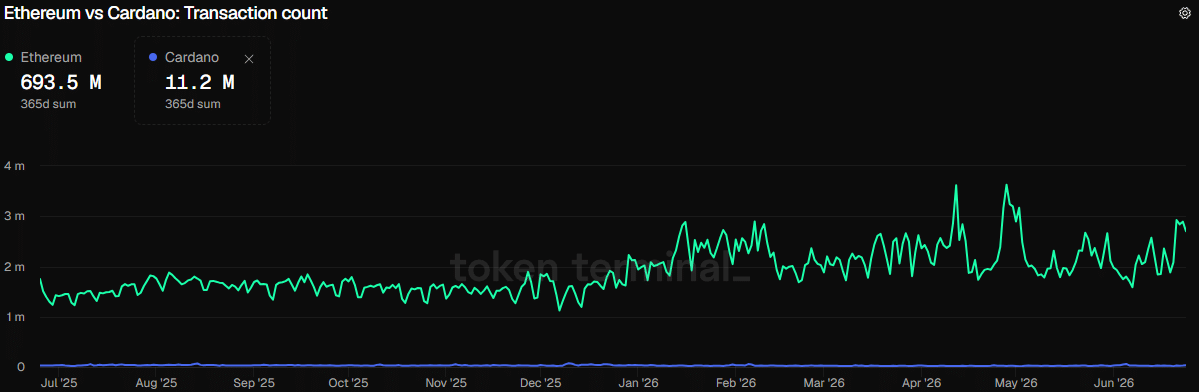
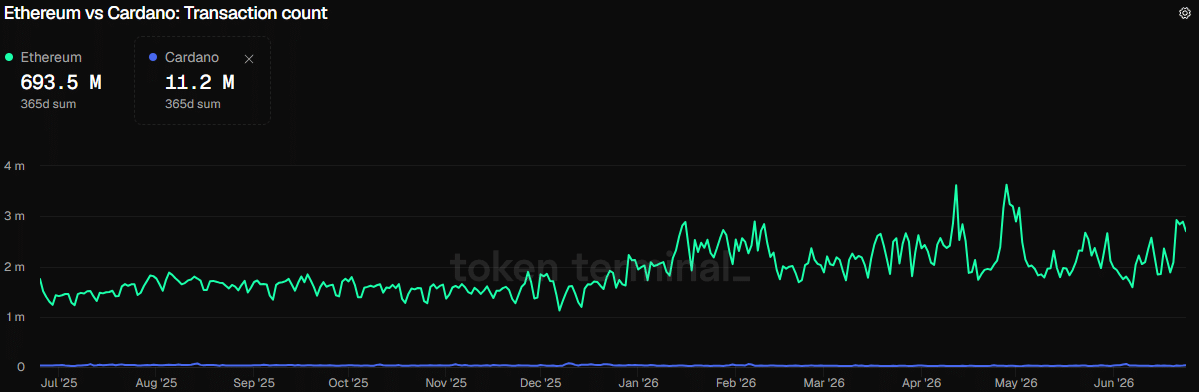
Source: Token Terminal

Yet, the transaction count comparison between Ethereum and Cardano showed a massive gulf. Solana was one of the leaders on this front, with 103.2 billion transactions over the past year, according to Token Terminal data.
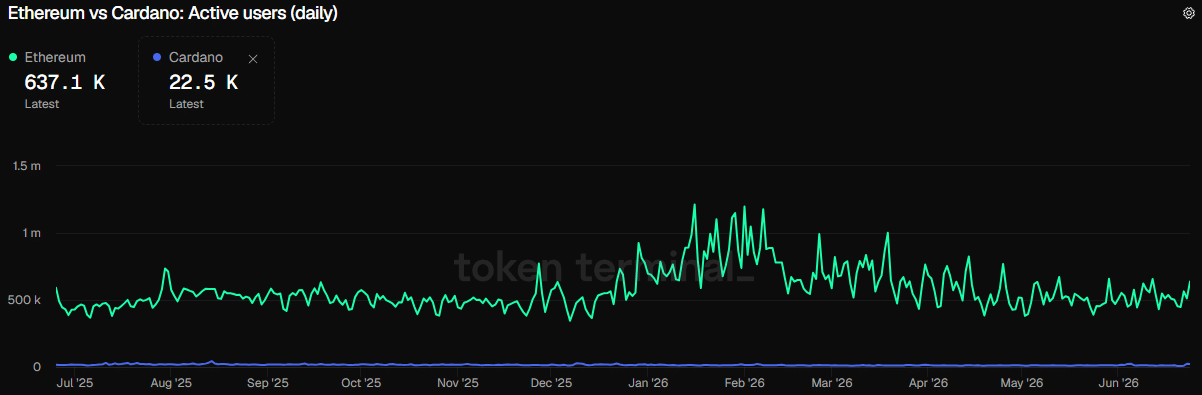
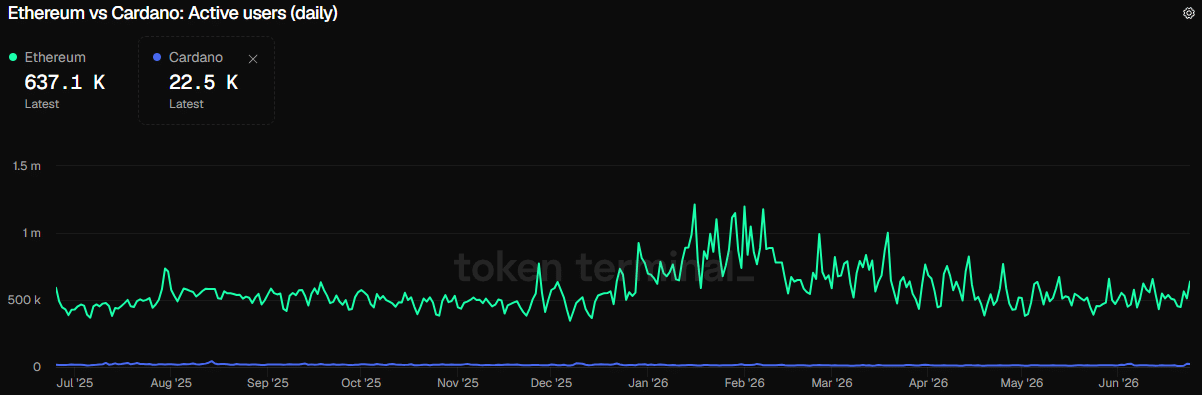
Source: Token Terminal

Similarly, the daily active users also showcased a giant gap in the numbers on the two chains. On this front, TRON was the winner, with 3.9 million active users, much higher even than Ethereum.

Explaining the vast gulf between Cardano and the other leading blockchains

While the extreme difference in on-chain activity can be alarming at first, it is not reason enough to conclude Cardano is a ghost chain. The network uses an Extended Unspent Transaction Output (EUTXO) model.

Batcher protocols scoop up the open orders on the blockchain, aggregating them into an optimized transaction that can be submitted to the Cardano ledger.

Effectively, the difference of a factor of 50 that we saw in a couple of metrics examined can be explained by the EUTXO model. Batching capabilities of the network offer advantages in determinism and security, but also underestimate on-chain activity.

In the past, blockchains that failed to fill a niche and dominate a segment of the market have withered away. The established survivors were doing relatively well, but it remains to be seen if they can keep their status in the years to come.


Final Summary

  • The blockchain trilemma means that various Layer 1s have to make their own tradeoffs. The dominant chains have managed to seize a niche for themselves.
  • The Cardano network activity was much lower than its peers, but this alone was not reason enough for critics to brand it a “ghost chain.”


热门币种推荐

相关问答

QWhat is a 'ghost chain' as defined in the article, and which blockchain is accused of potentially being one?

AA 'ghost chain' is defined as a blockchain that is technically running but has very little on-chain activity and development activity. The article discusses whether the label of a 'ghost chain' is justified for Cardano (ADA).

QAccording to the article, what are some of the key factors that have led critics to label Cardano a 'ghost chain'?

ACritics point to factors such as the shutdown of TapTools (Cardano's primary blockchain explorer), the warning from founder Charles Hoskinson about more dApps and DeFi projects potentially dying, and key metrics like Cardano having only 34 dApps compared to hundreds or thousands on other chains, as well as significantly lower transaction counts and daily active users.

QHow does the article explain the vast difference in on-chain activity metrics between Cardano and other leading blockchains like Ethereum and Solana?

AThe article explains the difference by citing Cardano's use of the Extended Unspent Transaction Output (EUTXO) model. Batcher protocols on Cardano aggregate multiple orders into single, optimized transactions for the ledger. This batching capability offers advantages in determinism and security but leads to an underestimation of on-chain activity when compared to simpler transaction counting on other networks.

QWhat is Cardano's stated unique role or focus in the crypto ecosystem, according to the article?

ACardano's focus is on sustainability, security, and a rigorous, peer-reviewed development methodology. As a result, it is described as being well-suited for institutional compliance and enterprise requirements.

QDespite the criticism, what positive metric for Cardano is highlighted in the article?

AThe article highlights that Cardano's developmental activity statistics are strong. Data from Santiment showed that Cardano ranked second only to Ethereum among the prominent Layer 1 networks discussed, in terms of developmental activity.

你可能也喜欢

2万亿美元,AI史上最大IPO进入倒计时

AI公司Anthropic预计将于今年十月进行IPO,估值可能突破2万亿美元,这将是史上最大规模的AI公司上市。其估值由六位投资人根据模型推算得出,其中有人甚至预估超过3万亿美元。公司内部对此并未设定明确目标。 Anthropic在短短五年内实现了惊人增长,从初创公司迅速跻身巨头行列。2025年底年化收入约90亿美元,到2026年5月已飙升至470亿美元,第二季度营收达115亿美元,同比激增14倍。内部预测,到2028年营收可能达到1900亿至2000亿美元。 公司收入主要依靠API和企业合同,按调用量计费,其中编程辅助工具Claude Code是增长核心,贡献近两成收入,在企业和开发者中广泛使用。 然而,公司内部正面临文化撕裂。CEO达里奥·阿莫代伊及其核心团队带有强烈的“拯救人类”使命感,被部分员工形容为“祭司阶层”,其管理风格引发基层员工不满,甚至出现了秘密的吐槽网络。员工在即将到来的财富自由与压抑的工作环境之间陷入挣扎。 Anthropic目前处境微妙:追求最安全的AI需要巨额算力投入,而这又依赖于资本市场支持,迫使公司在理想与商业现实间寻找平衡。其IPO前景虽被看好,但SpaceX上市后股价大跌的前例,以及监管、成本和内部治理等挑战,都为其未来增添了不确定性。

marsbit2分钟前

2万亿美元,AI史上最大IPO进入倒计时

marsbit2分钟前

降本增效的AI,让VC越来越烧钱

《降本增效的AI,让VC越来越烧钱》一文指出,尽管AI技术降低了创业公司的部分运营和开发成本,却推高了风险投资(VC)获取优质AI公司股权的价格。AI领域融资呈现“杠铃型”结构:一方面,普通初创企业融资规模趋于小额化;另一方面,顶尖团队(如来自OpenAI、Google DeepMind的核心人员)的早期项目估值急剧膨胀,数亿甚至上百亿美元的融资与估值在成立初期便已出现。 这种趋势导致VC持股成本显著上升。早期估值飙升的同时,创始人让渡的股权比例并未同步增加,使得VC为维持相同持股比例所需投入的资金大幅增加。为此,大型风投机构(如Accel、a16z)纷纷募集更大规模的基金,以覆盖从早期进入到后期跟投的全周期,确保在头部项目竞争中不落下风。 资金进一步向少数头部AI项目集中。2026年上半年,全球超70%的创业融资流向AI公司,其中OpenAI和Anthropic两家就占据了全球创业融资总额的43%。这种集中化加剧了VC行业的马太效应,大型基金凭借资金优势持续加码潜在赢家,而小型基金参与热门项目的能力受到削弱。 然而,高估值已提前计入了未来增长预期。若企业最终无法实现与估值匹配的商业化规模,投资回报将面临压缩。目前,许多基金的账面收益仍依赖后续融资的估值重估,而非实际退出。对大型VC而言,当下的核心策略已转变为:在技术“超级周期”中尽早押注潜在龙头,并为伴随估值飙升的持续跟投储备充足弹药。AI降低了创业门槛,却让投资优质AI公司的成本变得愈发昂贵。

marsbit28分钟前

降本增效的AI,让VC越来越烧钱

marsbit28分钟前

八年投入急转弯,以太坊为何突然放弃Poseidon?

以太坊基金会研究员Justin Drake近日宣布,以太坊将在Layer 1层放弃已研发八年的SNARK友好型哈希算法Poseidon,转而采用SHA2或BLAKE2等传统哈希函数。这一重大转向源于后量子密码学研究的突破性进展。 Poseidon自2019年起因其在零知识证明电路中的高效性,被广泛用于zkRollup等应用。但其算法历史较短,密码学分析时间不足。而随着后量子安全成为硬性要求,其局限性显现。最新的SNARK设计,特别是基于“二进制域”的证明系统(如Binius和Flock),已能高效处理传统哈希函数的布尔运算,使得SHA2等成熟算法在证明性能上可媲美甚至超越Poseidon,消除了采用后者的主要优势。 另一关键因素是应对量子计算威胁的时间表正在加速。报告预测“量子破译日”可能在本世纪30年代初到来,将对区块链资产构成巨大风险。以太坊因此需要尽快采用经过长期密码分析验证的、抗量子攻击能力更强的哈希方案。其后续量子路线图计划于2027年推出核心构件leanVM,并在2028年完成共识层、执行层和数据层的部署。 与此同时,其他公链如Solana已选定后量子签名方案Falcon,而StarkNet也计划采用BLAKE2等算法。以太坊此次转向,标志着技术重点从“设计SNARK友好型哈希”转变为“设计哈希友好型SNARK”,是在后量子时代选择更成熟、更稳健的密码学基元的战略调整。

marsbit1小时前

八年投入急转弯,以太坊为何突然放弃Poseidon?

marsbit1小时前

全球程序员都在给Anthropic白送钱!官方终于看不下去了

Anthropic官方发布博客,针对开发者使用Claude Code时可能产生的不必要高额费用,总结了六条核心省钱建议: 1. 任务完成后及时使用 `/clear` 清理对话,避免无关历史占用上下文。 2. 对话开始时固定好模型和推理强度,中途切换会导致提示缓存失效,需全价重新计算历史。 3. 使用 `@` 引用文件,而非手动输入路径,可避免Claude进行工具调用和试探性读取,减少上下文累积。 4. 为输出冗长的命令(如运行测试)添加静默参数,减少输出内容对上下文的占用。 5. 在会话缓存仍有效时(如休息前)进行 `/compact` 压缩对话,成本仅为十分之一。 6. 将产生大量输出的任务交由子Agent处理,其独立上下文不会污染主对话。 文章解释了费用产生的机制:输入token(预填充)成本较低,输出token(解码)成本约为其5倍。模型(Opus/Sonnet/Haiku)和推理强度直接影响单价和token数量。 **提示缓存是关键的省钱杠杆**:若请求前缀与之前完全相同,服务器可加载缓存结果,读取成本仅为正常输入价的10%。但切换模型、改变推理强度、执行压缩、缓存过期等操作都会导致缓存失效。 此外,对话历史会因不断追加文件内容和命令输出而“变胖”,导致后续每轮对话成本呈接近平方级(O(n²))增长。除了上述建议,还可使用 `/rewind` 回退无效轮次以保住前面缓存。 文章指出,管理token开销正成为AI时代开发者的新技能,关系到使用效率和成本控制。Anthropic自身大量使用AI编写代码,精细的成本管理至关重要。

marsbit3小时前

全球程序员都在给Anthropic白送钱!官方终于看不下去了

marsbit3小时前

交易

现货

热门文章

如何购买S

欢迎来到HTX.com!我们已经让购买Sonic(S)变得简单而便捷。跟随我们的逐步指南,放心开始您的加密货币之旅。第一步:创建您的HTX账户使用您的电子邮件、手机号码注册一个免费账户在HTX上。体验无忧的注册过程并解锁所有平台功能。立即注册第二步:前往买币页面,选择您的支付方式信用卡/借记卡购买:使用您的Visa或Mastercard即时购买Sonic(S)。余额购买:使用您HTX账户余额中的资金进行无缝交易。第三方购买:探索诸如Google Pay或Apple Pay等流行支付方法以增加便利性。C2C购买:在HTX平台上直接与其他用户交易。HTX场外交易台(OTC)购买:为大量交易者提供个性化服务和竞争性汇率。第三步:存储您的Sonic(S)购买完您的Sonic(S)后,将其存储在您的HTX账户钱包中。您也可以通过区块链转账将其发送到其他地方或者用于交易其他加密货币。第四步:交易Sonic(S)在HTX的现货市场轻松交易Sonic(S)。访问您的账户,选择您的交易对,执行您的交易,并实时监控。HTX为初学者和经验丰富的交易者提供了友好的用户体验。

3.6k人学过发布于 2025.01.15更新于 2026.08.06

如何购买S

相关讨论

欢迎来到HTX社区。在这里,您可以了解最新的平台发展动态并获得专业的市场意见。以下是用户对S(S)币价的意见。

活动图片