Cardano Founder Hoskinson Says Midnight Mainnet Is Now Live

bitcoinist发布于2026-04-01更新于2026-04-01

文章摘要

Cardano founder Charles Hoskinson announced the mainnet launch of Midnight, a privacy-focused blockchain within the Cardano ecosystem. The network, which has already produced over 163,000 blocks, is currently in a controlled "guarded era" with federated node operators ensuring stability. It features programmable privacy through zero-knowledge proofs, allowing selective data sharing. The ecosystem uses a dual-token model: NIGHT for governance and DUST for renewable transaction fees. Institutional partners include Worldpay, Google Cloud, and eToro. Hoskinson also released a free book on zero-knowledge proofs and confirmed upcoming Lace wallet updates.

Cardano founder Charles Hoskinson said Monday that Midnight is now live, marking the mainnet debut of the privacy-focused network that has been one of the highest-profile infrastructure bets tied to the broader Cardano ecosystem. In his March 30 livestream, Hoskinson said the chain had already been running for a while, with average block times holding at roughly six seconds, more than 163,000 blocks produced, and a finality gap of about two blocks.

Midnight Launch Marks Major Cardano Ecosystem Milestone

The launch itself was formally announced by Midnight via X. The project said the genesis block had been produced and that developers, partners and institutions would now be able to deploy applications and migrate assets onto the network. The release lands on the timeline the team had previously outlined in February, when Midnight said mainnet was scheduled for late March 2026. It also follows the December 2025 launch of NIGHT, the network’s native token, on Cardano.

Hoskinson framed the current phase as a controlled production launch rather than an instant jump to open decentralization. He described Midnight as being in a “guarded era,” with a strong federated network and an active post-launch bug-fix queue already numbering more than 130 items. None, he said, were showstoppers, but the team expects to spend the next two to three weeks hardening the system while partners and developers begin building against a live environment.

That characterization matches Midnight’s official rollout plan. The foundation said the network is entering production through a phased application deployment period designed to prioritize operational stability and security before later stages of decentralization. In this initial setup, federated node operators run the core infrastructure under explicit participation rules, with the longer-term goal of progressing toward a more decentralized and permissionless model.

Midnight’s launch post highlights a roster of federated node partners that includes Worldpay, Bullish, MoneyGram, Pairpoint by Vodafone, eToro, AlphaTON Capital, Google Cloud, Blockdaemon and Shielded Technologies. That institutional mix is central to Midnight’s pitch: a privacy-preserving public blockchain intended to support live applications without asking enterprises to accept the data exposure typical of fully transparent ledgers.

Midnight’s technical proposition is built around programmable privacy. According to the project’s launch materials, the network combines public and private data through a hybrid ledger architecture, uses client-side generation of zero-knowledge proofs so sensitive data remains on user devices, and supports both shielded and unshielded assets depending on the application’s needs. The protocol also supports selective disclosure, allowing counterparties, auditors or regulators to view specific records when application logic requires it, without exposing all underlying transaction data by default.

Economically, Midnight is also trying to differentiate itself from conventional gas-token networks. The chain uses a dual-component model in which NIGHT acts as the unshielded governance and utility token, while DUST functions as the renewable transaction resource consumed by applications. Midnight says DUST regenerates over time based on NIGHT holdings, with a full recharge reached over seven days, a design meant to make transaction costs more predictable for businesses and allow developers to subsidize usage for end users.

Hoskinson used the livestream to pair the launch announcement with a broader educational push. He said he has published a free book, Proving Nothing: A Complete Guide to Zero-Knowledge Proof Systems, aimed at non-technical readers who want a comprehensive overview of how ZK systems work.

On the product side, Hoskinson said Lace would receive an update tied to Midnight mainnet support, with version 136.2 already submitted for approval at the browser extension store. He added that Lace v2 and a mobile release are both expected in April.

At press time, Cardano traded at $0.24.
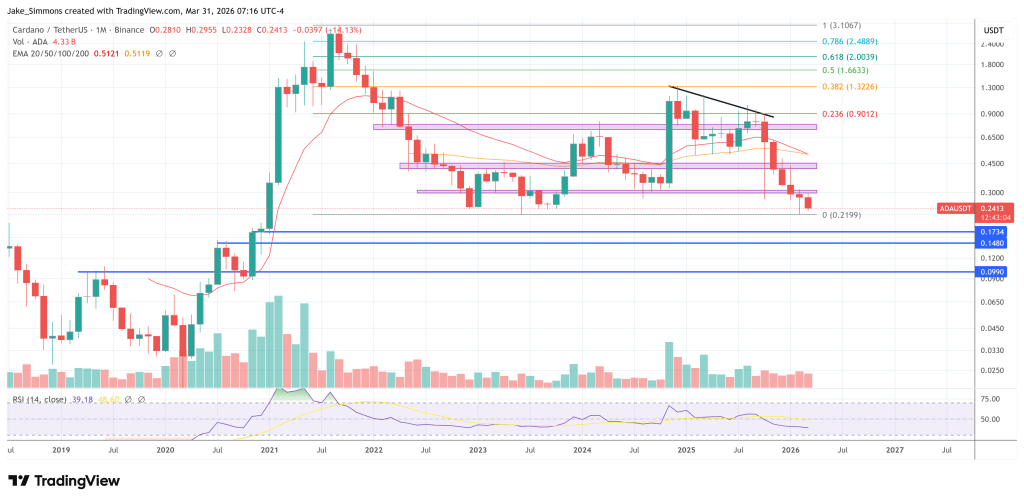
Cardano hovers below key resistance, 1-monthly chart | Source: ADAUSDT on TradingView.com

相关问答

QWhat is the significance of the mainnet launch for Midnight, as announced by Charles Hoskinson?

AThe mainnet launch marks the debut of the privacy-focused network Midnight, a high-profile infrastructure project within the Cardano ecosystem, and represents a major milestone for the broader Cardano ecosystem.

QHow does Midnight's initial 'guarded era' phase operate, according to the announcement?

AIn the initial 'guarded era,' Midnight operates with a strong federated network of node operators under explicit participation rules, prioritizing operational stability and security. This controlled production phase includes an active bug-fix queue and is designed to harden the system before progressing toward a more decentralized model.

QWhat key technical feature does Midnight use to ensure privacy for its users?

AMidnight uses a hybrid ledger architecture that combines public and private data, employs client-side generation of zero-knowledge proofs to keep sensitive data on user devices, and supports selective disclosure for authorized viewing of specific records without exposing all transaction data.

QWhat is the economic model of Midnight, and how does it differ from conventional blockchain networks?

AMidnight uses a dual-token model: NIGHT acts as the unshielded governance and utility token, while DUST functions as a renewable transaction resource that regenerates over time based on NIGHT holdings. This design aims to make transaction costs more predictable and allow developers to subsidize end-user usage, differentiating it from conventional gas-token networks.

QWhat did Charles Hoskinson announce alongside the mainnet launch to support broader education on the technology?

ACharles Hoskinson announced the publication of a free book titled 'Proving Nothing: A Complete Guide to Zero-Knowledge Proof Systems,' aimed at providing a comprehensive overview of ZK systems for non-technical readers.

你可能也喜欢

市场专家揭示为何以太坊是比Solana更好的投资选择

一位市场专家分析认为,尽管当前市场整体疲软,但以太坊(ETH)仍是比Solana(SOL)更好的投资选择。他指出,近期以太坊价格虽跌破关键支撑位且表现弱于大盘,而Solana过去一周也下跌超10%,但ETH的看涨逻辑超越了短期价格走势。 专家Emperor Osmo承认,以太坊网络手续费收入已大幅下降,而Solana的应用程序费用正以每月约9.5%的速度增长,两者年化费用差距已缩小至约900万美元。然而,他强调了以太坊的关键优势:其链上稳定币总价值高达约1618亿美元,占全网稳定币总值的50.7%。此外,全球最大资管公司贝莱德选择在以太坊上提交许可的ERC-20国债产品,显示出机构对其生态的青睐。 专家引用美国财政部长预测,指出稳定币市场规模到2030年可能达到3万亿美元。若以太坊能保持其稳定的市场份额,预计将有超过1.5万亿美元的价值锚定在其网络上。基于此,他设想了以太坊在捕获机构稳定币资产管理规模后的三种情景:牛市情况下,到2029年12月流通市值可能增长2400%;基准情况增长1150%;即使熊市情况也有400%的上涨空间。他认为,尽管当前价格反映了手续费增长放缓和市场结构疲软,但并未充分体现其由稳定币增长和长期网络价值支撑的潜力。

bitcoinist30分钟前

市场专家揭示为何以太坊是比Solana更好的投资选择

bitcoinist30分钟前

“ChatGPT以后可能要没了”

OpenAI在“Intelligence at Work”发布会上宣布,将在未来几周内把Codex正式并入ChatGPT应用,标志着其产品战略从“聊天”转向“执行”的关键一步。 此次合并的背景是Codex的快速增长:周活用户已突破500万,其中20%是非程序员的知识工作者,且企业营收贡献显著。OpenAI认为,未来的方向是构建“超级应用”,即用户通过ChatGPT发出指令,由Codex调用各种Agent(智能体)自动执行任务,实现从对话到全场景工作的闭环。为此,OpenAI还发布了三项Codex更新:覆盖六大岗位的Agent插件、可直接在原文上修改的Annotations功能,以及一键生成可交互网页的Sites功能。 文章指出,这次合并本质上是Codex路线对ChatGPT路线的升级。内部组织架构调整显示,Codex负责人已统领核心产品,而内部备忘录也强调建设“统一的agentic平台”。因此,ChatGPT将逐渐成为流量入口和品牌外壳,其内核将转变为以Codex为核心的智能体平台。 Codex的快速发展被认为是对手Anthropic旗下Claude Code竞争压力的结果。虽然Claude Code在代码质量上仍占优,但Codex凭借更实惠的价格和更少的token消耗(特别是搭配高效的GPT-5.5模型)实现了快速追赶。当前AI编程领域呈现双雄争霸,但竞争焦点已转向争夺Agent时代的核心入口。 最后,文章提出,合并后的应用虽然可能保留“ChatGPT”之名,但其本质已变——未来用户打开的或将是一个能直接完成任务的智能体,而“聊天”本身将不再是最核心的功能。这为中国AI玩家在Agent时代争夺本土化入口提供了新的机遇。

marsbit41分钟前

“ChatGPT以后可能要没了”

marsbit41分钟前

WWDC26终极前瞻:全新Siri是主菜,iOS 27修修补补又一年

苹果确认WWDC26将于北京时间6月9日凌晨1点举行。本届大会焦点在于,面对过去两年AI进展迟缓的局面,苹果能否通过全新Siri和系统更新,重新证明其生态在AI时代的竞争力。 根据爆料,iOS 27预计不会有颠覆性改动,重点在于细节优化和稳定性提升。主要变化可能包括:全新Siri将以更轻量的气泡形态从灵动岛弹出,并与系统搜索整合为一个统一入口;相机应用将增加“高级”控制选项;相册应用将增强AI编辑能力。系统亦可能为未来的折叠屏iPhone进行前期适配。iPadOS 27的重点则是继续完善多任务、文件管理等生产力基础。 macOS 27将成为Apple Intelligence的核心试验场,预计在性能优化、界面微调之外,重点展示AI如何深入复杂的工作流。系统将正式放弃对Intel芯片的支持。Safari浏览器将加入标签页自动分组功能。 毫无疑问,WWDC26的“主菜”将是基于谷歌Gemini技术驱动的全新Siri。其将与系统深度结合,调用本地个人数据,并可能推出独立App。苹果需借此机会阐明其AI战略:如何整合第三方模型与自身在隐私、端侧计算和生态协同上的优势,将AI能力无缝融入用户日常场景,而不仅是提供分散的功能点。 本届大会是对苹果AI能力的一次关键检验,它需要证明自己不仅能追赶潮流,更能重新定义AI在个人计算设备中的体验和价值。

marsbit1小时前

WWDC26终极前瞻:全新Siri是主菜,iOS 27修修补补又一年

marsbit1小时前

交易

现货
合约

热门文章

相关讨论

欢迎来到HTX社区。在这里,您可以了解最新的平台发展动态并获得专业的市场意见。以下是用户对ADA(ADA)币价的意见。

活动图片