Banks Advance Plans to Create Stablecoins as Bank for International Settlements Questions Their Role

cryptonews.ru发布于2026-08-29更新于2026-08-29

文章摘要

While the Bank for International Settlements (BIS) argues that stablecoins lack key properties to function as money at scale, major global banks are actively developing their own stablecoin plans on public blockchains. BIS head Pablo Hernández de Cos advocates for tokenized bank deposits as a superior foundation for modern digital payments, citing issues with stablecoins regarding uniformity, interoperability, and financial integrity. These problems include exchange rate fluctuations between different stablecoins, settlement complexities across fragmented blockchains, and anonymity concerns. Despite these warnings, a consortium of over a dozen major banks, including Bank of America and Citi, is preparing to launch a bank-issued stablecoin. This shift is driven by competitive pressure and regulatory changes like the GENIUS Act, with banks fearing potential deposit outflows to crypto-native issuers. Data shows stablecoin transaction volumes are massive, but a small fraction represents real-economy payments. While central banks prefer tokenized deposits for core payments, commercial banks increasingly see a strategic need for stablecoins to retain relevance, even as some, like JPMorgan, currently deny having imminent launch plans.

Despite the Bank for International Settlements (BIS) chief's view that stablecoins cannot be considered money on a large scale, the world's largest banks are moving financial settlements and regular transactions onto public blockchains.

Speaking at the Economic Symposium in Jackson Hole on August 28, BIS General Manager Pablo Hernández de Cos stated that a system based on tokenized deposits "looks more promising" than stablecoins. BIS representatives emphasized that tokenized deposits should form the foundation of modern digital payment systems as banks transition their operations to blockchain.

For banks, the dilemma is straightforward: should they adopt blockchain now, or wait for regulators to approve a more technologically advanced version of this innovative solution?

Where Stablecoins Fall Apart, According to de Cos

De Cos's argument centers on three properties he says money must possess: uniformity, interoperability, and financial integrity.

Regarding uniformity, he gave a simple example. If one person holds Tether's $USDT tokens and wants to transfer money to a recipient who only accepts Circle's $USDC tokens, that person would first have to sell $USDT and buy $USDC. However, since the coins' prices can fluctuate on the market, the final transfer amount might not equal one US dollar. The system does not guarantee that two stablecoins will exchange one-for-one.

The interoperability issue creates another problem. Most fiat-backed stablecoins operate on fragmented, permissionless public blockchains and scaling layers. Even a request to transfer the same stablecoin issued on different blockchains from one chain to another requires performing complex—and sometimes costly—procedures.

In contrast, the settlement process for tokenized deposits involves using central bank accounts, as de Cos noted, preserving the nominal redeemability and finality of such deposits.

The Integrity Issue BIS Keeps Returning To

The third issue is financial integrity. According to de Cos, information shows that most stablecoins are currently held in self-custodied wallets and that an increasing number of transfers between blockchain wallets are conducted without any platform performing "Know Your Customer" (KYC) checks. This is vastly different from traditional finance, where bank deposits, the least anonymous form of money, predominate.

In its Annual Economic Report on June 23, the Bank for International Settlements (BIS) presented a similar viewpoint. In the section on stablecoins, it went so far as to state that existing stablecoin designs "do not meet the fundamental properties of money and threaten financial integrity."

Furthermore, the research expressed concern about the concept of "stablecoin dollarization" in developing countries, where the demand for foreign stablecoins could impact capital flows and reduce their monetary sovereignty.

What Payment Data Actually Shows

The discussion on scale is backed by significant figures.

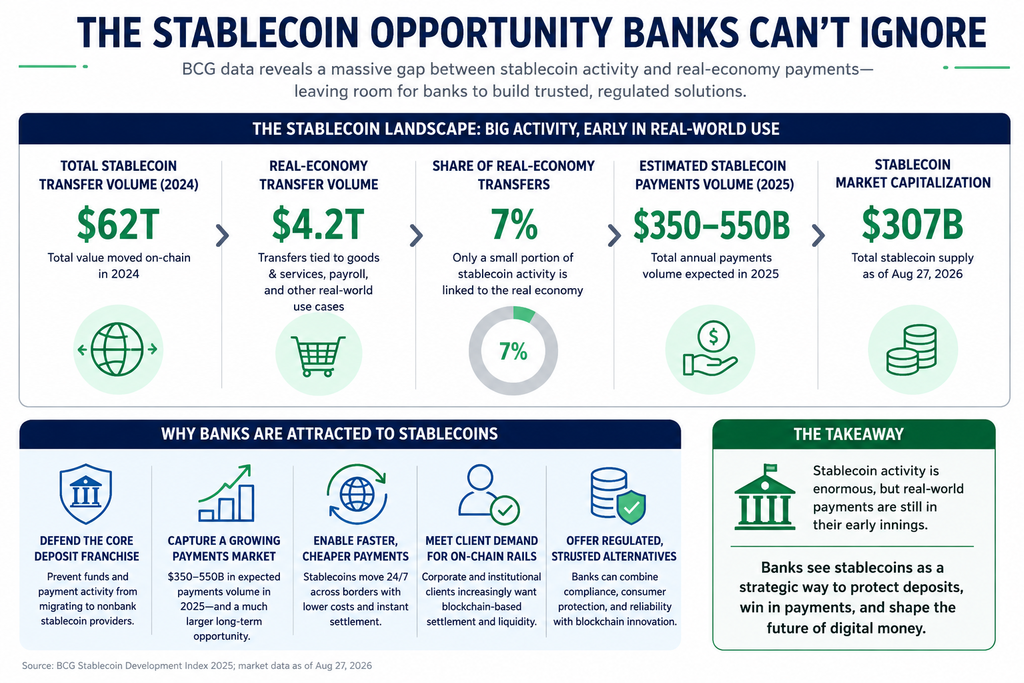
According to an analytical report published in January 2026 by Boston Consulting Group (BCG) and blockchain data analytics firm Allium, over $62 trillion worth of stablecoin transactions occurred on public blockchains in a year. However, of this amount, only about $4.2 trillion (approximately 7% of the total) represented payments made in the real economy.

BCG estimated the observed volume of bilateral payments for goods and services in 2025 to be between $350 and $550 billion, which they termed a minimal figure. Additionally, the article noted that the stablecoin market capitalization grew to $307 billion by December 2025.

Why Are Banks Shifting Policy at All?

These warnings have not stopped banks from moving towards blockchain adoption.

On August 28, Forkast reported that a consortium of over 12 global banks, including Bank of America, Wells Fargo, Santander, Citi, Goldman Sachs, and UBS, is preparing to issue its own stablecoin on public blockchains, rather than leaving the market to Tether and Circle.

The GENIUS Act, which took effect on July 18, 2025, was a legislative measure allowing banks to access the federal level through subsidiaries approved by the Office of the Comptroller of the Currency (OCC), although it prohibited issuers from paying any interest to holders.

Bank of America CEO Brian Moynihan warned that up to $6 trillion in deposits could be withdrawn from banks if stablecoin issuers were allowed to offer yields.

"If it is legalized, we will engage in this business."

Smaller lending institutions are also adopting new technologies. Cryptopolitan reported that 39 state bankers' associations have formed the BankChain Alliance, set to launch in 2027. This initiative aims to provide local banks with shared access to tokenized deposits and stablecoins without relying on crypto platforms.

Are Banks Moving from Research to Creating a Joint Stablecoin?

Today's article in the Seoul Economic Daily states that a major banking group is considering initially issuing a dollar-pegged token, with subsequent expansion to G7 currencies. It also highlights the strategic reason: banks fear stablecoins could divert deposits away from traditional banks.

Feature Stablecoins Tokenized Deposits
What is it? Digital tokens designed to maintain a stable value relative to a reference asset, typically the US dollar. Digital representation of ordinary commercial bank deposits on a programmable ledger.
Issuer Typically a private stablecoin issuer. Commercial bank.
Holder's Claim Claim on the stablecoin issuer's/reserve structure. Direct claim on the issuing bank.
Backing Typically reserves like cash, central bank reserves, Treasury bonds, or other permitted assets. Ultimately, the bank's deposit obligations are part of the banking system.
Redeemability Intended for redemption at $1, but secondary market prices may deviate from par. Exchanges at par as a bank deposit/claim.
Settlement Transfers between token holders on blockchain networks. Payment results in debiting one bank account and crediting another, with interbank settlement ultimately using central bank money.
Blockchain Often public/permissionless networks. Typically permissioned/controlled bank platforms, though hybrid models are possible.
Interoperability Can be fragmented across issuers and blockchains. Higher fungibility achieved when using tokenized central bank reserves.
AML/KYC May involve anonymous wallets and self-custody. Account ownership and activities within regulated bank infrastructure.
Bank Deposits Could potentially divert funds away from banks. Secures deposits within the banking system.
Main Advantage Global reach, programmability, and 24/7 transfer capability. Programmability while preserving the existing bank/central bank monetary structure.
BIS's Preferred Role Specialized uses, not the basis for everyday payments. Handling large daily payments and wholesale settlements.
Current Examples $USDT, $USDC, and other fiat-backed tokens. JPMorgan's deposit token model and other bank tokenization projects.
The differences between stablecoins and tokenized deposits are structural, not merely numerical. | BIS

Central banks want to see tokenized deposits and central bank money at the heart of the blockchain economy, while commercial banks are increasingly concluding that they also need stablecoins. Notably, JPMorgan's position remains that the company has no current plans to issue a stablecoin.

end-content

热门币种推荐

相关问答

QAccording to the head of the BIS, what are the three properties that money should have, and how do stablecoins fail to meet them?

AAccording to the head of the BIS, Pablo Hernández de Cos, the three properties money should have are unity (uniqueness), compatibility (interoperability), and financial integrity. He argues stablecoins fail because: 1) Different stablecoins like USDT and USDC are not guaranteed to exchange at a 1:1 rate (unity). 2) They operate on fragmented, permissionless blockchains, making cross-chain transfers complex (compatibility). 3) Many are held in self-custody wallets with limited KYC checks, raising concerns about financial integrity versus traceable bank deposits.

QWhat is the Bank for International Settlements' (BIS) preferred model for the foundation of modern digital payment systems, and why?

AThe BIS prefers a system based on tokenized bank deposits as the foundation for modern digital payment systems. They argue this model is more promising than one based on stablecoins because tokenized deposits utilize central bank accounts for settlement, preserving nominal redemption and finality. This approach maintains the existing monetary structure, ensures financial integrity through bank-level AML/KYC, and prevents potential disintermediation of commercial bank deposits.

QDespite the BIS's warnings, why are major global banks reportedly planning to issue their own stablecoin on public blockchains?

AMajor global banks are reportedly planning to issue their own stablecoin on public blockchains to prevent deposits from being drained away by private stablecoin issuers like Tether and Circle. They fear that if these private issuers are allowed to offer yield, trillions in deposits could leave the traditional banking system. The passing of the GENIUS law, which allows banks to access the public blockchain space via OCC-approved subsidiaries (though without paying interest), is a key factor enabling this strategic move.

QWhat does the data from Boston Consulting Group (BCG) and Allium reveal about the volume of stablecoin transactions versus payments in the real economy?

AData from BCG and Allium reveals a significant gap between total stablecoin transaction volume and real-economy payments. They estimated that over $62 trillion worth of stablecoin transactions occurred on public blockchains in a year. However, only about $4.2 trillion (approximately 7% of the total) constituted payments made within the real economy. The observed volume of bilateral payments for goods and services in 2025 was estimated to be between $350 billion and $550 billion, which they termed a minimal figure.

QAccording to the article's comparison table, what is a key structural difference between the holder's claim in a stablecoin versus a tokenized deposit?

AA key structural difference is the nature of the holder's claim. For a stablecoin, the holder has a claim on the stablecoin issuer's reserve structure. For a tokenized deposit, the holder has a direct claim on the issuing commercial bank itself, just like a traditional bank deposit. This makes tokenized deposits an integral part of the existing banking system, whereas stablecoins represent a claim on an external, often private, entity.

你可能也喜欢

明日对比特币至关重要:重大变革即将来临!

比特币核心开发者、Bitcoin Knots项目重要人物卢克·达什吉尔宣布,计划于8月30日(周日)进行一项可能影响比特币挖矿算法的重大工作量证明(PoW)算法变更测试。达什吉尔建议使用SHA-2算法的矿工在周六暂停挖矿,以便为Bitcoin Knots 29.4.1rc4版本的主网启动预演做准备。 根据计划,该版本软件将设置一个“最后的SHA-2区块”作为分界点。随后,在《纽约邮报》周日早间网络版发布后,将提供一个名为“canonical blake2b_headline”的参数,用于启动基于BLAKE2b算法的新链条。 如果测试顺利,Bitcoin Knots 29.4.1正式版将按计划于9月1日发布,且8月30日产生的区块链历史将被保留。若出现问题,系统可回滚至最后一个SHA-2区块,并使用rc5版本重新尝试。达什吉尔还建议有意在变更后第一时间开始挖矿的用户,提前在testnet4测试网上使用rc3版本进行准备。 **技术变更要点:** 目前比特币的PoW系统在挖矿时使用的是属于SHA-2家族的SHA-256哈希算法。此次提及的变更是计划在PoW计算中使用另一个名为BLAKE2b的哈希算法。由于两种算法的计算架构不同,目前大多数比特币ASIC矿机无法直接用于BLAKE2b挖矿,因此该变更可能对现有挖矿硬件基础设施产生重大影响。 达什吉尔所称的“最后的SHA-2区块”,是指按照当前基于SHA-256的PoW规则生成的最后一个区块。此后,采用新规则的节点可开始跟随由BLAKE2b创建的区块。需要强调的是,如果比特币网络中的其他节点不接受此变更,链规则可能发生分裂。因此,这不应被视为整个比特币网络最终采纳的协议变更,而是针对Bitcoin Knots软件及其用户群体的计划内测试流程。

cryptonews.ru52分钟前

明日对比特币至关重要:重大变革即将来临!

cryptonews.ru52分钟前

比特币如何抵御量子计算机?三大格基签名方案优劣比较

比特币当前的Schnorr与ECDSA签名易受未来量子计算机攻击,格基签名是重要的后量子替代方案。Blockstream研究院评估了Dilithium、Falcon和Hawk三种方案。 评估基于四大标准:链上成本(公钥与签名大小、验证速度)、实现复杂度、部署风险及支持BIP-32密钥派生等发展潜力。报告建议比特币至少采用NIST 3级安全标准,为长期安全预留余量。 **Dilithium(ML-DSA)** 设计简洁,全部为整数运算,易于安全实现,且是唯一有密钥派生研究基础的方案。但其体积最大(3级安全合计约5.2KB),链上成本高。 **Falcon(FN-DSA)** 体积最为紧凑(5级安全的Falcon-1024仅约3KB),验证速度快。其签名需要浮点运算,存在跨平台一致性问题,但可通过整数模拟等工程手段解决,代价是签名速度下降。主要短板是目前缺乏可行的密钥派生方案,且标准尚未最终定稿。 **Hawk** 曾试图兼顾小体积和整数运算,但因其依赖较新的安全假设被发现结构性安全漏洞,已从NIST竞赛中撤回。 **结论**:在现有格基方案中,**Falcon-1024**在紧凑性、验证速度和成熟度上综合表现最佳,是当前首选。但其密钥派生问题和标准化进程是主要障碍。报告建议短期可考虑更成熟的哈希基签名作为过渡,待Falcon标准完善后,再将其或混合方案部署于比特币网络。

marsbit1小时前

比特币如何抵御量子计算机?三大格基签名方案优劣比较

marsbit1小时前

交易

现货

热门文章

什么是 $BANK

银行人工智能:银行业未来的革命性一步 介绍 在科技迅速发展的时代,银行人工智能站在人工智能(AI)和银行服务的交汇点。这个创新项目旨在重新定义金融格局,通过人工智能的力量提升运营效率、安全措施和客户体验。在我们开始探讨银行人工智能的过程中,我们将深入了解该项目的内容、运营动态、历史背景和重要里程碑。 什么是银行人工智能? 从本质上讲,银行人工智能代表了一项变革性倡议,旨在将人工智能融入各种银行运营中。该项目利用人工智能的能力自动化流程、改善风险管理协议并通过个性化服务增强客户互动。 银行人工智能的主要目标包括: 银行功能自动化:通过利用人工智能技术,银行人工智能旨在自动化日常任务,减轻人力资源的负担并提升效率。 增强风险管理:该项目利用人工智能算法预测和识别风险,从而加强对欺诈和其他威胁的安全措施。 个性化银行服务:银行人工智能专注于通过分析客户数据和行为提供量身定制的金融产品和服务。 改善客户体验:实施人工智能驱动的解决方案,如聊天机器人和虚拟助手,旨在为用户提供更人性化的互动,彻底改变客户与银行的互动方式。 凭借这些目标,银行人工智能将自己定位为一个重要参与者,使银行服务更加高效、安全和以用户为中心。 银行人工智能的创造者是谁? 关于银行人工智能创造者的详细信息仍然未知。因此,在现有信息中没有确定的个人或组织。有关项目创立的匿名性引发了各种问题,但并不削弱其雄心勃勃的愿景和目标。 银行人工智能的投资者是谁? 与项目的创造者类似,银行人工智能的投资者或支持组织的具体信息尚未披露。没有这些信息,很难概述可能推动该项目前进的资金支持和机构保障。尽管如此,拥有坚实的投资基础对于在如此创新的领域维持发展至关重要。 银行人工智能如何运作? 银行人工智能在多个创新领域运作,专注于使其与传统银行框架区分开来的独特因素。以下是关键运营特点: 自动化:通过应用机器学习算法,银行人工智能自动化银行内的各种手动流程。这降低了运营成本,使人类员工能够将精力转向更具战略性的活动。 先进的风险管理:将人工智能整合到风险管理实践中,使银行具备准确预测潜在威胁如欺诈的工具,从而确保客户信息和资产的安全。 量身定制的财务建议:通过持续学习客户互动,人工智能系统对用户需求形成细致了解,使其能够在财务决策上提供量身定制的建议。 增强客户互动:利用由人工智能驱动的聊天机器人和虚拟助手,银行人工智能使客户体验更加生动,让用户能够快速解决问题,从而减少等待时间,提高满意度。 这些运营特点共同将银行人工智能定位为银行业的先锋,为服务交付和运营卓越建立新的基准。 银行人工智能的时间线 了解银行人工智能的轨迹需要查看其历史背景。以下是突显重要里程碑和发展的时间线: 2010年代初:人工智能与银行服务的整合构思开始受到关注,银行机构认识到潜在的好处。 2018年:当银行开始使用聊天机器人等人工智能工具进行基本客户服务和风险管理系统以提高安全性时,人工智能技术的实施显著增加。 2023年:人工智能的复杂性继续提高,生成式人工智能被引入用于更复杂的任务,如文档处理和实时投资分析。今年标志着人工智能技术为银行提供的能力的重大飞跃。 2024年至今:截至今年,银行人工智能处于上升轨迹,持续的研究和开发正在进一步提升银行运营的能力。对人工智能应用的持续探索暗示着即将出现的激动人心的发展。 关于银行人工智能的关键点 人工智能在银行业的整合:银行人工智能专注于采用人工智能来简化银行流程并改善用户体验。 自动化和风险管理重点:该项目在这些领域有很强的强调,旨在减轻日常任务的负担,同时通过预测分析增强安全框架。 个性化银行解决方案:通过利用客户数据,银行人工智能能够提供符合个人用户需求的量身定制的银行服务。 对发展的承诺:银行人工智能承诺持续进行研究和开发,确保其适应性和持续的相关性,随着技术的不断发展而演变。 结论 总之,银行人工智能体现了银行业向前迈出的重要一步,通过运用人工智能来重塑操作范式、增强安全性并促进客户满意度。尽管关于创造者和投资者的信息缺如,银行人工智能清晰的目标和功能机制为其持续演变提供了坚实的基础。随着人工智能技术的不断进步并与银行业结合,银行人工智能在未来的金融服务中将对我们理解和互动银行的方式产生重大影响。

568人学过发布于 2024.04.06更新于 2024.12.03

什么是 $BANK

如何购买BANK

欢迎来到HTX.com!我们已经让购买Lorenzo Protocol(BANK)变得简单而便捷。跟随我们的逐步指南,放心开始您的加密货币之旅。第一步:创建您的HTX账户使用您的电子邮件、手机号码注册一个免费账户在HTX上。体验无忧的注册过程并解锁所有平台功能。立即注册第二步:前往买币页面,选择您的支付方式信用卡/借记卡购买:使用您的Visa或Mastercard即时购买Lorenzo Protocol(BANK)。余额购买:使用您HTX账户余额中的资金进行无缝交易。第三方购买:探索诸如Google Pay或Apple Pay等流行支付方法以增加便利性。C2C购买:在HTX平台上直接与其他用户交易。HTX场外交易台(OTC)购买:为大量交易者提供个性化服务和竞争性汇率。第三步:存储您的Lorenzo Protocol(BANK)购买完您的Lorenzo Protocol(BANK)后,将其存储在您的HTX账户钱包中。您也可以通过区块链转账将其发送到其他地方或者用于交易其他加密货币。第四步:交易Lorenzo Protocol(BANK)在HTX的现货市场轻松交易Lorenzo Protocol(BANK)。访问您的账户,选择您的交易对,执行您的交易,并实时监控。HTX为初学者和经验丰富的交易者提供了友好的用户体验。

2.3k人学过发布于 2025.05.09更新于 2026.06.02

如何购买BANK

相关讨论

欢迎来到HTX社区。在这里,您可以了解最新的平台发展动态并获得专业的市场意见。以下是用户对BANK(BANK)币价的意见。

活动图片