Terra has begun the purchase of $10 billion worth of Bitcoin to use it as a reserve asset.
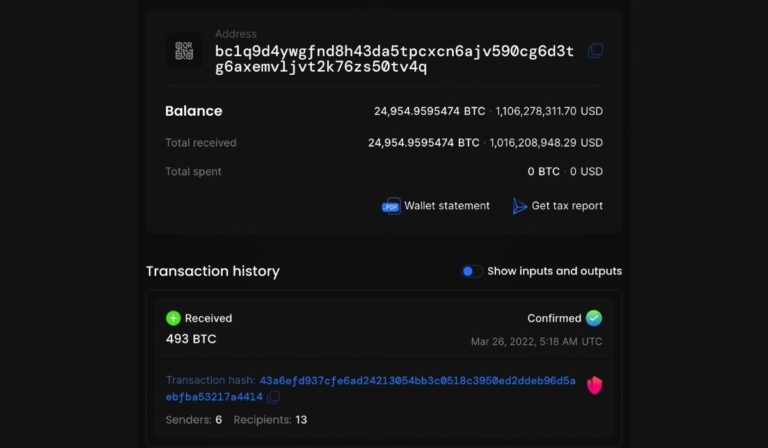
According to blockchain search and analytics engine Blockchair, Terra bought 5,934 BTC for approximately $260 million between 20th March and 24th March as part of its gradual accumulation plan for the said asset.
As of Saturday, 26th March, the network had accumulated a total of 15,390.9 BTC, bringing its total holdings to 24,954.95 BTC ($1,108,077,140.35). Terra, which is now the 40th largest BTC holder in the world plans on wrapping on Cosmos and depositing them in smart contracts supporting the algorithmic UST stable coin, with more purchases on the way.
Terra's BTC Reserves Hit $1 Billion Following Aggressive Buying On Bitcoin Price Dips
The purchase comes days after Do Kwon, founder of Terra and Terraform Labs announced that his firm was planning on purchasing Bitcoin worth $10 billion to back its UST stablecoin as part of its bigger strategy to decouple from centralized stablecoins while creating a more “sustainable and organic” stablecoin.
The plan to form a Bitcoin reserve for Terra’s UST has however been in the works, and as recently as last month, the Luna Foundation raised $1Billion for this purpose through a private sale of LUNA tokens.
After the event, Kwon stated that Terra would continue stacking its reserves “until it becomes mathematically impossible for idiots to claim de-peg risk for UST”. He thereafter outlined a $3 billion investment plan on Bitcoin before raising the bar to $10 billion. If Kwon’s purchase is to come to fruition, it would mean purchasing more than 232,018.50 BTC (at current prices) which is almost double what MicroStrategy holds.
Given the large sums involved, it is however sufficient to believe that the purchases will be rolled out gradually, catalyzing the ushering in of a “new monetary era of the Bitcoin standard”.
In the past two or so months, Terra’s ecosystem has been riding the DeFi wave, emerging out exceptionally strong due to its attractive UST stablecoin. As ZyCrypto reported, the ecosystem recently toppled Solana, Ethereum, Cardano, and Avalanche, becoming the most staked blockchain.
“One of the fastest-growing categories of applications on Terra has been neo banks that use stable coin rails to make transactions easier and to expose people to defy structured yields,” Kwon said in a podcast with ‘Udiverse’ on Tuesday.
That said, the purchase of $10 billion worth of Bitcoin could ignite a bullish run for the crypto asset as Terra continues to accumulate with no intention of selling. As stated, the process which will be gradual could also give Terra the much-needed attention, igniting a strong move for its native coin LUNA, which is currently trading at $90, up 110% in the past fifty days.