An order-book-style decentralized exchange that fulfills different derivative investors’ needs
Aboard provides an all-in-one decentralized exchange for crypto derivatives, giving users an efficient trading system and advanced smart tools. With its services, Aboard wants to make it easier for investors to trade and invest in crypto derivatives, all powered by the Ethereum layer-2 solution Arbitrum.
The crypto industry has witnessed a massive surge of interest in derivatives. However, the existing exchanges failed to provide investors with various trading products. Furthermore, the market urgently requires a more efficient trading system and advanced trading tools. To further release the potential of this promising market, Aboard introduced a comprehensive trading platform incorporated with various smart tools.
To understand what Abroad offers, let’s first talk about crypto derivatives. A derivative is a financial instrument that derives its value from an underlying asset. Derivatives, therefore, play a crucial role in the global financial market by improving the liquidity of the underlying asset and providing various ways for investors to hedge their risks. The estimation of this gigantic segment is over $1 quadrillion on the high end. According to Futures Industry Association, 2021 is the fourth year in a row that global exchange-traded derivatives markets registered a high compared to the prior year.
Thanks to blockchain technology, individual and institutional investors benefit from various emerging financial instruments, and crypto derivatives are one of them. Similarly, crypto derivatives provide more liquidity to the market and allow investors to hedge their positions. Interest in crypto derivatives has surged, with a gross market value of over-the-counter (OTC) derivatives reaching $15.5 trillion during the first half of 2020.
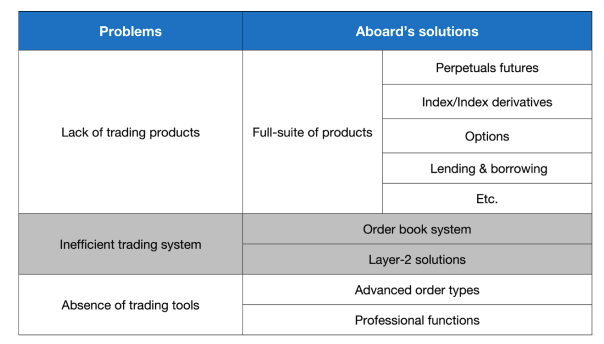
The advantages of blockchain, including decentralization, transparency, and barrier-free transactions, have brought many investors into the crypto world. However, to better facilitate decentralized finance, the infrastructure underpinning those activities still requires continuous maturity. Specifically, existing DEXes face three major issues: lack of trading products, inefficient trading system, and absence of trading tools.
First, most of the existing decentralized derivative platforms only provide perpetual products, which are not sufficient for professional traders to apply various investment strategies.
Second, most DeFi derivatives exchanges are built on AMM (automated market makers). Though effective in decentralization, AMM suffers slippage, impermanent loss, latency, and front-running trading issues. Subsequently, trading or even backtesting on AMM is infeasible for quantitative strategies due to excessive randomness during the trading process. Lastly, decentralized derivatives exchanges do not provide a diverse professional toolbox, which is essential for sophisticated derivative trading.
In response to the market needs above, Aboard introduced an all-in-one exchange. Aboard Exchange will bring the experience of crypto derivative trading experience to a whole new level, featuring a full suite of products, high-efficiency, and easy-to-use tools.
A 360-degree optimization in crypto derivatives trading
With a team from both TradFi derivative and asset management background as well as the crypto realm, Aboard has a deep understanding of how to address the trilemma of crypto derivative trading mentioned before. Aboard provides a potential solution by creating a decentralized exchange that will offer a wide range of products, increased efficiency, and professional trading functions catering to advanced traders’ needs.
Full suite of products
Aboard will offer various DeFi products, including token perpetuals, index perpetuals, options, spots, margin, and lending & borrowing.
- Perpetuals and Leverage trading – Traders can access perpetual contracts of mainstream cryptocurrencies on Abroad, such as ETH-USDC, BTC-USDC, UNI-USDC, and more. Moreover, an up to 25x leverage and a cross-margin trading system will allow users to maximize capital efficiency.
- Indices and Index Futures – Aboard will launch a series of indices and matching index futures to fulfill traders’ different appetites for derivatives in DeFi. Potential indices will cover the core sectors in the crypto world, including Crypto Large-cap Index, DeFi Index, NFT Index, SocialFi Index, GameFi Index, and Metaverse Index.
Aboard will provide users with a diverse toolbox that contains advanced orders types and trading tools. In addition to basic order types, including market, limit, post-only, and stop orders, professional traders can trade with various advanced order types on Aboard. Types include trailing stop market/limit, pegged, snap, conditional, combo, hedge, batch, and more.
As for advanced trading tools, Aboard will provide book trader, chart trader, options trader, trading API, risk controller, portfolio monitor, and more. These tools can tackle the more sophisticated needs of traders. For instance, Aboard’s trading API enables quants to implement algorithms or quantitative trading strategies.
Improved efficiency
Aboard is engineered to be efficient and cost-effective. To be specific, Aboard employs an order book system. As a result, market makers and professional investors who are used to centralized exchanges will find it easier to transfer to a decentralized order book exchange. Therefore, investors have almost no learning cost to join the platform and start trading. In addition, Aboard is an advocate of Layer-2 solutions, currently already deployed on Arbitrum Mainnet. This approach significantly reduces trading costs and thus essentially increases traders’ profits.
The revolutionary advisory protocol
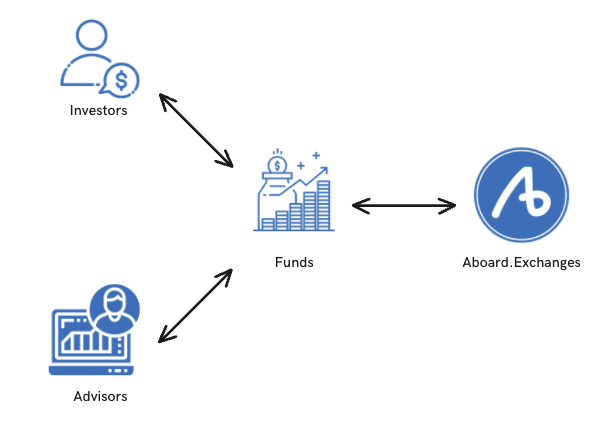
The advisory protocol revolutionizes traditional finance by cutting out all intermediaries and directly connecting crypto fund investors with fund managers. Most importantly, the agreement is transparent and immutable.
How does it work? Abiding by the idea of “Code is Law”, Aboard leverages smart contract technology to break the inefficient workflow of traditional fund management. With smart contracts, investors and fund managers can establish ties by simply e-signing an agreement without third parties or paying a custody fee.
ABE Token and how to use
Aboard would not exist without its native ABE token, which serves as a governance and utility token. Therefore, ABE serves two primary functions. First, ABE bootstraps liquidity and enhances the network effect. Second, ABE is a reward and governance token to facilitate Aboard’s decentralized governance and incentivize the community. In a nutshell, these are the five ways traders can use the ABE token:
- Trading fee offset – participants can stake ABE tokens to get a trading fee offset that is proportional to the holdings.
- Voting – ABE token holders have weighted voting rights proportional to their holdings.
- Trade mining – holders can stake their tokens in staking pools to receive rewards in return. Additionally, ABE serves as an incentive to those who provide liquidity or trade on Aboard.
- Advisory protocol and fees – participants can stake ABE tokens to unlock the advisory protocol function. Moreover, users can pay asset management fees with ABE.
- Access to professional functions – Participants can stake ABE to experience advanced functions, such as risk controller and portfolio management.
Trading cryptocurrencies is gaining popularity among institutional and retail investors. But, then, without reliable infrastructure, the development of the derivatives market may stall. A healthy financial system requires effective allocation of capital and liquidity. With the Aboard platform and diversified products, we have reason to believe that the derivatives market will have a more dynamic future.
A future with Aboard
Crypto derivatives trading is gaining popularity among institutional and retail investors. However, without reliable infrastructure, the mass adoption of the derivatives market may stall. As known to all, the efficiency of capital allocation and liquidity are crucial factors to gauge a healthy financial system. With Aboard Exchange and its diversified products, a dynamic future for the crypto derivatives market is bound to happen.