Author: Moses Sternstein, a16z
Compiled by: Deep Tide TechFlow
Deep Tide Introduction: This week, a16z's 'Charts of the Week' outlines three forming structural forces in the U.S. economy. Firstly, the themes of ETFs have completely changed in just a few years—from clean energy, emerging market technology, and healthcare in 2020, to AI, nuclear power, space, defense, and infrastructure dominating by 2026. Secondly, data centers are not only behemoths of capital expenditure but are also quietly reshaping blue-collar employment and wages: offering construction workers an hourly wage approximately 50% higher than the market rate. Thirdly, ride-hailing prices are rising, with 'social commerce' emerging strongly in the gig economy. Meanwhile, AI Agents, though in their infancy, are consuming nearly 5 times more tokens than humans and beginning to encroach on traditional automation tools. These three scenarios point to the same conclusion: the winds of capital and labor are shifting from 'bits' back to 'atoms'.
The Wind of Thematic Rotation
ETFs have become an increasingly prominent presence in public markets, especially for retail investors. Beyond thematic ETFs, there are active and passive ETFs, index-tracking ETFs, credit ETFs—a wide variety, with varying degrees of leverage. The surge of ETFs owes much to low fees, low barriers to entry, easier distribution, and excellent marketing (and, of course, an overall increase in retail participation).
According to Citadel data, ETF net inflows are heading towards their strongest year on record, with July hitting an all-time high.
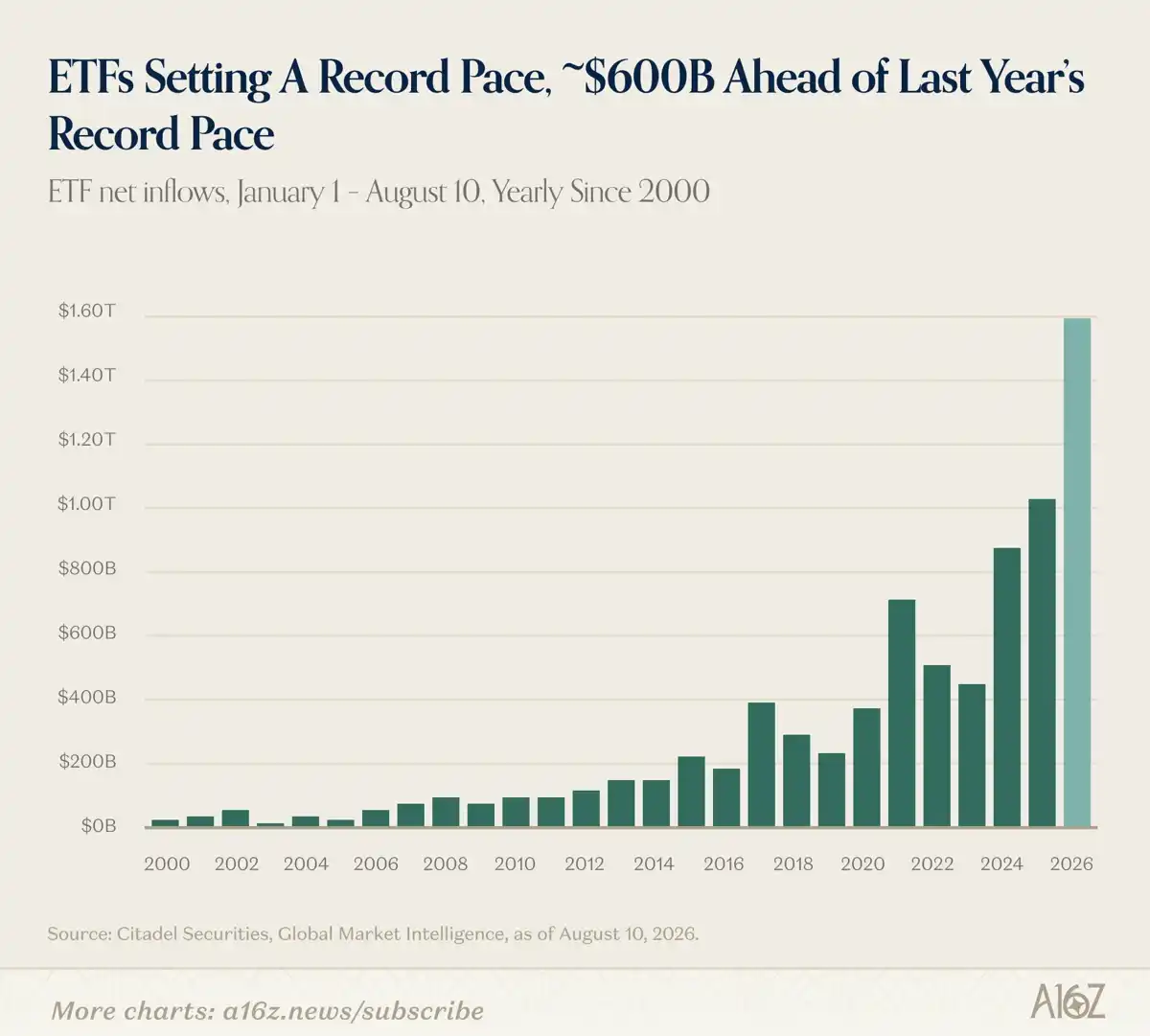
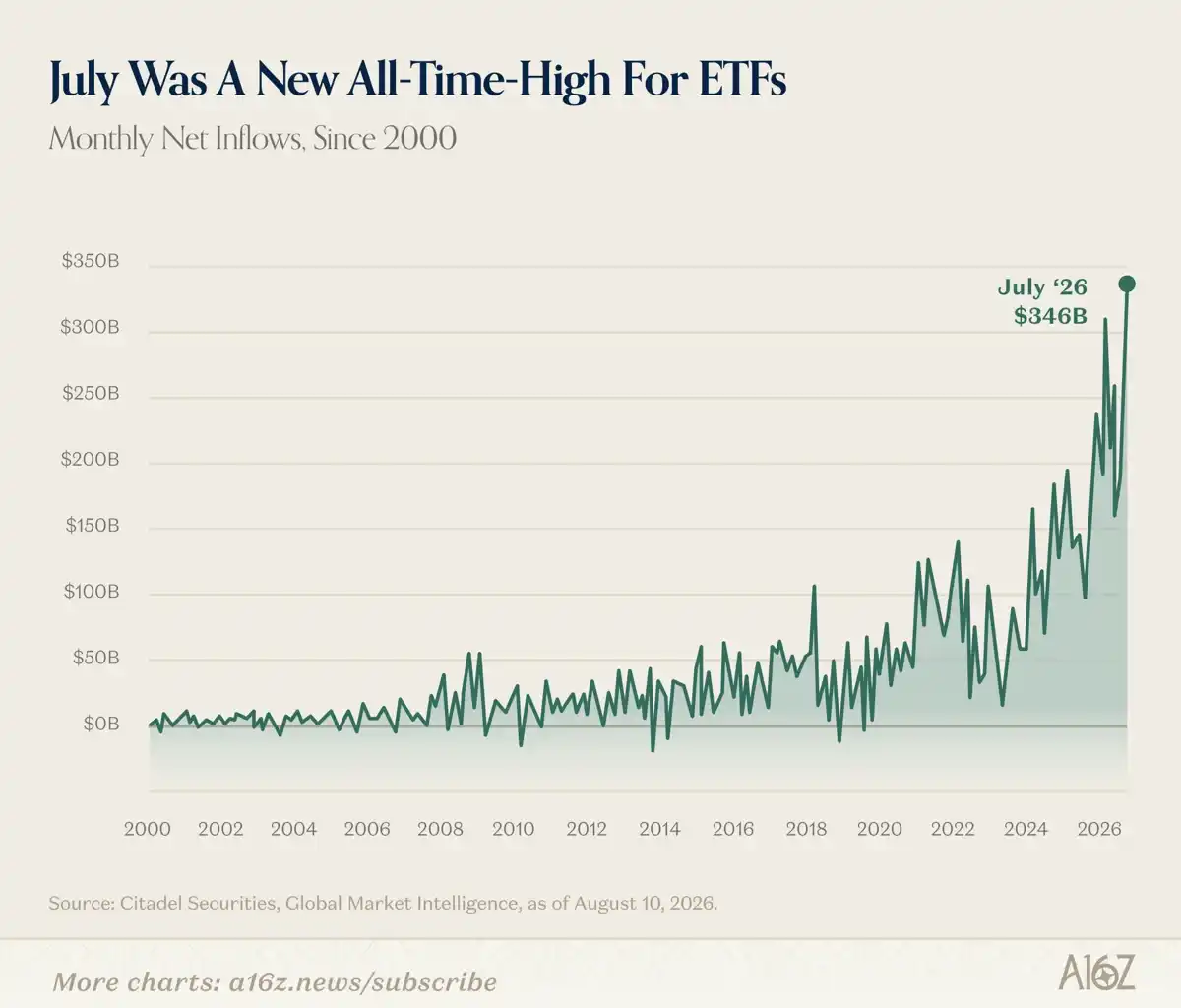
One thing ETFs excel at is latching onto any hot theme of the moment. "Oh, you think robotics is the next big opportunity? We have an ETF for that. Want to ride the memory chip rocket? You'll love the taste of DRAM. Looking for something spicier? Try our latest photonics product PHOX; it pairs nicely."
That statement is interesting in itself, but perhaps more intriguing is how dramatically the 'themes' of ETFs have rotated in a relatively short period—
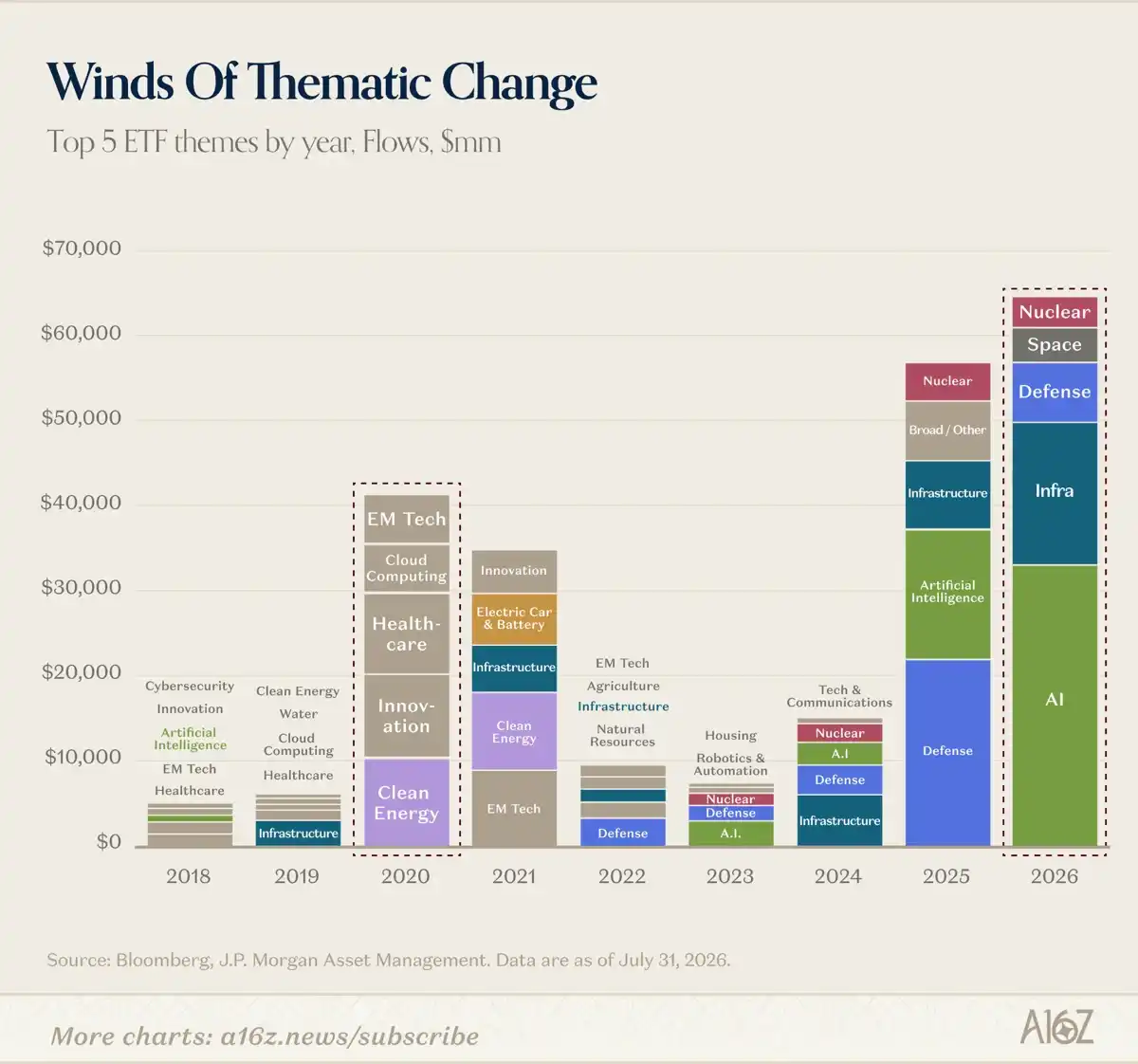
In 2020, the top five themes included clean energy, emerging market technology, and healthcare. By 2026, the thematic narrative has been completely rewritten: AI, nuclear power, space, defense, and infrastructure dominate the rankings.
For capital-intensive, ambitious businesses where 'atoms matter more than bits,' this amounts to an ETF blitz. As for the outcome, the charts cannot predict, but it must be said: 2026 is indeed far more interesting than before.
Data Centers Are a Boon for Blue-Collar Workers
People might love putting data centers into their ETFs, but somehow, they increasingly dislike seeing data centers near their homes.
I don't intend to jump into that debate prematurely (at least not yet). I'll just say this: whether you like it or not, data centers are economically significant, and in some cases, they are the most important thing locally.
For states that are actually building data centers, this construction represents a significant portion of all non-residential building expenditures:
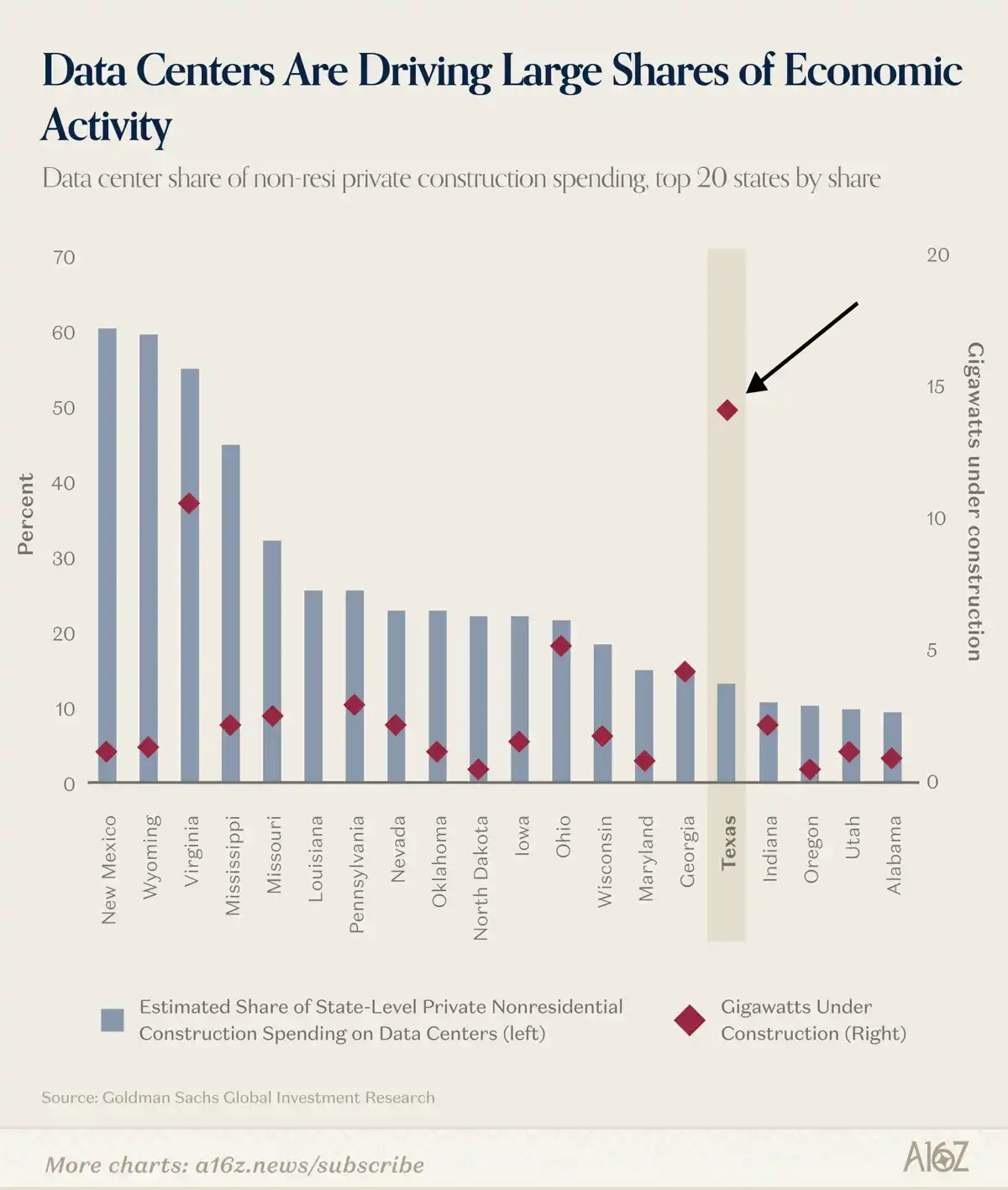
New Mexico and Wyoming aren't building much—under 3 gigawatts under construction—but because these states don't have much construction activity to begin with, data centers account for about 60%(!) of private non-residential building spending. Even in a much larger state like Pennsylvania, a mere ~3 GW of data centers approaches 30% of non-residential spending. In contrast, Texas, with much more capacity under construction, only accounts for 10% of total spending—still substantial but far less dramatic than 60%.
Regardless, no matter your view on data centers, one fact remains unchanged: they are one of the most important (if not *the* most important) economic pulses at present.
Wells Fargo attempted to parse the 'notable economic benefits' accompanying data centers (whether operational or under construction):
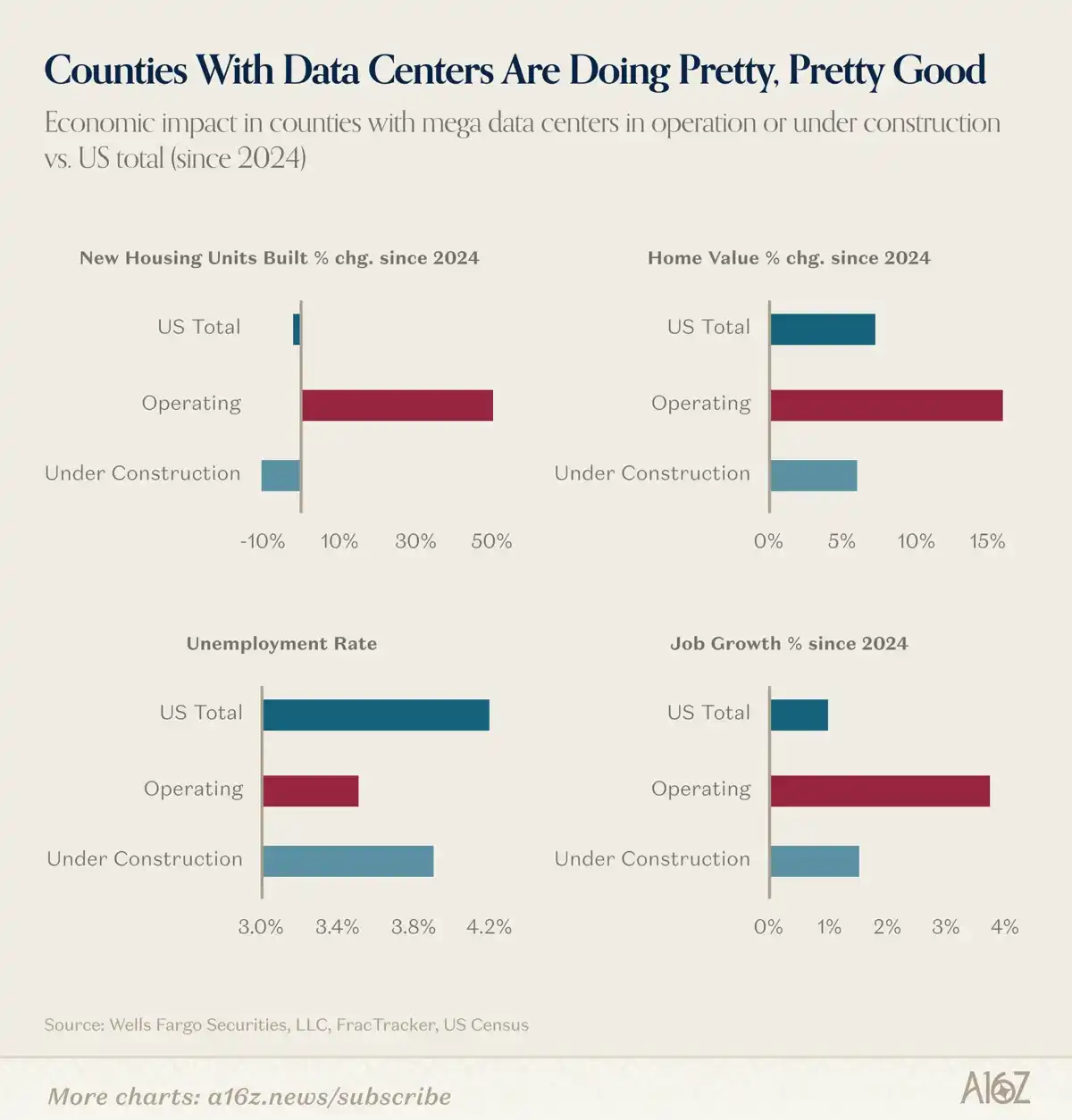
Since 2024, counties with operational data centers have uniformly better metrics: more housing, higher home prices, lower unemployment, faster employment growth. For counties building data centers, employment conditions are indeed better, but new housing construction has seen a more noticeable decline, and home price increases aren't as high.
To be fair, causality here isn't clear-cut. Many existing (and new) data centers are in Loudoun County, Virginia—one of the wealthiest counties in the U.S. Similarly, many new data centers are in Texas, which experienced historic residential construction (and home price increases) before 2024, so the housing decline starts from a much higher base.
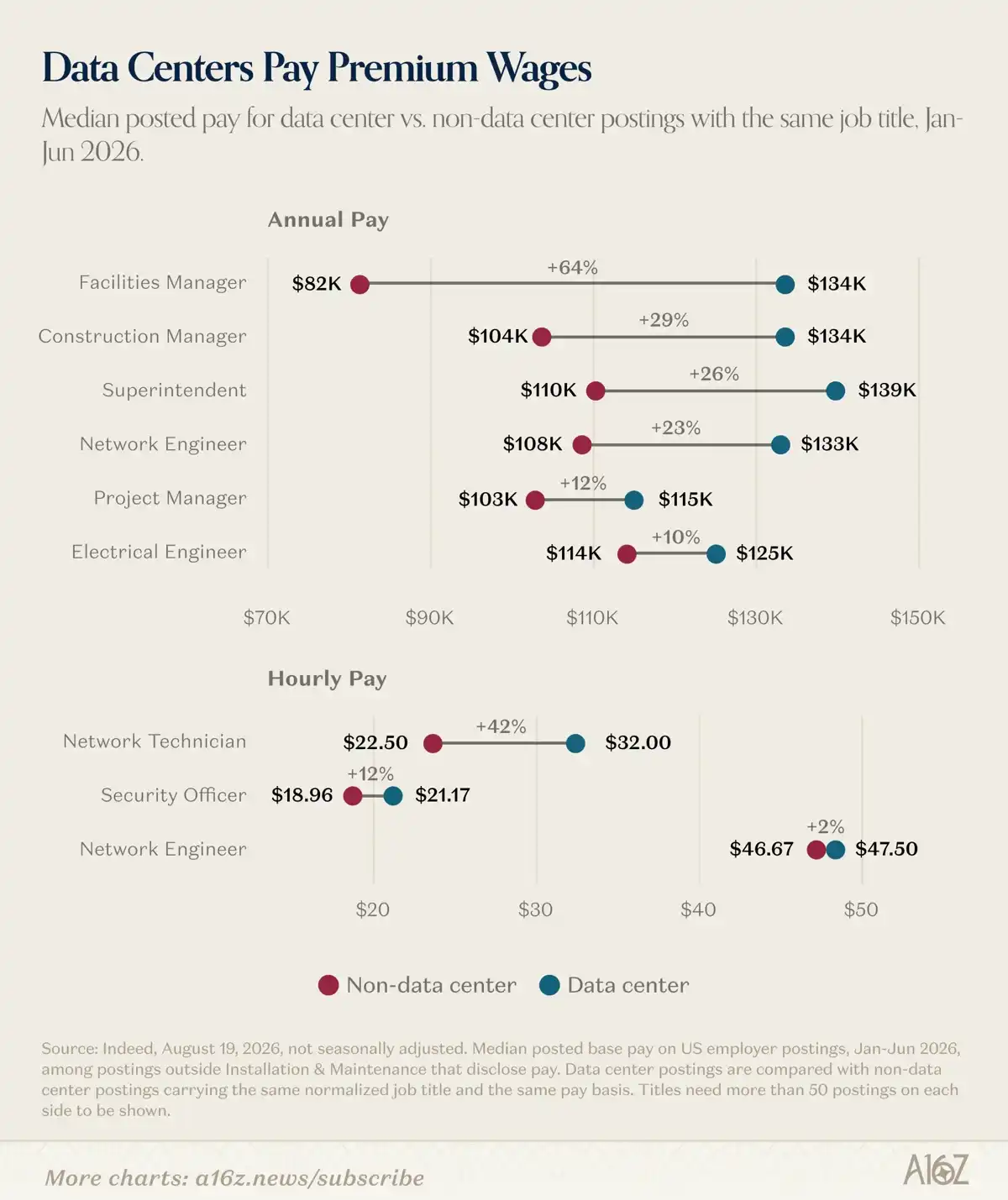
But back to the point above: building a data center is almost certainly good for employment. Beyond the hundreds of hard-hat jobs being created, data centers offer significantly better pay than comparable employers:
According to Indeed data, data centers offer wage premiums as high as 64% (facility manager), and even the lowest-paid electrical engineers see a 10% premium.
Data centers are making good times even brighter for skilled trades. A recent commentary from a Dallas Fed report hits the nail on the head:
A heavy industrial construction contractor stated: "We've been offering what we thought were competitive wages for skilled concrete workers, $28–$32 per hour. Data centers are offering $45 per hour, plus a $150 per day per diem."
For concrete workers on data centers, that's about a 50% wage premium—a life-changing raise.
ADP data tells a similar story. Looking at wage premiums for job switchers—a proxy for 'where demand is hot,' since a raise is needed to induce someone to change jobs—premiums for data-center-related categories are simply 'sizzling':
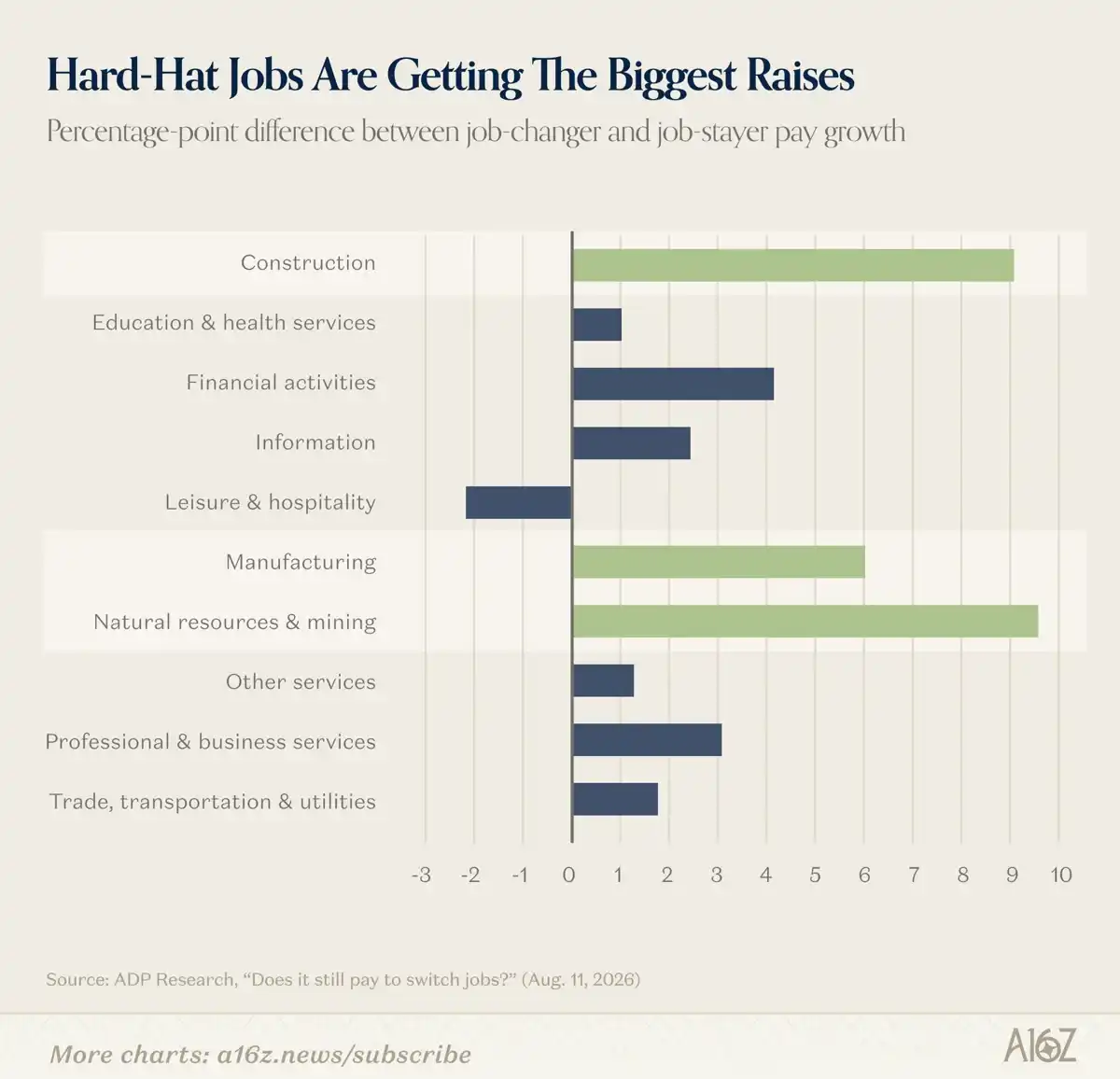
Wage growth for job switchers in construction, manufacturing, and natural resources/mining is 6–9.5 percentage points higher than for those who stay. This switching premium far exceeds that of any other industry.
Again, the point here is not to deliver a definitive defense of data centers. The point is to note: saying 'no' to data centers almost certainly means saying 'no' to higher wages for blue-collar workers (and the surrounding most substantial investment pulse).
Ride-Hailing Is Indeed More Expensive—It's Not Your Imagination
If you feel Uber rides have been more expensive lately, it's probably because—they are. At least, that's what Gridwise Analytics data suggests.
Since 2024, both the average and median Uber fares have increased by about 20% (and seem to keep climbing):
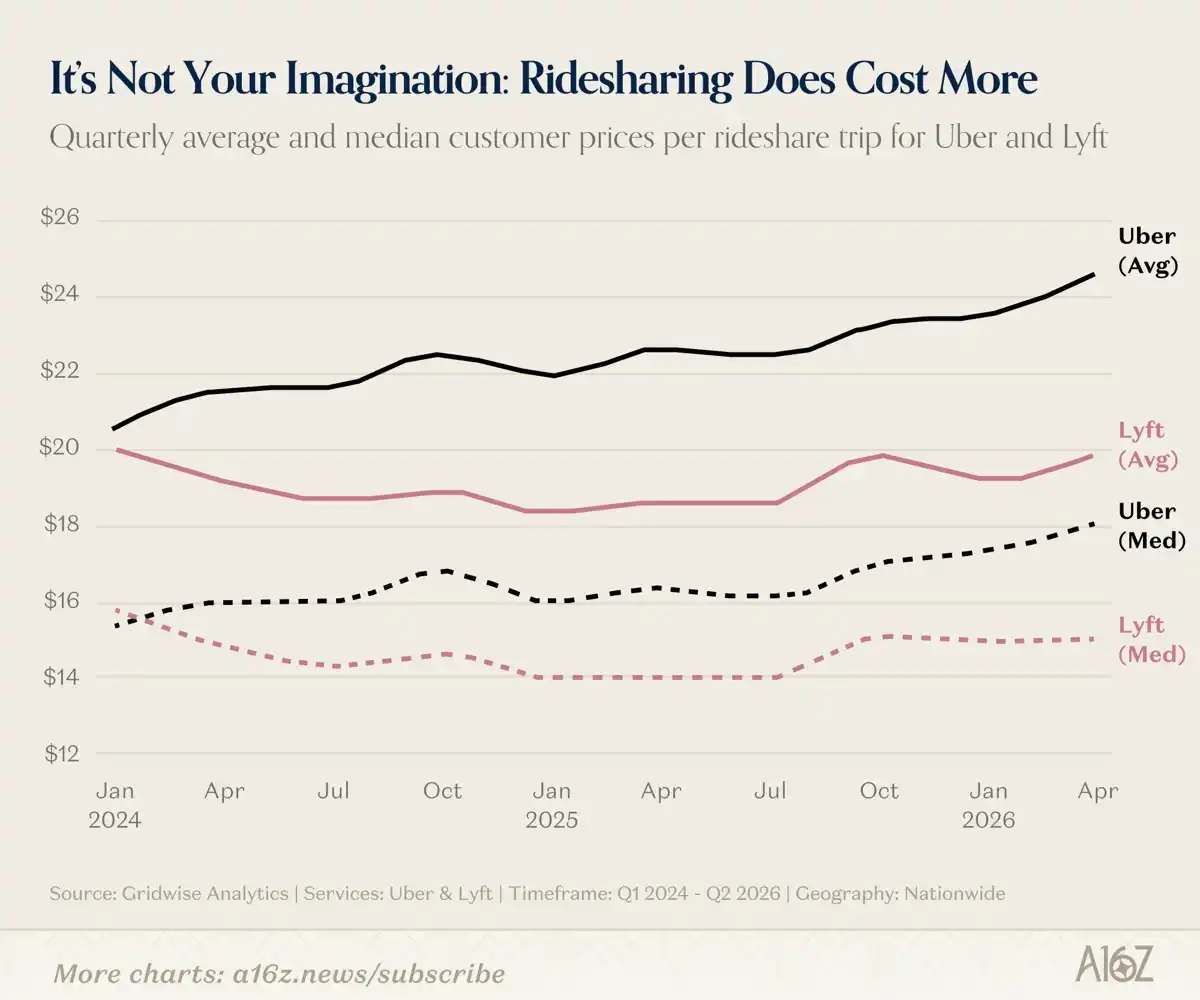
Notably, during this period, only Uber has increased prices—Lyft's median and average fares are actually slightly cheaper than at the start of 2024 (overall about 24% lower than Uber), although they have also risen recently.
A significant source of the price increase seems to be rising platform fees, especially for Uber:
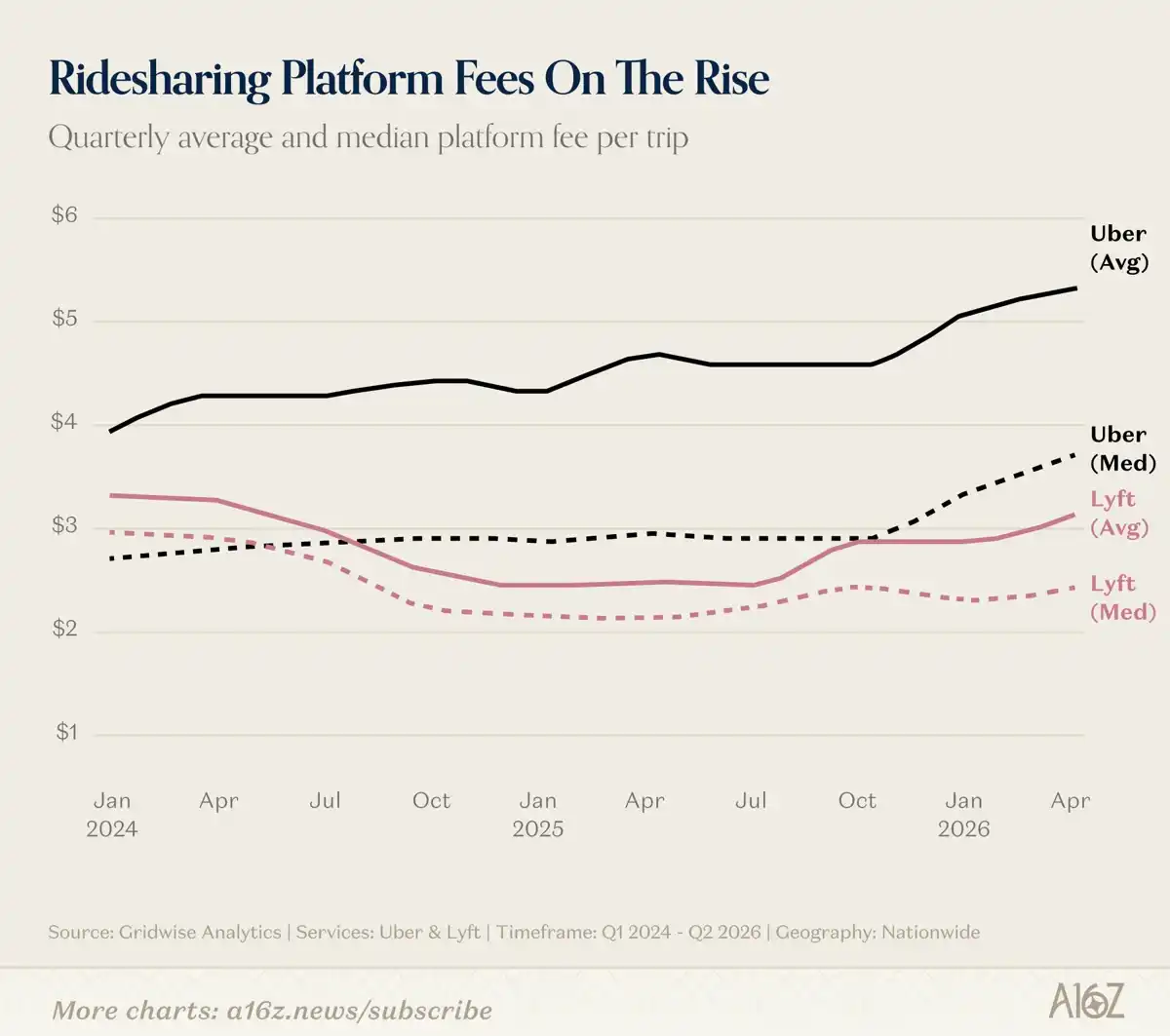
Uber's platform fees have been steadily rising over the past year (median fees jumped noticeably in October), while Lyft's platform fees, after a period of significant decline, have only just started to rise.
This is good for Uber and good for Lyft.
To be fair, it's not just the platforms benefiting—Uber/Lyft drivers are also getting a share:
Average gross driver earnings per trip have also been rising continuously since 2024, recently hitting an all-time high.
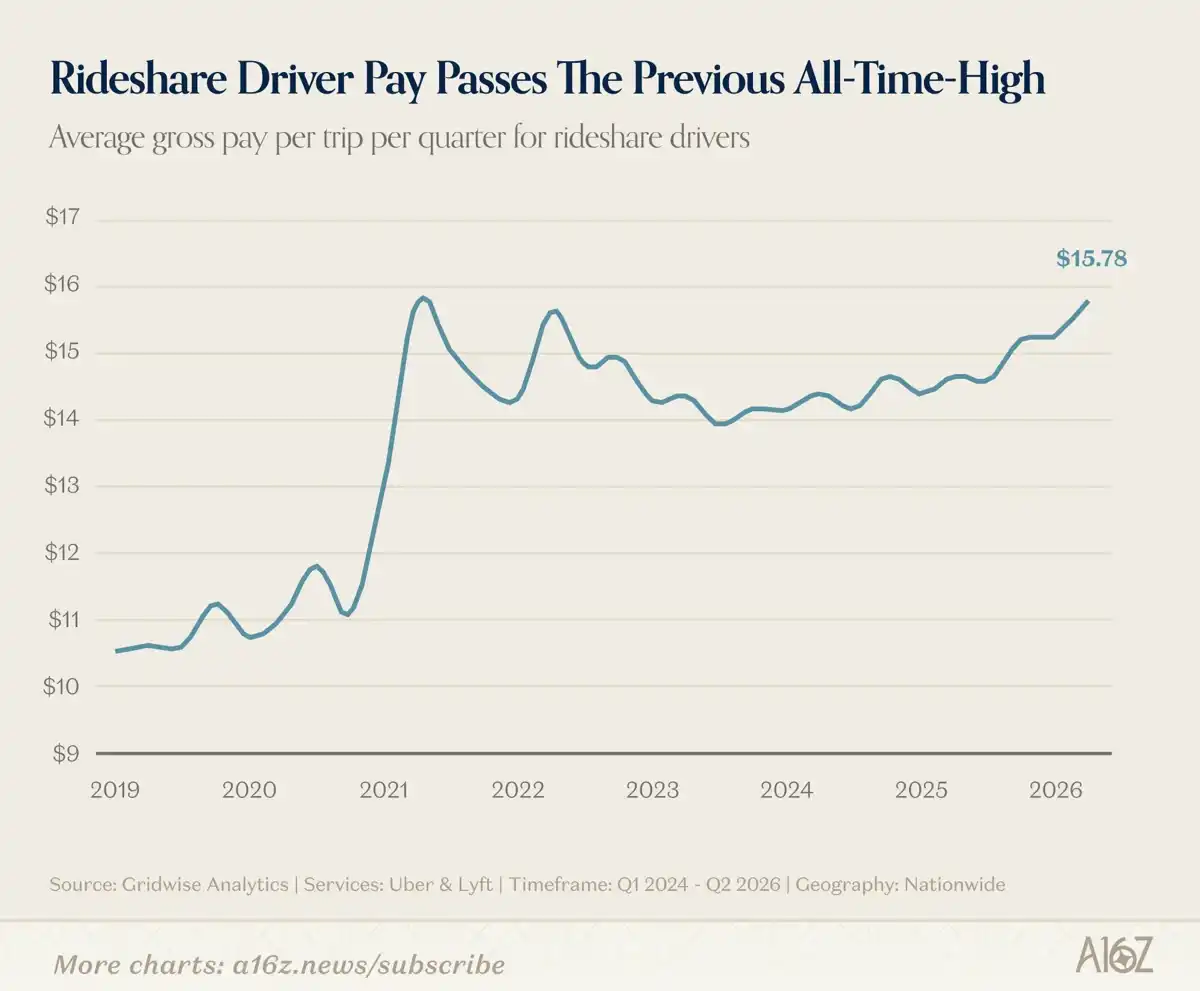
In the long term, whether higher ride-hailing prices will put downward pressure on demand remains to be seen; but for now, fares are getting more expensive, and the gains are flowing to both platforms and drivers.
Another interesting aside: despite the overall weak hiring market, besides more people starting their own businesses, more are also turning to 'gig' work—likely partly attracted by rising earnings.
However, while ride-hailing gigs are growing in popularity, they are far from the fastest-growing type of gig. The hottest new thing in the gig space is undoubtedly 'social commerce,' the QVC of the social media era:
In Bank of America's client accounts, all categories of gig work grew except vacation rentals, but social commerce surged over 30%, far outpacing any other category—despite a smaller base.
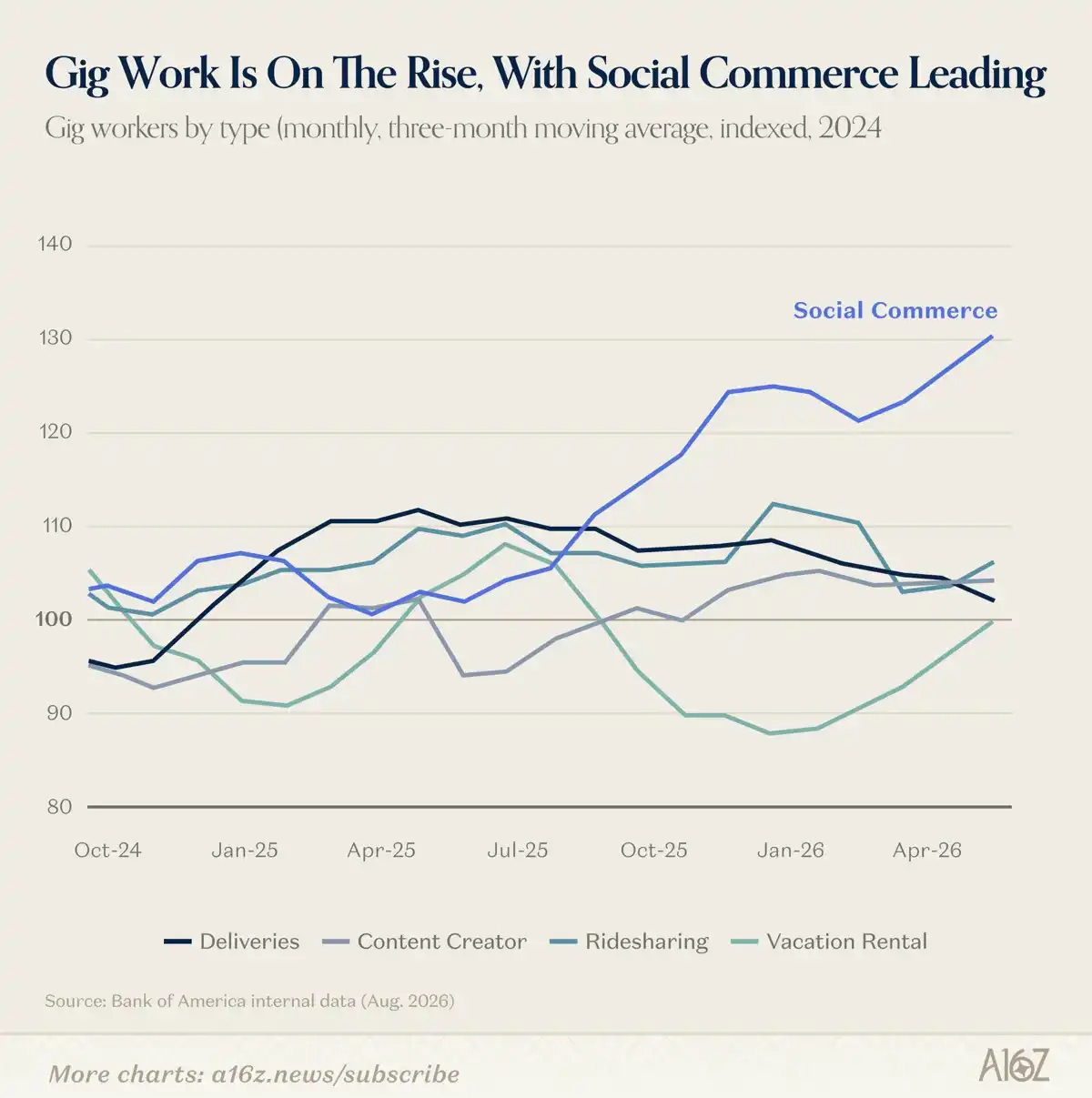
Exactly why social commerce is exploding is anyone's guess. Perhaps it's the shift of media consumption from TV to social, combined with the broader e-commerce boom; it's also likely that AI has lowered the cost of all other aspects of running a social-media version of QVC, making social commerce a more sustainable livelihood for more people. Or maybe Instagram's ad targeting is just too precise to resist. Or perhaps all of the above.
AI Agents Are Early, But Already Changing the Game (And Other Stories from the Frontier)
Charts previously observed: although overall AI demand is rising, growth is far from normally distributed. There's a massive divergence in usage between median and heavy users, and recent data from OpenAI (OAI) suggests this divergence is widening further.
Output tokens for the typical enterprise roughly doubled, but the top 10% are pulling further away:
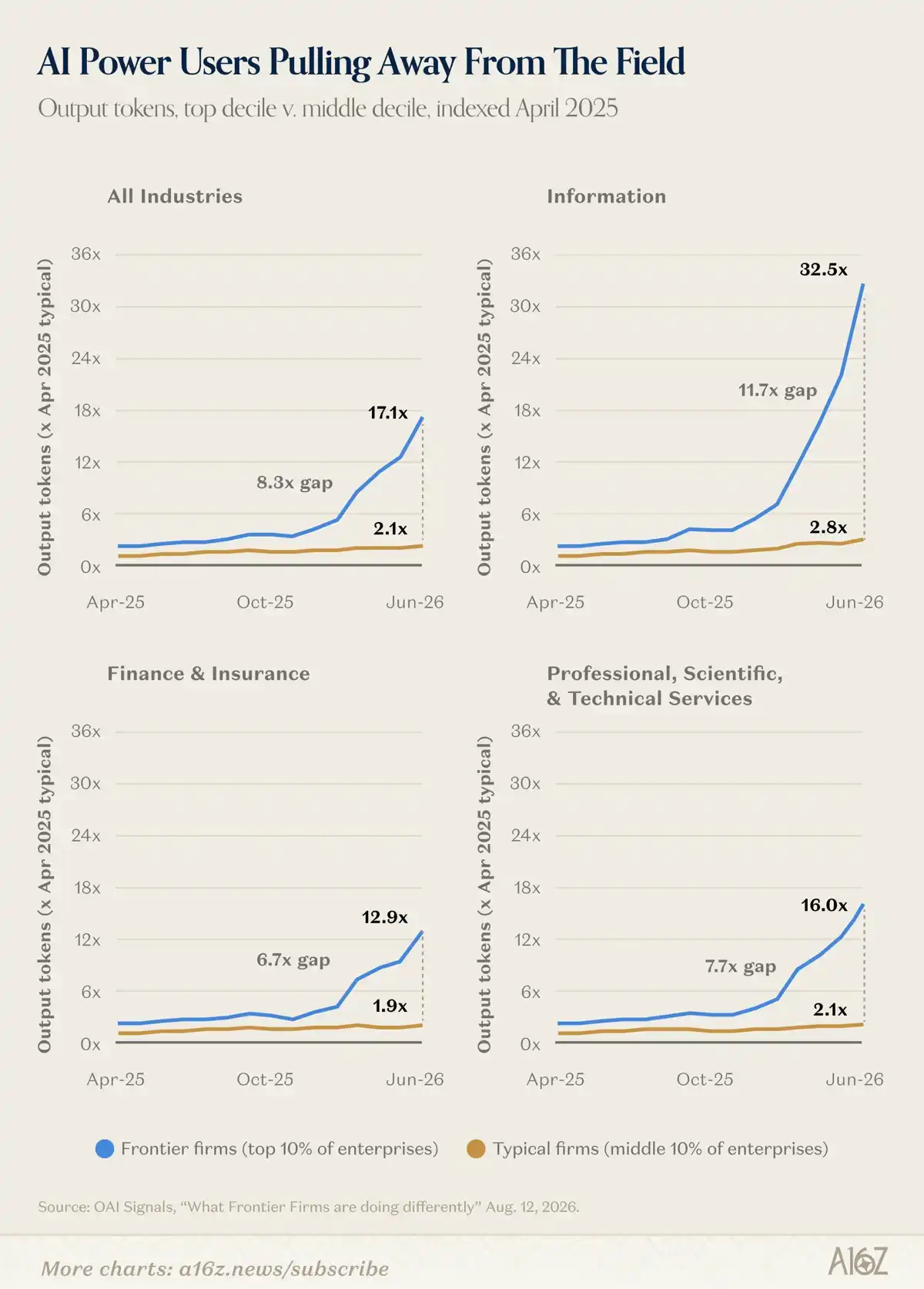
Across all industries, the token output gap between the typical enterprise and the top 10% is about 8x, with the latter's output growing over 17x since April 2025. In certain specific industries, the gap is larger—close to 12x in the Information (i.e., tech) sector, where the top 10%'s token output is 32.5x(!) higher than over a year ago.
Unsurprisingly, heavy users aren't generating more tokens by chatting with AI companions. They have largely moved beyond chatting toward more advanced AI tools:
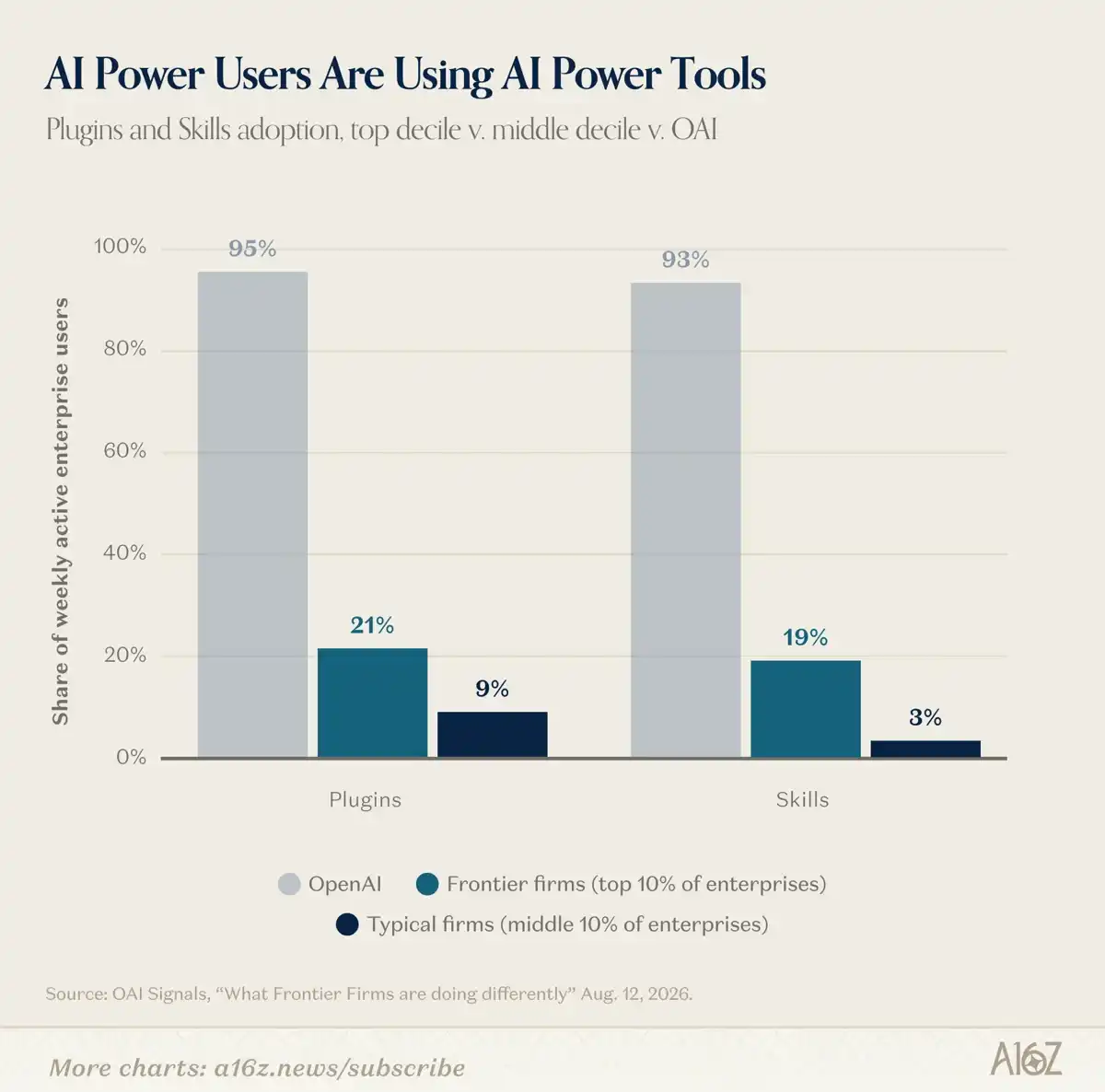
The adoption rate of plugins and Skills among the top 10% is about 2x and 6x that of the typical enterprise, respectively, although even heavy users have a long way to go compared to OAI's internal adoption levels.
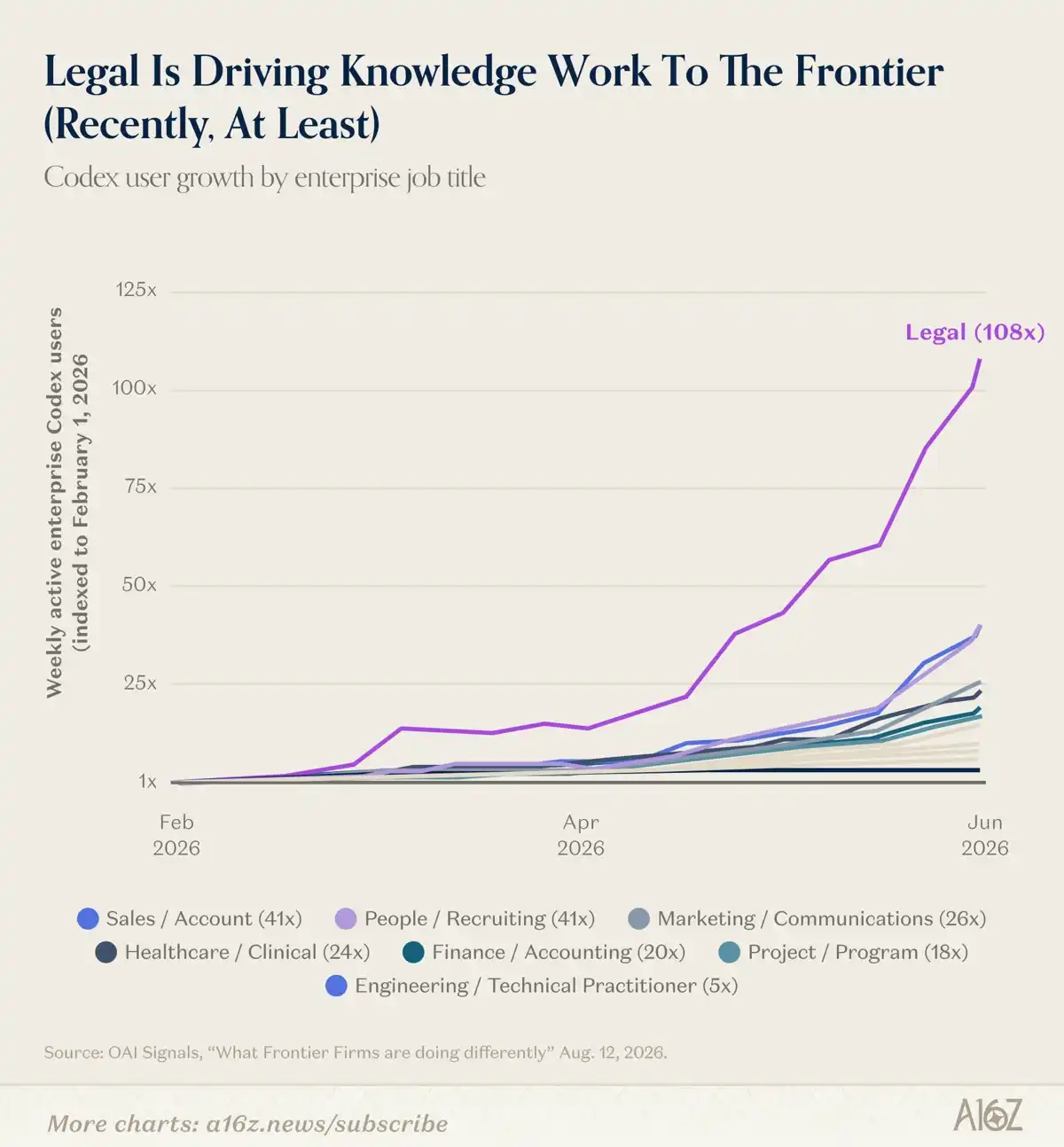
However, interestingly, tech is not the sector with the fastest recent growth in adopting more powerful tools. If Codex adoption is used as a measure of maturity, then overall knowledge worker maturity is increasing, but no group stands out more than legal professionals:
Codex adoption among legal practitioners has skyrocketed 108x since February 2026. How much of this is driven by broader Codex rollouts is debatable, but regardless, the legal field stands out.
Another implication of this shift towards more sophisticated AI adoption is that it is dramatically changing the growth and composition of token consumption.
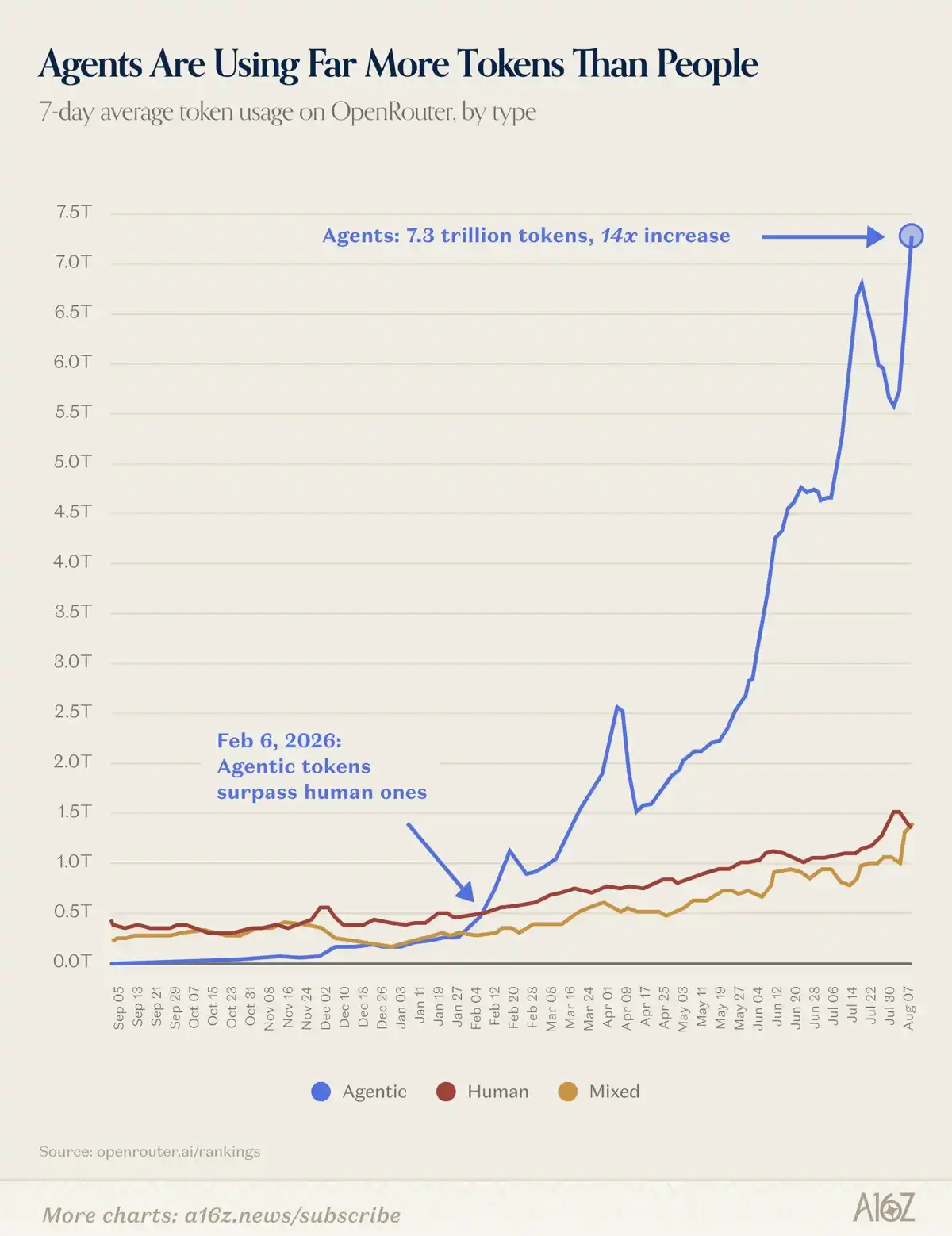
Although only a tiny fraction of AI adopters have deployed full Agents, Agents contribute a massive share of tokens:
According to OpenRouter (and chart author Peter Walker), Agents use almost 5x more tokens than humans, and Agent usage has grown about 14x since February.
Agents not only use far more tokens than humans but also use them in a fundamentally different way. Agents do much more work with cached tokens than humans do:
Also according to OpenRouter, over 85% of Agent token consumption comes from cached prompts—and cached tokens constitute almost all of the relative growth in token usage.
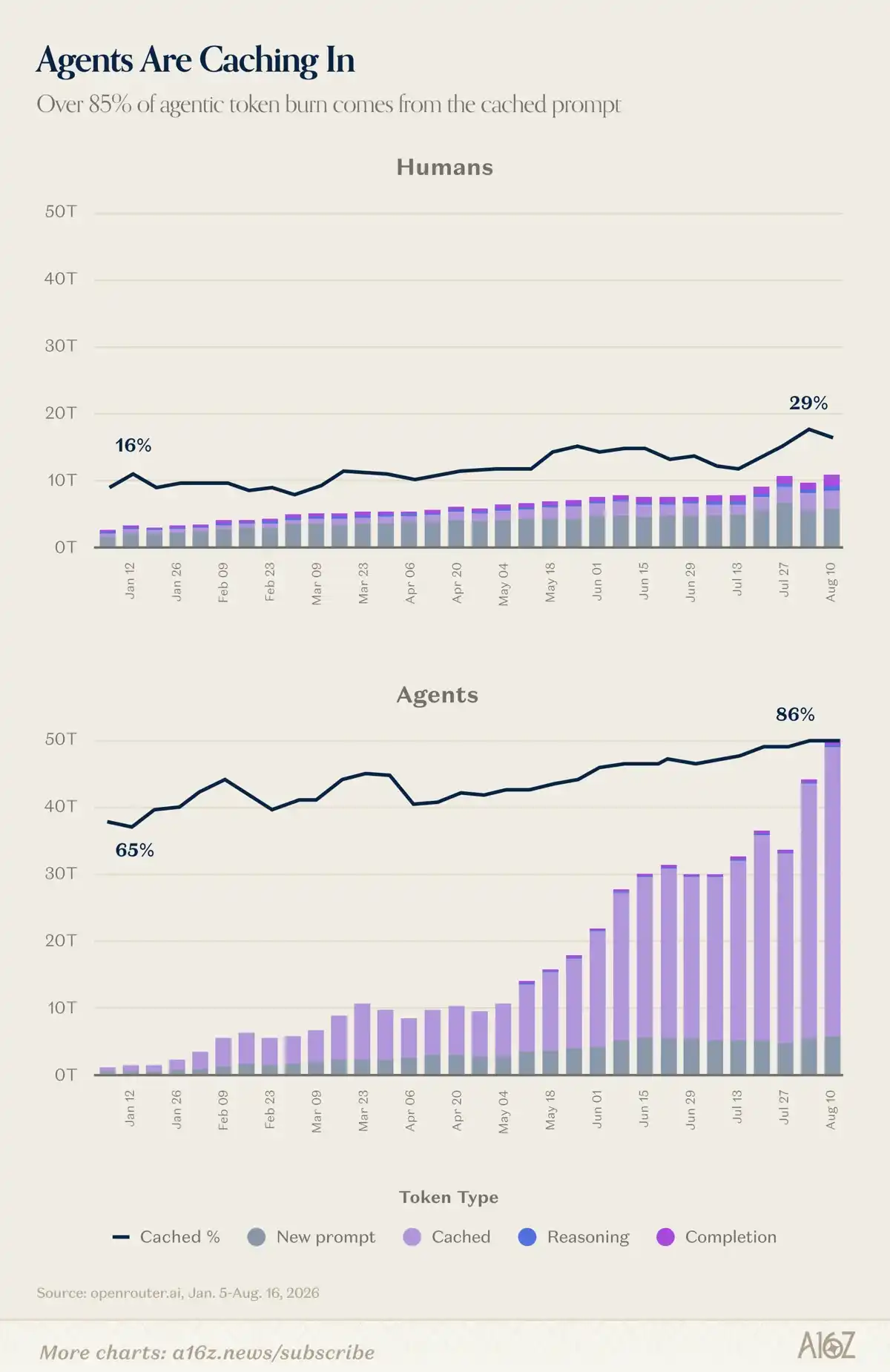
The reason is fairly straightforward: humans tend toward 'question-answer' dialogues, while Agents are designed to iterate repeatedly toward a goal. The initial prompt contains token-dense 'pre-fill' (i.e., core context around the goal, be it policy processes, code specifications, etc.), then the Agent incrementally reads and writes—progressively adding content to the cache as it moves toward a final result.
Cached tokens are far cheaper than pre-fill—this is good, making Agent economics increasingly viable—but (by definition) are also extremely memory-intensive. Now you understand why high-bandwidth memory is especially sought after—all those busy Agents (which don't need to start from scratch each cycle) need memory to 'fire.' And though overall development remains very early, Agents are proliferating rapidly.
Another notable potential second-order effect of Agents: they may be undermining demand for traditional automation and workflow tools.
According to Similarweb data, traffic to automation tool websites is consistently declining, except for Gumloop:
N8N, Zapier, and Make all predate LLMs, and although they dominate the entire automation segment (by visits), each has seen double-digit declines on a rolling 12-week basis. In contrast, Gumloop, launched in 2023 as an 'AI-native Agent builder,' is the only automation platform still gaining momentum (per Similarweb).
It's too early to pronounce death on the Zapiers—they have AI too—but Agents have just arrived and are already substantively changing the game.
To be continued.