Nothing in a stablecoin's code keeps its price fixed at $1, meaning the peg is simply an economic promise where the issuer states each token can be exchanged for one real dollar, and arbitrage does the rest. If $USDT trades at $0.99, professional traders buy it at a discount and redeem it with Tether for $1.00, pocketing the difference and pushing the market price up.
Conversely, if it trades above $1, they mint new tokens for exactly $1 and sell them. The market price remains pegged only because this "redemption machine" is believed to work.
In practice, access to this "redemption machine" is limited. For instance, Tether requires clients to pass verification and have a minimum of $100,000 for direct redemptions, while Circle (the issuer of $USDC) operates through institutional accounts. Everyone else (be it a retail holder, a DeFi protocol, or an offshore exchange) relies on a chain of arbitrageurs who have both the access and the courage to keep buying tokens at a discount during panic.
It is this structure that causes a peg deviation to appear on exchange screens even in cases where the issuer never misses a redemption, i.e., the first line of defense for the peg is the trust of other people, not the reserves themselves.
Four Cases of Peg Deviation, Four Different Reasons
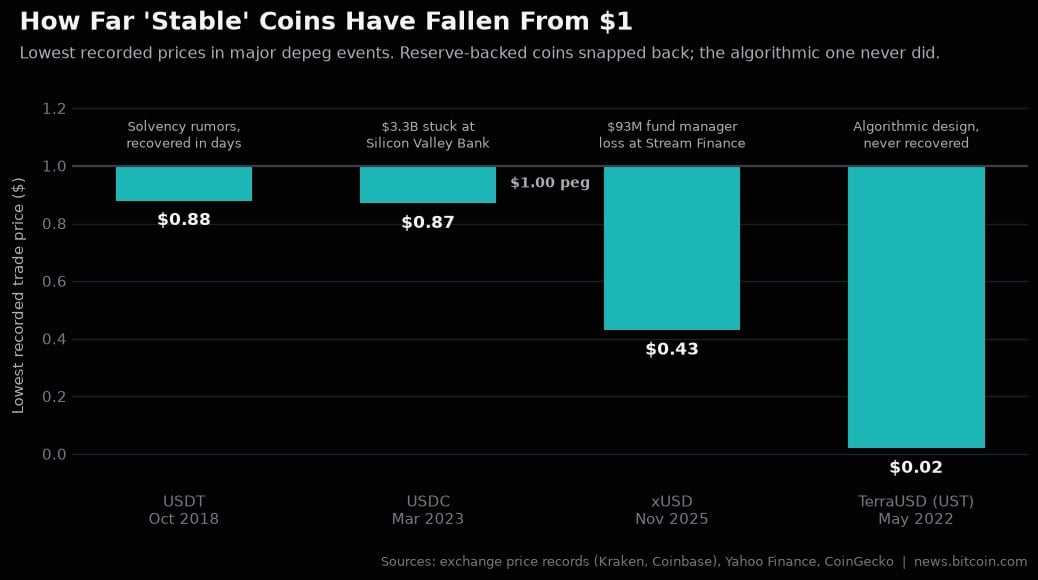
The panic around $USDT in October 2018 was a trust issue: rumors about the solvency of Tether and its associated exchange Bitfinex led to $USDT dropping to around $0.88 on some platforms. Ultimately, the reserves covered the redemptions, and the peg was restored within days.
The deviation of $USDC in March 2023 was more of a banking issue, as Circle disclosed that $3.3 billion of its reserves were held in the failed Silicon Valley Bank, causing the token's price to fall to $0.87 before US regulators guaranteed the bank's deposits. It is worth noting that this incident led to a broader market decline in decentralized finance (DeFi): $DAI, largely backed by $USDC, dropped to around $0.89.
The collapse of xUSD in November 2025 was a counterparty issue and serves as the most recent reminder that yield-bearing stablecoins carry risks not present with the giants. xUSD from Stream Finance was not backed dollar-for-dollar in a bank account, as the company employed leveraged strategies through third-party fund managers to generate yield for holders.
When one of these managers reported a $93 million loss, Stream froze withdrawals, and the price of xUSD plummeted from $1 to a low of $0.24 within hours (with $160 million in user deposits frozen at the same time).
Last but not least, the collapse of terraUSD (UST) in May 2022 was caused by a structural issue, and this token has never recovered. UST maintained its peg not through reserves but via an algorithmic "seesaw" mechanism relative to its "sister" token $LUNA (burning $1 of $LUNA to mint one UST and vice versa).
When mass withdrawals knocked UST off its $1 peg, holders rushed to convert it to $LUNA and sell, leading to hyperinflation of $LUNA's supply and the disappearance of the very asset meant to back the peg. UST fell below $0.10 within a week and trades around $0.02 today. The combined value of both tokens evaporated by roughly $40 billion, and the crash dragged down hedge funds, lenders, and ultimately, the fragile empire of the FTX exchange.
2026: A Decline, Then Stabilization at a Certain Level
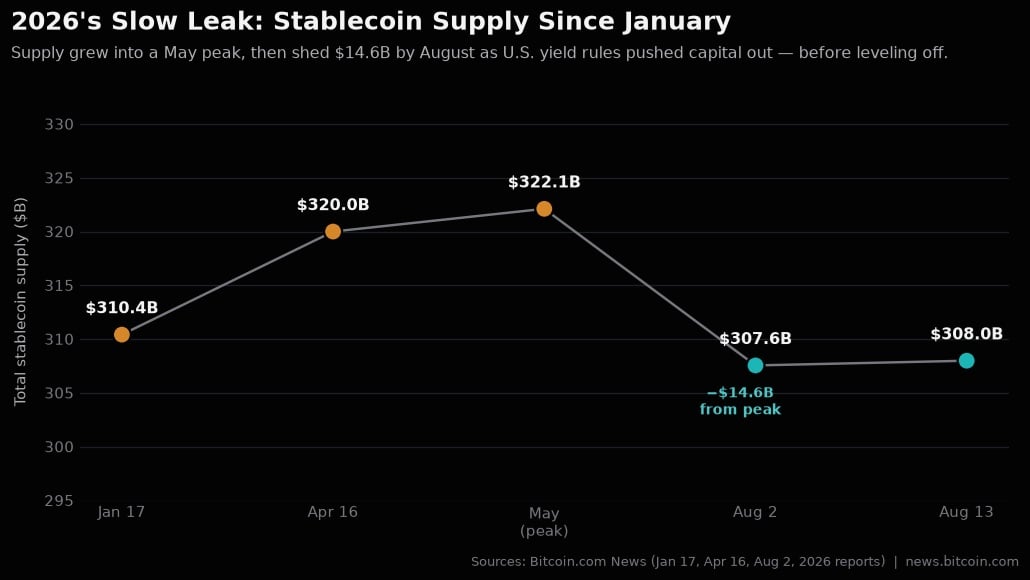
Tensions this year so far do not resemble an "instant crash" but rather a slow leak driven by regulatory measures. After new US federal stablecoin rules deprived digital dollars of the ability to pay interest, yield-seeking capital began to exit. The stablecoin market volume was $310 billion at the start of 2026, grew to about $320 billion by mid-April, and peaked at $322.1 billion in mid-May.
After that, the trend reversed sharply: by early August, the total stablecoin supply had contracted by $14.56 billion—the sharpest contraction since the Terra crash. Over the same period, the volume of $USDT shrank from about $189 billion to $183.2 billion (it had increased by $5 billion earlier this year while competitors saw a $4.2 billion contraction). The volume of $USDC, meanwhile, fell from a March peak near $80 billion to about $72.1 billion.
The decline was not limited to these two giants: in early July, the market volume contracted by $1.9 billion, with Sky Dollar's USDS showing the sharpest weekly drop, although PayPal's PYUSD and Ripple's RLUSD continued to grow.
A supply contraction does not directly cause a peg deviation, but it reduces the buffer of arbitrage capital that absorbs shocks, and it is this buffer that gets tested when the next crisis hits.
Why Concentration Raises the Stakes
Furthermore, this buffer is unevenly distributed, as $USDT and $USDC still account for roughly 83% of the entire $307.6 billion stablecoin market, meaning the redemption mechanism that keeps this entire category at $1 runs through the balance sheets and banking relationships of two companies.
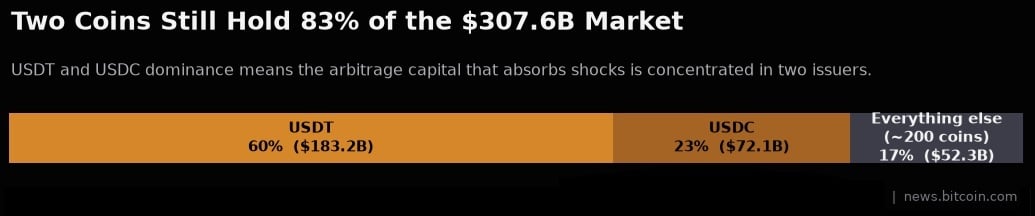
This concentration means that while these two coins dominate trading, which is generally a stabilizing factor, it also leads to disruptions for either issuer (such as a bank failure like the one Circle experienced in 2023, regulatory action, or a dispute over reserves) causing massive, unpredictable damage.
How to Interpret the Next Peg Deviation
First, it is crucial to identify the underlying cause, as reserve-backed coins (knocked off peg due to panic or bank failures) almost always restore their peg quickly once enough tokens are redeemed. However, models based on a native token (like TerraUSD) or an opaque yield strategy are incapable of this.
Second, investors should monitor redemption dynamics, not just price, as a coin trading at $0.97 (with the issuer processing withdrawal requests normally) is simply selling at a discount, not entering a "death spiral."
Third, it is critical to watch where "contagion" spreads: after all, fluctuations in $USDC led to a revaluation of $DAI within hours, the Terra crash affected companies that never dealt with UST, and the xUSD collapse triggered a chain reaction among DeFi lenders holding it as collateral.
end-content