IT桔子 recently released the "China Embodied AI Entrepreneur Ecosystem Portrait Report", which systematically analyzes 1,155 embodied AI entrepreneurs. One of its key findings is: A 'background from a major tech firm' has become the strongest amplifier for financing in the embodied AI sector.
The report shows that over 300 entrepreneurs have previously worked at leading tech companies such as Huawei, Microsoft, Baidu, Google, DJI, Alibaba, Tencent, ByteDance, and Xiaomi. Although the 232 embodied AI companies they founded account for only 20% of the total in the industry, they have secured approximately half of the sector's total financing.
A Comparison of the Financing Strength of Nine Major Firm Affiliated Factions
A horizontal comparison across three dimensions—number of companies, total financing amount, and average financing per company—reveals significant differences among the nine major firm affiliated factions.
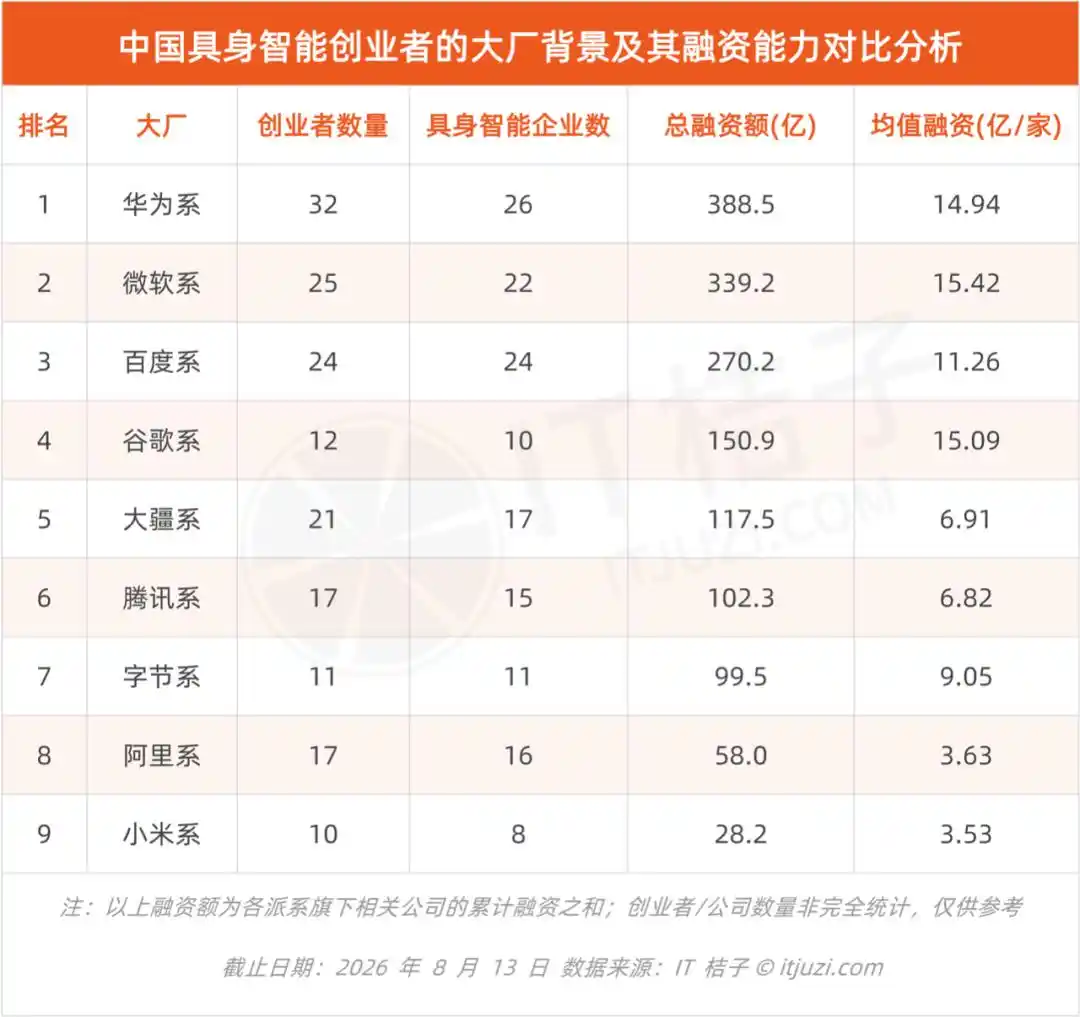
Due to the existence of entrepreneurs who have worked at more than two major firms, there is a slight overlap in financing amounts among the factions, but this does not affect the overall results. This data still clearly reflects the relative financing strength and industrial influence of each faction.
From the table, it can be seen that the Huawei faction ranks first in both the number of companies and total financing amount, demonstrating very strong strength. The Huawei faction's 388.5 billion yuan far exceeds that of the internet-born Alibaba and Tencent factions, indicating that capital in embodied AI is increasingly concentrating on teams that can "truly build robots."
Secondly, the Microsoft faction tops the list with an average financing per company of 1.542 billion yuan, followed closely by the Google faction at 1.509 billion yuan. Founders from both factions are top-tier AI research talents, leveraging a "high-precision" route to secure substantial funding.
The Alibaba faction has 16 embodied AI companies, which is not a small number. However, with the exception of Lin Junyang's Pragmatic Technology as the leading company, the financing amounts for the rest are relatively low. This results in an average financing per company of only 363 million yuan, placing it nearly at the bottom among the major firms, only higher than the Xiaomi faction.
Analysis of Representative Figures and Style Profiles of Major Firm Affiliated Factions
Huawei Faction: "Hardware King"
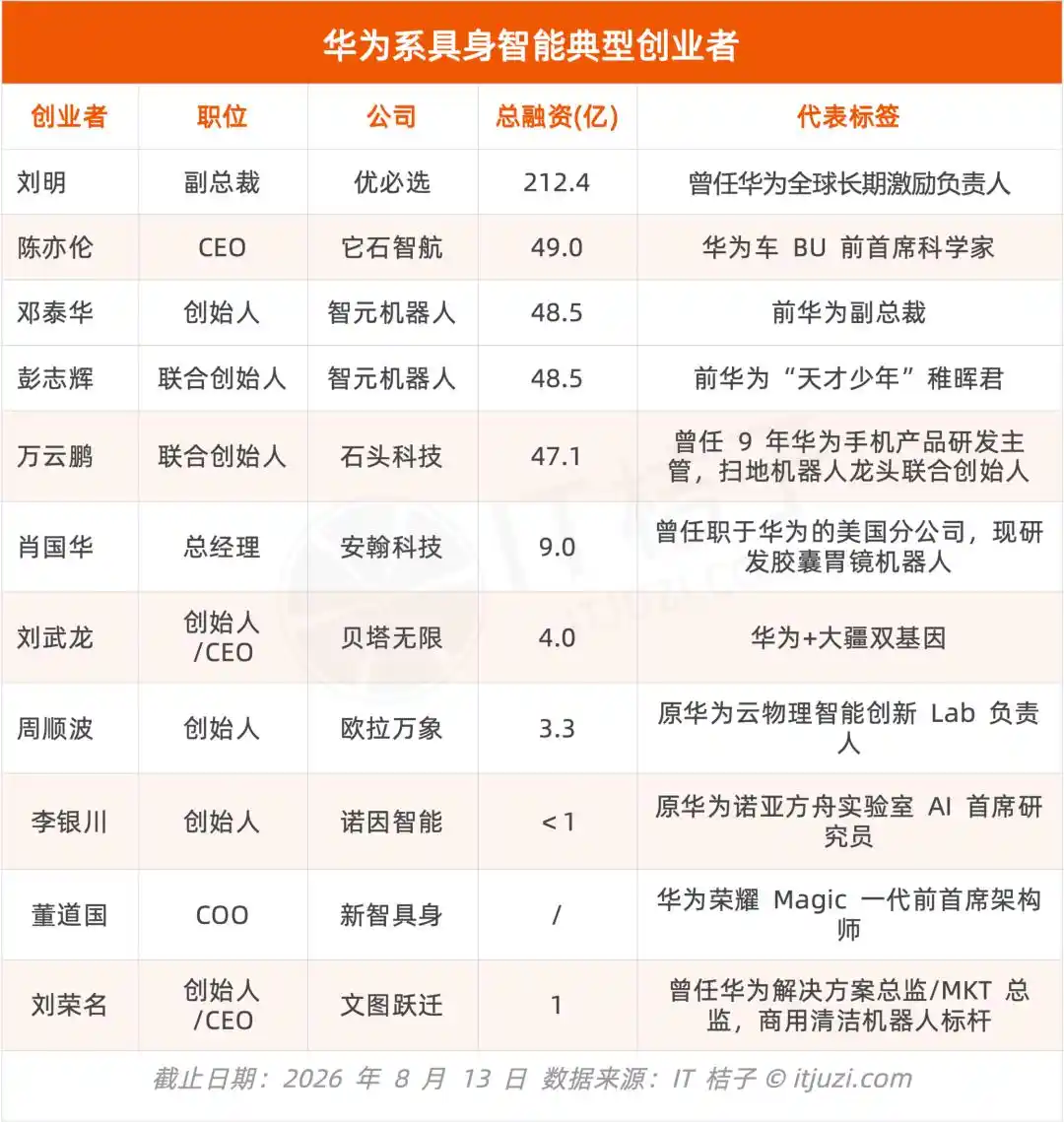
The Huawei faction has the highest total financing in the embodied AI sector, with 26 companies raising a combined 388.5 billion yuan. Its core advantage likely lies in "systems thinking + engineering implementation." Engineers from Huawei are accustomed to thinking from top-level architecture all the way through to mass production, capable of connecting the dots across hardware, software, and supply chains—precisely the kind of talent most lacking in embodied AI.
The most prominent figures include Zhiyuan Robotics founder Deng Taihua and co-founder Peng Zhihui (top Bilibili creator "Zhi Hui Jun"), Itashi Zhihang CEO Chen Yilun (former Chief Scientist of Huawei's Intelligent Automotive Solution BU), YoubiXuan Vice President Liu Ming, and Wan Yunpeng, who founded the new energy company Endless Watts after leaving Roborock. Huawei-affiliated embodied companies are highly concentrated in hard-tech directions like complete machines and industrial scenarios.
Microsoft Faction: "AI-Native Faction"
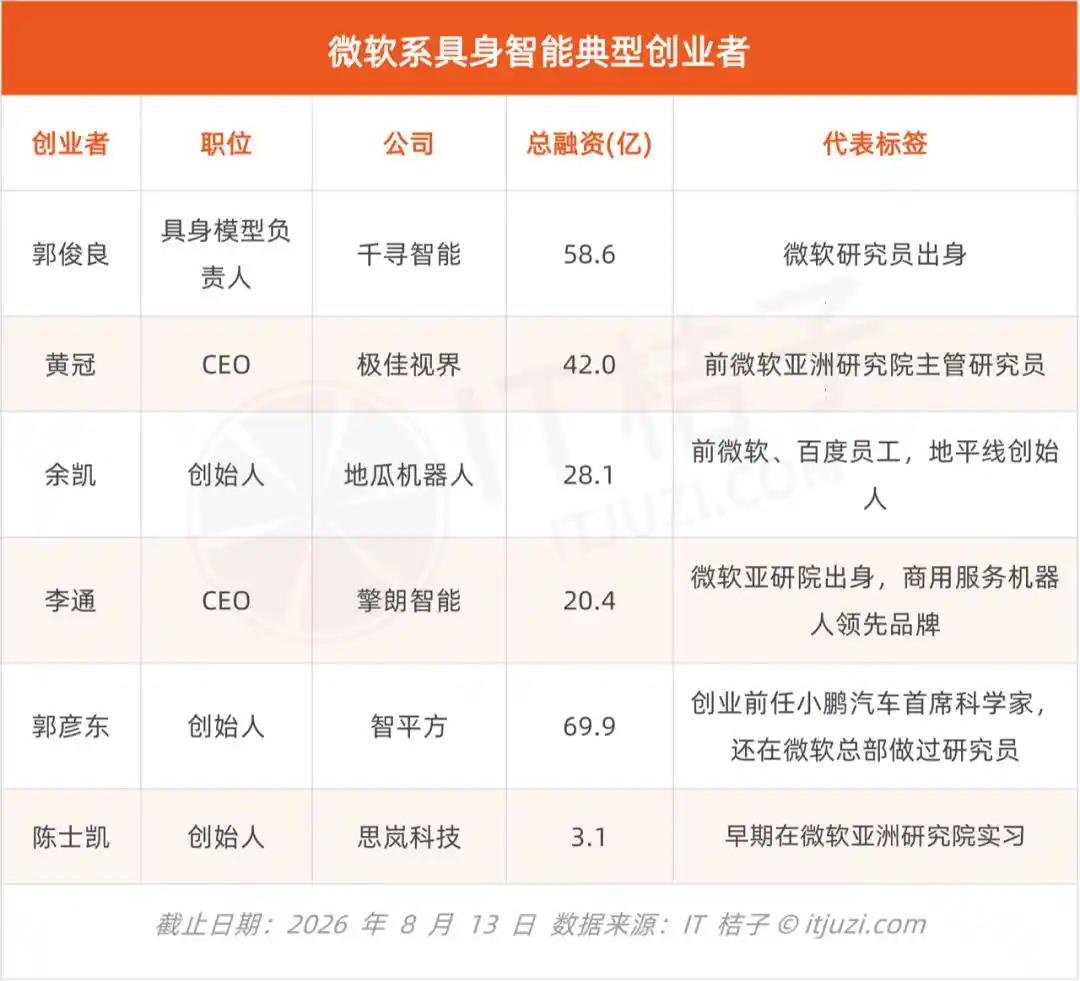
The Microsoft faction ranks second with a total financing of 339.2 billion yuan. The common background of these entrepreneurs is "AI research-driven," with most being former researchers. Microsoft Research Asia (MSRA) has nurtured a generation of algorithm talent for China's AI industry, many of whom have transitioned from AI to embodied AI and robotics.
Representative figures include Digua Robotics founder Yu Kai (who worked at Microsoft before joining Baidu), Jijia Vision CEO Huang Guan (former Principal Researcher at MSRA), Qianxun Intelligent's head of embodied models Guo Junliang (former Microsoft researcher), Zhipingfang founder Guo Yandong, and Qinglang Intelligent CEO Li Tong. Additionally, entrepreneurs with Microsoft backgrounds are not uncommon in publicly listed robotics-related companies like Horizon Robotics and Roborock.
Baidu Faction: "Autonomous Driving Transition Army"
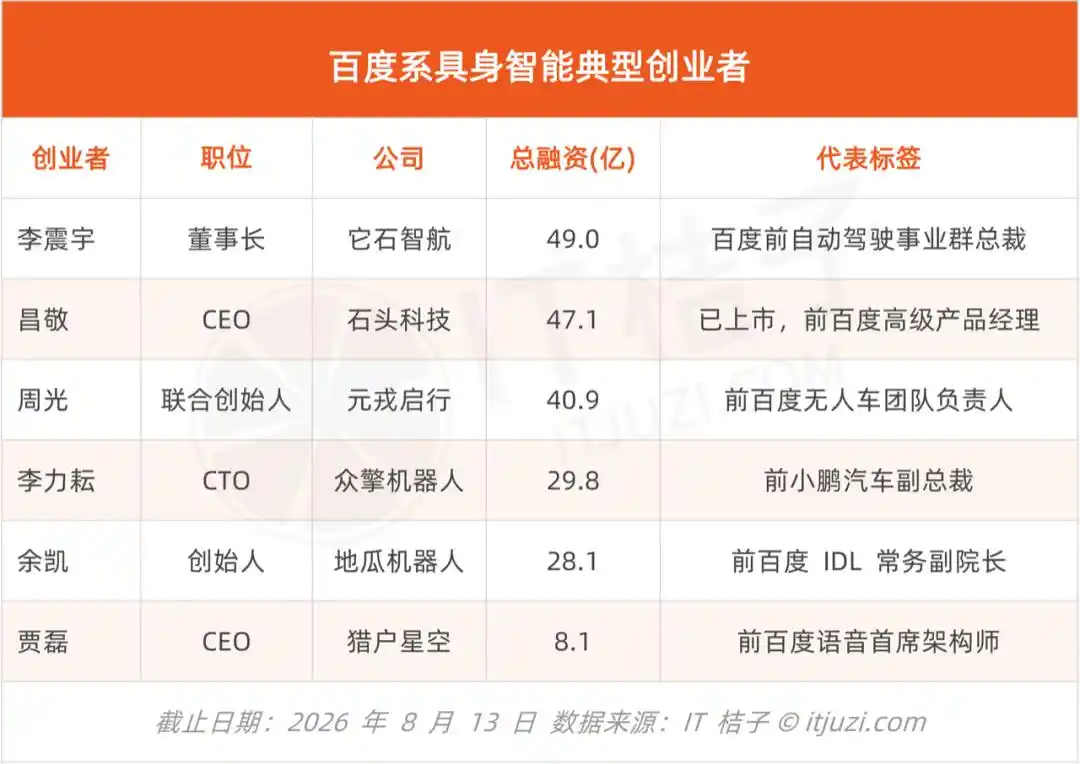
The Baidu faction's 24 embodied AI companies have raised 270.2 billion yuan. The distinctive feature of this faction is its "autonomous driving talent background." Baidu Apollo trained China's earliest batch of autonomous driving technical talent. Their technical stack (perception, planning, control) is largely transferable and reusable when transitioning to embodied AI.
Representative figures include Itashi Zhihang Chairman Li Zhenyu (former President of Baidu's Intelligent Driving Business Group), Yuanrong Qixing co-founder Zhou Guang (former head of Baidu's unmanned vehicle team), Zhongqing Robotics CTO Li Liyun, and Roborock CEO Chang Jing. The Baidu faction is characterized by a natural progression "from vehicles to robots," though some of its companies are positioned somewhat ambiguously within the industry chain.
Google Faction: "Elite Youth Faction"
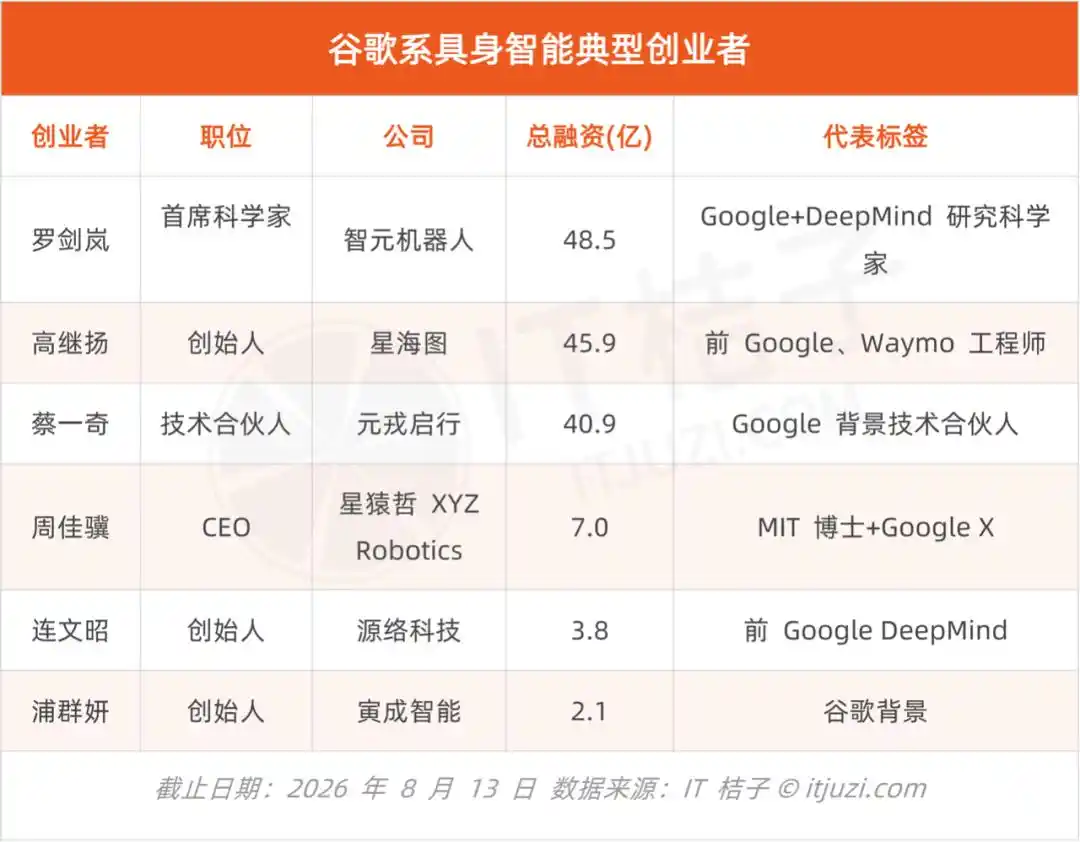
Although the Google faction has only 10 companies in the embodied AI sector, its average financing per company is as high as 1.509 billion yuan, second only to the Microsoft faction. These entrepreneurs are typically AI researchers with strong academic backgrounds, international perspectives, and experience, pursuing high-valuation, cutting-edge directions. Representative figures include Zhiyuan Robotics Chief Scientist Luo Jianlan (Google+DeepMind research scientist), Xinghai Tu founder Gao Jiyang (former Google, Waymo engineer), and Yuanrong Qixing technical partner Cai Yiqi (Google-background technical partner).
Google-affiliated entrepreneurs are known for being "few but elite." Their companies are mostly concentrated in Beijing and Shanghai, with relatively weak connections to the supply chain ecosystem of the Greater Bay Area.
DJI Faction: "Full-Stack Hardware Faction"
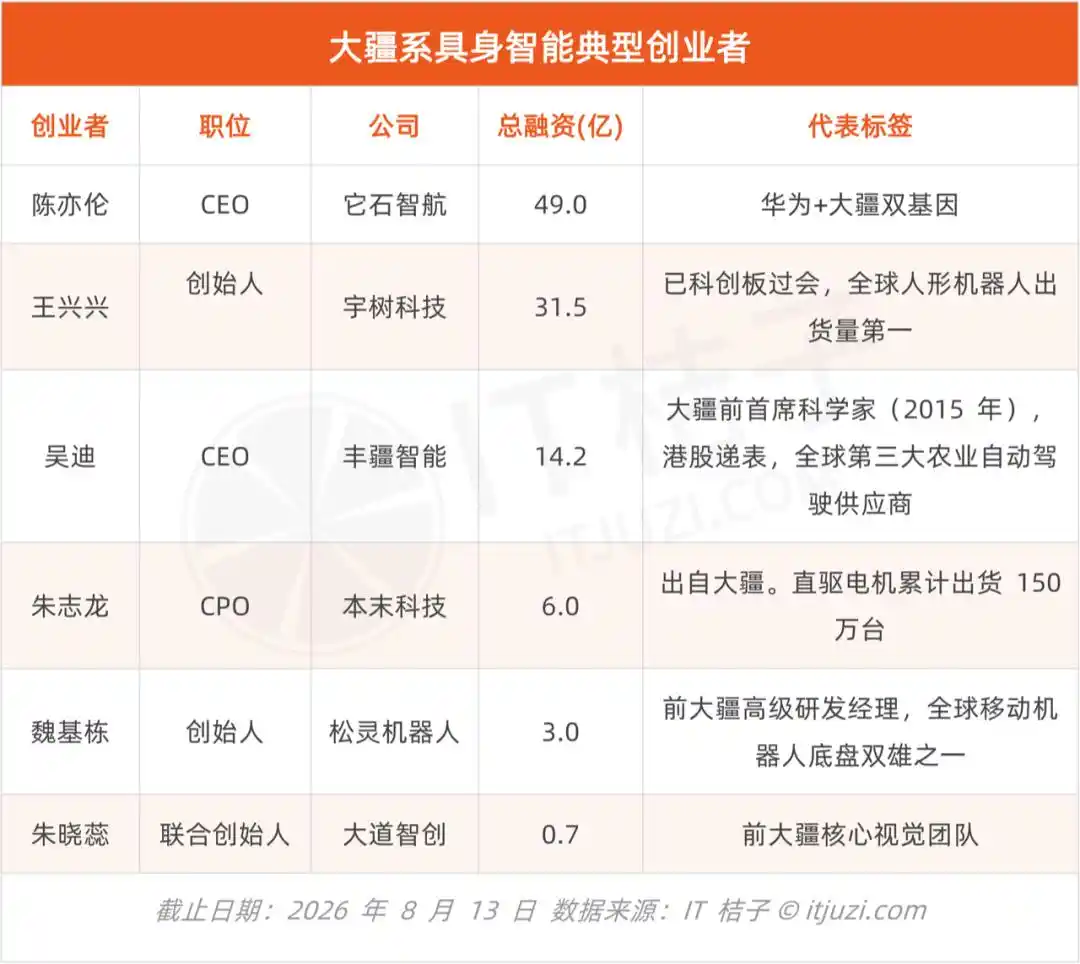
The DJI faction's 17 companies have raised 117.5 billion yuan, excelling with a full-stack hardware mindset. As the global leader in consumer drones, DJI's talent pool covers the entire industry chain from complete robots to core components, holding a pivotal position in China's robotics industry.
Representative figures include Unitree Robotics founder Wang Xingxing (once interned at DJI), Itashi Zhihang CEO Chen Yilun (with both Huawei and DJI backgrounds), and Fengjiang Intelligent CEO Wu Di (served as Chief Scientist at DJI in 2015). Furthermore, DJI's RoboMaster competition system, running for a decade, has continuously cultivated and discovered a large number of young engineers for China's robotics industry.
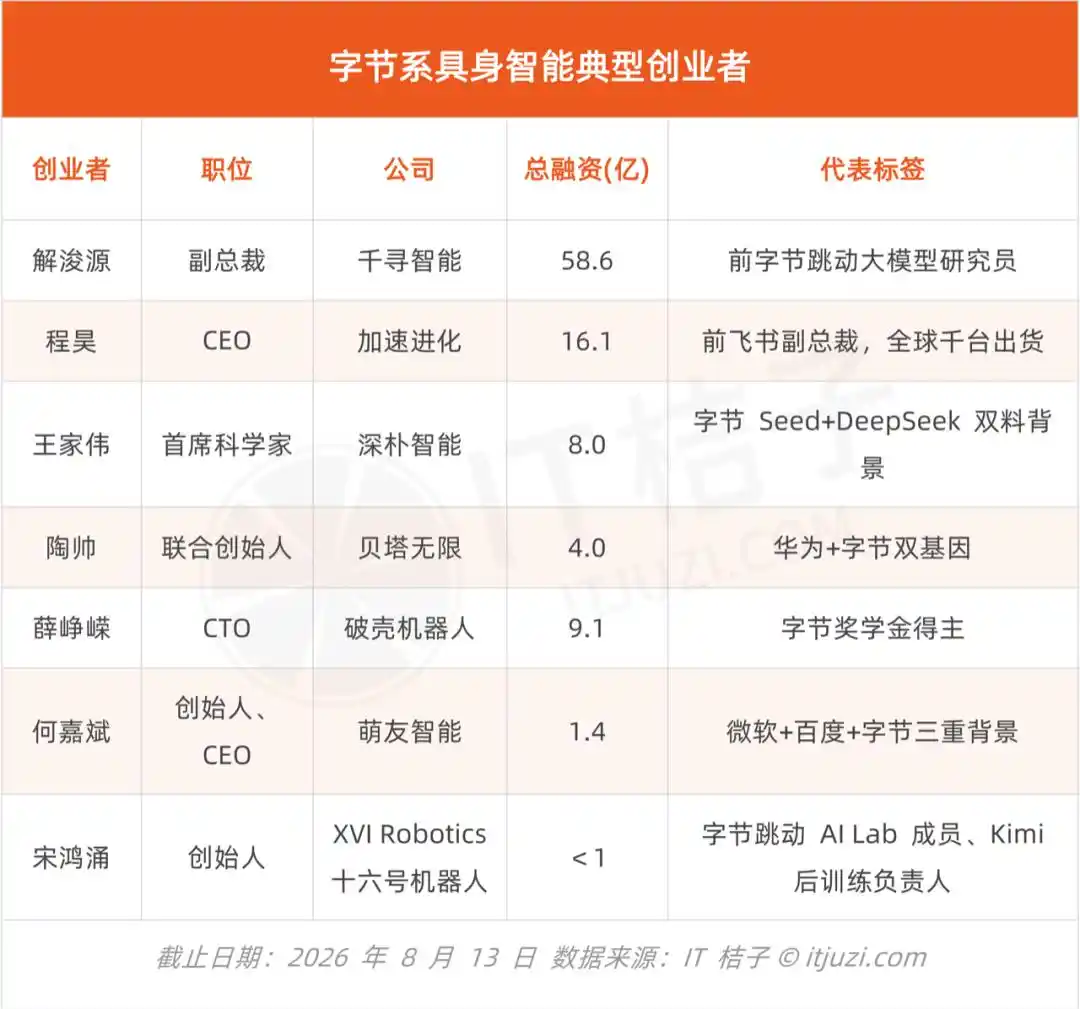
ByteDance Faction: "AI-Native New Recruits"
The ByteDance faction's 11 companies have raised 99.5 billion yuan, with an average of 905 million yuan per company, placing it in the mid-upper range among the major firm factions.
The most defining characteristic of ByteDance-affiliated entrepreneurs is an AI-native + consumer product mindset. The methodologies of "driving growth with algorithms" and "extreme user experience," honed at ByteDance, are being transplanted into the embodied AI field.
Representative figures include Qianxun Intelligent Vice President Xie Junyuan (former large language model researcher at ByteDance), Jiaosu Evolution CEO Cheng Hao (former Feishu Vice President), and Shenpu Intelligent Chief Scientist Wang Jiawei (with dual backgrounds from ByteDance's Seed+ and DeepSeek).
The ByteDance faction also has obvious shortcomings: weak hardware accumulation. The mass-production capabilities and supply chain experience of most of its companies still need to be verified.
Tencent Faction: "Veterans + Emerging Forces"
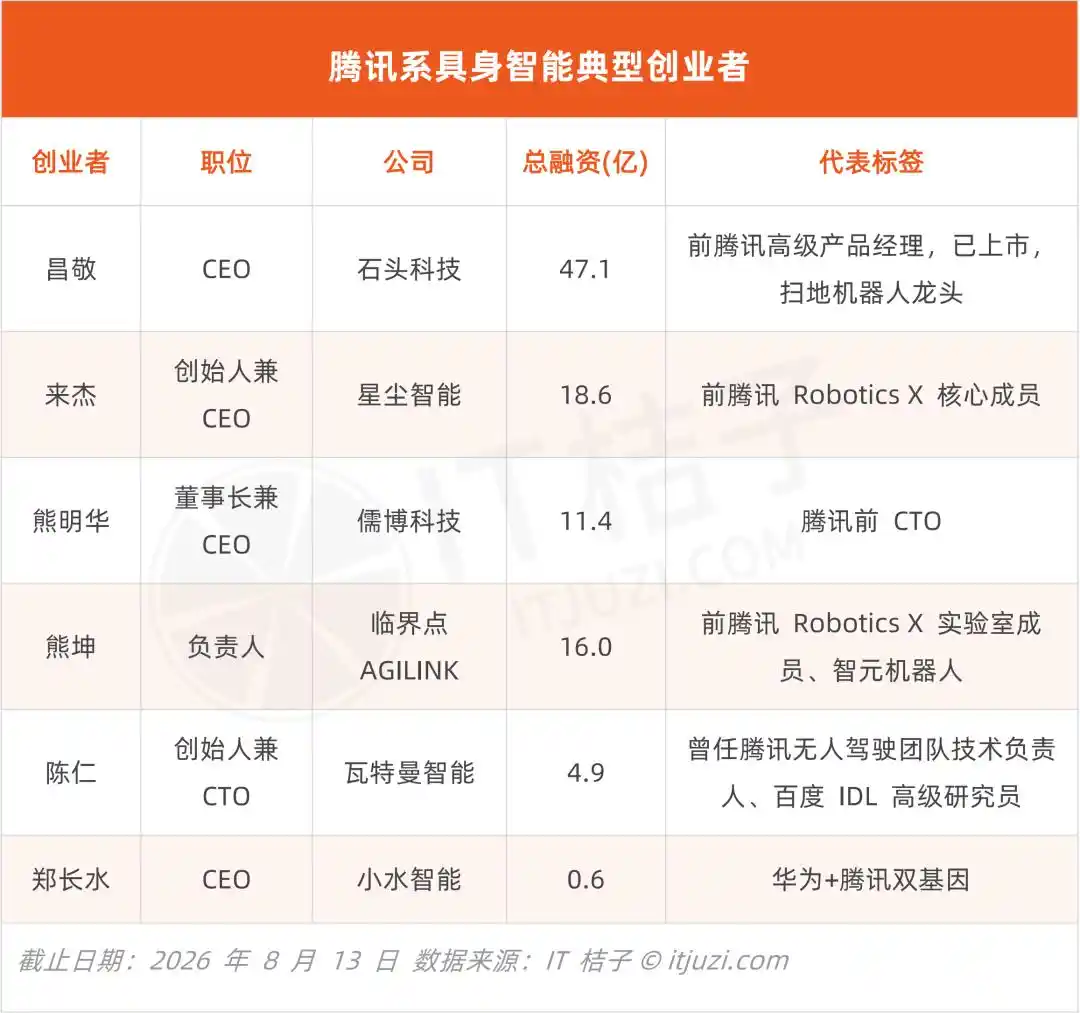
The Tencent faction's 15 companies have raised 102.3 billion yuan, ranking sixth.
The style of Tencent-affiliated entrepreneurs is relatively diverse, ranging from veteran entrepreneurs like Roborock's Chang Jing (former PM at Tencent and Baidu) and Rubo Technology Chairman Xiong Minghua (former Tencent CTO), to emerging forces. Among the latter, prominent representatives are those emerging from the core members of Tencent's Robotics X lab, including StarDust Intelligent founder Lai Jie and Critical Point AGILINK founder Xiong Kun. Interestingly, both have chosen to focus deeply on the niche direction of dexterous manipulation in humanoid robots.
Compared to Huawei and Baidu, Tencent plays more of an investor role in the embodied AI field. For example, Tencent has directly invested in leading companies like YoubiXuan, Unitree, and Fengjiang Intelligent. The direct output of entrepreneurial talent from Tencent is relatively smaller.
Alibaba Faction: "Alibaba Cloud + DAMO Academy as Major Talent Sources"
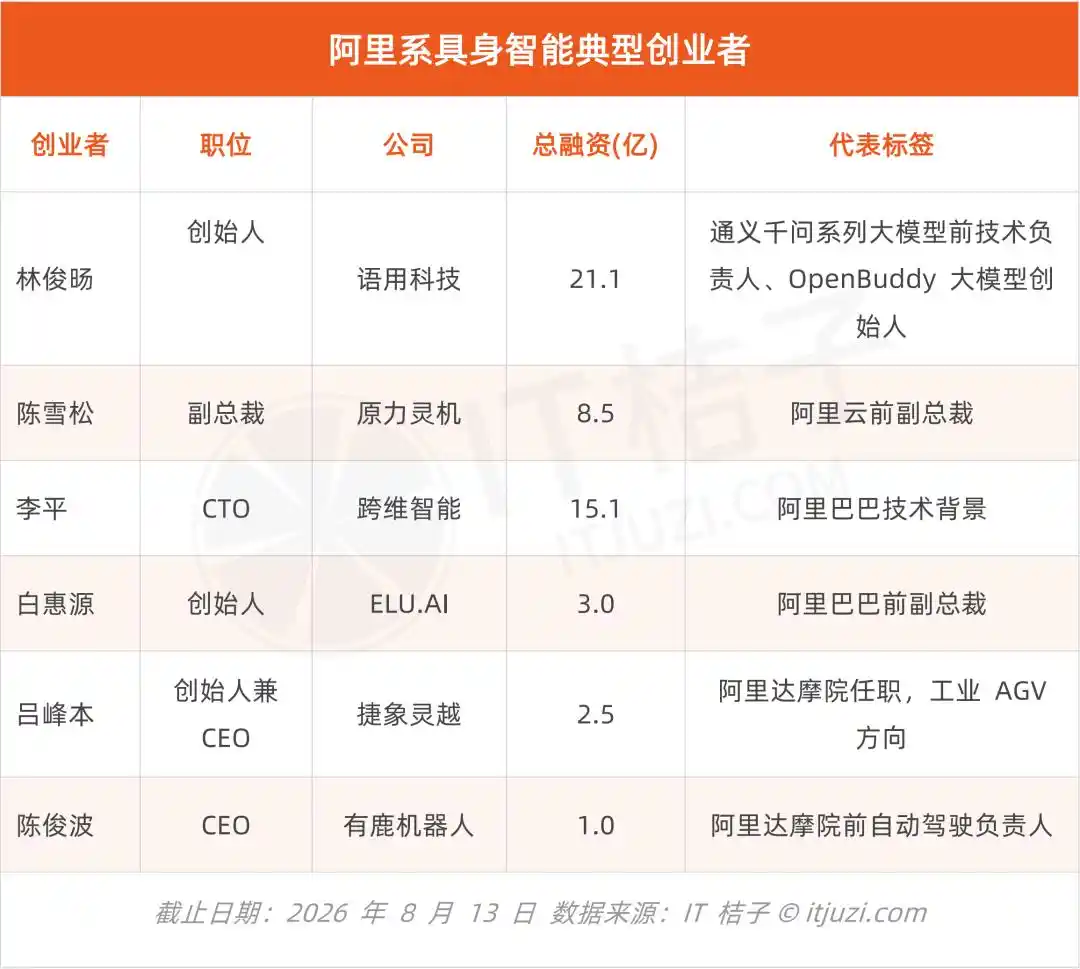
The Alibaba faction has 16 companies, but with total financing of only 58.0 billion yuan and an average of 363 million yuan per company, it falls into the bottom tier among the nine factions. This is mainly because these projects are mostly still in pre-Series A stages, lacking mature leading projects.
Lin Junyang is one of the most representative figures. He joined Alibaba in 2019 as a senior algorithm engineer at DAMO Academy, later served as the technical lead for the Tongyi Qianwen series of large models after 2022, and founded Pragmatic Technology in 2026, which has already secured $220 million in financing shortly after its establishment. Other representative figures include Yuanli Lingji Vice President Chen Xuesong (former Alibaba Cloud Vice President) and Kuayi Intelligent CTO Li Ping.
It is worth noting that the downsizing of innovative business lines like Alibaba's DAMO Academy has indirectly contributed to a number of embodied AI entrepreneurs. Although they possess certain research capabilities from their lab backgrounds, there is still a significant gap to true commercialization.
Xiaomi Faction: "Ecosystem Chain Approach"
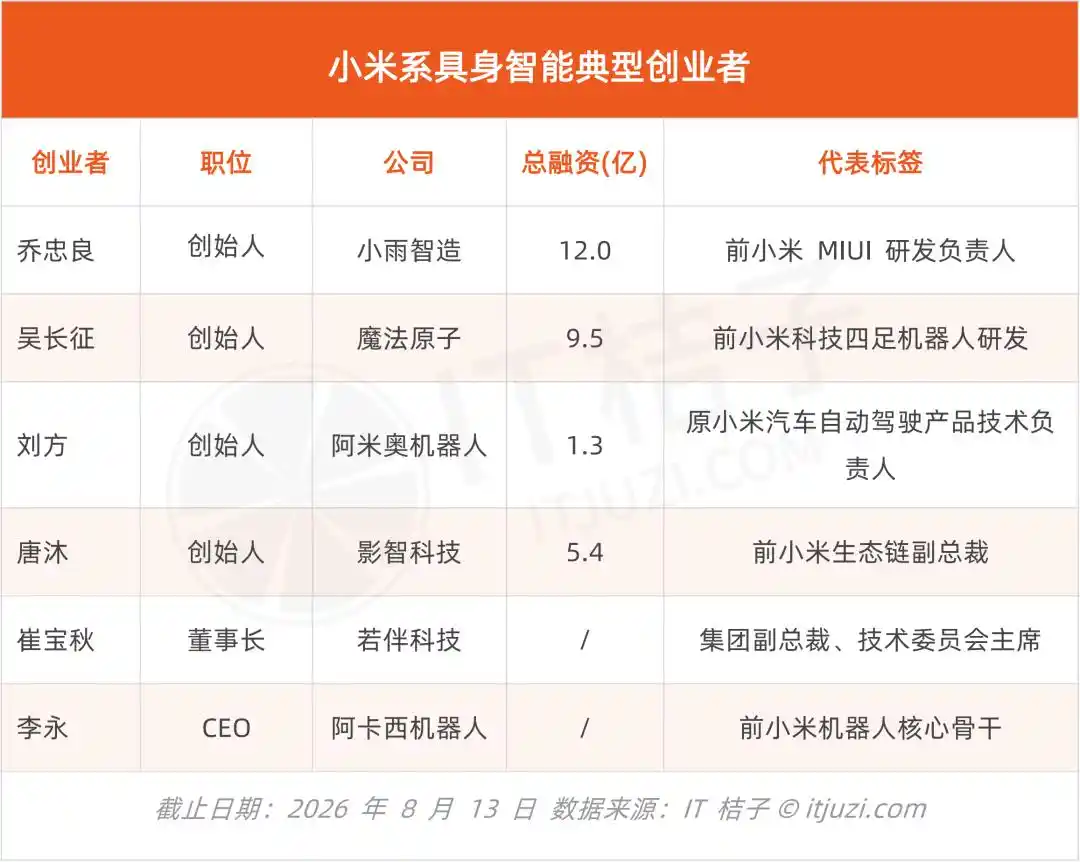
The Xiaomi faction's 8 companies have raised a combined 28.2 billion yuan, making it one of the smaller and relatively newer forces among the nine major firm factions. Its characteristics are also distinct: entrepreneurs mostly come from the Xiaomi ecosystem chain, familiar with product definition, supply chain integration, and the extreme cost-performance approach. They also have natural synergies with Xiaomi's automotive and robotics businesses.
Representative figures include Xiaoyu Zhizao founder Qiao Zhongliang (former head of Xiaomi MIUI R&D), Magical Atom founder Wu Changzheng (former four-legged robot R&D at Xiaomi Tech), and Amiao Robotics founder Liu Fang (former head of autonomous driving product technology at Xiaomi Auto). Currently, most Xiaomi-affiliated companies are in early angel or seed stages. However, with the leverage of Xiaomi's ecosystem chain mass-production experience, their subsequent commercialization is worth observing.
What Kind of Major Firm Background is the Strongest Financing Amplifier?
Although a major firm's brand significantly reduces investors' trust cost, the differentiation among them also reveals certain issues.
A "Hardware + AI" Composite Gene is the True "Hard Currency"
The top financing tier—Huawei, Microsoft, and Baidu—share the common characteristic of possessing composite "hardware + algorithm" capabilities.
The Huawei faction excels in hardware design, supply chain management, and mass-production experience. The Microsoft and Baidu factions excel in AI algorithms and large models. Combining these two types of capabilities creates the complete puzzle needed for embodied AI. In contrast, the financing scale of purely internet-background factions like Alibaba and Tencent lags noticeably behind. For the newly entered Xiaomi faction, its financing strength comes from ecosystem chain veterans with hardware mass-production genes.
The flow of money already tells the story: For embodied AI startups, teams that are strong in algorithms and have real hardware experience find it noticeably easier to secure funding. The valuation imagination for teams with only internet backgrounds focused on writing models is being rapidly compressed.
"Mass-Production Capability" is the Dividing Line
The comparison between the DJI and ByteDance factions is quite illustrative.
The ByteDance faction's average financing (905 million yuan/company) is higher than the DJI faction's (691 million yuan/company). However, in terms of mass-production and shipping capabilities, the DJI faction far surpasses ByteDance. For instance, Fengjiang Intelligent's products are distributed in over 110 countries, and Benmo Technology's direct-drive motors have cumulatively delivered over 1.5 million units. The DJI-affiliated companies generally had already sorted out their supply chain and mass-production capabilities at the time of financing. In contrast, most companies founded purely by ByteDance-affiliated entrepreneurs are still in the product validation stage.
This means that capital may grant AI-native backgrounds higher initial valuations in the short term, but the ability to mass-produce and deliver is what determines whether a company can transition from "financing for survival" to "self-sustaining."
This article is from the WeChat public account "IT桔子" (ID: itjuzi521), author: Wu Meimei