By | Alpha Factory
The year's most expensive new stock has been listed.
Upon opening, Pinson Laser will officially debut on the STAR Market. As "the first stock in the A-share market for precision lasers," Pinson Laser's issue price per share reached 186.88 yuan, making it the most expensive new stock of the year. In comparison, the most discussed stock on the STAR Market currently, Yushu, has an issue price of 150.8 yuan per share.
Over the past three years, the company's revenue has grown at a compound annual growth rate of 68.2%, with gross margin consistently above 67%. The company is engaged in the R&D, production, and sales of precision lasers, primarily serving fields with grand prospects like quantum technology.
However, before reaching that future, Pinson Laser still faces a series of real-world challenges, including fluctuations in downstream demand and competition from overseas giants.
01 How Did Pinson Laser Become the 'Year's Most Expensive New Stock'?
"Small yet beautiful" is an important reason why Pinson Laser became the most expensive new stock.
"Small" refers to its small float.
In this IPO, Pinson Laser issued only 10 million new shares, making it one of the new stocks with the smallest number of shares issued this year. Calculated at the issue price, the company is expected to raise a total of 1.869 billion yuan.
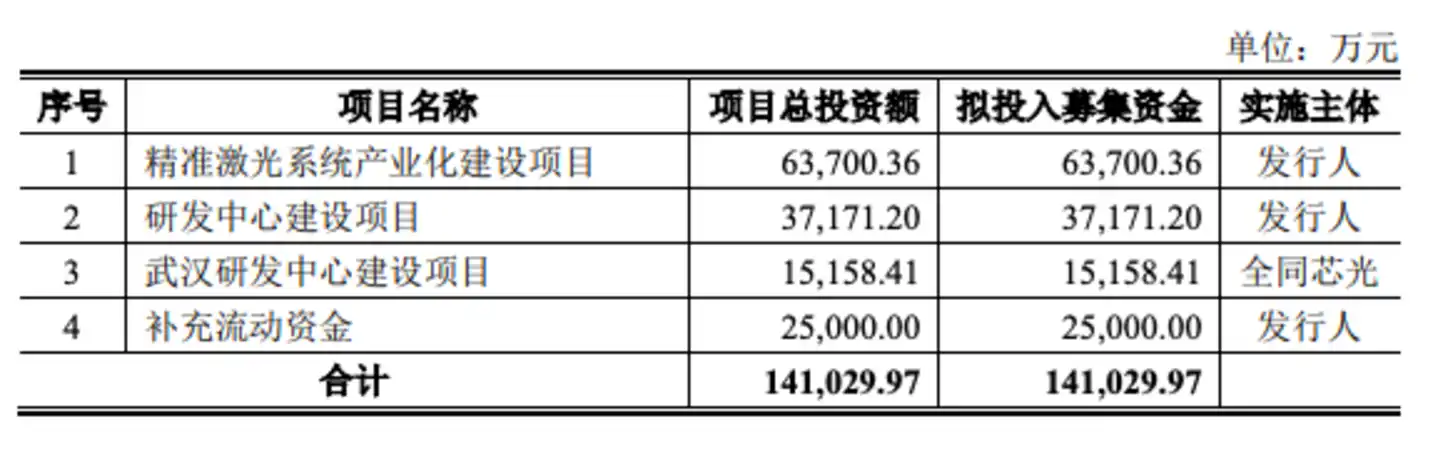
Pinson Laser's proposed fundraising projects are expected to use 1.41 billion yuan of the raised funds; Data source: Prospectus
The small share capital not only pushed up the issue price but also increased the post-listing stock price volatility. Pinson Laser's unrestricted float is only 7.6178 million shares, accounting for 19.04% of the total share capital, corresponding to a float market value of approximately 1.42 billion yuan—this size is also not large within the STAR Market.
At the same time, this makes the subscription threshold quite friendly. The upper limit for online subscription is 2,000 shares, requiring a Shanghai market value of only 20,000 yuan for a full subscription, allowing many retail investors to participate. Consequently, Pinson Laser's lottery winning rate is quite low at only 0.02%.
Pinson Laser's "beauty" refers to its impressive performance.
Pinson Laser's main business is precision lasers, with its core application scenario being the quantum technology field.
In terms of performance, from 2023 to 2025, the company's revenue was 148 million yuan, 292 million yuan, and 418 million yuan respectively, achieving a three-year compound growth rate of 68.2%. During the same period, net profit attributable to shareholders grew from 60.46 million yuan to 159 million yuan, with profit growth largely matching revenue expansion.
Performance growth has also strengthened the company's position in the industry. According to QY Research data, in 2024, Pinson Laser held a 9.21% market share in the global quantum technology laser market and a 16.85% share in the domestic market. In the niche field of precision lasers, Pinson Laser is already the domestic leader.
Furthermore, the company's gross margin has remained stable at a high level between 67% and 70%, indicating that Pinson Laser's growth is driven by genuine demand rather than price competition.
Besides being "small yet beautiful," the valuation premium brought by scarcity is another significant reason why Pinson Laser became the "year's most expensive new stock."
For investors looking to buy into a core hardware player in the quantum technology sector, Pinson Laser is currently almost the only choice in the A-share market. This "one-of-a-kind" scarcity supports the market's acceptance of its high pricing, a logic that has been repeatedly validated on the STAR Market this year.
It's worth noting that Pinson Laser's price-to-earnings (P/E) ratio at issuance is 49.42 times, lower than the industry average P/E ratio (68.04 times). This largely implies that the company's high gross margin has not been fully "priced in."
02 The Road to the Stars and Beyond is Paved with Thorns
Quantum technology is often imbued with "star-reaching" imagination. Whether it's quantum computing, quantum precision measurement, or quantum communication, each direction points toward disruptive technological revolutions. And lasers are indispensable core hardware for these cutting-edge technologies.
But stripping away the conceptual halo, the quantum information laser track where Pinson Laser operates is currently still a niche market dominated by scientific research procurement.
Data from QY Research shows that the global scientific research laser market size in 2024 was approximately $2.147 billion, expected to reach $3.331 billion by 2030, with a compound annual growth rate of less than 8%.
An 8% growth rate might be respectable in the manufacturing sector, but this growth rate clearly cannot support excessively high imaginations.
The reason for the limited market size is straightforward: quantum computing and quantum precision measurement are still mainly in the laboratory stage, with true industrial applications still far off.
Pinson Laser's customer list is quite impressive, covering top-tier quantum research institutions in Europe and America such as Harvard University, University of Colorado, California Institute of Technology, and ETH Zurich.
This client list certainly testifies to the company's technical strength from the side. However, the demand from research institutions is significantly influenced by funding cycles. Orders surge when funding is ample and contract sharply when budgets tighten—a challenge faced by all scientific instrument and equipment manufacturers.
Pinson Laser also frankly admits in its prospectus that if downstream market demand declines or competition increases significantly in downstream application segments, the company may face risks of declining gross margin and operating performance.
Competition from overseas giants is another layer of pressure. The high-end narrow-linewidth precision laser market has long been dominated by overseas manufacturers, with Germany's Toptica and America's Coherent being the traditional powerhouses in this field.
Pinson Laser's technical approach has its own characteristics, adopting a "seed source + fiber amplification + nonlinear frequency conversion + frequency stabilization" architecture, which differs from the traditional schemes of overseas manufacturers. It can achieve narrow linewidth, low-noise laser output across the full spectrum from 177nm to 5000nm. While this route offers advantages in cost and spectral coverage, it still needs time to catch up in terms of brand recognition.
A greater variable lies in the significant uncertainty surrounding the industrialization pace of quantum computing. The industry generally believes that commercial applications for general-purpose quantum computers are at least a decade or more away.
Before that, the primary customers for quantum technology lasers will remain research institutions, with a clearly visible market ceiling. If the industrialization process of quantum computing is slower than expected, Pinson Laser's growth story will need to find new support.
The semiconductor business has been entrusted with high hopes as a second growth curve. Pinson Laser's products have already penetrated semiconductor fields such as wafer fabrication, wafer measurement and inspection, and wafer stealth dicing. From 2023 to 2025, the company's revenue in this field increased from 25.15 million yuan to 104 million yuan.
The semiconductor equipment market is far larger than the scientific research laser market. If Pinson Laser can gain a foothold in the semiconductor field, it would undoubtedly significantly raise the company's business ceiling.
But competition in the semiconductor market is equally fierce. International giants like Coherent and II-VI have deep layouts in the semiconductor laser field. For Pinson Laser to increase its share from 1.98% in the semiconductor sector will be no easy task.
R&D is another test for Pinson Laser. During the reporting period, the company's R&D expenses were 22.12 million yuan, 41.71 million yuan, and 61 million yuan respectively, accounting for 14% to 15% of revenue. This proportion is not low, but the absolute amount pales in comparison to the hundreds of millions of dollars in R&D investment by overseas giants.
It's not hard to see that between the "star-reaching" prospects and revenue lies a long path of industrialization.
For Pinson Laser, focusing on the present is more likely to lead to the shores of the future.