Written by: G_Gyeomm
Compiled by: AIdidiaoJP, Foresight News
I. A New Type of Insurance Directly Priced by the Market
The recently launched AI risk management tool Blanket is attempting to turn predictive markets into a genuine insurance tool usable by businesses. The logic is straightforward: a business inputs its operational information, the system automatically diagnoses its main risk exposures, and then recommends corresponding Kalshi event contracts to help the business hedge against these risks.
The hedging mechanism itself is not complex. The contract structure of a predictive market is extremely clear — it pays $1 if an event occurs and $0 if it doesn't. The contract's real-time price represents the market's collective judgment on the probability of that event occurring.
It is precisely this simple structure that gives predictive markets the potential to become real hedging tools. Businesses can preemptively purchase contracts for events that could impact their operations, such as abnormal weather, energy price volatility, or tariff policy changes. If these risks materialize, the contract payouts can partially or fully offset the operational losses.
A specific example: an ice cream shop that would lose about $20,000 in revenue if the summer is unusually cool.
The hedging operation is as follows: buy 20,000 temperature contracts at $0.30 each. If the average summer temperature falls below a preset threshold, each contract pays out $1. The total cost is $6,000.
There are only two possible outcomes:
- Cool Summer: The temperature is below the threshold, revenue is down $20,000, but the contracts pay out $20,000 in total. The net loss is locked at $6,000 — exactly the initial cost of buying the contracts.
- Hot Summer: The temperature is above the threshold, revenue is unaffected, but the contracts expire worthless, and the $6,000 cost is completely lost.
Regardless of the outcome, the final loss is firmly locked at $6,000. This $6,000 is essentially the insurance premium. And the rate for this premium is not set by an insurance company's actuary or any traditional underwriting institution, but by the market itself — the price quoted in real-time by countless buyers and sellers with real money.
II. Is the Hedging Market Really Functioning?
Predictive markets have already accumulated enough speculative demand. They first gained fame through election predictions, then smoothly expanded into the sports arena, largely solving the volume problem. The industry generally believes the next growth space lies in expanding more practical use cases, with hedging needs repeatedly mentioned as one of the most promising directions.
In principle, its value is indeed significant. The gaps not covered by existing hedging tools are quite broad. Traditional business interruption insurance in commercial insurance typically requires physical damage as a precondition. A ski shop losing revenue because there was hardly any snow all winter — this kind of pure "operational risk" — is almost impossible to find suitable insurance products to cover on the market.
There are mature hedging tools in the futures market, but the barriers are high: requiring an ISDA agreement, opening a specialized futures account, posting margin, and minimum contract size limits. These are not issues for large institutions, but are almost unattainable for ordinary small and medium-sized enterprises. Goldman Sachs can maintain a professional derivatives trading team, but the cafe on the corner obviously cannot.
The problem is, there has always been a clear chasm between theoretical rationality and actual use. Predictive markets have long carried the label of "gambling," and whether they can truly operate as an independent hedging market — rather than just a speculative tool — has never been systematically verified.
The real question that needs answering is: Are predictive markets actually being used for hedging? Does real hedging demand exist? Trading behavior itself can provide clues. We selected three sets of data for comparison.
The first set is CME grain futures — a typical traditional hedging market, primarily used to mitigate losses from price fluctuations in agricultural and livestock products.
The second set is the Kalshi sports market — where hedging demand is extremely limited, and trading is almost entirely driven by speculation.
The third set is the Kalshi weather market — it handles weather risk in a manner similar to CME weather futures, while sharing the exact same event contract structure and trading environment with the Kalshi sports market. This makes it an excellent test sample — to see which side its trading behavior is closer to.
Hedging and speculation typically exhibit different trading characteristics. Hedgers tend to establish positions well before the actual risk window arrives and hold them until expiration; speculators move in and out more frequently, chasing prices, with noticeably higher turnover rates.
If the Kalshi weather market's turnover rate and holding behavior are closer to traditional hedging markets than to the sports market, then hedging demand is real.
Conversely, if it's not much different from the sports market, then actual usage is closer to pure speculation. In that case, tools like Blanket might be responding to a nice industry hypothesis, not a real demand confirmed by data.
The dataset for this analysis covers 1,265 Kalshi markets settled between August 2025 and August 2026. The screening criteria were: cumulative trading volume of at least 500 contracts, and trading lasting at least three days.
III. Data Point 1: Average Daily Turnover Rate
First, look at how frequently positions are traded in each market. Turnover rate is defined as daily trading volume divided by open interest (OI) for that day. We calculated the daily turnover rate for each contract in each market and then took the median for the entire trading cycle.
The results are clear: Kalshi weather contracts have the lowest turnover rate, only 0.210. The traditional hedging product corn futures is 0.266, and Kalshi sports contracts are the highest at 0.315.
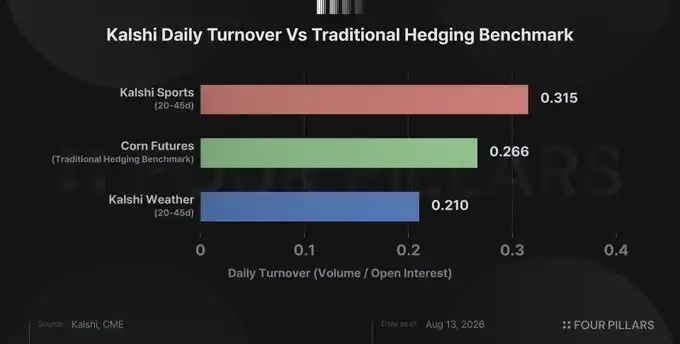
Sports contracts turn over about 1.5 times faster than weather contracts. This indicates a relatively longer holding tendency for weather contracts, initially suggesting the possible existence of real hedging demand.
However, a caveat: Corn futures' turnover rate sits in the middle, and the differences among the three data sets are not particularly stark. Based on turnover rate alone, we cannot fully confirm the existence of hedging demand in the weather market. What this data can definitively tell us so far is only that weather contract turnover is significantly lower than sports contract turnover.
IV. Data Point 2: Hold-to-Expiration Ratio
The second key metric is the hold-to-expiration ratio — measuring how many positions remain untouched in the market at settlement. It is calculated as the final open interest for each contract divided by the cumulative trading volume. A higher value indicates more positions were firmly held until the expiration date.
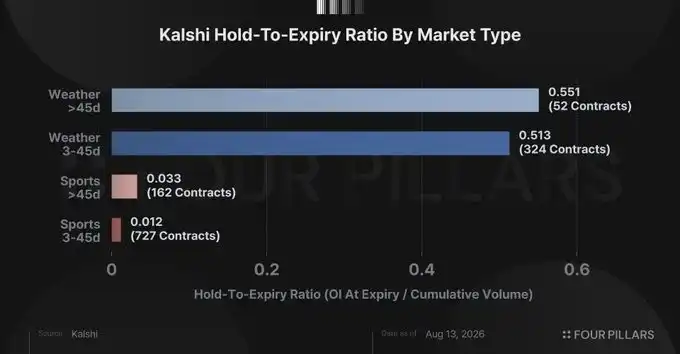
The difference in results is very striking: regardless of trading duration, the hold-to-expiration ratio for weather contracts exceeds 0.5. In contrast, sports contracts are only 0.012 and 0.033 respectively. In the 3 to 45-day trading interval, weather is 42.8 times that of sports; in the over 45-day interval, the gap is still 16.7 times.
This clearly shows: Weather contracts are far more inclined to "buy and hold" than sports contracts. Hedgers hold contracts to receive payouts if the risk materializes, not to chase price differences. Therefore, a high hold-to-expiration ratio strongly supports the judgment that there is real hedging demand in the weather market.
Of course, this cannot be directly interpreted as the entire weather market being used for hedging. This data does not track the identities of individual position buyers and sellers, so it cannot be simply equated with the proportion of original buyers holding to expiration. What can be confirmed at present is that the holding behavior of weather contracts is distinctly different from that of sports contracts.
V. Data Point 3: When Were Positions Established?
The final question is: When were these positions established? We divided the daily open interest for each contract by that contract's peak open interest, converted the time from launch to expiration into a progress bar from 0% to 100%, and then plotted the median curve.
The criterion for judgment is the point at which half of the peak open interest is reached. If half is reached when there is still more time until expiration, it means positions were built earlier — which is more in line with the behavior pattern of hedgers.
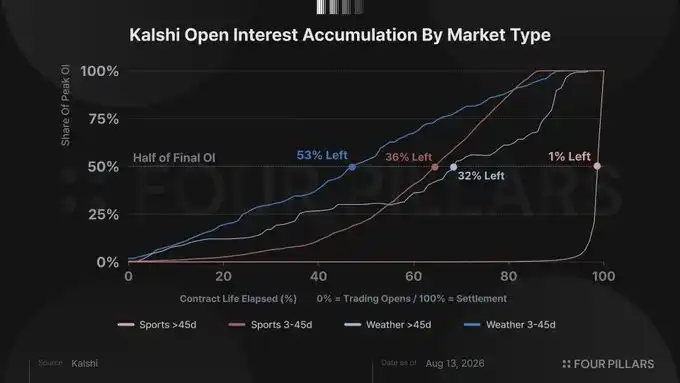
For weather contracts trading for 3 to 45 days, they had already reached half their peak open interest when their lifecycle was at 47%, leaving 53% of the time until expiration. Sports contracts in the same interval didn't reach half until 65%, with only 36% of the time remaining.
For contracts over 45 days, the difference is even more astonishing. Weather contracts reached half when there was still 32% until expiration, while sports contracts had only 1.3% left. Regardless of the interval, weather positions were established much earlier than sports positions.
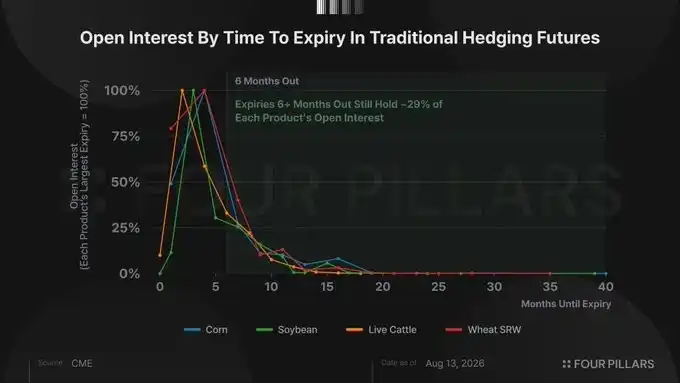
This behavior of "early positioning" is precisely a typical characteristic of traditional hedging markets. As of August 11, 2026, CME grain and livestock futures contracts expiring in six months had already accumulated massive open interest. Corn futures even held 65,127 positions on contracts expiring 16 months later.
This reflects the tendency to act well before the risk actually materializes. And the behavioral pattern of Kalshi weather contracts is clearly closer to traditional hedging markets than to sports markets.
VI. Hedging Relies on Liquidity Built by Speculation
Conclusion first: The Kalshi weather market is neither a purely hedging market nor a purely speculative one like sports. Speculative demand still contributes a significant portion of the liquidity, but on top of that, hedging demand has also emerged relatively clearly.
The three indicators point in the same direction: weather contracts trade less frequently, retain more positions at settlement, and positions are established earlier. No single indicator can confirm trading intent with 100% certainty, but the high consistency of these behaviors collectively supports a judgment — there indeed exists a holding demand in the Kalshi weather market distinct from sports, and a considerable part of it is likely real hedging demand.
More importantly, speculative demand is not so much a weakness of predictive markets as it is a prerequisite for the hedging function to exist. A market with only hedgers and no speculators would struggle to find sufficient counterparties and continuous liquidity.
In predictive markets, speculators are responsible for pricing and providing liquidity, while hedgers transfer the risks they do not wish to bear on this foundation. The risk is no longer directly underwritten by an insurance company but is naturally dispersed among market participants through trading.
Therefore, the next phase of growth for predictive markets is not about "squeezing out" speculation and shifting entirely to hedging. What truly matters is: How much real corporate hedging demand can be layered on top of the liquidity base already built by speculation? This is the core variable that determines whether it can upgrade from an "interesting speculative tool" to a "usable risk management infrastructure."