The BIP-110 Chain Faces a Long Struggle for Survival

cryptonews.ru发布于2026-08-15更新于2026-08-15

文章摘要

The BIP-110 minority chain, a fork from the main Bitcoin network, has successfully mined a small chain of four blocks. Typically, this would immediately doom a fork, but BIP-110 proponents have an alternative survival strategy: to abandon the overwhelming SHA-256 difficulty by replacing the chain's Proof-of-Work (PoW) hash function entirely. Rumors suggest a transition to a new PoW algorithm, likely Blake2b, could occur in September. Currently, mining has stalled at block 961635, leaving over 400,000 transactions pending. The new BIP-110 coin has no exchange listings, resulting in no established market price or liquidity. Holders face risks from a lack of replay protection, which can cause unintentional coin movement between chains. The community is watching to see if the fork will successfully implement the PoW change to Blake2b, reset the mining difficulty, and add proper replay protection, facing a significant uphill battle for survival with minimal industry infrastructure support.

The BIP-110 faction has split from the main Bitcoin network and managed to mine a tiny chain of four blocks. Typically, this would immediately kill a fork, but supporters of BIP-110 have a different path to survival: to rid the minority chain of the unbearable SHA-256 difficulty by completely replacing the proof-of-work cryptographic hash function. Rumors suggest the switch to a new PoW algorithm could happen in September.
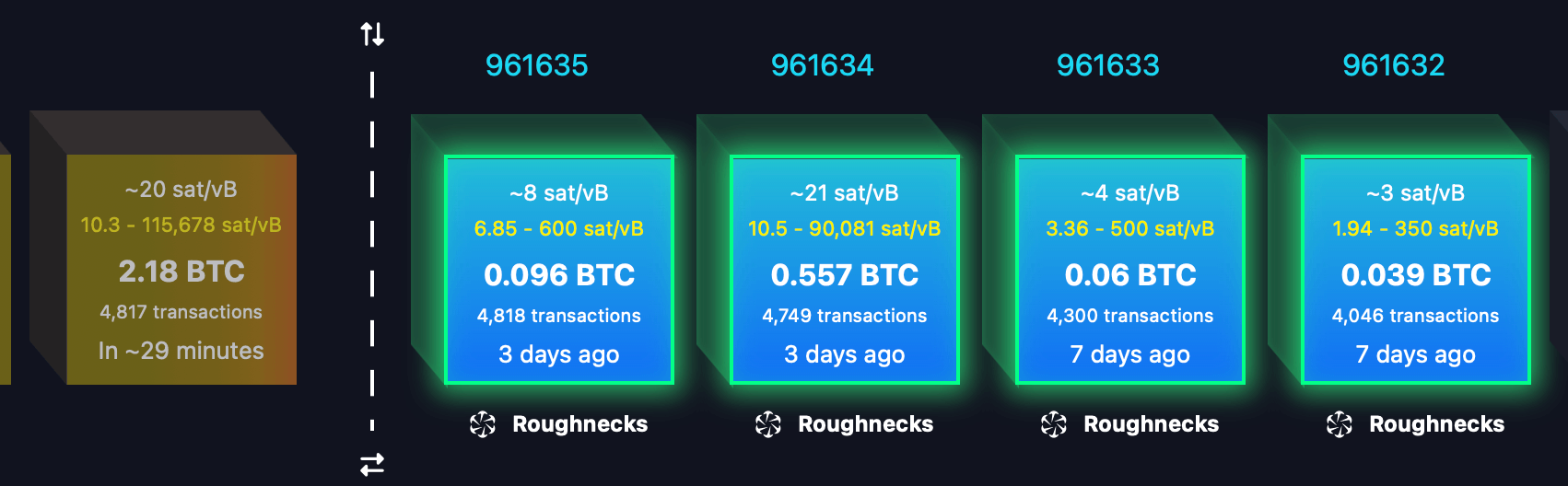
The four blocks mined by the Roughnecks.

To date, the Roughnecks have extended the minority chain to block 961635, but after this block was mined three days ago on August 12th, progress has stalled once again. Since then, block 961636 has accumulated a staggering amount of fees, but with virtually no exchange support, no one can reliably assess the value of the asset created by the BIP-110 fork or determine what these fees are worth.

The Plan: Blake2b

Supporters of BIP-110, including Ocean co-founder Luke Dash Jr., claim the minority chain will switch its PoW hash function from SHA-256 to Blake2b. According to available information, this choice was made from several randomly selected hash functions and PoW algorithms. Importantly, changing the minority chain's PoW hash function does not mean inventing or implementing a completely new consensus mechanism.

The original Blake algorithm was developed in 2008, and Blake2 emerged on December 21, 2012, thanks to Christian Winnerlein, Jean-Philippe Aumasson, Samuel Neves, and Zcash founder Zooko Wilcox-O'Hearn. Blake2b is an optimized 64-bit variant of this primitive, designed for higher performance on modern processors. Blake2b was developed with the goal of outperforming SHA-256 on modern 64-bit CPUs while maintaining an equivalent or higher level of cryptographic security.
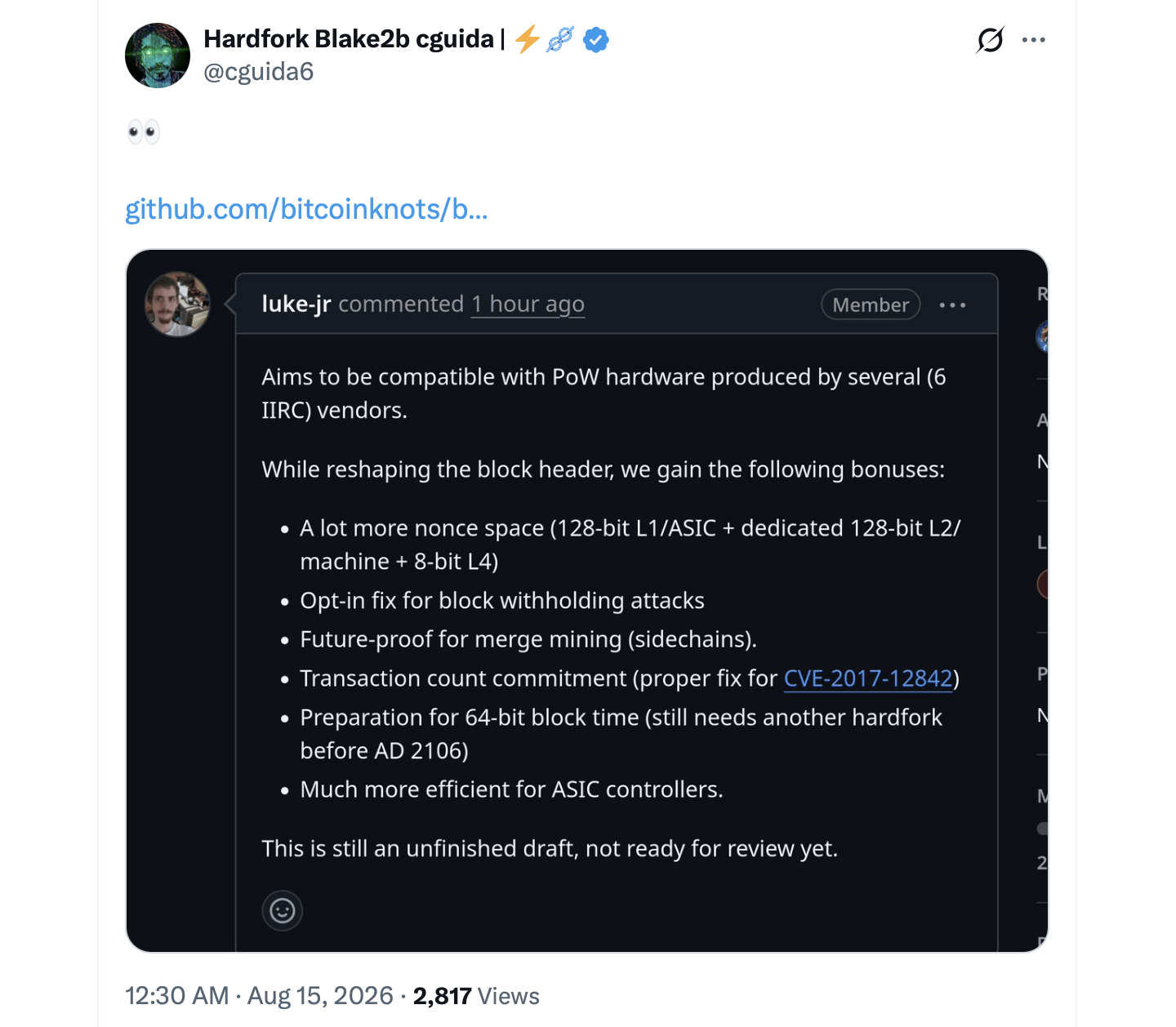
Knots/BIP-110 developers have developed a roadmap for changing the PoW algorithm on the minority chain. Image source: X.

As a Nakamoto consensus-based mining primitive, Blake2b has seen relatively limited adoption: it is used in Siacoin and only a few other PoW blockchains. For Blake2b to work, BIP-110 developers must rewrite the header validation mechanism and implement new PoW validation in the minority chain. Mining software, Stratum servers, and pool infrastructure must support the updated header format and hash function.

Explorers, wallets, and indexing tools also need updates to recognize the altered chain and its tokens. Miners, in turn, will require hardware or software capable of efficiently processing Blake2b. This is a large-scale undertaking, but its supporters seem determined to see it through.

No Exchange Trading Means No Price for the New Coin

The coin resulting from the BIP-110 fork has yet to appear on any exchange. There is no demand, no supply, no liquid market capable of determining a reliable price. Coins mined by the Roughnecks, under current rules, cannot be spent until they receive 100 confirmations. For now, transfers are mainly limited to holders who know how to safely split their coins, and users unknowingly sending BIP-110 coins due to the fork's lack of replay protection.
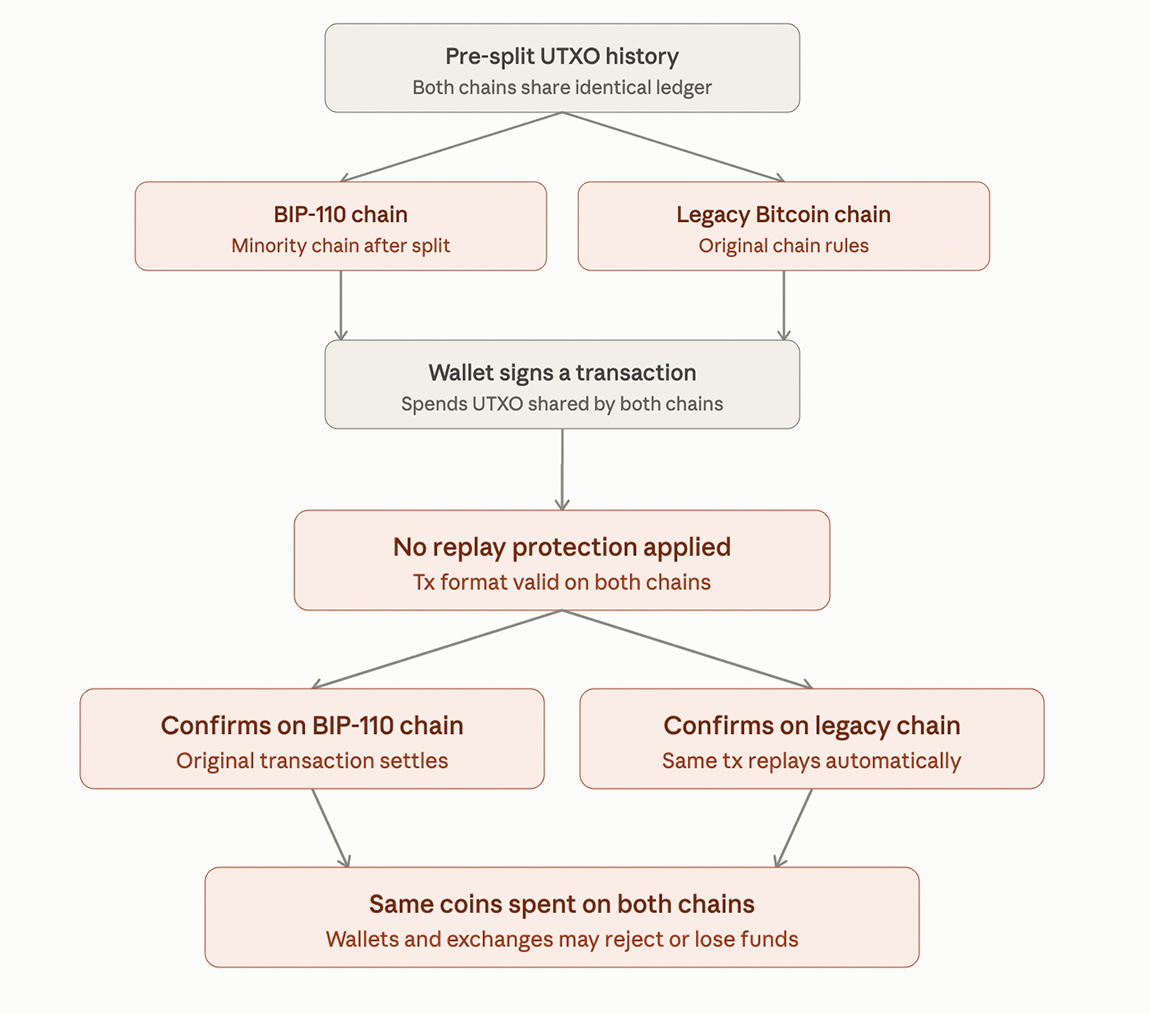
A visual illustration of a replay attack in a blockchain network. Replay attacks occur when a transaction valid in one branch can be copied and broadcast on another chain. Without replay protection, spending bitcoins on one chain can unintentionally move forked coins on the other chain.

As of this weekend, over 400,000 transactions have accumulated, waiting for a block and confirmations in the minority chain. Since the fork froze after just four blocks, this backlog will not be cleared anytime soon. With practically no economic incentives, supporters of the minority chain are already facing a brutal and difficult struggle. This fork has perhaps received the weakest support from industry infrastructure since the 2017 fork frenzy, when dozens of split coins still managed to gain recognition from major wallets and exchanges.

Here, this hasn't happened at all, and the crypto community is forced to watch events unfold. The real test will come if BIP-110 supporters actually abandon SHA-256 for Blake2b, reset the excessive mining difficulty, and finally add proper replay protection.

end-content

热门币种推荐

相关问答

QWhat is the BIP-110 minority chain's primary strategy for survival, and what specific change does it plan to implement?

AThe primary survival strategy for the BIP-110 minority chain is to replace its Proof-of-Work (PoW) hash function. It plans to switch from SHA-256 to Blake2b, which is a change in its consensus algorithm's cryptographic primitive.

QWho is a notable figure associated with the BIP-110 movement, and what potential timeline has been suggested for the PoW change?

AA notable figure is Luke Dash Jr, co-founder of Ocean. Rumors suggest the transition to the new PoW algorithm could happen in September.

QWhat is one major technical challenge mentioned for the chain's successful transition to Blake2b, beyond just the core software change?

AOne major technical challenge is the need for updates across the entire ecosystem. This includes mining software, Stratum servers, pool infrastructure, explorers, wallets, and indexing tools to recognize the changed chain and its tokens.

QWhat major problem is highlighted regarding the economic viability and valuation of the BIP-110 forked coin?

AThe major problem is the lack of exchange listing. Without trading on exchanges, there is no market to establish a price, no supply and demand, and no liquidity for the new coin, making its value impossible to assess reliably.

QWhat specific security vulnerability currently exists in the BIP-110 fork, and what risk does it pose to users?

AThe fork currently lacks replay protection. This vulnerability means that a transaction valid on the main Bitcoin chain can be copied and broadcast on the BIP-110 chain, potentially causing users to unintentionally move their forked coins when they spend their main chain bitcoins.

你可能也喜欢

八年投入急转弯,以太坊为何突然放弃Poseidon?

以太坊基金会研究员Justin Drake近日宣布,以太坊将在Layer 1层放弃已研发八年的SNARK友好型哈希算法Poseidon,转而采用SHA2或BLAKE2等传统哈希函数。这一重大转向源于后量子密码学研究的突破性进展。 Poseidon自2019年起因其在零知识证明电路中的高效性,被广泛用于zkRollup等应用。但其算法历史较短,密码学分析时间不足。而随着后量子安全成为硬性要求,其局限性显现。最新的SNARK设计,特别是基于“二进制域”的证明系统(如Binius和Flock),已能高效处理传统哈希函数的布尔运算,使得SHA2等成熟算法在证明性能上可媲美甚至超越Poseidon,消除了采用后者的主要优势。 另一关键因素是应对量子计算威胁的时间表正在加速。报告预测“量子破译日”可能在本世纪30年代初到来,将对区块链资产构成巨大风险。以太坊因此需要尽快采用经过长期密码分析验证的、抗量子攻击能力更强的哈希方案。其后续量子路线图计划于2027年推出核心构件leanVM,并在2028年完成共识层、执行层和数据层的部署。 与此同时,其他公链如Solana已选定后量子签名方案Falcon,而StarkNet也计划采用BLAKE2等算法。以太坊此次转向,标志着技术重点从“设计SNARK友好型哈希”转变为“设计哈希友好型SNARK”,是在后量子时代选择更成熟、更稳健的密码学基元的战略调整。

marsbit40分钟前

八年投入急转弯,以太坊为何突然放弃Poseidon?

marsbit40分钟前

全球程序员都在给Anthropic白送钱!官方终于看不下去了

Anthropic官方发布博客,针对开发者使用Claude Code时可能产生的不必要高额费用,总结了六条核心省钱建议: 1. 任务完成后及时使用 `/clear` 清理对话,避免无关历史占用上下文。 2. 对话开始时固定好模型和推理强度,中途切换会导致提示缓存失效,需全价重新计算历史。 3. 使用 `@` 引用文件,而非手动输入路径,可避免Claude进行工具调用和试探性读取,减少上下文累积。 4. 为输出冗长的命令(如运行测试)添加静默参数,减少输出内容对上下文的占用。 5. 在会话缓存仍有效时(如休息前)进行 `/compact` 压缩对话,成本仅为十分之一。 6. 将产生大量输出的任务交由子Agent处理,其独立上下文不会污染主对话。 文章解释了费用产生的机制:输入token(预填充)成本较低,输出token(解码)成本约为其5倍。模型(Opus/Sonnet/Haiku)和推理强度直接影响单价和token数量。 **提示缓存是关键的省钱杠杆**:若请求前缀与之前完全相同,服务器可加载缓存结果,读取成本仅为正常输入价的10%。但切换模型、改变推理强度、执行压缩、缓存过期等操作都会导致缓存失效。 此外,对话历史会因不断追加文件内容和命令输出而“变胖”,导致后续每轮对话成本呈接近平方级(O(n²))增长。除了上述建议,还可使用 `/rewind` 回退无效轮次以保住前面缓存。 文章指出,管理token开销正成为AI时代开发者的新技能,关系到使用效率和成本控制。Anthropic自身大量使用AI编写代码,精细的成本管理至关重要。

marsbit2小时前

全球程序员都在给Anthropic白送钱!官方终于看不下去了

marsbit2小时前

交易

现货

热门文章

加密市场宏观研报:《GENIUS Act》法案取得重大进展,BTC突破历史新高,后市全新展望

2025年5月22日,比特币价格正式突破11万美元大关,创下历史新高。在政策面、宏观经济、资金面与投资者结构共同作用下,一场结构性牛市浪潮正在展开。而此轮上涨背后的核心驱动,是美国《GENIUS稳定币法案》的实质性进展以及多项利好的叠加。本文将从政策端突破、宏观环境转向、链上与ETF资金结构、交易行为演化,以及重点受益赛道五大维度,全面解析此轮BTC再创新高的深层逻辑,并前瞻下半年市场的潜在趋势。

1.9k人学过发布于 2025.05.22更新于 2025.05.22

加密市场宏观研报:《GENIUS Act》法案取得重大进展,BTC突破历史新高,后市全新展望

相关讨论

欢迎来到HTX社区。在这里,您可以了解最新的平台发展动态并获得专业的市场意见。以下是用户对BTC(BTC)币价的意见。

活动图片