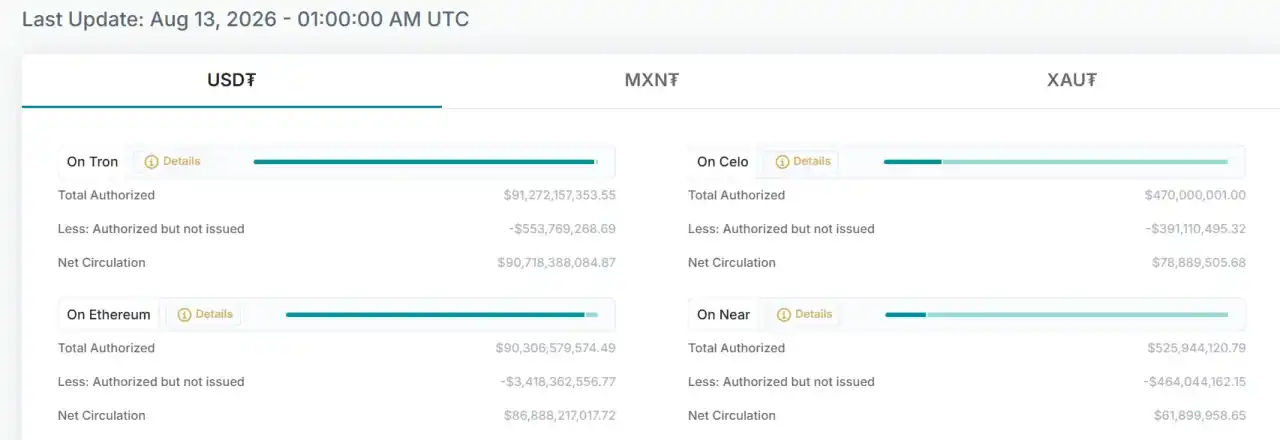
According to official Tether data, as of August 13, 2026, the on-chain USDT issuance on the Tron Network increased by another $10 billion to reach $91.2 billion, once again surpassing the USDT issuance on the Ethereum network ($90.3 billion) to claim the top spot among all blockchain networks. This historic milestone further solidifies Tron's dominant position in the stablecoin sector and reaffirms the continued attractiveness of low-fee, high-efficiency settlement networks for global stablecoin capital.
From Trading Asset to Settlement Tool: TRC20-USDT Use Cases Continue to Expand
The growth of USDT on the Tron Network stems first and foremost from sustainable real-world usage demand. As of August 2026, the issuance of TRC20-USDT on the Tron Network officially surpassed $91.2 billion, setting a new historical record, with a cumulative increase of approximately 10 billion tokens year-to-date. The number of holding accounts has reached approximately 75.47 million. This volume means Tron has long carried about half of the global USDT issuance share, accounting for approximately 50%.
From a usage structure perspective, Tron's real-world payment attributes are becoming increasingly clear. CoinDesk Research data shows that in Q1 2026, Tron's quarterly average of daily active accounts rose to approximately 3.2 million, setting a new quarterly high. Meanwhile, Tron's share of retail USDT transfers under $1,000 is about 50%, and it maintains a dominant position in the $1,000 to $100,000 range, continuously reinforcing its positioning as a "user-friendly" public chain for retail and small-to-medium value settlements. This indicates that one of the primary uses of USDT on Tron has consistently been for actual value transfer between wallets.
Observing over a longer period, on-chain transfer and settlement volumes support this assessment. A Messari research report indicates that in Q1 2026, the USDT transfer volume processed by the Tron Network reached approximately $2.04 trillion, with a total of about 950 million transactions network-wide. Daily average transactions increased from about 10.2 million in the previous quarter to about 10.9 million, also setting a new quarterly record. Since the beginning of 2026, Tron has led all public chains with an annual USDT transfer volume of approximately $4.2 trillion.
This paints a picture not of ledger entries within a single trading platform, but of a vast number of wallets directly completing value transfers on an open blockchain.
Specifically, an overseas worker can send USDT to a family member's wallet, and the recipient can convert it into local currency; cross-border e-commerce merchants can settle payments with suppliers using USDT, reducing the impact of bank operating hours and intermediary bank processes; freelancers can receive payments from international clients and have on-chain confirmations within minutes; digital asset service providers can move liquidity between exchanges, custody wallets, and market-making accounts. The amounts and purposes differ across cases, but the common requirements are fast arrival, transparent fees, and 24/7 operation.
Furthermore, cost stability is particularly important in market environments with volatile network fees. Since August 2025, when Tron passed Governance Proposal 104, reducing the energy unit price by approximately 60%, on-chain transfer costs have been further lowered.
Ecological Integration and Security Collaboration Advance in Parallel, Stablecoin Infrastructure Continuously Improving
The long-term development of a stablecoin network depends not only on issuance volume but also on entry point coverage, liquidity depth, developer support, and risk governance capabilities. Tron is simultaneously building infrastructure in these directions.
In terms of application entry points, widespread support for TRC20-USDT by wallets, trading platforms, payment service providers, and DeFi protocols enables users to conduct deposits, withdrawals, transfers, exchanges, and on-chain interactions relatively conveniently. With new stablecoins like USDD joining the Tron ecosystem, the variety of stablecoin assets has been further enriched; protocols like JustLend DAO extend stablecoin usage to collateral and lending scenarios. Stablecoins are gradually evolving from a single transfer tool to a foundational asset for on-chain financial activities.
Regarding user experience, mechanisms like GasFree aim to address a common pain point: new users' wallets might hold USDT but cannot initiate transactions because they lack the native token. By supporting payment of related network fees with stablecoins, such solutions help simplify the initial usage process. For merchants, wallets, and payment applications, reducing the cognitive load for users to understand bandwidth, energy, and native gas tokens is also beneficial for stablecoin services to enter broader consumer-facing scenarios.
More importantly, scale expansion needs to be synchronized with security governance capabilities. In September 2024, Tron, Tether, and TRM Labs jointly established the T3 Financial Crime Unit (T3 FCU), combining Tron's network visibility, TRM Labs' on-chain intelligence capabilities, and Tether's issuer freeze capabilities, directly collaborating with law enforcement agencies across multiple jurisdictions. A typical process is: after law enforcement identifies wallets linked to illegal activities, TRM Labs traces the fund flow, Tron provides network-level fund movement information, and Tether implements a freeze at the issuer level.
As of May 2026, the T3 FCU announced it had frozen over $450 million in illicit assets globally, covering 23 jurisdictions across five continents. TRM Labs disclosed that the mechanism can complete relevant actions within 24 hours of receiving a law enforcement request. These results demonstrate that combining the transparency of public blockchains with public-private collaboration models can improve the efficiency of identifying and responding to suspicious funds.
While continuing to lead in the stablecoin settlement sector, Tron is accelerating its bets on the new frontier of artificial intelligence. B.AI (Chinese brand name "Bai B.AI"), officially launched in April this year, is positioned as the "underlying financial infrastructure for the AI Agent era." This strategic move is consistent with Tron's deep stablecoin liquidity and its advantages in high-frequency, low-cost payments. It signifies Tron's evolution from the "world's largest stablecoin settlement network" towards becoming the "underlying infrastructure for the AI agent economy," firmly betting on the long-term trend of AI and Web3 convergence.
From leading in issuance scale to expanding payment and settlement advantages, gradually improving security mechanisms, and actively deploying in the AI field, the competitiveness of USDT on the Tron Network is transitioning from "quantitative accumulation" to "qualitative enhancement."
Tron will continue to optimize network performance and user experience around stablecoin infrastructure, deepening collaboration with issuers, wallets, payment institutions, and security analysis firms to provide global users with more efficient, secure, and inclusive digital value circulation services.