Original Author: Gino Matos
Original Compilation: Saoirse, Foresight News
Data from sFOX shows that cryptocurrency dark pool trading volume continues to climb, growing from negligible levels in April to account for 15% of total monthly volume by June. The firm's July 30th report also noted that 77.7% of institutional capital on its platform was matched through OTC desks, with only 18.4% flowing to public exchanges. In May alone, dark pool transaction volume reached $147 million.
In an interview with CryptoSlate, sFOX's Diana Pires described this as a structural shift, similar to the industry transformation experienced by stock and foreign exchange markets years ago.

Why Institutions Choose Crypto Dark Pools
Large orders placed on public order books leave clear footprints. Other traders can identify these trading patterns, execute trades ahead of the order, or push prices in the opposite direction before the order is filled, thereby increasing trading slippage.
Pires gave an example: institutions like Jane Street and Citadel have strong incentives to hide their trading trails. Once trading patterns are identified by the market, other participants will conduct targeted reverse trades.
This is also the fundamental reason why more and more crypto orders are choosing dark pools, OTC desks, and platforms that can route single orders to over a dozen trading venues simultaneously.
sFOX alone is connected to over 40 exchanges and OTC desks, and its institutional clients typically use 14 to 19 of these channels to complete trades each month on average.
OTC desks that receive large orders typically break them down into smaller orders before distributing them to avoid single transactions from causing severe market fluctuations.
Pires summarized the core logic of crypto dark pools as follows: trading platforms privately take on large positions, then split them into small orders to be sent to exchanges; these small orders hardly disturb the order book. She believes that this type of capital inflow into the public market helps deepen the order book and further narrow the bid-ask spread.
In the past, public order books could reflect the vast majority of real market trading activity, but now they only represent a small fraction of it. Quiet exchange order books do not mean institutions are not trading. Large buyers can accumulate positions over weeks without posting any visible buy orders; large sellers can complete significant reductions in holdings without massive sell pressure appearing on the order book.
The Information Advantage of Tracking Whales Is Being Actively Diminished
Bitcoin and crypto traders once had a natural advantage over participants in other markets: everyone could continuously monitor exchange fund balances, large orders on the order book, and large on-chain holdings.
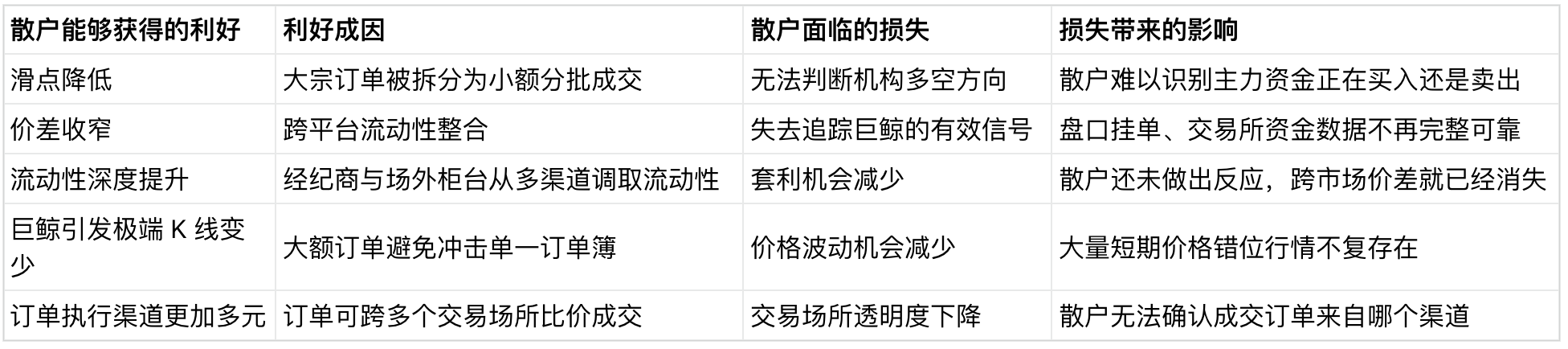
Pires pointed out that dark pools, by design, eliminate this advantage. Trading platforms, OTC desks, and brokers can see the underlying fund flows. This information is protected by regulatory rules and client agreements, preventing retail traders from knowing whether institutions are buying or selling.
Simple cross-market arbitrage opportunities are also disappearing. Information once spread slower than capital flows, allowing investors to buy low on one exchange and sell high on another for profit. Pires stated that as prime brokers and aggregation platforms simultaneously scan dozens of trading venues, completing arbitrage and closing price gaps before retail traders can capture them, such opportunities are shrinking year by year.
She predicts the crypto trading market will eventually evolve towards a structure similar to the stock market: individual investors will no longer connect directly to exchanges but will instead go through brokers, who will seek the best prices across major trading venues on their behalf.
Retail account trading volumes typically struggle to meet the minimum fee tier thresholds set by exchanges, while brokers aggregating massive institutional orders can easily meet them. Pires believes this disparity will continue to drive ordinary traders towards brokers, although this shift won't be mandated by regulation as it was in the stock market.
Two Market Outlook Scenarios
Optimistic Scenario
Order aggregation platforms and mainstream trading venues handle retail orders in the same way they handle institutional orders. Market spreads continue to narrow, slippage decreases further, and instances of large orders piercing thin order books diminish.
Trading opportunities lost from public exchanges shift to other arenas. On-chain and DeFi markets still maintain public data on large holdings, providing channels for traders wanting to speculate on price volatility; regulated, compliant trading markets will exhibit more stable trends.
Pessimistic Scenario
For traders with ordinary capital sizes, the loss of trading transparency outpaces the realization of expected trading optimization benefits. Retail and medium-sized investors completely lose the ability to discern institutional capital movements.
Spread optimization and premium order routing services remain exclusively for large clients with sufficient capital to access prime brokers and aggregation platforms. Public exchange price signals continue to weaken, with participants relying on monitoring exchange order books being the first to feel the change.
Regardless of the market's direction, traders need to adjust their habits: do not treat the trading volume of a single exchange as a reflection of the entire market; compare total trading costs across different channels before referencing exchange-listed fee rates; when order book depth is insufficient, use limit orders as much as possible to guard against market orders impacting prices.

Beneath seemingly calm order books may lurk large-scale institutional trading.
As the crypto market matures and trading experiences continuously optimize, the difficulty of interpreting the market increases. Retail traders encounter fewer sudden price shocks from whales, but they also find it harder to observe the movements of the most influential capital.