JPMorgan backs crypto bill as Donald Trump vows to ‘not sign other bills’ – What now?

ambcrypto发布于2026-07-11更新于2026-07-11

文章摘要

The House-passed Digital Asset Market Clarity Act of 2025 faces an uncertain future despite gaining significant backing from JPMorgan, a major shift for the traditionally crypto-skeptical bank. According to BitGo CEO Mike Belshe, this support is crucial as regulatory uncertainty has been the largest obstacle to institutional adoption. Should the bill pass, it could simplify market entry for institutional investors, potentially leading to wider cryptocurrency uptake. However, approval odds on Polymarket have dropped to 45%. Supporters, including Rep. French Hill and former CFTC Chairman Michael Selig, are pushing for a Senate vote before the August recess to force a compromise. Ethereum co-founder Joseph Lubin also supports the legislation. Yet, Democratic Senator Elizabeth Warren criticizes the current draft as enabling sanctions evasion. A further complication is former President Donald Trump's vow not to sign other bills until the SAVE America Act is passed, pushing the CLARITY Act's next deadline to August 7th.

The House passed its version of the Digital Asset Market Clarity Act of 2025 nearly a year ago, but the bill is still in a tight spot. However, Mike Belshe, CEO of BitGo, recently pointed out that JPMorgan has shown full support for the CLARITY Act.

He said,

Let that sink in. The world’s largest bank — long crypto-skeptical — is now publicly supporting crypto market structure legislation. This is a different ballgame.

AD

What does this mean for the market?

Belshe emphasized that JPMorgan’s backing of the CLARITY Act is important because regulatory uncertainty has long been the largest obstacle. So banks, asset managers, pension funds, and investment advisers are likely to be encouraged to get ready for increased crypto participation.

Should the bill pass, it might make it simpler for institutional investors to confidently join the market, which could lead to a wider uptake of cryptocurrencies.

This occurs as the approval odds on Polymarket have dropped to 45%, a 20% decrease from 74% two months ago.
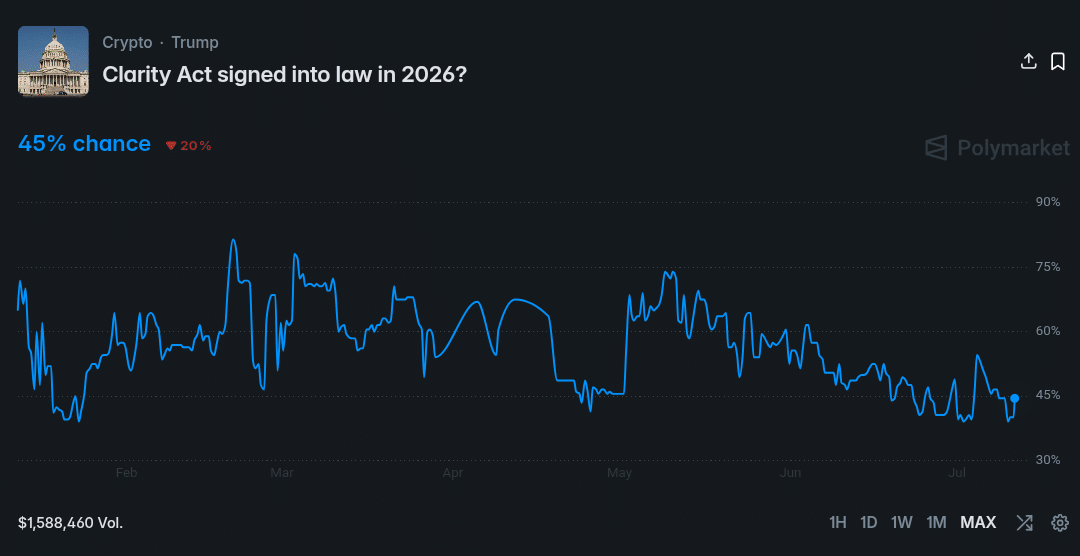
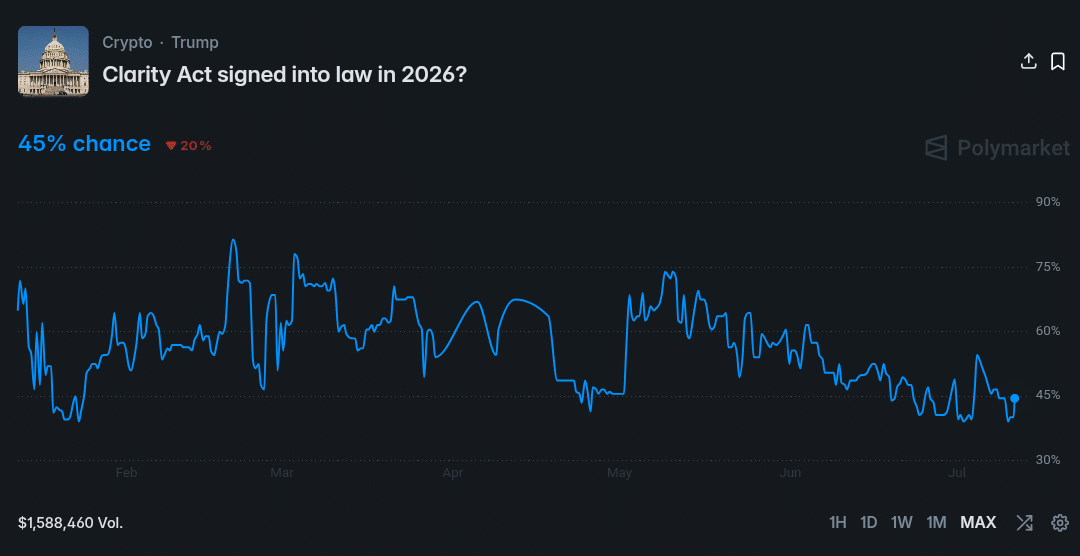
Source: Polymarket

Others supporting the passage of the CLARITY Act

However, regarding the approval, the community still appears to be in favor.

For instance, Rep. French Hill is arguing that the best way to force lawmakers to reach a compromise is to give them a clear deadline to vote on the CLARITY Act before Congress starts its August recess.

Rather than leaving these activities in a regulatory gray area, Hill believes the CLARITY Act would subject them to defined standards and said,

I’ve encouraged Senate leadership to put it on the floor. I think if you schedule a floor date here in the month of July, that will cause these final meetings, these final discussions to take place. You’ve got to have a deadline in Congress to get people to move and find consensus.

Supporters net increases

Not only this, the bill is also supported by Michael S. Selig, the 16th Chairman of CFTC, who said,

The Clarity Act, talking to this future proof notion of making sure that crypto is here to stay.

Echoing similar sentiments, Joseph Lubin, Ethereum’s co-founder, added,
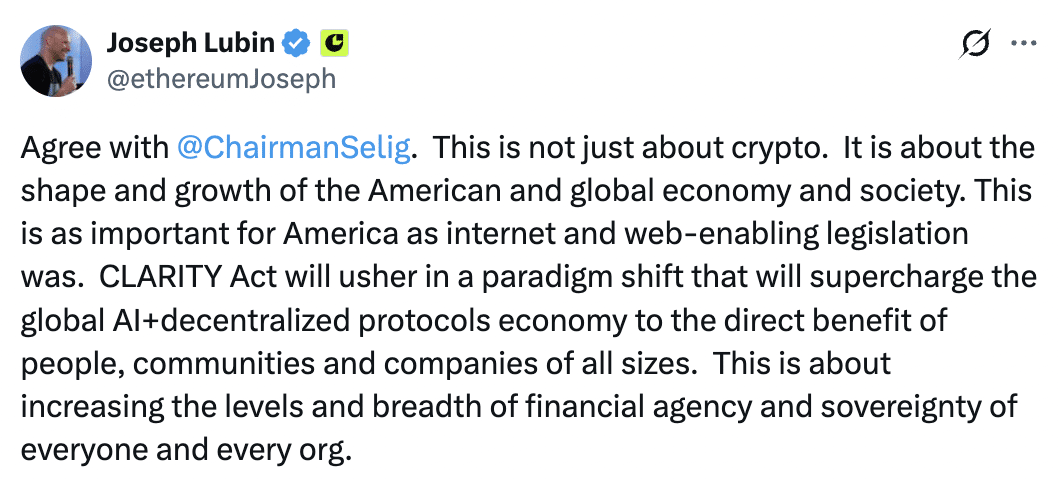
Source: Joseph Lubin/X

In fact, Democratic Senator Elizabeth Warren, who has been a stern supporter of the bill, recently put it best when she said,

As currently drafted, the CLARITY Act is a ticket to sanctions evasion.

However, Trump has stated that he will “not sign other bills” until Republicans in Congress have passed the SAVE America Act. As a result, the CLARITY Act is now awaiting a new deadline of the 7th of August to advance.


Final Summary

  • JP Morgan, supporting the bill, has ignited fresh optimism for the approval of the CLARITY Act.
  • Though the Polymarket odds have fallen to the 45% Senators, CFTC chairman, Ethereum co-founder, and many others are demanding the bill’s approval.


热门币种推荐

相关问答

QAccording to the article, what is the significance of JPMorgan's public support for the CLARITY Act?

AAccording to Mike Belshe, CEO of BitGo, JPMorgan's support is highly significant because it signals a major shift from a long-time crypto-skeptical stance. It indicates that regulatory uncertainty, a major obstacle, might be addressed, which could encourage banks, asset managers, and institutional investors to prepare for greater participation in the crypto market.

QWhat is the current approval probability for the CLARITY Act on Polymarket, and how has it changed?

AThe current approval odds on Polymarket have dropped to 45%. This represents a 20% decrease from a probability of 74% recorded two months ago.

QWhat strategy did Representative French Hill propose to advance the CLARITY Act?

ARep. French Hill argued that setting a clear deadline for a vote on the CLARITY Act before Congress's August recess is the best way to force lawmakers to reach a compromise and find consensus.

QWho are some of the notable figures mentioned as supporting the passage of the CLARITY Act?

ASupporters mentioned include Michael S. Selig, the 16th Chairman of the CFTC; Joseph Lubin, co-founder of Ethereum; and Democratic Senator Elizabeth Warren, who has been a stern supporter, though she has also voiced specific concerns about the bill's current draft.

QWhat is the main political obstacle currently facing the CLARITY Act, as stated in the article?

AThe main political obstacle is that former President Donald Trump has stated he will "not sign other bills" until Republicans in Congress have passed the SAVE America Act. This has put the CLARITY Act in a tight spot, with its next advancement deadline set for August 7th.

你可能也喜欢

Gate 研究院:加密金融产品掀起“华尔街化”浪潮,是竞争还是融合?

2009年比特币的创世区块暗含对传统金融体系的批判,其理想是建立去中心化、去中介、去银行的点对点金融系统。然而十七年后,比特币现货ETF获批、贝莱德等巨头发行相关产品、CME推出受监管衍生品、RWA(真实世界资产)和代币化国债市场快速增长等现象,显示传统金融正系统性地介入加密资产的发行、定价、托管和分销环节,引发了加密市场是否“华尔街化”的讨论。 文章认为,这并非单方面的吞并,而是加密体系与传统金融的双向融合与互补。加密领域提供无许可开放性、24小时交易和可编程结算,但缺乏合规通道、机构级托管和主流分销网络;传统金融则拥有牌照、信任、资金和渠道,但受限于交易时间、跨境门槛和结算效率。双方正朝彼此的核心优势靠拢。 这种融合体现为两条路径:一是以Gate为代表的加密交易所,逐步从提供代币化美股、CFD差价合约,发展到接入真实股票、港股、韩股交易,成为连接加密账户与传统券商基础设施的前端入口;二是以Robinhood为代表的传统券商,通过收购加密交易所、推出股票代币和建设自有Layer 2,将加密资产和链上代币化产品整合进其平台。两者的共同目标是争夺下一代综合金融账户的入口,让用户在一个界面内交易多种资产。 同时,RWA和链上国债作为资产层的融合正在加速。尽管规模尚小,但代币化国债等产品为链上提供了低波动收益资产,并吸引JP摩根、贝莱德等传统机构参与,测试未来资本市场的底层结算方式。 最终,加密与华尔街并非谁征服谁,而是在共同塑造一个更高效、全球化的统一资本市场。用户未来或将在同一个账户中自由交易比特币、股票、ETF、链上国债等多种资产,体验无缝的跨资产配置。去中心化的理想仍在底层协议中延续,而在应用层,一个融合了双方优势的新金融形态正在形成。

marsbit17分钟前

Gate 研究院:加密金融产品掀起“华尔街化”浪潮,是竞争还是融合?

marsbit17分钟前

给AI喂“噪声”也能涨分,这项工作让噪声实现正迁移

这篇发表于ICML 2026的研究提出了一种名为“半监督噪声自适应(SSNA)”的新方法,其核心思想是:迁移学习中,用于辅助训练的“源数据”可以不是真实的图像或文本,而是**完全没有语义的随机噪声**。 传统迁移学习需要大量有标签的源数据,但在隐私、版权等限制下,真实数据往往难以获得。SSNA框架(NAF)打破了这一限制。研究者为每个目标类别(例如CIFAR-10的10个类)生成一组对应的高斯分布噪声样本,并为每个噪声类预先指定一个目标类别编号(但编号本身无意义)。 NAF通过三个步骤实现“正迁移”: 1. **利用少量真实标签**:使用目标域中极少的标注样本进行基础监督学习,建立噪声与真实类别间的初步联系。 2. **在噪声域构建判别结构**:训练模型将同类噪声聚集、异类噪声分离,形成清晰的类别结构。 3. **跨域对齐**:将噪声域中学习到的类别结构(分布)与目标域的对齐,从而将判别性知识迁移到真实数据上。 实验表明,在每类仅有4个标注样本的极端少样本设定下,NAF相比仅使用标注数据的基线方法(ERM)在多个数据集上取得显著提升(如CIFAR-10提升12.35%)。研究还发现,关键因素在于噪声域中是否形成了**可分离的类别结构**,而非噪声数量多少。当把所有噪声压缩为一点(无结构)时,性能会大幅下降。 这项工作的意义在于,它揭示了迁移学习中可迁移的知识可能不限于数据的“语义内容”,**表征空间的“组织结构”本身也是一种有效的知识**。这为无法获取真实源数据的场景提供了一种低成本、保护隐私的替代方案。

marsbit23分钟前

给AI喂“噪声”也能涨分,这项工作让噪声实现正迁移

marsbit23分钟前

交易

现货

热门文章

如何购买BILL

欢迎来到HTX.com!我们已经让购买Billions Network(BILL)变得简单而便捷。跟随我们的逐步指南,放心开始您的加密货币之旅。第一步:创建您的HTX账户使用您的电子邮件、手机号码注册一个免费账户在HTX上。体验无忧的注册过程并解锁所有平台功能。立即注册第二步:前往买币页面,选择您的支付方式信用卡/借记卡购买:使用您的Visa或Mastercard即时购买Billions Network(BILL)。余额购买:使用您HTX账户余额中的资金进行无缝交易。第三方购买:探索诸如Google Pay或Apple Pay等流行支付方法以增加便利性。C2C购买:在HTX平台上直接与其他用户交易。HTX场外交易台(OTC)购买:为大量交易者提供个性化服务和竞争性汇率。第三步:存储您的Billions Network(BILL)购买完您的Billions Network(BILL)后,将其存储在您的HTX账户钱包中。您也可以通过区块链转账将其发送到其他地方或者用于交易其他加密货币。第四步:交易Billions Network(BILL)在HTX的现货市场轻松交易Billions Network(BILL)。访问您的账户,选择您的交易对,执行您的交易,并实时监控。HTX为初学者和经验丰富的交易者提供了友好的用户体验。

859人学过发布于 2026.05.07更新于 2026.06.02

如何购买BILL

相关讨论

欢迎来到HTX社区。在这里,您可以了解最新的平台发展动态并获得专业的市场意见。以下是用户对BILL(BILL)币价的意见。

活动图片