By Ma He, Foresight News
On July 6th, both the official account of Yield Guild Games (YGG) and its co-founder Gabby Dizon simultaneously announced the decision to shut down its game publishing division, YGG Play. The team will gradually phase out the platform and certain games by July 31st according to plan, with 35 employees receiving an additional 8 weeks of salary compensation. Some games, like GIGACHADBAT, will be transferred to the developer Delabs for continued operation. Others, such as LOL Land and Waifu Sweeper, will be officially retired. Games published by YGG Play have generated cumulative revenue exceeding $9 million, with a single quarter in Q1 2026 contributing $876,000.
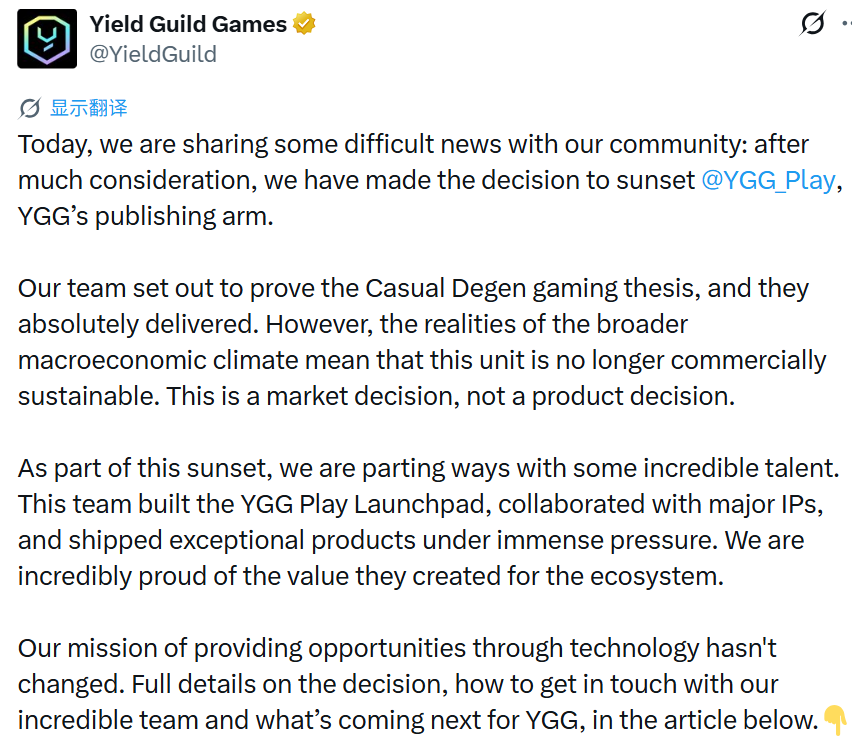
In the statement, Gabby Dizon stated: This is a market decision, not a product decision. Although the team successfully validated the casual gaming segment—short sessions, high engagement, and rapid feedback loops for crypto-native users—the lack of liquidity and declining user confidence in the macroeconomic environment have rendered this business commercially unsustainable.
Alongside shutting down YGG Play, YGG also announced a full pivot to the AI Data Economy, aiming to capture the multibillion-dollar market for AI training datasets, initially focusing on building B2B pipelines around gaming datasets.
The Chain Game Publishing Platform YGG Play
Launched by YGG in 2025, YGG Play was its Web3 game publishing arm, dedicated to serving the casual player community in the crypto space. It targeted short, quick, mobile-friendly games with a touch of social interaction and rewards, helping independent studios quickly go on-chain for distribution and acquire and operate users through YGG's community network. These games accumulated significant revenue during 2025-2026, proving that specific vertical segments could still generate genuine revenue even at the tail end of a bear market.
However, revenue peaked around October 2025. The large-scale liquidation event in October's crypto market further dampened the payment willingness and retention of target users. The closure of YGG Play marks a strategic contraction for YGG, moving away from the dual-engine drive of "guild operations + publishing."
To understand the weight of this closure, one must trace YGG's complete trajectory.
In 2020, veteran Philippine gaming industry figures Gabby Dizon, Beryl Li, and anonymous partner Owl of Moistness co-founded YGG. This was during the peak of the COVID-19 pandemic when many service industry workers in the Philippines were unemployed. Axie Infinity, the hottest Play-to-Earn (P2E) game at the time, was enabling players to borrow Axie NFTs for free to battle and share earnings through its "scholarship" model.
YGG seized this window, starting as a small guild, raising funds to purchase Axie assets, organizing and training players, and rapidly becoming one of the largest and most scalable guilds within the Axie ecosystem.
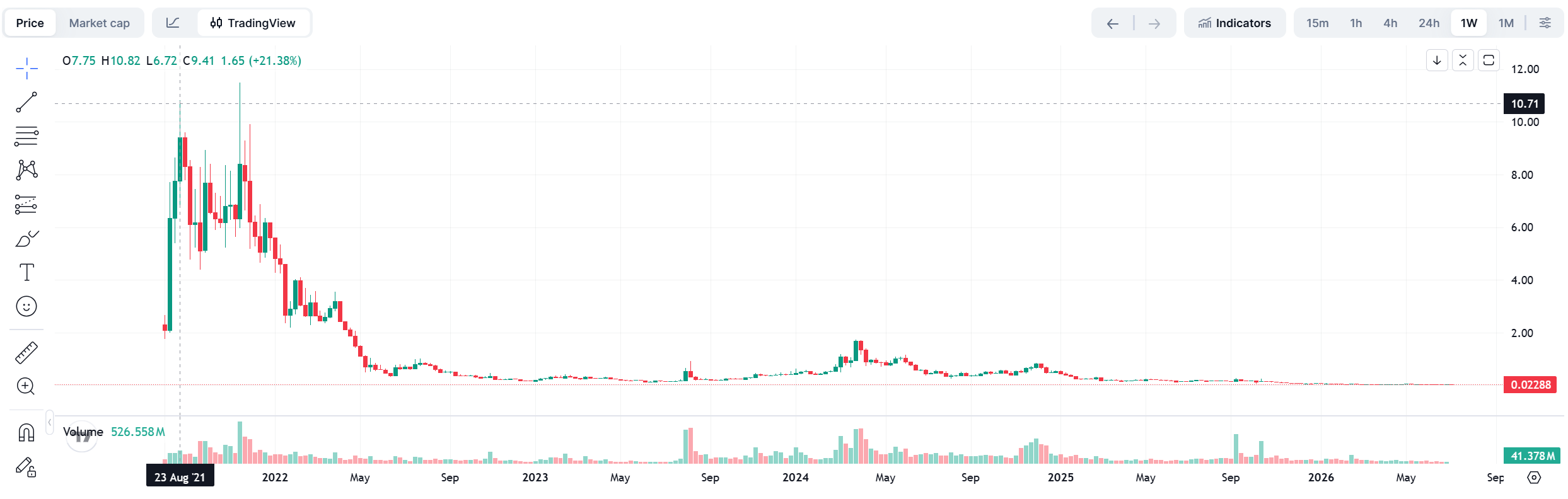
2021 was YGG's peak year. Driven by both the bull market and the P2E narrative, its token price soared, exceeding $10 at its highest. YGG expanded from a single Axie guild into a global network covering dozens of regional sub-guilds and partnered with over 80 blockchain games and infrastructure projects. It moved beyond mere asset lending, helping players maximize earnings through quests, events, and community operations. In places like the Philippines, the real economic phenomenon of "playing games as work" emerged, and YGG became a benchmark for the P2E model.
At its peak, YGG's model was widely replicated: guilds became crucial intermediaries connecting players, assets, and games, with DAO governance and token incentives allowing participants to share in growth benefits. YGG evolved from a simple "asset manager" into an investment, content, and community platform.
When the crypto bear market arrived in 2022, the fragility of Axie Infinity's economic model was laid bare—new user inflow slowed, token prices crashed, and player churn was severe. Many guilds and P2E projects vanished outright, and the entire industry entered a deep trough. YGG did not collapse but began a long adaptation. In 2025, YGG bet on a new direction: launching YGG Play and formally entering the game publishing arena, as heavy P2E was no longer viable, while crypto users naturally gravitated towards high-frequency, instant-feedback casual experiences.
This shutdown comes barely a year after that last pivot.
A Microcosm of the Chain Gaming Industry
The closure of YGG Play can be seen as a concentrated reflection of the chain gaming industry's development trajectory over the past five years.
In April this year, the crypto quantitative trading and market-making firm Caladan reviewed the five-year journey of the Web3 gaming sector from frenzied explosion to comprehensive collapse. Its core conclusion was that the decline of Web3 games is not a normal cyclical downturn but stems from a fundamental "structural misalignment" between the underlying speculative financial design and the genuine entertainment needs of players, leading to a staggering $15 billion in capital being obliterated.
Examples abound: Pixelmon, which raised $70 million but failed to launch public beta in 4 years; Ember Sword, which burned through $18 million and was liquidated; and Hamster Kombat, which lost 96% of its users within 6 months.
As of April 2026, in the roughly 3,200 chain gaming projects tracked by the report, 93% have been categorized as "practically dead" or have completely lost activity. The average decline in the crypto token prices for the entire gaming sector compared to the 2022 all-time highs reached 95%.
The prosperity of chain gaming was entirely built upon the Ponzi-like dividend logic of "Play-to-Earn." This model is inherently an unsustainable speculative financial closed loop: the earnings of early players and token prices entirely depend on a constant influx of new players buying tokens or NFTs to sustain the system. Once new user growth slows and external capital inflow decreases, the token's severe inflation rapidly breaches economic equilibrium, triggering a "death spiral" of token crashes, shrinking earnings, and a mass exodus of users.
YGG Play was not a failure in terms of product delivery or revenue figures but was defeated by "market timing."
The story of chain gaming may be nearing its end.