On July 4, Doubao and Tongyi Qwen announced the upcoming discontinuation of their agent functionality.
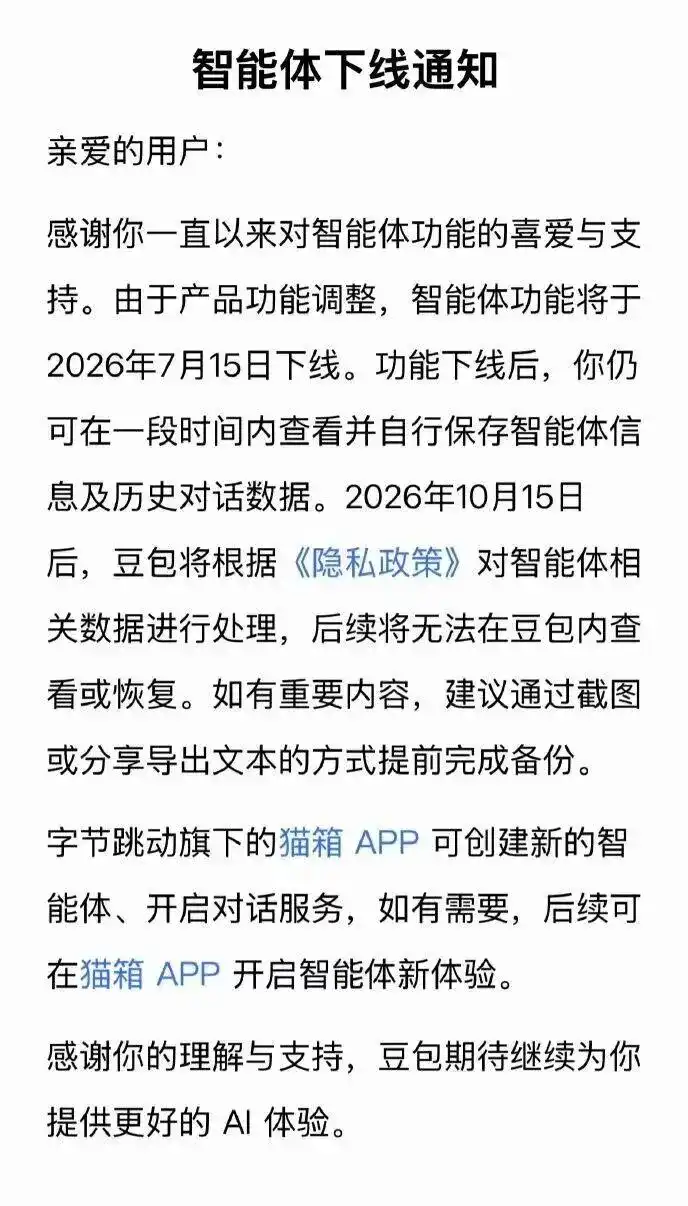
Doubao issued the "Notice on Discontinuation of Doubao Agent Functionality," confirming that the agent functionality will be discontinued on July 15, and will redirect users to ByteDance's Mao Xiang App to meet related needs.
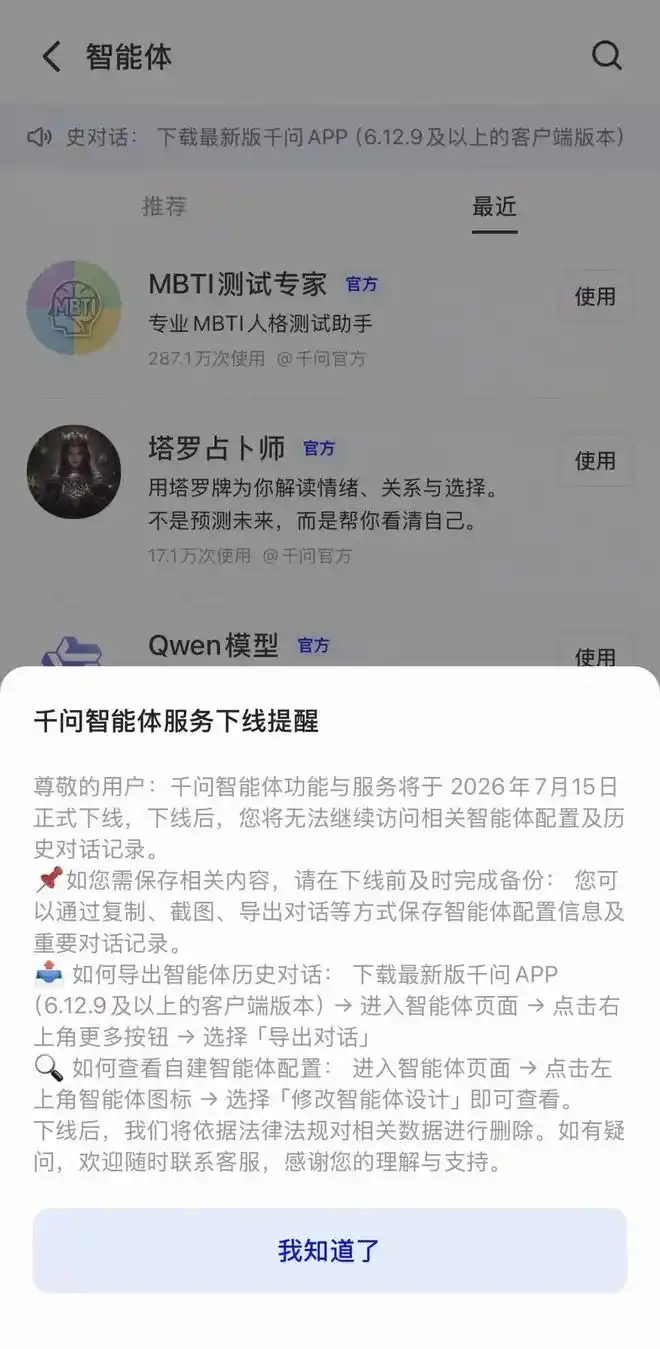
On the same day, Tongyi Qwen pushed a discontinuation reminder to users, stating that personified interaction agents and user-created agent functionality will be discontinued on July 10, and that after the complete discontinuation of Qwen agent functionality and services on July 15, users will no longer be able to access related agent configurations and historical conversation records.
This adjustment affects the most core personalized usage scenarios for C-end users of AI platforms — including role-playing, exclusive assistants, and vertical tool-type agents.
For Doubao and Qwen, user-created agents were previously a key means to gather C-end users and accumulate UGC content. The comprehensive discontinuation of this functionality signifies a directional shift in the platforms' traffic strategies.
New Regulations Force Action, Discontinuation Date Not a Coincidence
The discontinuation date chosen by Doubao and Qwen, July 15, coincides with the official implementation date of the "Interim Measures for the Administration of AI Personified Interaction Services."
These measures strictly regulate "personified emotional interaction services," requiring platforms to implement mechanisms to prevent addiction, verify the identities of minors, conduct content reviews, and fulfill other primary responsibilities.
Regulatory rectification actions have already begun. On June 26, the Cyberspace Administration of Shanghai Municipal Committee announced the results of the first phase of the "Clear and Bright: Rectifying Irregularities in AI Applications" special campaign, having removed over 14,000 non-compliant agents. Among them, agents from Xuanyu (MiniMax) involving functions like "one-click undressing" and soccer betting/gambling were key targets of the crackdown.

Currently, the Cyberspace Administration of Shanghai Municipal Committee has completed regulatory briefings for nearly a hundred key platforms, urging enterprises to fulfill their compliance obligations.
Against this backdrop, Doubao and Qwen proactively aligning with the regulatory timeline, choosing to complete the functionality discontinuation on the day the new regulations take effect, is widely interpreted by the industry as a proactive move to mitigate compliance risks in advance and fulfill platform responsibilities.
User Transition Arrangements and Data Processing Timeline
Both platforms have provided a transition window for existing users to save their data.
For Doubao, after the functionality is discontinued, users will still be able to view and manually save their agent information and historical conversation data for a period of time; after October 15, Doubao will process the relevant data according to its privacy policy, at which point the data will no longer be viewable or recoverable.
Doubao recommends users back up their data in advance by taking screenshots or exporting text, and migrate agent creation and conversation functionality to the Mao Xiang App.
Tongyi Qwen similarly advises users to save important content before the discontinuation by copying, taking screenshots, or exporting conversations. After discontinuation, access to related agent configuration information and historical conversation records will no longer be possible.
As leading platforms successively scale back their C-end agent layouts, the competitive logic of the AI application market is undergoing a fundamental shift.
Compliance capabilities and sustainable business models will replace user scale and feature richness as the core dimensions of platform competition in the next phase.
High Consumption, Low Efficiency, Business Logic Also Unsustainable
In addition to regulatory pressure, difficulties in commercial monetization are also an intrinsic motive driving this adjustment.
Analysis suggests that personified chit-chat and niche role-playing agents typically generate scattered, high-frequency, lightweight conversation calls, resulting in high computing power consumption and low per-unit commercial value, representing a typical "high consumption, low efficiency" business model.
In the phase where AI applications are shifting from "land grabbing" to "value verification," while such UGC agents may bring short-term traffic and user engagement metrics, they are difficult to convert into direct commercial revenue. Their economic rationale for continued existence is being questioned.
Tongyi Qwen's pivot to the B-end has already shown signs. On June 3, Qwen officially announced the comprehensive opening of Agent and Skill access permissions to third-party enterprises and developers across all industries. Leading brands like Luckin Coffee, KFC, Mixue Ice Cream & Tea, and China Eastern Airlines have already initiated service testing.
This strategic shift indicates that platforms are concentrating resources from low-value C-end UGC ecosystems towards high-value B-end enterprise service scenarios.