CLARITY Act Countdown: How Will the Crypto Market Fare If It Doesn't Pass Before the August Recess?

marsbit发布于2026-07-05更新于2026-07-05

文章摘要

The CLARITY Act, a major US crypto market structure bill, faces a tight deadline before the Senate's August 10 recess. It must overcome final hurdles—negotiations on ethics provisions and law enforcement concerns—to secure the 60 votes needed for passage. Analysts warn that missing this window significantly lowers its chances in 2026, with prediction markets giving only a 40% probability of success this year. If the act fails to pass by the recess, the market is expected to react not with a crash but with continued "slow bleeding," particularly in premium products like ETFs. June saw record net outflows from US Bitcoin spot ETFs, partly attributed to this legislative uncertainty. Assets like XRP, which would receive permanent commodity classification under the act, stand to lose a "regulatory premium" on further delays. Bitcoin and Ethereum, already classified as commodities by regulators, face less direct impact, but DeFi innovation and institutional capital inflows would remain stifled by regulatory ambiguity. The path forward includes passing before the recess (a major catalyst), postponement to 2027 (prolonging uncertainty), or failure, requiring the bill to be reintroduced in the next Congress. Despite the stalled negotiations, the bill's advancement this far signals the US is closer than ever to resolving crypto regulatory clarity.

Author: Qin Xiaofeng, Odaily Planet Daily

The highly anticipated Digital Asset Market Structure Act (CLARITY Act) has unsurprisingly been delayed once again. Senator Cynthia Lummis previously stated that negotiators expected to finalize a compromise text around July 4th (U.S. Independence Day) and "advance it in July," but progress has clearly lagged.

Now, with the Senate's August 10th recess approaching, the window of opportunity is shrinking rapidly: the bill must meet the 60-vote threshold in the Senate (requiring at least 7 Democratic defections), be reconciled with the text from the Senate Agriculture Committee, merged with the House bill, and signed by the President—all within the next 25 working days. The timeline is extremely tight.

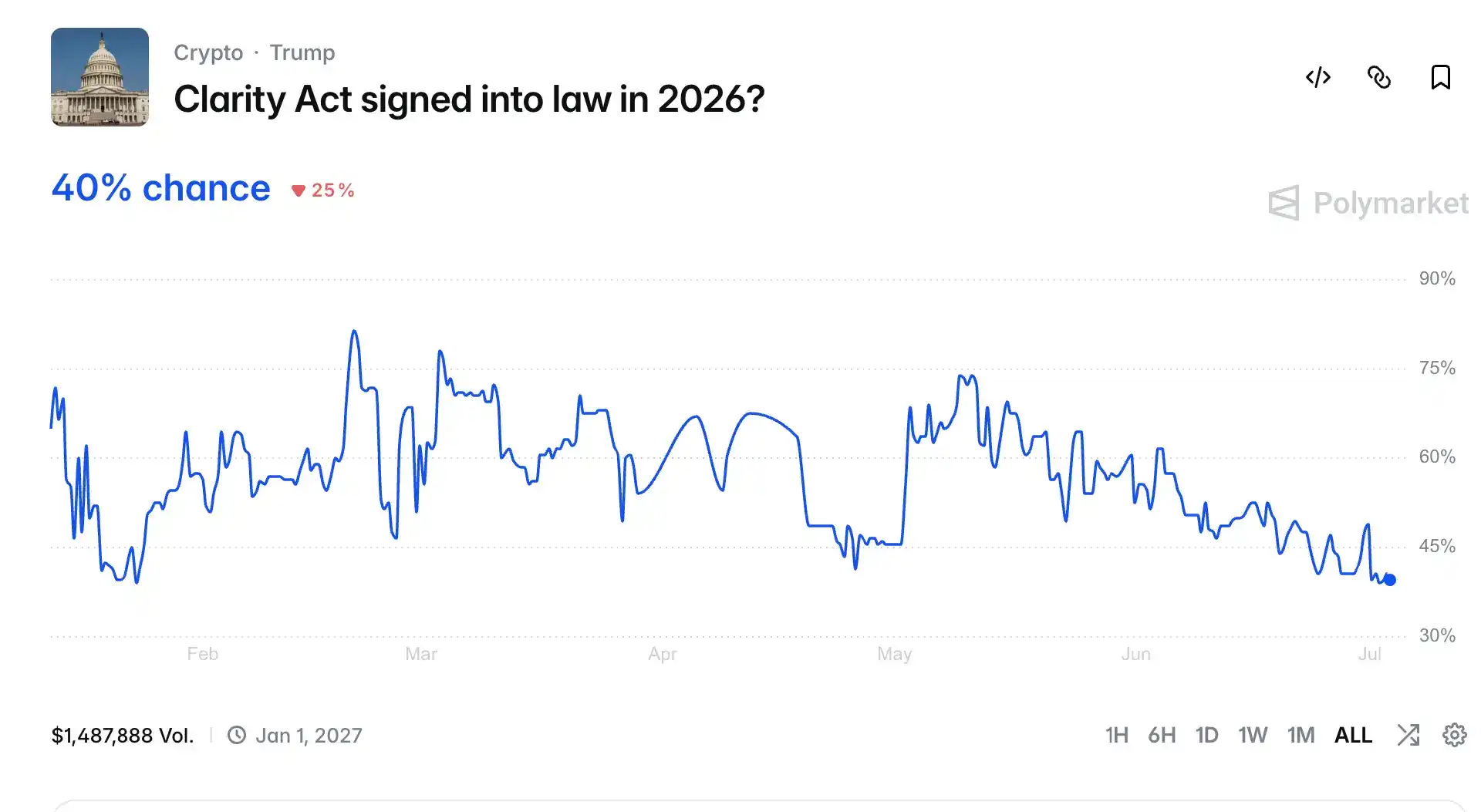
If the window before the August recess is missed, the probability of the CLARITY Act passing this year will further decrease. In fact, data from the prediction market Polymarket shows the probability of the bill passing this year is only 40%; Galaxy Digital has also lowered the probability of passage by 2026 to 50%.
I. Review of the Latest Progress on the CLARITY Act

The CLARITY Act is landmark crypto market structure legislation being advanced in the U.S. Congress, aiming to clarify the regulatory boundaries between the SEC and CFTC, provide a non-security pathway for decentralized tokens, and mandate registration and anti-money laundering obligations for digital commodity intermediaries.

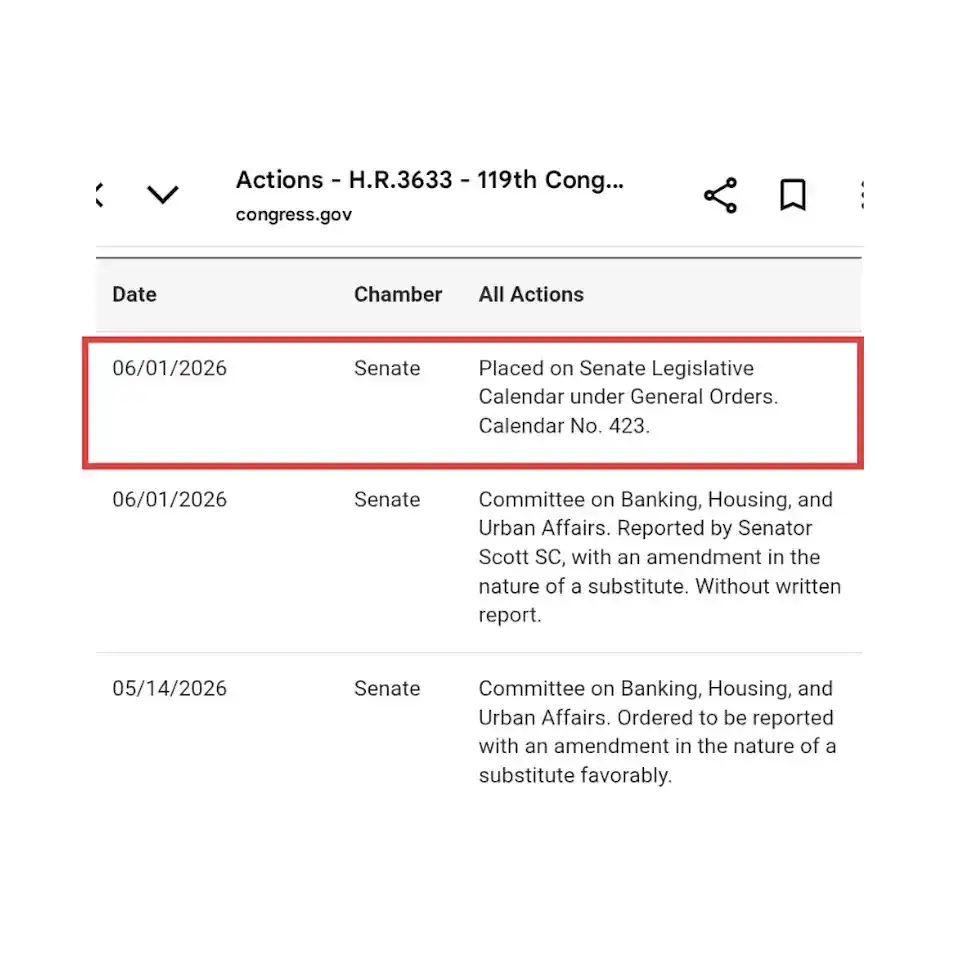
On July 17, 2025, the House of Representatives passed HR 3633, proposed by French Hill, with 294 votes in favor and 134 against, including over 70 votes from Democrats. On May 14, 2026, the Senate Banking Committee advanced and passed it with a 15-9 vote (supported by 13 Republicans and 2 Democrats). On June 1, 2026, the CLARITY Act was officially placed on the Senate legislative calendar (Calendar No. 423), qualifying for full consideration.

However, progress on the CLARITY Act throughout June was not smooth. On June 9th, negotiations over the ethics clause regarding the President's crypto holdings broke down, directly leading to some Democratic lawmakers softening their stance or imposing additional conditions, slowing the pace of the bill reaching the floor for debate. On June 10th, the White House held meetings with police and prosecutor groups. Afterwards, the enforcement battle over Section 604 (the developer protection clause) in the Blockchain Regulatory Certainty Act reached an impasse; if unresolved, law enforcement groups might lobby against it, and Democratic lawmakers might also vote against it for "insufficiently protecting consumers/combating crime."

In simple terms, the former is a "political/ethics hurdle," and the latter is an "enforcement/security red line." Together, they constitute the final two major obstacles before the CLARITY Act can "clear" the Senate. If these are not resolved, it will be difficult to gather the 60 votes and finalize the text, making it impossible to complete the legislation before the August 10th recess. These two sets of negotiations are the key "stumbling blocks" directly hindering the final advancement of the CLARITY Act, causing the July 4th target to be missed and the overall progress to stall. Negotiations are still trying to break the deadlock, but time is running very short.

Brian Gardner, Chief Washington Policy Strategist at Stifel Financial, stated that for the bill to pass in 2026, "it likely needs to pass the Senate by the end of July, preferably in June," and warned that if the Senate misses the recess deadline, the outlook would deteriorate significantly.
However, the market has largely lost hope for the bill's passage this year. Alex Thorn, Head of Galaxy Research, lowered his prediction for the bill passing in 2026 from 75% to 60% on June 5th, citing the increasingly tight Senate schedule. Data from the prediction market Polymarket shows the probability of the bill passing this year is only 40%.

II. What Will Happen to Crypto If the CLARITY Act Fails to Pass on Schedule?

According to CCN's analysis, if the CLARITY Act fails to pass before the August recess, the market's most likely reaction will not be a crash, but rather a "slow bleed through premium products." In fact, the poor performance of cryptocurrencies throughout June indicates that the market has already begun to reprice for legislative uncertainty. (Odaily Note: The premium products here mainly refer to various spot ETFs.)

Data shows that throughout June, U.S. spot Bitcoin ETFs saw cumulative net outflows of approximately $4.5 billion, equivalent to about 77,000 BTC being redeemed. This marks the largest monthly net outflow since the products launched in January 2024, surpassing the previous record from February 2025 (~$3.56 billion), setting the worst monthly record ever.

In fact, XRP might be the asset most directly and significantly affected by the bill, as it would permanently cement its commodity classification, eliminating the risk of reversible agency interpretation. In case of long-term delay or failure, XRP could lose some of its "regulatory premium."

Geoffrey Kendrick, Global Head of Digital Asset Research at Standard Chartered, forecasts an XRP target price of $8, contingent on the Senate fully passing the relevant bill and $4-8 billion in ETF inflows. JPMorgan predicts that if the bill passes, XRP ETFs could see $4.3-8.4 billion in inflows in the first year. Data shows that since the launch of XRP spot ETFs in November 2025, cumulative net inflows have been about $1.41 billion, with 84% from retail, while institutional inflows await clearer regulatory signals.

For Bitcoin, which was already classified as a commodity through a joint SEC-CFTC interpretation in March 2026, the CLARITY Act's main role would be to codify this reversible decision into permanent federal law. Even if the bill fails or is significantly delayed, Bitcoin's "digital gold" narrative is relatively robust, and the direct impact would be smaller.

The impact on ETH is similar to Bitcoin. Ethereum was also classified as a commodity via the joint interpretation. Failure of the bill could lead to prolonged compliance ambiguity for DeFi protocols, stifling innovation and capital inflows. Standard Chartered's Geoffrey Kendrick previously forecasted an ETH target price of $7,500 by the end of 2026 (later revised to $4,000), contingent on the passage of the relevant bills.

Kristin Smith, President of the Solana Policy Institute, stated that many asset allocators are actively exploring investments in digital assets but are holding back funds due to the lack of clear regulatory guidelines. The same principle applies to institutional DeFi; currently, DeFi projects are also on hold awaiting the outcome of Section 604.

III. What's the Path Forward?

Time is running short for the CLARITY Act to overcome the final hurdles. The following scenarios are possible:

  • First, Passage Before the August Recess: The biggest catalyst, likely triggering a significant price rebound, especially for XRP and related ETFs.
  • Second, Postponement to 2027: The scenario least desired by the market, extending the "slow bleed" process, with institutional capital continuing to wait on the sidelines.
  • Third, Failure and Pushing to the Next Congress: The CLARITY Act is currently in the 119th Congress. If the Senate floor vote, reconciliation, and final passage are not completed before the August 2026 recess, the entire process cannot conclude within this Congress. When the new Congress (120th, 2027-2028) begins, the bill must be reintroduced and go through the entire process of committee consideration, floor debate, etc., all over again.

The CLARITY Act is currently at a critical stage of being "on the cusp but stuck." Technically, it's on the Senate calendar, but political negotiations, the time window, and bipartisan support remain the biggest obstacles.

However, as Vincent Chok, CEO of First Digital, stated: "The fact that the CLARITY Act has reached the Senate floor vote itself shows the U.S. is closer than ever to resolving regulatory ambiguity... A successful vote would accelerate this process, but failure won't necessarily stop it. In fact, delays in the U.S. framework could create urgency and extend the time window for setting global standards, potentially positioning the U.S. as the de facto global digital asset hub."


热门币种推荐

相关问答

QWhat is the CLARITY Act and what are its primary objectives in regulating the US cryptocurrency market?

AThe CLARITY Act, officially the Digital Asset Market Transparency Act, is a landmark piece of U.S. crypto market structure legislation. Its primary objectives are to clarify the jurisdictional boundaries between the SEC and CFTC, provide a non-security pathway for decentralized tokens, and mandate that digital commodity intermediaries register and comply with anti-money laundering obligations.

QWhat are the two main political and procedural obstacles currently blocking the CLARITY Act's progress in the Senate?

AThe two main obstacles are: 1) A political/ethics threshold related to negotiations over a provision concerning presidential crypto holdings, which softened some Democratic support. 2) A law enforcement/safety red line concerning the developer protection clause (Section 604) in the related Blockchain Regulatory Certainty Act, which law enforcement groups oppose. These unresolved issues make it difficult to secure the necessary 60 votes for Senate passage.

QAccording to the article, what is the most likely market consequence if the CLARITY Act fails to pass before the August recess?

AThe most likely consequence is not a market crash, but a 'slow bleed' through premium products like spot ETFs. The article points to the record $4.5 billion in net outflows from US Bitcoin spot ETFs in June as evidence that the market is already repricing assets due to legislative uncertainty, and this trend would likely continue.

QWhy is XRP considered the asset most directly impacted by the fate of the CLARITY Act?

AXRP is most directly impacted because the Act would permanently codify its classification as a commodity into federal law, eliminating the risk of a reversible agency interpretation (like the SEC potentially re-classifying it as a security). Without the Act's passage, XRP could lose a portion of its 'regulatory clarity premium' that has been supporting its valuation expectations for an ETF and institutional inflows.

QWhat are the three potential future scenarios for the CLARITY Act outlined in the article if it does not pass before the August recess?

AThe three scenarios are: 1) Passage before the August recess (leading to a significant price rebound, especially for XRP). 2) Delayed to 2027, extending the period of market uncertainty and 'slow bleed'. 3) Failure in the current (119th) Congress, requiring the entire legislative process to restart from scratch in the next (120th) Congress beginning in 2027.

你可能也喜欢

特朗普,最会炒股的美国总统

美国联邦政府道德办公室公布的文件显示,特朗普2025年个人收入超22亿美元,创总统任内年收入纪录,远超奥巴马与拜登的净资产。其收入主要来自加密货币(约14亿美元)和房地产(约5.75亿美元),两者合计占比近90%。 加密货币收入中,特朗普推出的个人模因币$TRUMP带来超6亿美元授权费,其家族成立的World Liberty Financial代币销售及股权出售亦贡献巨额收益。房地产方面,其经常光顾的海湖庄园等度假村和高尔夫俱乐部收入显著增长,海湖庄园年收入超7700万美元,飙升50%。 2025年,特朗普进行了超2.2万笔股票交易,平均每日87笔,远高于其首任任期及拜登的交易频率。媒体报道指出,其交易时机多次与重大政策出台前后吻合,引发关于利益冲突的质疑。白宫解释称交易由信托团队执行,但该信托由家族管理,并非独立盲信托。 舆论批评特朗普将总统影响力转化为商业收益,例如从批评加密货币转为大力支持并从中获利,其家族也从相关项目获利至少23亿美元;海湖庄园会员费因“与特朗普交流机会”飙升至百万美元级别;其股票持仓中包含英伟达等受政策影响的公司,并在公开场合频繁提及。 支持者视之为商业成功,批评者则认为这模糊了公共权力与私人商业的界限,凸显现有道德准则的不足。特朗普集团则称这份财务披露体现了高度透明。关于其财富积累是否合法的争议,可能推动美国政治道德规范的新讨论。

marsbit7小时前

特朗普,最会炒股的美国总统

marsbit7小时前

交易

现货

热门文章

什么是 DOGE M

Doge Matrix ($doge m):新一代社区驱动的加密货币 介绍 在不断演变的加密货币领域,新项目层出不穷,每个项目都旨在吸引投资者和爱好者的关注。最新进入这一领域的项目之一是Doge Matrix,代表符号为$doge m。由于其扎根于围绕Dogecoin的流行表情包文化,该项目引起了关注,并在web3空间中确立了自己的位置。本文旨在对Doge Matrix进行全面分析,涵盖其概述、创始人、投资者、功能、时间线和显著特点。 什么是Doge Matrix ($doge m)? Doge Matrix是一个社区驱动的加密货币项目,似乎建立在Dogecoin的广泛吸引力之上,这是一种以柴犬吉祥物和表情包起源而闻名的数字货币。虽然Doge Matrix的总体目标并没有被广泛定义,但它的特点是致力于利用社区的参与和支持。与传统加密货币通常强调实用性或通过底层技术体现内在价值不同,Doge Matrix将自己定位于一个拥抱加密货币文化现象的空间,特别吸引那些与基于表情包资产的精神产生共鸣的人。 Doge Matrix借助Dogecoin社区的优势,作为更广泛生态系统的一部分运作,邀请对加密货币和数字领域感兴趣的用户参与和互动。 Doge Matrix ($doge m)的创始人是谁? Doge Matrix的创始人身份仍然未知。这种缺乏透明度在加密货币领域并不罕见,一些项目在未透露创始人身份的情况下启动。关于创始团队缺乏信息可能会引发潜在投资者对项目的问责和方向的质疑。 Doge Matrix ($doge m)的投资者是谁? 目前,没有公开的信息详细说明支持Doge Matrix的投资者或投资基金。该项目似乎主要依赖于社区支持,而不是机构投资。这一模式与该倡议的社区驱动性质相一致,营造了一个项目方向由参与者而非少数财务支持者决定的环境。 Doge Matrix ($doge m)是如何运作的? 关于Doge Matrix的运营机制的具体细节有些模糊,反映了表情包币领域项目的一个更广泛趋势,即创新功能并不总是明确阐述。然而,Doge Matrix似乎旨在通过鼓励用户参与,同时利用与Dogecoin相关的熟悉文化参考,来利用现有的加密货币生态系统。 其潜在的独特特征源于社区互动,而非技术进步,强调代币持有者之间的共享经验和协作。虽然确切的创新尚未明确列出,但该项目似乎创造了一个社区成员可以互动、分享想法并推动项目潜力的空间。 Doge Matrix ($doge m)的时间线 回顾该项目的时间线,揭示了一些定义其迄今为止旅程的重要事件: 2024年11月25日:Doge Matrix达到了历史最高值,标志着其早期历史中的一个重要里程碑。 2025年1月1日:相反,Doge Matrix达到了历史最低值,说明了加密货币通常伴随的波动性,尤其是在项目生命周期的早期阶段。 持续进行中:该项目仍在积极交易,并得到其社区的支持,尽管具体的未来里程碑或目标尚未披露。 关于Doge Matrix ($doge m)的关键点 社区关注 Doge Matrix的核心是对社区参与的承诺。该项目基于成员之间的合作和共同目标的前提而蓬勃发展,强调集体努力的重要性。与通常有明确领导结构的集中项目不同,Doge Matrix目前展示了一种更灵活的治理方式,每个社区成员的声音都很重要。 波动性 加密货币市场以其波动性而闻名,Doge Matrix也不例外。其价格历史反映了高低值之间的显著波动,这在许多新加密货币中是典型的,但也突显了投资新兴代币所带来的风险。 缺乏详细信息 Doge Matrix最引人注目的特点之一是关于其技术基础和运营机制的详细信息稀缺。这种模糊性要求潜在投资者在参与该项目之前进行彻底的尽职调查。 结论 总之,Doge Matrix ($doge m)展示了一波新兴的加密货币项目,这些项目在很大程度上依赖于社区参与和文化相关性。尽管在某些细节上缺乏明确性——例如清晰的领导、明确的目标和详细的功能——该项目仍然成功地在加密社区中引起了兴趣,利用了表情包文化的既有吸引力。与任何加密货币投资一样,理解固有风险并进行全面研究对于潜在参与者至关重要。Doge Matrix提醒我们,加密行业的动态性和有时不可预测的特性,标志着不断的演变和对社区驱动倡议的热情。

994人学过发布于 2025.02.03更新于 2025.02.03

什么是 DOGE M

什么是 $M

理解 Mantis ($M):跨链互操作性的新纪元 在不断发展的 Web3 和加密货币领域,新项目努力提供创新解决方案,旨在提升用户体验并扩展去中心化金融生态系统中的功能可能性。其中一个备受关注的项目是 Mantis ($M),这是一个基于跨链互操作性和基于意图的结算原则的开创性协议。本文深入探讨 Mantis 的基本方面,包括其核心功能、创建者、投资支持、创新特性和关键里程碑。 什么是 Mantis ($M)? Mantis 被描述为一个 多领域意图结算协议,简化跨链交互,使用户能够在各种区块链平台上无缝执行复杂的金融交易。该协议通过三个主要层次运作: 意图表达:用户可以使用自然语言表达他们的交易目标,借助 DISE LLM,一个先进的 AI 语言模型。例如,用户可能会表达希望以 1% 的特定滑点容忍度将以太坊 (ETH) 兑换为索拉纳 (SOL)。 执行:这一层利用一网络的求解者竞争以满足用户意图。交易通过需求一致性 (CoWs) 和订单流拍卖 (OFAs) 等机制执行,确保用户需求得到最佳满足。 结算:利用跨区块链通信 (IBC) 协议,Mantis 实现原子跨链交易,使用户能够在包括以太坊、索拉纳和 Cosmos 在内的各种支持链上操作。 Mantis 旨在为闲置资产引入 原生收益生成,利用密码学证明在整个过程中保持交易的完整性。 创建者与开发团队 Mantis 由 Composable Foundation 构思,该组织以其对区块链互操作性解决方案的重视而闻名。该基金会与包括哈佛大学和里斯本大学在内的知名学术机构合作,致力于广泛的研究和开发工作,以指导 Mantis 的架构和功能。 Composable Foundation 对于促进区块链领域创新的承诺,使 Mantis 成为满足多个区块链网络间互操作性日益增长需求的强大解决方案。 投资者与支持 虽然关于个别投资者的具体细节尚未公开披露,但 Mantis 得到了来自多个实体的 substantial 支持,包括: 来自 IBC 支持链的生态系统补助,支持协议在去中心化金融生态系统中的增长和整合。 与基础设施提供商的战略合作伙伴关系,增强 Mantis 的网络能力和部署策略。 通过 Composable Foundation 的财政支持,确保持续的财务支持以满足持续开发和运营成本。 这些合作努力反映了利益相关者对增强跨链功能和 Mantis 基础设施创新潜在效用的重要性达成共识。 关键创新 Mantis 通过几项开创性创新使其功能和效用得以提升: 链无关意图:用户可以从任何支持的链发起交易,同时在另一条链上结算。这种灵活性赋予用户权力,推动不同平台之间的互动增加。 AI 驱动界面:DISE LLM 的集成使用户能够使用自然语言进行复杂的 DeFi 操作,从而简化交互,使区块链技术对更广泛的受众可及。 跨域 MEV 捕获:Mantis 通过求解者之间的竞争创建了一个最大可提取价值 (MEV) 的内部市场。这种创新方法允许在复杂交易中实现更高的效率和价值提取。 模块化结算层:该协议支持多种验证方法,包括零知识证明和乐观汇总,提供一个可以适应新兴区块链技术的多功能框架。 历史时间线 Mantis 的发展标志着几个关键里程碑,描绘了其轨迹和增长: | 年份 | 里程碑 | |————|————————————————————————-| | 2022 | 在 Composable Foundation 的研究部门内进行初步概念开发。 | | 2024 年 Q3 | 启动具有索拉纳和以太坊之间桥接能力的测试网。 | | 2025 年 Q1 | 预计代币生成事件 (TGE) 与主网启动同时进行。 | | 2025 年 Q2 | 预计集成 DISE LLM 并扩展跨链能力。 | | 2025 年下半年 | 计划通过进一步的 IBC 升级支持超过 15 条链。 | 该时间线概述了 Mantis 的演变,从概念讨论到积极实施和未来增长阶段。 生态系统增长策略 Mantis 的生态系统增长策略包括几项旨在鼓励用户参与和开发者参与的举措: 积分系统:用户可以通过提供流动性和参与推荐计划获得协议积分。这些积分可在未来兑换奖励,促进一个强大的用户社区。 模块化软件开发工具包 (SDK):该工具包使开发者能够基于意图驱动模型创建应用程序,利用 Mantis 的基础设施,从而促进其生态系统内的创新。 治理模型:随着协议的成熟,$M 代币持有者将对协议治理拥有发言权,允许他们对提议的升级和变更进行投票,从而增强社区参与和去中心化。 Mantis 代表了跨链架构领域的重大进展。通过无缝集成先进的 AI 算法与强大的结算框架,Mantis 旨在解决多链生态系统中的碎片化问题。其创新方法优先考虑改善用户体验,同时遵循去中心化和安全性的基本原则,为区块链技术的未来互操作性设定了新标准。 随着 Mantis 继续其增长和实施之旅,它承诺成为 Web3 和去中心化金融竞争格局中值得密切关注的项目。凭借其跨越边界和提升用户参与的关注,Mantis 有望成为加密货币领域未来发展的重要组成部分。

150人学过发布于 2025.03.18更新于 2025.03.18

什么是 $M

如何购买M

欢迎来到HTX.com!我们已经让购买MemeCore(M)变得简单而便捷。跟随我们的逐步指南,放心开始您的加密货币之旅。第一步:创建您的HTX账户使用您的电子邮件、手机号码注册一个免费账户在HTX上。体验无忧的注册过程并解锁所有平台功能。立即注册第二步:前往买币页面,选择您的支付方式信用卡/借记卡购买:使用您的Visa或Mastercard即时购买MemeCore(M)。余额购买:使用您HTX账户余额中的资金进行无缝交易。第三方购买:探索诸如Google Pay或Apple Pay等流行支付方法以增加便利性。C2C购买:在HTX平台上直接与其他用户交易。HTX场外交易台(OTC)购买:为大量交易者提供个性化服务和竞争性汇率。第三步:存储您的MemeCore(M)购买完您的MemeCore(M)后,将其存储在您的HTX账户钱包中。您也可以通过区块链转账将其发送到其他地方或者用于交易其他加密货币。第四步:交易MemeCore(M)在HTX的现货市场轻松交易MemeCore(M)。访问您的账户,选择您的交易对,执行您的交易,并实时监控。HTX为初学者和经验丰富的交易者提供了友好的用户体验。

2.2k人学过发布于 2025.07.02更新于 2026.06.18

如何购买M

相关讨论

欢迎来到HTX社区。在这里,您可以了解最新的平台发展动态并获得专业的市场意见。以下是用户对M(M)币价的意见。

活动图片