Aave V4 to Move Wall Street Securities Financing On-Chain: Composability Layer Transforms from Risk Point to Backbone

marsbit发布于2026-07-03更新于2026-07-03

文章摘要

Aave V4 aims to bring Wall Street securities financing on-chain, targeting the massive traditional markets for repo, securities lending, and margin financing. It proposes three core products: securities-backed loans, atomic repo settlements, and securities lending. This shifts the narrative from "RWA as collateral" to building foundational "on-chain securities finance infrastructure." The key innovation lies in its third-layer approach: composability. V4 doesn't alter underlying asset credit but systematically connects all on-chain assets to leverage and liquidation mechanisms, making composability the system's backbone instead of just a risk point. Aave's dominant market share and its relatively prudent engineering for its Horizon institutional RWA lending market support this ambition. However, a critical design choice introduces a new risk dimension. The "centralized liquidity Hub + multiple Spoke" architecture and Horizon's shared liquidity pools prioritize capital efficiency by allowing new assets instant access to deep liquidity. The trade-off is the loss of risk isolation: a problem with one collateral type in a stress period can draw from the same stablecoin pool backing all others, spreading risk across the entire market. This risk is not theoretical, as demonstrated by a 2026 incident where compromised collateral from a bridge attack created bad debt on Aave. As the system scales—with Horizon targeting over $1B—it remains untested in a genuine credit or liquidity ...

On June 19th, Aave founder Kulechov positioned the upcoming Aave V4 as an on-chain alternative to Wall Street securities financing, targeting the U.S. daily markets of approximately $12.6 trillion in repo, $4.6 trillion in securities available for lending, and margin financing. He proposed three product types: securities-backed loans, repo (atomic settlement), and securities lending. Its institutional-grade RWA lending market, Horizon, has accumulated about $440 to $550 million in deposits since its launch in August 2025, with a target of exceeding $1 billion by 2026. This upgrades the narrative from "RWA as collateral" as a single product to "on-chain securities financing infrastructure."

Using the three-layer framework, the essence of this lies in the third layer—composability. V4 does not change the credit of any underlying assets, nor does it directly create liquidity mismatches; what it does is uniformly connect any issues from the first two layers to on-chain leverage and liquidation. In other words, it transforms the composability layer we have consistently highlighted, from a risk point, into the backbone of the system.

Aave is qualified to do this. By the end of 2025, it commanded about 61.5% of the active lending market share and held over half of the total TVL in the entire lending sector. Its engineering is also more prudent than typical DeFi—Horizon uses Chainlink's NAV oracle for net asset value pricing, employs LlamaRisk and Chaos Labs for risk parameters, makes aTokens non-transferable, and maintains non-custodial contracts. These aspects should be acknowledged, not dismissed outright.

However, one design choice warrants closer examination. V4's "centralized liquidity Hub + multiple Spokes" architecture, along with Horizon's shared liquidity pool, reflects the same orientation—prioritizing capital efficiency. The shared pool allows new assets to immediately access deep liquidity upon listing, resulting in more stable interest rates, which is an advantage; the trade-off is the loss of risk isolation: if collateral of a certain type encounters problems during stress periods, it draws from the same stablecoin pool shared by all other collateral types. While enhancing efficiency, the shared pool expands the risk exposure of the composability layer from a single asset to the entire market. This is the other side of the trillion-dollar TAM narrative that is often overlooked.

This risk is not hypothetical. In April 2026, an attack on a third-party cross-chain bridge resulted in approximately 116,500 unbacked rsETH being deposited as collateral into Aave, creating bad debt—this is precisely the template for "collateral integrity issues → bad debt," unrelated to whether the underlying asset defaults.

In terms of scale, Horizon's current ~$500 million and target of $1 billion is just a starting point relative to the $12.6 trillion repo market it aims for (see chart below); precisely because of this, this mechanism for uniformly levering various RWAs has not yet been tested in any genuine credit or liquidity stress scenario. Combined with our previous estimate of 5%–10% NAV drift for CLO-like tokens during stress periods, leveraged positions might be wiped out before the NAV is rebalanced. We tend to believe that the first scaled bad debt or forced liquidation for RWA collateral will be triggered by a dislocation between the price/NAV of the collateral token during stress, rather than by underlying asset default—manifesting as a liquidation or loss distribution in an institutional-grade RWA lending market, while the underlying credit does not default.

The implications differ for various parties: Institutions supplying collateral to such markets should set discounts based on the "NAV vs. on-chain price" gap during stress, not just credit. Lenders supplying stablecoins to these markets must understand they are exposed to a shared pool and to every type of collateral within it, not just the specific type they favor. For risk service providers and protocols, the choice between isolated pools and shared pools is a trade-off between risk isolation and capital efficiency. Within our three-layer framework, this article, along with the concurrent stablecoin discussion (the assets being borrowed) and the previous CLO discussion (the assets being collateralized), point to the same main theme—the market still primarily focuses on the credit layer, while tokenization repeatedly creates new risks in the latter two layers. Independently pricing the liquidity and composability risks of collateral tokens is precisely Coinfound's position.
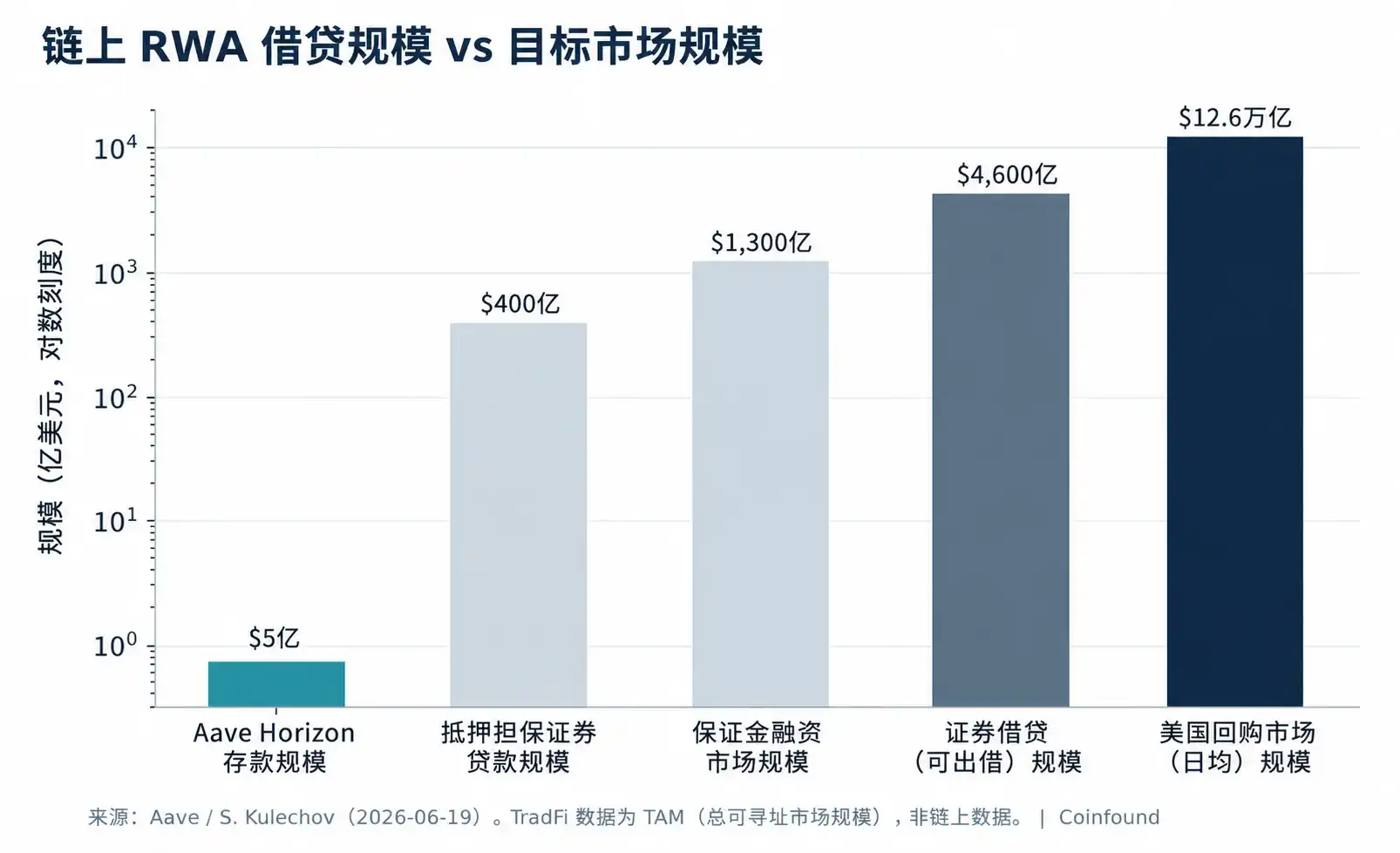
Chart: On-chain RWA lending remains minuscule relative to the traditional securities financing market it targets (Source: Aave / Kulechov, 2026-06)

Disclaimer: This article is for informational purposes only and does not constitute any investment advice; data may be delayed or contain errors, please refer to official disclosures.

热门币种推荐

相关问答

QAccording to the article, what is the core innovation of Aave V4 and how does it change the role of the 'composability layer'?

AThe core innovation of Aave V4 is positioning itself as an on-chain alternative to Wall Street securities financing, targeting markets like repo and securities lending. It changes the role of the 'composability layer' from being a point of risk to becoming the main backbone of the system by connecting all underlying asset issues to on-chain leverage and liquidation mechanisms.

QWhat specific risk does the 'centralized liquidity Hub + multi-Spoke' architecture and shared liquidity pool design in Aave V4 introduce?

AThe 'centralized liquidity Hub + multi-Spoke' architecture and shared liquidity pool design prioritize capital efficiency but introduce a key risk: the loss of risk isolation. If one type of collateral experiences problems during a stress period, it can drain liquidity from the shared stablecoin pool that supports all other collateral types, potentially amplifying risks across the entire market.

QWhat real-world incident does the article cite as a template for the risk where 'collateral integrity failure leads to bad debt'?

AThe article cites an incident in April 2026 where a third-party cross-chain bridge was attacked, resulting in approximately 116,500 unbacked rsETH being deposited as collateral into Aave, creating bad debt. This serves as a template for the risk of collateral integrity failure leading to bad debt, independent of the underlying asset's default.

QWhat is the article's prediction for the likely first trigger of a large-scale bad debt or forced liquidation in RWA collateral markets?

AThe article predicts that the first trigger for large-scale bad debt or forced liquidation in RWA collateral markets will likely be a dislocation between the price/net asset value (NAV) of the tokenized collateral during stress periods, rather than an actual default of the underlying credit asset.

QFor providers of stablecoin liquidity to markets like Aave V4, what key understanding about their risk exposure does the article emphasize?

AThe article emphasizes that providers of stablecoin liquidity must understand they are exposed to every type of collateral asset within a shared liquidity pool, not just the specific collateral types they might individually favor or analyze. Their risk is pooled across the entire market supported by that shared capital.

你可能也喜欢

Robinhood Chain生态速览:哪些项目值得提前布局?

Robinhood Chain作为Robinhood进军Layer2的核心,旨在构建覆盖股票代币、RWA、永续合约和现货交易的完整生态。主网上线后同步开启了为期90天的Gas费减免活动。截至2026年7月6日,其生态总锁仓价值约为7673万美元。本文梳理了生态内值得关注的部分项目: **Arcus**:由dYdX Labs与Robinhood Crypto联合构建的DEX,专注现货和永续合约,促进股票代币的点对点交易,其未来代币将优先分配给dYdX社区成员。 **Lighter**:一个ZK驱动的去中心化永续和现货交易所,已部署在Robinhood Chain上,并为Robinhood社区提供了价值1100万美元的代币激励计划。 **Morpho**:支持Robinhood Earn功能,用户可通过自托管钱包借出稳定币USDG获取收益,资金会存入Morpho金库进行分配。 **Rialto**:一个链上现货交易所,支持加密资产、股票、ETF等多种资产,初期将上线90多种Robinhood股票代币,其核心采用propAMM(使用自有库存和定价逻辑的链上做市商)模式。 **Arrakis**:面向代币发行方的非托管链上做市商协议,帮助管理DEX上的集中流动性。 **Meridian**:专注于RWA的永续合约和预测市场平台,结算资产为USDe,其前身为Ethereal。 **Native**:一个链上价格发现和执行系统,已部署至Robinhood Chain,该项目表示目前没有代币发行计划。 (请注意:本文内容不构成任何投资建议,参与者应自行研究并评估风险。)

marsbit11分钟前

Robinhood Chain生态速览:哪些项目值得提前布局?

marsbit11分钟前

调整尾声还是趋势延续:BTC、HYPE技术结构复盘 | 特邀分析

本期特邀分析围绕BTC与HYPE的技术结构展开复盘与展望。 **BTC部分:** 自5月6日高点开启的日线级别调整呈现四段式结构,当前处于(3-4)反弹段。关键看反弹终点“端点4”能否突破65,700美元阻力:若突破,则后续跌破57,820美元支撑的概率降低,市场可能进入区间震荡;若无法触及,则后续延续下行趋势概率大。4小时级别上,自6月15日高点的下跌已完成五段式结构并形成底背离,当前(44-45)反弹段已突破约62,300美元的下轨,短期走势对多头有利。 **本周BTC操作策略:** 市场结构已转为空头主导,中线空头仓位暂保持20%。若反弹至65,700~67,300美元区域出现滞涨及模型顶部信号,可考虑加空仓至50%以内。短线可利用30%仓位,依据支撑压力位寻找价差机会,并制定了在强阻力区试探性做空(方案A)与在强支撑区轻仓试多(方案B)两套预案。核心压力区关注64,500~65,700美元、67,300美元及69,500~71,000美元;核心支撑区关注60,950~62,300美元、57,820美元及55,000美元。 **HYPE部分:** 4小时级别上,自6月25日低点启动的反弹可细分为七段式上涨结构。价格在逼近历史高位76.94美元附近时,模型已触发顶部预警信号,需警惕短线调整风险。 **本周HYPE操作策略:** 以平仓锁定利润、防范风险为主。若持有多单,建议将止损位上移至68美元附近保护利润。核心压力位关注75~76.94美元及80美元附近;核心支撑位关注68美元、65.5美元及60.5~61.5美元区域。 **交易复盘:** 上周依据模型底部共振信号于64美元开立HYPE多单,后依据顶部共振信号于70.55美元附近清仓,成功盈利约10.23%。 **特别提示:** 交易需严格执行止损与移动止盈纪律。本文所有内容均为个人技术分析,不构成投资建议,市场有风险,投资需谨慎。

Odaily星球日报37分钟前

调整尾声还是趋势延续:BTC、HYPE技术结构复盘 | 特邀分析

Odaily星球日报37分钟前

交易

现货

热门文章

如何购买LAYER

欢迎来到HTX.com!我们已经让购买Solayer(LAYER)变得简单而便捷。跟随我们的逐步指南,放心开始您的加密货币之旅。第一步:创建您的HTX账户使用您的电子邮件、手机号码注册一个免费账户在HTX上。体验无忧的注册过程并解锁所有平台功能。立即注册第二步:前往买币页面,选择您的支付方式信用卡/借记卡购买:使用您的Visa或Mastercard即时购买Solayer(LAYER)。余额购买:使用您HTX账户余额中的资金进行无缝交易。第三方购买:探索诸如Google Pay或Apple Pay等流行支付方法以增加便利性。C2C购买:在HTX平台上直接与其他用户交易。HTX场外交易台(OTC)购买:为大量交易者提供个性化服务和竞争性汇率。第三步:存储您的Solayer(LAYER)购买完您的Solayer(LAYER)后,将其存储在您的HTX账户钱包中。您也可以通过区块链转账将其发送到其他地方或者用于交易其他加密货币。第四步:交易Solayer(LAYER)在HTX的现货市场轻松交易Solayer(LAYER)。访问您的账户,选择您的交易对,执行您的交易,并实时监控。HTX为初学者和经验丰富的交易者提供了友好的用户体验。

1.0k人学过发布于 2025.02.11更新于 2026.06.02

如何购买LAYER

相关讨论

欢迎来到HTX社区。在这里,您可以了解最新的平台发展动态并获得专业的市场意见。以下是用户对LAYER(LAYER)币价的意见。

活动图片