Author: Dan Bin
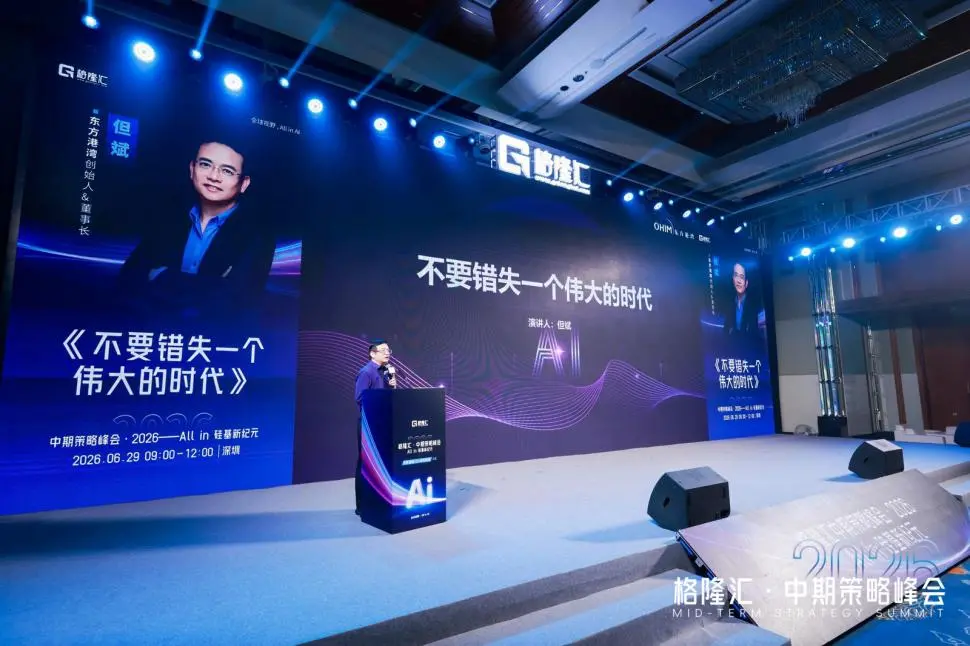
On June 29th, Dan Bin, Chairman of Oriental Harbor, delivered a keynote speech titled Do Not Miss Out on a Great Era at the Gelonghui "2026--All in Silicon-based New Era" Mid-Term Strategy Summit.
Addressing market concerns about AI bubbles from an industry cycle perspective, Dan Bin pointed out:"The risk of missing an entire era may be greater than the risk of worrying about short-term bubbles."
In his view, humanity is standing at the starting point of the artificial intelligence era—this era may be even more disruptive than the electronic era, the internet era, and the mobile internet era.
He judges that the AI wave is unlikely to conclude in just three or four years. At the industry level, it might follow the ten-year rhythm of the internet era. With the release of ChatGPT at the end of 2022 as the starting point, a key reference point for risk assessment could be around 2033.
He pointed out that the "primary driver" of long-term capital market growth is technological progress, while factors like trade wars, interest rate hikes, and wars are secondary. He also discussed the long-term logic of silicon-based life replacing carbon-based life from the perspective of human civilization, emphasizing the importance of focusing on primary drivers, respecting corporate innovation, and market fundamentals in investment.
Finally, he stressed the importance of not failing this great era.
"The tide never turns back, the wheel of the era rolls forward silently. Being born in such times is a great fortune itself; don't let hesitation trap your steps, don't let short-sightedness waste the years—never miss this magnificent, grand era that belongs to us."
The following are excerpts from Dan Bin's speech compiled by Gelonghui, shared with everyone.
01 From an Industry Cycle Perspective, the Risk of Missing the AI Era is Greater Than the Risk of Worrying About Short-Term Bubbles
Recently, people keep asking: Is there a bubble in AI? What's the short-term view?
Dan Bin's response is: From the perspective of long-term industry development, for market participants, the risk of missing an entire era may be greater than the risk you worry about regarding short-term bubbles. Of course, in the face of short-term volatility and uncertainty, investors also need to make independent judgments based on their own investment horizon and risk tolerance.
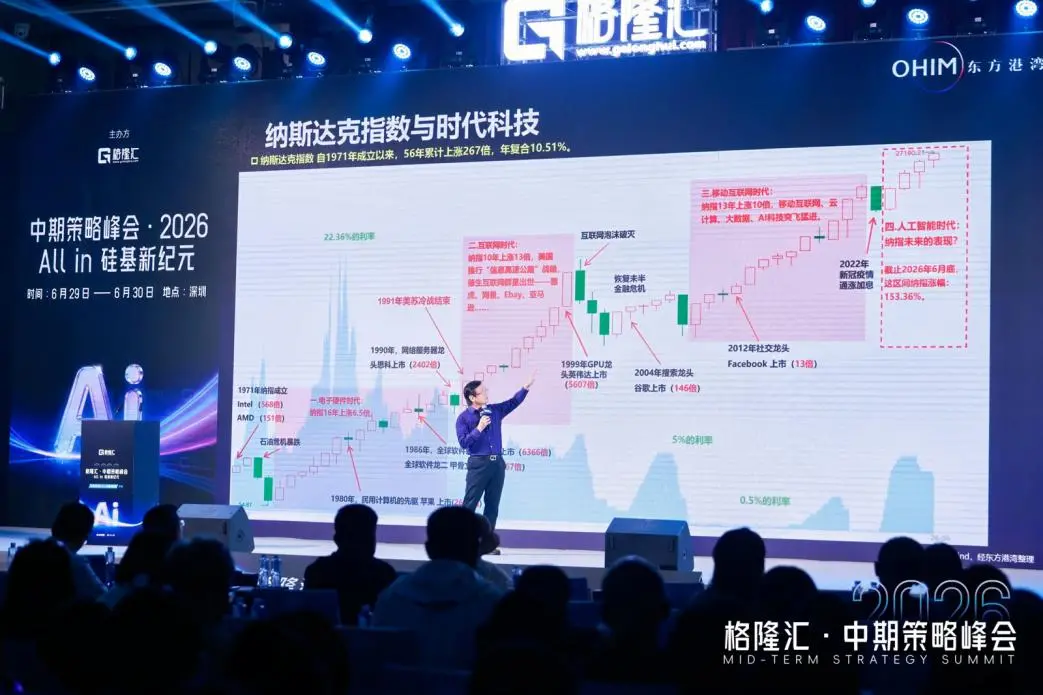
Looking back at the 55-year history of Nasdaq from its establishment in 1971 to the present, the core driving force that has truly propelled long-term capital market growth is technological progress, not short-term factors like interest rates or macroeconomic policies.
Some worry that a high-interest-rate environment will cause market collapse.
Let's look at history: The US benchmark interest rate once reached as high as 22% in the 1970s, yet the electronic hardware era gained 6.5x over 16 years; the internet era experienced a full interest rate cut-hike cycle and surged for a full 10 years; the same was true for the mobile internet era. Interest rates have never been the primary cause; technological progress is the primary driver.
02 The AI Era is More Disruptive Than the Previous Three Eras; Its Industry Cycle Might Follow the Ten-Year Rhythm of the Internet Era
He further pointed out that at last year's annual meeting, he predicted that 2026 might resemble 1994—forming a cross-star pattern followed by a significant rise. The years '23, '24, and '25 have already seen three years of strong gains, and this year continues to show strong industry momentum.
"Why? Because the AI era is more disruptive than the previous three eras—the electronic era, the internet era, and the mobile internet era."
Dan Bin's basic judgment is: The artificial intelligence era will have a relatively long industry cycle, similar to the internet era—ChatGPT was released at the end of 2022. If we reference the historical "ten-year" rhythm of the internet, that point (around 2033) is likely a reference window when risk needs to be examined. Before that, the industry development of AI is unlikely to conclude in just three or four years. However, short-term market fluctuations and local bubbles objectively exist, and investors still need to make rational assessments based on their own situations.
03 The Long-Term Vision of Silicon-Based Life: A Thought Experiment from a Civilizational Perspective
Dan Bin presented two videos, shifting the perspective from capital markets to the dimension of human civilization.
His viewpoint is highly imaginative: Silicon-based life replacing carbon-based life is a highly probable direction. If Earth's civilization is to continue, silicon-based life will likely replace carbon-based life or become the dominant productive force.
He provided a set of vastly different time coordinates:
In 4.1 billion years, the Sun may expand into a red giant and engulf Earth, or it may collapse into a white dwarf.
The Voyager spacecraft has been flying for 77 years and still has about 70,000 light-years to go before leaving the solar system.
In 10 billion years, the Andromeda Galaxy may collide with the Milky Way—by then, humanity must fly out of the Milky Way.
"Carbon-based life cannot fly out of the Milky Way. But silicon-based life—it is a million times smarter than us, thinking and working non-stop 24/7. The revolutionary changes it brings may propel civilization far beyond our understanding."
Dan Bin stated that this is not a short-term investment judgment but provides a framework for thought: The economic growth paradigm brought about by silicon-based intelligence may have infinite possibilities and a longer industry chain. Understanding this helps to transcend immediate distractions and examine long-term trends.
04 Technology Rewrites the Rules of War; Neither China Nor the US Can Afford to Lose the AI Competition
Dan Bin showed a recent example from the Russia-Ukraine battlefield: a Russian soldier was captured by a Ukrainian drone and robot.
"The weaponization of AI is an exponential change, an inevitable process."
He believes that neither China nor the United States can afford to lose this AI race. The US has a first-mover advantage in foundational technology and top talent, while China has formed differentiated competitive strengths in application scenarios, data scale, and industry chain completeness. Both sides are continuously increasing their long-term AI investments.
05 Buffett's "Regret" and Oriental Harbor's Evolution in Cognition
Dan Bin compared the portfolio changes of the "old-timers" in China and the US.
Buffett bought Google in the third quarter of last year and continued to add to the position this year. Google has now entered Berkshire Hathaway's top five holdings.
"Before his passing, Charlie Munger said in an interview that in his era, he should have made $100 billion or even $1 trillion. He had such a close relationship with Bill Gates, yet he only symbolically bought 100 shares of Microsoft. Microsoft rose 7,000 times."
"If he had taken $100 million from Coca-Cola to buy Microsoft, that would have become $700 billion, more than all the money he ever made."
Dan Bin admitted that these historical fragments cannot predict the future, but they remind us that investment requires constantly breaking cognitive boundaries. Oriental Harbor is also iterating and evolving: our company's research team continues to conduct in-depth tracking in AI foundational computing power, storage, and other areas.
06 Settle the Mind, Maintain Perspective, and Rationally Grasp the Chips Endowed by the Era
Dan Bin concluded with a poem he wrote:
"The tide never turns back, the wheel of the era rolls forward silently.
Some are trapped in the immediate noise and details; some stand above the cycles, gazing at the starry river.
Don't dwell on momentary ups and downs, don't blindly follow fleeting trends of heat or cold.
Mountains and rivers are reborn amidst upheavals; opportunities blossom through prolonged perseverance.
Being born in such times is a great fortune itself; don't let hesitation trap your steps, don't let short-sightedness waste the years.
Live well, move forward earnestly, and never miss this magnificent, grand era that belongs to us."