Bridgewater founder Ray Dalio has recently, in interviews and media reports, linked the decline in trust from US allies and the rise in China's strength to a modern version of a 'tribute-style order'. For the markets, this is not merely a historical analogy. If the US's commitments to allies and key regions are seen as more negotiable, while China alters the choices of neighboring countries through economic, financial, and diplomatic influence, the first factors priced into the market are likely to be regional risks, AI chip supply chains, RMB assets, and sentiment in Asian markets.
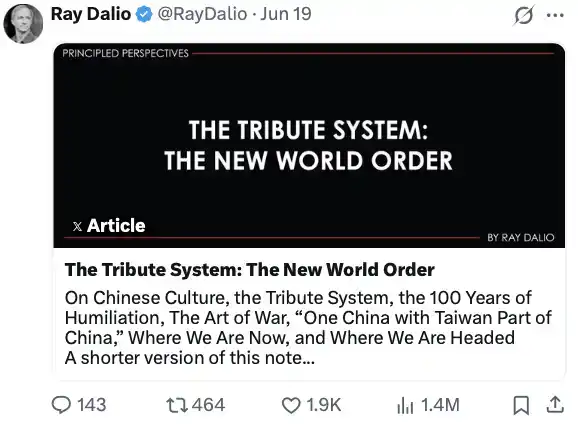
Dalio's assessment is sharp: as US relative deterrence declines and China's economic and financial influence rises, Asian countries may reassess who can provide security and economic order. He borrows the historical concept of the 'tribute system', referring not to simple direct control, but to a hierarchical relationship composed of power differentials, economic interests, diplomatic protocol, and pressure constraints.
One real-world focal point is East Asia's advanced semiconductor supply chain. Related regions hold key positions in the global manufacturing of advanced semiconductors, particularly AI-chip-related wafer fabrication. Public data widely indicates that this region produces over 60% of the world's semiconductors and over 90% of the most advanced chips. Even without extreme events, delays in commitments, shipping uncertainties, diplomatic pressure, or progress in supply chain self-sufficiency alone could be enough to cause related assets to fluctuate in advance.
US Commitments Becoming 'Negotiable' Is a Danger Signal in Dalio's Eyes
Dalio observes several recent events along the same line.
First is the Middle East conflict and risks in the Strait of Hormuz. Market reports surrounding Iran, energy transport, and the cost of US intervention are used by him as an analogy: the US public and government are increasingly unwilling to bear the cost of long-term, multi-front conflicts. This analogy is more of a macro investor's historical reference; it does not mean Middle East developments have already proven US decline. But it explains why a strait risk gets incorporated into narratives about shifts in Sino-US power.
Second is the pace of progress in some US external arrangements. According to reports from AP, *The Washington Post*, etc., planned arrangements involving around $14 billion have not yet been fully finalized. Concerned parties state they have not received suspension notices; a US acting Navy secretary stated that some external arrangements were delayed due to the Iran war and munitions needs. Trump also referred to related matters as a 'negotiating chip' in talks with China.
This is the part most sensitive to the market. If US commitments to key regions are understood by the outside world as negotiable, other Asian economies will reassess the reliability of US promises. Whether the related arrangements are ultimately implemented remains undecided, but 'uncertainty' itself already constitutes a signal.
Third is the change in tone from the US in Asian security forums. US Secretary of Defense Pete Hegseth's speech at the Shangri-La Dialogue on May 30th was interpreted by media compared to 2025 as toning down its hawkishness towards China, though he still emphasized the US would maintain a favorable balance of power in the Indo-Pacific and remain vigilant about China's military expansion. This may not represent a US withdrawal from Asia, but it deepens one question: when the US simultaneously faces pressures in the Middle East, Europe, and the Indo-Pacific, how much cost is it willing to bear for its regional commitments?
'Tribute-Style Order' Is Not a History Lesson, But an Explanation of Indirect Pressure
Dalio's argument sparks discussion because he does not explain China solely from a military perspective, but combines economics and finance, historical narratives, and political culture.
In his understanding, the traditional 'tribute system' was more like a set of regional order arrangements: surrounding states acknowledged power differentials in exchange for trade, protection, and stability; the central state maintained influence through rewards, punishments, protocol, and access rules, without frequently resorting to direct control.
This connects to the idea in *The Art of War* of 'subduing the enemy without fighting'. Truly effective pressure may not be firing shots, but forcing an opponent to adjust on their own in the face of economic, diplomatic, supply chain, and internal costs.
The advanced chip supply chain thus becomes the focal point of this logic. For global markets, key regions are where advanced chip production capacity is highly concentrated. Technology, capital, and regional order overlap here, amplifying any changes in pressure.
Dalio also notes that China's export profits, accumulation of capital surpluses, increased use of the RMB in trade and capital transactions, and the enhanced competitiveness of China's financial system will increase its appeal to neighboring countries. This is not equivalent to 'China's financial system has already replaced the US', but if more trade, financing, and supply chain arrangements revolve around China, regional economies' choices between security and economics will become more complex.
Advanced Chips Are the First Pressure Point Where Markets React
For investors, the most critical question is not 'will an extreme event immediately occur', but whether pressure will change asset prices before an extreme event happens.
Related regions produce the majority of the world's advanced chips. AI servers, cloud computing capital expenditures, semiconductor equipment, and consumer electronics supply chains are all highly tied to them. The AI chip supply chain does not only involve wafer fabrication but also includes HBM, advanced packaging, equipment, and materials. However, the most advanced process capacity is concentrated in key East Asian regions, which remains one of the most sensitive geopolitical risk exposures for global tech stocks.
This is also why Dalio emphasizes 'non-direct conflict'. Modern financial markets do not need to wait for the worst outcome to occur before adjusting. Shipping insurance, chip inventories, corporate capital expenditures, USD and RMB flows, and Asian equity, currency, and bond assets may all fluctuate as risk expectations change.
If China continues to advance self-sufficiency in advanced chips, the external constraints of key production capacity on the mainland supply chain may decrease; but in the short term, related regions remain a key link the global AI industry cannot bypass. The so-called 'threat-as-action' refers precisely to this: when critical capacity is concentrated in a high-pressure region, even just the possibility of blockade or sanctions is enough to affect global tech stock valuations and corporate procurement decisions.
The RMB and Chinese assets will also face dual impacts. On one hand, China's trade surplus and increased use in cross-border settlements will support the RMB internationalization narrative; on the other hand, if regional risks heat up, capital will also reassess the political risk and liquidity constraints of Chinese assets.
Policy Volatility and Miscalculation Are the Hardest Parts to Price
Dalio has not packaged his judgment as a definitive conclusion. His identity is that of a global macro investor; the advantage lies in observing historical cycles, monetary finance, and geopolitical shifts together; the limitation is also here—it's more of a macro scenario than an official policy roadmap.
US policy itself can be volatile. The Trump administration can treat some external arrangements as negotiating chips, but may also re-strengthen regional commitments under pressure from Congress, allies, or electoral politics. The open and contentious nature of US domestic politics increases short-term swings but may also create reverse constraints on key issues.
Internal regional factors will also influence the pace. Different approaches within regions emphasize communication, confrontation, and risk management differently. Election cycles around 2028, US midterms, and China's internal political schedule may all change the timing of actions by various parties.
Chip self-sufficiency is also not something that can be achieved by slogans alone. Advanced processes, equipment, materials, EDA software, and talent systems all require time. If China cannot significantly reduce external dependency in key links, the importance of East Asia's advanced chip capacity will only increase, and the cost of pressure maneuvers will be harder to control.
Indirect pressure does not equal low risk. The greater the reliance on deterrence, ambiguous signals, and diplomatic probing, the more prone the situation is to miscalculation. What the market fears may not be an extreme event suddenly occurring one day, but rather all parties repeatedly testing each other between commitments, exercises, blockades, sanctions, and negotiations, ultimately pushing the situation to a harder-to-manage point. What Dalio truly reminds investors is that changes in the Asian order may not begin with a clear conflict, but first manifest in wavering commitments, diplomatic alignment, chip anxiety, and shifts in capital flows.