Idle Macs Can Also Make Money? An Overview of Eigen Labs' Decentralized AI Inference Network Darkbloom

marsbit发布于2026-06-22更新于2026-06-22

文章摘要

AI inference is becoming a crucial layer of internet infrastructure, yet it remains largely dependent on costly, capacity-limited centralized systems with potential security risks. Meanwhile, millions of powerful computers sit idle globally. Eigen Labs' Darkbloom network aims to utilize this idle capacity by enabling distributed AI inference on Mac computers, specifically those with Apple Silicon chips. Darkbloom's architecture consists of three components: users who send inference requests, a coordinator (operated by Eigen Labs) that routes these requests, and providers (Mac owners) whose machines run the models and return outputs without being able to see the request content. The system prioritizes privacy through a hardened provider process, software integrity checks, and hardware-supported attestation based on Apple's security architecture to ensure verifiable privacy. Economically, Darkbloom differs from traditional models. It leverages existing hardware, with marginal costs primarily driven by electricity, allowing it to offer pricing roughly 50% lower than major API aggregators. Providers keep 100% of the inference revenue, and the project does not rely on token subsidies; earnings come solely from real AI inference demand. However, early-stage earnings are modest, with top providers currently earning under $6 per day, influenced by factors like hardware specs, uptime, and network demand. The network currently supports models like Google's Gemma 4 and OpenAI's GPT-OS...

Compiled by: Felix, PANews

AI inference is gradually becoming a critical layer of internet infrastructure. However, most inference currently still relies on a centralized architecture, which is costly, has limited capacity, involves multiple layers of stacking, and carries certain security risks. At the same time, there are millions of powerful computers worldwide that remain idle for most of the day.

Eigen Labs recently launched the AI inference network Darkbloom, which explores performing distributed AI inference on idle Mac computers. By combining verified nodes, hardware-level privacy protection, and superior economic efficiency, it transforms idle Apple Silicon chips into a more efficient, privacy-first computing network.

The project was launched as a research preview around April this year, upgraded to a public alpha version in May, and is now available on the OpenRouter platform. In the alpha version, the available models are Google's Gemma 4 and OpenAI's GPT-OSS.

Core Architecture and Verifiable Privacy

The Darkbloom network consists of three parts: users, coordinators, and providers.

  • Users can send inference requests through a chat interface or a compatible OpenAI API.
  • The coordinator (operated by Eigen Labs) routes these requests to eligible Macs in the network.
  • Providers (users who own these eligible Macs) run the models and return the output, but they cannot see the request content.
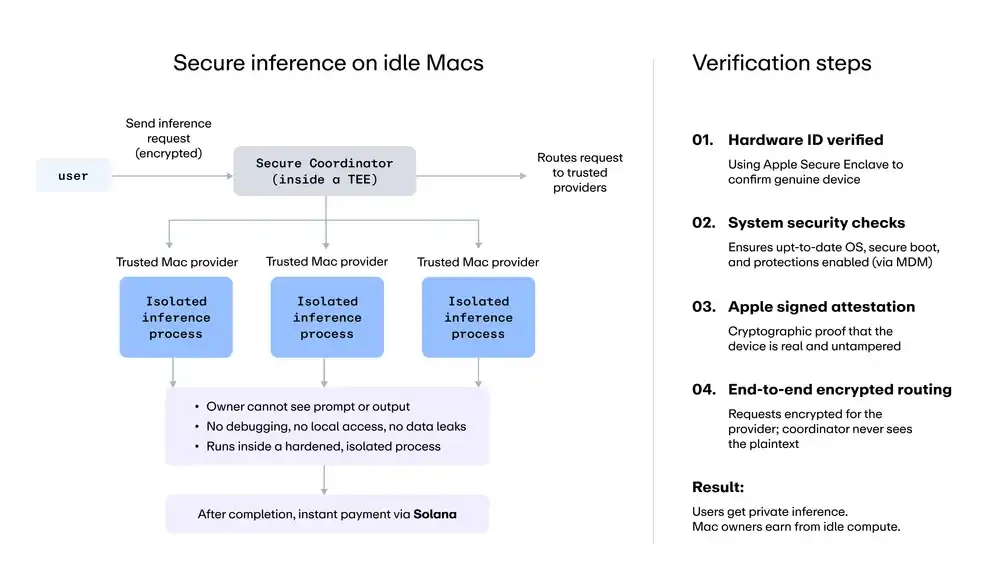
Darkbloom is built on a privacy-first distributed inference model. The provider process is hardened to resist common local inspection paths, including debugger attachment and external memory inspection. The integrity of the running binary is also part of the trust model, helping to ensure that the software serving requests conforms to network expectations.

The system also uses hardware-supported attestation based on Apple's security architecture. Secure Enclave keys, attestation signals, and periodic challenge-response checks are used to verify that participating nodes are running with the intended protections and software state, achieving truly verifiable privacy.

Economic Model and Daily Earnings

Darkbloom is fundamentally different in its business model compared to the vast majority of projects. In the traditional tech stack, costs include hardware, facilities, cooling, networking, operational overhead, and layers of profit margins. In Darkbloom's model, the hardware already exists, and the marginal cost is primarily driven by electricity. Darkbloom's benchmark pricing is only about 50% of current mainstream API aggregators. Providers (Mac hosts) can keep 100% of the inference revenue. Furthermore, Darkbloom has not taken the path of issuing tokens to subsidize early participants; node earnings come entirely from real AI inference demand.

It is worth noting that, given the project's early stage of development, earnings are relatively modest. Factors such as memory and hardware configuration, uptime, model demand, node health, and network demand can all influence earnings to some extent.

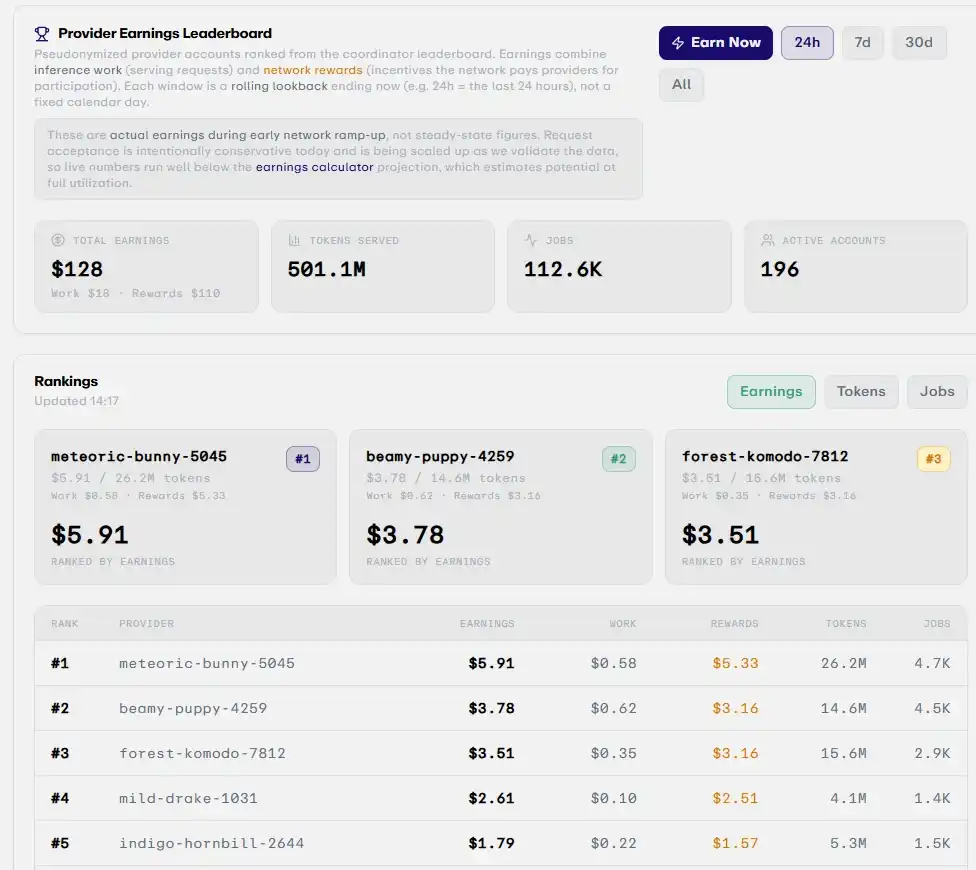
Current leaderboard data shows that the top provider earns less than $6 per day, and the fifth-ranked provider earns even less than $2. However, as the network opens up to large language models with high memory requirements and real user usage increases, this situation is expected to improve.
Regarding how to set up an idle Mac, the steps are as follows:

  • Acquire a Mac with an Apple Silicon chip
  • Ensure it runs macOS 14 or higher
  • Install the Darkbloom provider
  • Keep the Mac online with a stable internet connection
  • Let the network route supported AI tasks

Related reading: A Roundup of Recent Stocks and Crypto Assets Worth Watching: AI, RWA, and Space Stocks...


热门币种推荐

相关问答

QWhat is the core concept of Eigen Labs' Darkbloom network, as described in the article?

ADarkbloom is a decentralized AI inference network that aims to utilize the idle computing power of Mac computers equipped with Apple Silicon chips. It distributes AI inference tasks across these devices, offering a more cost-effective and privacy-focused alternative to centralized infrastructure.

QHow does Darkbloom's architecture ensure privacy for user requests?

ADarkbloom ensures privacy through a hardware-supported verification model. It uses Apple's Secure Enclave keys, attestation signals, and periodic challenge-response checks to verify that provider nodes are running with the expected protections. Provider processes are hardened against local inspection, and providers cannot see the content of user requests.

QWhat is the current economic model for providers (Mac owners) participating in the Darkbloom network?

AProviders keep 100% of the inference revenue they generate. The model is based on real AI inference demand, not token subsidies. Currently, however, earnings are low; the top provider earns less than $6 per day, and the fifth earns under $2, with factors like hardware, uptime, and network demand influencing income.

QWhich AI models are available in Darkbloom's current alpha version, and where is it accessible?

AIn its current public alpha version, Darkbloom offers Google's Gemma 4 and OpenAI's GPT-OSS models for inference. The network is accessible on the OpenRouter platform.

QWhat are the basic requirements for a Mac to become a provider on the Darkbloom network?

ATo become a provider, a user needs a Mac with an Apple Silicon chip, running macOS 14 or a higher version. They must install the Darkbloom provider software and keep the Mac online with a stable internet connection to allow the network to route AI tasks to it.

你可能也喜欢

超级无敌螺旋大爆炸,美光财报重燃半导体长牛

北京时间6月25日,美光公布2026财年第三季度财报,业绩远超市场预期。季度营收达414.56亿美元,同比暴涨346%;净利润282.43亿美元,同比暴增近15倍。更亮眼的是下一季指引,预计第四季度营收将高达500亿美元,远超市场预期,毛利率预计约86%。 增长的核心驱动力是AI浪潮,其影响已从HBM扩散至整个存储产业链。美光云端内存、数据中心、SSD等所有核心业务均实现数倍增长,各业务线毛利率普遍维持在80%以上。HBM4已批量出货,HBM4E按计划推进,2026年HBM产能已全部售罄。AI需求拉动下,DRAM与NAND市场供需紧张,预计将持续至2027年之后。 更关键的是,美光已签署16份长期战略客户协议(SCA),大部分为期5年,最远覆盖至2030年,采用强约束性的“照单全付”模式。这些协议已对应约1000亿美元保底收入,并获得约220亿美元履约保证金,为未来扩产提供资金支持。 基于此,美光计划大幅增加资本开支,第四财季预计达100亿美元,主要用于扩充HBM、先进DRAM及先进封装产能。此次扩产有长期订单托底,不同于传统周期性的盲目扩张。 财报发布后,美光股价盘后暴涨16%,并带动全球半导体板块集体走强。这份财报不仅展示了美光的强劲业绩,更强化了市场对AI基础设施建设持续加速、存储行业长期景气的信心。

Odaily星球日报28分钟前

超级无敌螺旋大爆炸,美光财报重燃半导体长牛

Odaily星球日报28分钟前

解读以太坊基金会新架构:在机构化趋势中重申自我主权

以太坊基金会(EF)裁员20%并公布了全新的五层工作架构,旨在明确自身职责并重申以太坊的核心价值观。这五个层级分别是: 1. **协议层**:维护以太坊的核心属性CROPS(抗审查、鲁棒、开放、私密、安全),专注于底层技术发展,如安全推进硬分叉、抵抗量子威胁等,坚守自我主权底线,避免为短期金融化牺牲原则。 2. **访问层**:确保用户在实践中能真正使用以太坊的自我主权能力,关键操作(读链、交易等)需有不依赖不可验证中介的路径。其核心原则是“零选项”,即为每条中介化路径提供可信的无中介替代方案。 3. **用户层**:连接协议层与访问层,基于真实用户和组织的需求开展工作。旨在改变过去技术端与应用端割裂的状况,使开发决策更贴合实际,在竞争日益激烈的公链环境中更好地理解并满足“新世界居民”的需求。 4. **社区层**:对内维护和传播以太坊的价值观共识(如不被中心化利益裹挟、坚持技术中立、坚守CROPS),对外与相关领域建立连接。文章指出,当前周期随着机构大规模进场(如ETF、稳定币法案),市场底层逻辑和“去中心化”共识正面临前所未有的挑战和稀释风险。 5. **机构层**:负责与机构的互动,但前提是坚持自我主权。EF强调并非“让机构更容易控制用户”,而是用以太坊技术创造更好的集成案例,使那些需要持续、中立服务的全球性业务能够在一个不受单方面干扰的平台上运行。 文章最后指出,尽管加密世界正处在一个拥抱机构的巨大浪潮中,以太坊通过此次架构调整,再次明确了其作为“公海”般中立、去中心化基础设施的定位,旨在长远维护其不可篡改和抗审查的核心价值。

链捕手50分钟前

解读以太坊基金会新架构:在机构化趋势中重申自我主权

链捕手50分钟前

交易

现货
合约

热门文章

加密市场宏观研报:原油飓风、AI巨浪与比特币的十字路口

全球金融市场正经历一场由地缘冲突引发的系统性重估:霍尔木兹海峡封锁导致原油一度暴涨30%,G7紧急释放储备后涨幅收窄,滞胀风险取代通胀成为核心担忧,美元成为“唯一避风港”并逼近100大关,亚太及美股遭遇“黑色星期一”全线重挫;AI领域则冰火两重天,国家发改委提出“十五五”末10万亿规模目标,OpenClaw项目火爆推动概念股狂飙;比特币在宏观风暴中跌破70000美元关键防线。

595人学过发布于 2026.03.12更新于 2026.03.12

加密市场宏观研报:原油飓风、AI巨浪与比特币的十字路口

相关讨论

欢迎来到HTX社区。在这里,您可以了解最新的平台发展动态并获得专业的市场意见。以下是用户对AI(AI)币价的意见。

活动图片