Original Author: Curry, Shenchao TechFlow
During the days of SpaceX's IPO, the pre-IPO price of SPCX on Hyperliquid was everywhere on social media, but few looked into who was behind building that market.
In fact, it was a team called Trade.xyz. Anonymous, emerged only this year, and now it alone accounts for over 90% of the open interest in pre-IPO contracts on Hyperliquid. The buzz around SpaceX's on-chain Pre-IPO was essentially driven by this single player.
And just three days after SpaceX's listing, on June 15, another team doing the same business announced it was shutting down.
This one was called Ventuals, backed by Paradigm, and it also offered pre-IPO contracts for SpaceX, as well as for OpenAI and Anthropic. It launched earlier this year, and from opening to closing, it lasted only nine months.
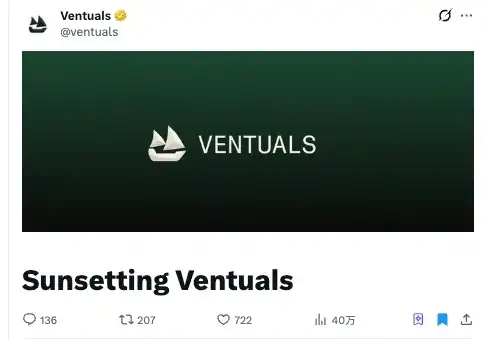
Same blockchain, same HIP-3 mechanism, same niche. One turned SpaceX into the biggest market on the platform, the other held OpenAI and Anthropic, yet ended up failing.
What's particularly noteworthy is the way Ventuals exited. According to its official social media post, it didn't shut down because it ran out of money. The announcement said it was acquired, with the entire team being integrated into another project within the Hyperliquid ecosystem. User principal was returned at 1:1, marking a relatively graceful exit.
But here's the puzzle. Holding onto the two most coveted banners in the entire market—OpenAI and Anthropic—it should have been the last one to fail. What went wrong?
Trade XYZ vs. Ventuals
The successful one, Trade.xyz, remains anonymous to this day.
The project founder only revealed a bit of background during an interview with Hyperliquid founder Jeff Yan, saying he bought his first Bitcoin for $66 in 2013, had been an investor since, never started a project, and would have left the crypto space long ago if not for meeting Jeff.
It was this semi-outsider who built the largest pre-IPO market on Hyperliquid. According to a Colossus report, Trade.xyz has grown 38% weekly since last October, with cumulative trading volume exceeding $130 billion.
It started with silver, then crude oil, then S&P 500, and finally SpaceX.
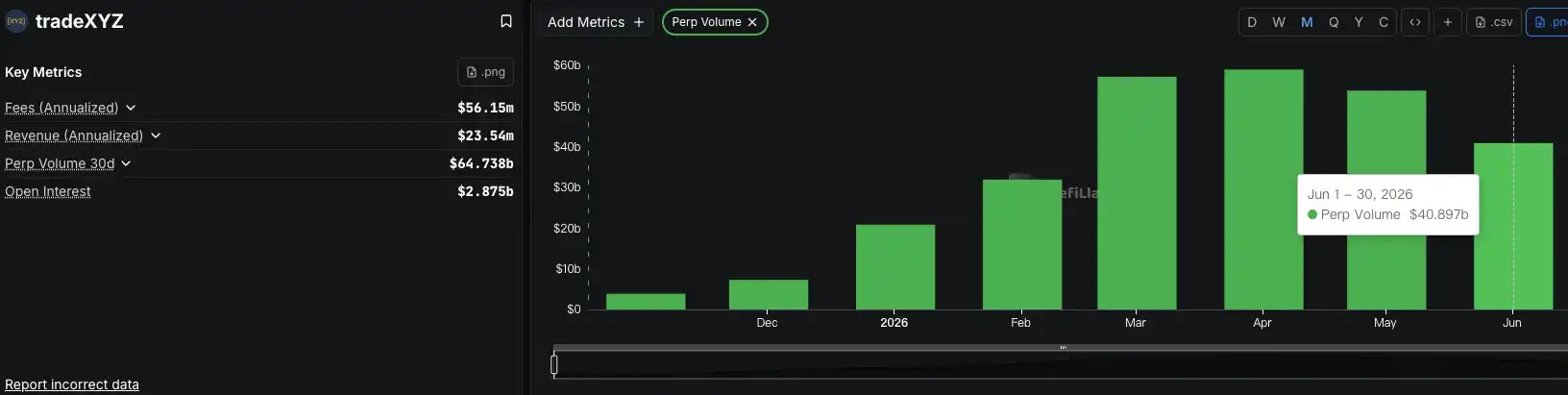
Its choice of SpaceX was clever.
SpaceX was set to list on Nasdaq on June 12, with a determined IPO price and date. By listing the pre-IPO contract, Trade.xyz was essentially betting on an event with a guaranteed outcome. On the listing day, Nasdaq would provide a real price. This real price acted like an anchor, preventing the pre-IPO price from drifting too far. Even if the price deviated in the middle, it would be pulled back at the moment of listing.
And that's exactly what happened. In the days before its IPO, SPCX traded between $154 and $172, betting on a premium above the $135 IPO price. The stock later surged at the open, proving the bet right.
Ventuals chose a different type of asset.
Backed by Paradigm, one of crypto's top-tier VCs, its pedigree was far more respectable than the anonymous Trade.xyz. Its chosen banners were also bigger: OpenAI and Anthropic, the two most coveted assets in the entire market.
But these two companies have no listing date in the foreseeable future.
There are external reference prices. According to Bloomberg, Anthropic allowed employees to sell secondary shares this year at a $350 billion valuation, and OpenAI does similar periodic offerings. But these prices are set behind closed doors. In a secondary share transaction, buyers and sellers are often the same long-term, heavily invested shareholders; the asset doesn't genuinely change hands in a public market.
Such pricing might be precise at times, but it lacks a public order book where everyone can step in to correct errors.
By putting these prices on-chain as contracts, Ventuals essentially hung the entire market on one or two off-chain price feeds. Worse, it layered on a mechanism that essentially argued with itself.
Some on-chain analysts dug into Ventuals' pricing logic:
Its oracle price was half from external secondary share transactions and fundraising valuations, and half from a moving average of the contract's own price. In other words, half the price was referencing itself. When buying pressure pushed the price up, the moving average rose, pulling the oracle price higher, which in turn pushed the price ceiling further up, leading to even higher bids.
The result was that prices for OpenAI and Anthropic contracts were perpetually pinned near the ceiling, with sell orders and liquidations difficult to execute. The charts showed steady uptrends, but in reality, prices were structurally stuck, bearing little relation to genuine supply and demand.
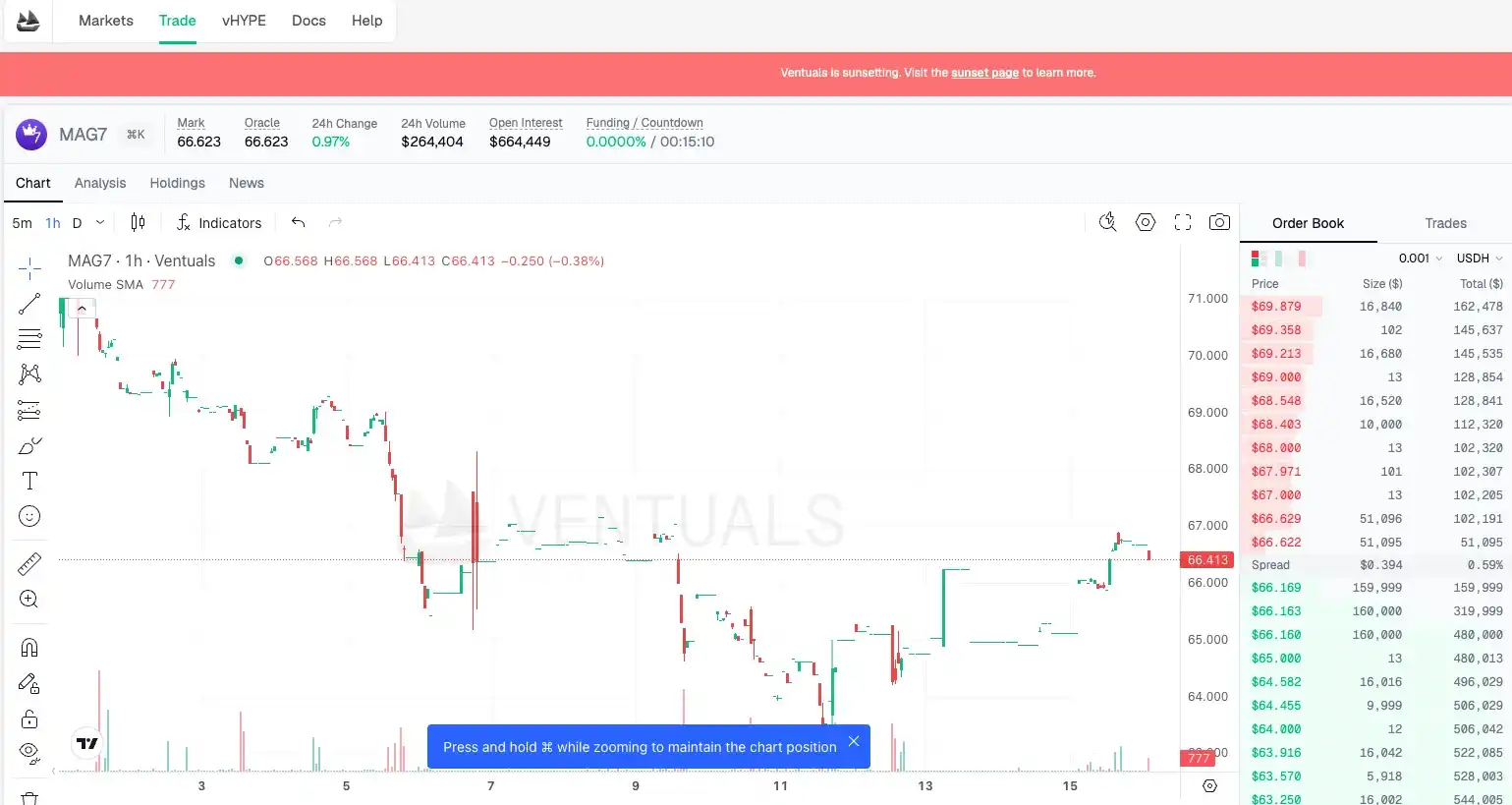
Source: MAG7 assets on Ventuals, showing intermittent candlestick charts with no trades in some periods.
So this type of Pre-IPO wasn't so much the market telling you what OpenAI was worth, but rather a machine pushing the price up and then lifting it further based on the very price it pushed up.
Trade.xyz bet on an asset destined for a Nasdaq reckoning, with a real price as a backstop if wrong; Ventuals bet on assets existing only in internal valuations, then layered on a self-referential price feed, leaving the price suspended in mid-air with no floor beneath.
Final Settlement Prices: OpenAI $1300, Anthropic $1600
When winding down, did the final price it reported count?
At shutdown, Ventuals had to set a final price for its contracts to settle all positions. Its method was to freeze the average price of the past 24 hours. OpenAI was finally set at $1341.80 per share, Anthropic at $1618.90.
These two numbers are now etched into the settlement records, becoming the last quoted prices for these companies on-chain.
As mentioned earlier, this price was half referenced from external secondary prices and half from its own price moving average, perpetually crawling near the ceiling. In other words, a significant portion of that $1341.80 was the result of the machine lifting the price based on the level it had already pushed up.
It's precise to two decimal places, but it's not necessarily true.
The most ironic part is that some people actually took this price seriously.
According to Bloomberg, employees of SpaceX, OpenAI, Anthropic, and some late-stage venture capitalists approached Ventuals, saying they used the platform to value their own equity holdings.
This needs unpacking.
These individuals hold real secondary shares. In theory, they should know best what their stock is worth. But primary market valuations are drip-fed once a year, leaving a vast blank space between funding rounds where no one knows if the price is rising or falling.
Places like Ventuals, however unreliable, at least quote a number 24/7, complete with price movements.
Thus, an inverted situation emerged. Those who should have the most pricing power were instead looking at a number from a retail trading table, seeking psychological comfort.
This is the fundamental paradox of the pre-IPO pricing business.
The most coveted assets lack a fair price the most; the greater the lack, the more willing people are to cling to anything that looks like a price, even if it's a machine arguing with itself.
Ventuals has closed shop, and those final prices are frozen in time. But the demand for such reference points likely hasn't diminished one bit.
The Pre-IPO Pricing Business: Players Rushing In
Demand hasn't decreased, but supply is actually increasing, and becoming more formal.
In the same week Ventuals shut down, Coinbase launched its own pre-IPO perpetual contracts, with SpaceX as the first asset, targeting users outside the US.
Not just Coinbase. Polymarket uses Nasdaq data for prediction markets on private company valuations; Citi launched tokenized private company stock for wealth and institutional clients. The crypto side is doing it, traditional investment banks are doing it too.
This is no longer just a small-scale experiment by a few anonymous teams on Hyperliquid. Giving unlisted companies a price that can be traded anytime is becoming a legitimate business everyone wants a piece of.
For readers in some regions, this demand isn't unfamiliar. IPO subscriptions involve long queues, primary market shares are allocated only among institutions and high-net-worth individuals, leaving ordinary people shut out. Now, seeing prices for companies like OpenAI and SpaceX listed for 24/7 trading gives many their first chance to touch such assets. The demand is real.
But Ventuals' shutdown over the past half-year has also laid bare the Achilles' heel of this business.
For a price to be meaningful, willingness to trade isn't enough. It requires a public market where anyone can step in to constantly correct errors. Even if Coinbase takes over, this fundamental flaw doesn't disappear. It merely shifts from the banner of an anonymous team to that of a bigger brand. The underlying company still isn't listed; that fair price still doesn't exist.
Will the next entity setting its price do a better job than Ventuals? The answer might only be revealed when OpenAI finally stands before its own bell-ringing day.