Author: The Heart of Computing Power
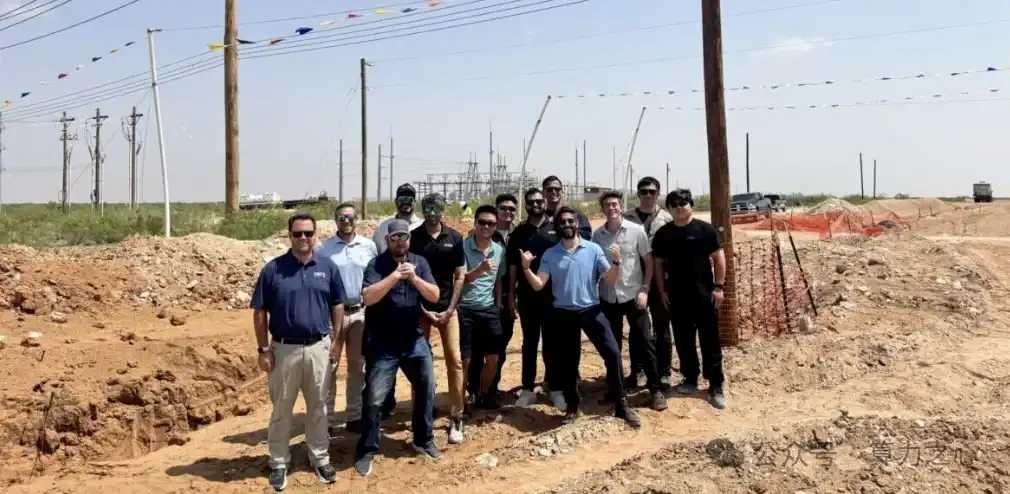
In December 2025, Spencer Marr cut a red ribbon in Ector County, Texas.
Behind the red ribbon was a Bitcoin mining farm named Genesis.
Less than six months after powering up, in June 2026, his company Sangha announced that it was considering selling it, forming a joint venture, or bringing in a strategic partner.
It's not because they couldn't continue, but because it's too valuable.
Because what's eyeing this mining farm is AI.
I. The Farm Goes Live and Immediately Lists for Sale
The Genesis farm is not large, at 19.9MW.
They didn't build their own power plant; instead, they connected to a 180MW solar farm owned by South Korea's Hanwha Group.
They use "behind-the-meter direct supply," meaning electricity generated by solar doesn't go through the public grid but is directly delivered to the farm via a dedicated line.
This saves on grid fees and avoids grid congestion, a win-win.
Additionally, the French energy giant TotalEnergies provides retail electricity services, helping them supplement electricity from the grid when solar power is insufficient.
Sangha named this model the "Triple Win."
IPP (Independent Power Producer) earns extra revenue, investors get low-cost Bitcoin, and the grid becomes more stable due to flexible load.
The project timeline is clear: groundbreaking in May 2025, power on in December 2025.
For this, Sangha also set up an SPV (a special purpose vehicle company shell for this single project), allowing investors to invest directly in the farm's machines instead of trading Bitcoin themselves, sharing profits based on Bitcoin output.
However, just six months after powering up, in June 2026, Sangha announced it was considering selling, forming a joint venture, or bringing in a strategic partner.
The deal is managed by investment bank Marathon Capital, codenamed Project Genesis, proceeding in two phases with the goal of closing in the fourth quarter.
Sangha co-founder Spencer Marr didn't hide it either, stating directly, "We're casting a wide net," talking to "all kinds of institutions," and he admitted the company is "watching the market like everyone else."
But why consider selling a profitable farm that just went live six months ago?
II. The Mining Rigs Aren't Worth Much; It's That Power Line That's Valuable
Yes, Genesis isn't being sold because it's losing money.
Marr says that although the hashprice (the revenue per unit of computing power) is declining, their farm is still profitable.
The reason is simple: their electricity price is low.
From December 2025 to the first quarter of 2026, its all-in electricity price was about $32/MWh.
For comparison, the average industrial electricity price in North America is $60-80/MWh; Genesis's price is less than half of that.
Interestingly, while Marr expresses optimism about Bitcoin and hashprice, he's simultaneously considering selling the farm, forming a joint venture, or bringing in a strategic partner.
It sounds contradictory, but it's not.
Because being optimistic about Bitcoin doesn't equal being optimistic about "continuing to mine it themselves."
When AI companies are scrambling for large power blocks, a site that's already live, has grid interconnection agreements, and has a low-cost power contract is a ready-made treasure trove in their eyes. "How many GPUs can we fit" is Genesis's value.
Not to mention, for AI companies, the most expensive cost isn't construction, but time—power access, land approval, which can take years.
And Sangha is indeed paving the way in this direction.
They modified the grid interconnection agreement, expanding the site's power capacity from 20MW all the way to 110.4MW, targeting completion by May 2028.
At 110.4MW, Sangha either needs to raise funds themselves to expand into an AI data center or sell the "power asset" at a peak valuation to a richer buyer.
Sangha is also calculating that selling the power asset at a high valuation might be more profitable than expanding themselves.
Now, when Sangha promotes Genesis externally, they're no longer just talking about Bitcoin mining; AI computing, high-performance computing (HPC), hybrid strategies—all are in the PPT.
And this isn't just Sangha's story.
III. The Entire Mining Industry is Leaning Towards AI
Looking at listed mining companies, the shift is even more apparent.
Companies like Core Scientific, TeraWulf, and Hut 8 have either secured major AI/HPC contracts or are in the process of transitioning.
Total AI/HPC related contract values have exceeded $70 billion. Among listed miners, the proportion of revenue from AI could rise from 30% to 70%.
But Sangha is different from them.
It's not a listed company, so it faces no stock price pressure or quarterly reports for Wall Street.
It operates project-by-project; one SPV is one asset package. If Genesis is sold, the team can immediately move on to the next one.
This agility makes it an attractive target for buyers.
For buyers, acquiring Genesis means directly obtaining a compliant, powered-on, power-contracted, and expandable AI-ready site.
No three-year approval queues, no haggling with the grid, no building substations from scratch.
Objectively speaking, Genesis's own model is proven.
Solar power paired with mining, electricity prices compressed to $32—the model is validated. Continuing expansion requires more capital investment, and AI buyers are willing to pay a premium.
Selling is a calculated decision.
It's just that the "Triple Win" story told to investors—more revenue for power producers, low-cost Bitcoin for investors, a more stable grid—at this point, might boil down to one sentence: whoever offers the highest price takes it.
Spencer Marr once said that what Sangha does is "building new models for Bitcoin capital flow."
Now, this "new model" might become "selling power assets to AI, then distributing the profits."
The question is, as prime power sources and land increasingly shift towards AI, where will Bitcoin miners find their next stronghold?