Bitcoin Bull Turn Hinges On US Debt Wall, Real Vision Says

bitcoinist发布于2026-06-09更新于2026-06-09

文章摘要

Real Vision crypto analyst Jamie Coutts says Bitcoin's long-term technical setup is approaching attractive, accumulation-zone levels, suggesting a potential cycle bottom in Q2/Q3. However, he cautions that a major macroeconomic obstacle could delay a sustained bullish reversal: a looming US Treasury refinancing wall. In 2027, $3.67 trillion of government debt matures and must be refinanced at significantly higher interest rates. Coutts argues current market liquidity is insufficient to absorb this issuance smoothly, especially as capital continues rotating out of crypto and into AI-related equities and commodities since late 2025. This liquidity constraint, combined with a potential contraction of the Federal Reserve's balance sheet, poses a risk to all risk assets, including Bitcoin. While Bitcoin may be the first to detect a future shift toward increased Fed liquidity, Coutts believes such a shift may only come after stress emerges in the Treasury market. Therefore, despite a positive technical structure, Bitcoin's next durable bull phase may hinge on navigating this significant macro refinancing challenge.

Real Vision Chief Crypto Analyst Jamie Coutts says Bitcoin is moving into a more attractive long-term setup, but a major US Treasury refinancing wall may still stand between the market and a durable bullish reversal.

In a post on X, Coutts said Bitcoin’s long-term technical backdrop is beginning to resemble the kind of structure that can precede a cycle bottom. “I’ll be the first to turn bullish on Bitcoin when the long-term technicals hit exhaustion and the trend turns,” he wrote. “I’ve argued Q2/Q3 would mark the bottom based on historical bear-market structures. Its playing out that way. The relative setup is approaching very attractive levels. The asset is in the long-term accumulation zone, imo.”

US Debt Refinancing Wall May Pressure Bitcoin

The issue, in Coutts’ view, is not simply Bitcoin’s chart. It is the macro plumbing around it.

He pointed to 2027, when the US faces $3.67 trillion in coupon maturities, a figure he said is 36% above the 2020–2025 average. The refinancing burden reflects the repricing of Covid-era debt issued when rates were near zero into a market where rates are now in the 4% to 5% range.
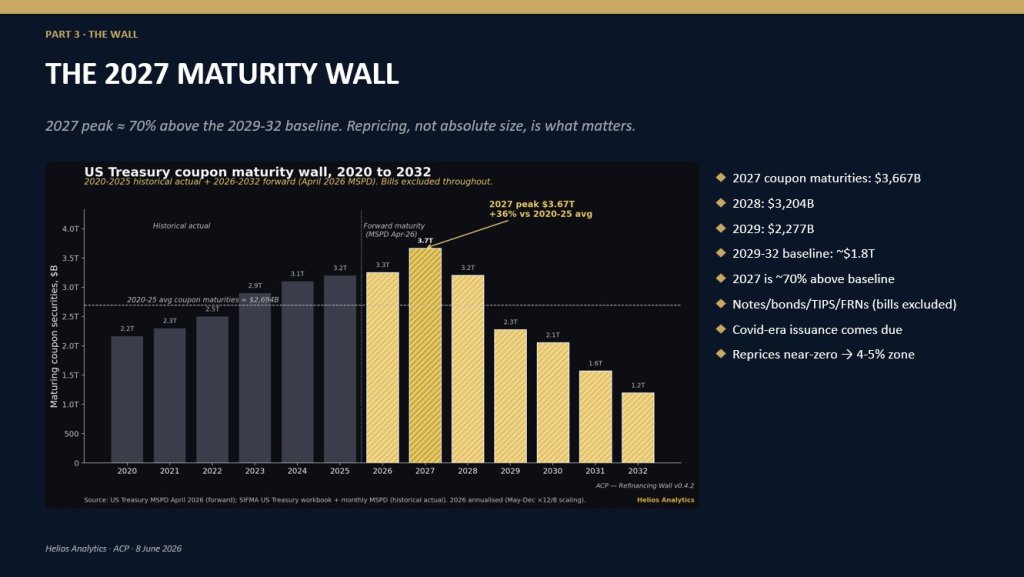
Source: X @Jamie1Coutts

For Bitcoin and other risk assets, the concern is whether current liquidity conditions can absorb that level of issuance without stress in the Treasury market. Coutts argued that liquidity remains a constraint, particularly as capital has continued to rotate away from crypto since late 2025.

“Retail and insto flows have been rotating out of Bitcoin and crypto since Q4 2025,” he said. “Every marginal unit of liquidity has flowed into AI buildout assets. That makes sense. Capital flows to where it’s treated best. Right now, the capital allocation argument sits with AI equities and commodities. On-chain activity is back at multi-year lows.”

That rotation matters because Bitcoin’s bull phases have historically depended not only on internal crypto positioning, but also on broader liquidity expansion and risk appetite. Coutts’ point is that Bitcoin may be entering a structurally attractive zone at the same time liquidity remains scarce and competing asset classes are absorbing the available capital.

He also pushed back against the market’s focus on IPO issuance, arguing that the larger issue is the government refinancing burden and the ability of the financial system to intermediate it. “While the market fixates on IPO issuance,” he wrote, “what concerns me about all risk assets is that markets ex-crypto don’t seem bothered by the fact that current liquidity levels can’t easily absorb this refi supply.”

The complication is the Fed’s balance sheet. Coutts noted that Kevin Warsh wants a smaller balance sheet, adding another potential constraint if policymakers try to roll a large maturity wall through a system with reduced central bank liquidity.

“Yes, they will continue to stuff the short end and monetise through the banks,” Coutts said, adding that stablecoins are likely to play an “increasingly important role.” But he warned that rolling $3.67 trillion of maturities through a contracting Fed balance sheet “without a bond market accident would be among the most impressive acts of fiscal/monetary policy management in a generation.”

The implication for Bitcoin is nuanced. Coutts is not dismissing the bottoming case. He is arguing that the market may still need a macro trigger before the next sustained advance can take hold. In his framework, Bitcoin is likely to sense a shift in Fed-side liquidity before other assets, but that shift may not arrive until stress appears in Treasuries.

“I don’t see how they do it without far more Fed-side liquidity,” he wrote. “Bitcoin will detect it first. But there’s still an uncomfortable distance to travel. Treasuries will need to start misbehaving before the policy needle moves. That’s the tricky part.”

At press time, BTC traded at $63,196.
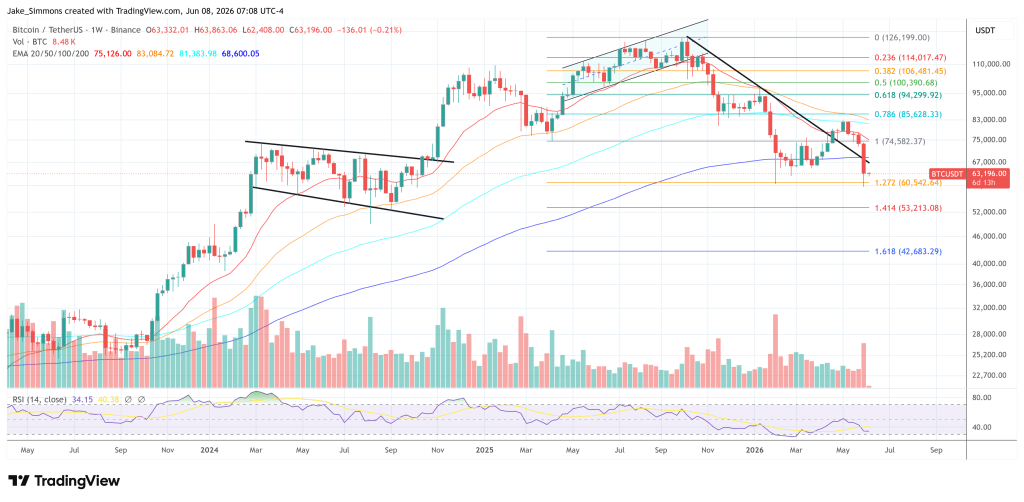
Bitcoin trades below the 200-week EMA, 1-week chart | Source: BTCUSDT on TradingView.com

热门币种推荐

相关问答

QAccording to Jamie Coutts, what is the key macroeconomic event that could prevent a sustained Bitcoin bull run?

AThe key macroeconomic event is the US Treasury's massive refinancing wall in 2027, involving $3.67 trillion in coupon maturities. The concern is whether current liquidity can absorb this issuance without stress in the Treasury market, potentially constraining capital flow to risk assets like Bitcoin.

QWhat does Jamie Coutts mean when he says Bitcoin is in a 'long-term accumulation zone'?

AHe means that Bitcoin's long-term technical setup is approaching very attractive levels, resembling structures that have historically preceded a cycle bottom. This suggests the asset is at a price level where long-term investors might consider accumulating positions.

QWhere has capital been rotating since Q4 2025, according to the article?

ACapital has been rotating away from Bitcoin and crypto and flowing into AI buildout assets (AI equities and commodities), as capital flows to where it is 'treated best' based on the current capital allocation argument.

QWhy does Jamie Coutts believe Bitcoin might sense a macro shift before other assets?

AHe believes Bitcoin is likely to detect a shift in Fed-side liquidity (potentially increased liquidity in response to Treasury market stress) before other assets, given its sensitivity to such monetary and liquidity conditions.

QWhat potential role does Coutts see for stablecoins in the context of the US debt refinancing challenge?

AHe suggests that stablecoins are likely to play an 'increasingly important role' as the financial system intermediates the large refinancing burden, potentially as part of the mechanisms to manage liquidity.

你可能也喜欢

存储的繁荣,能够持续多久?

半导体存储器市场正经历历史性的爆炸式增长。根据WSTS数据,存储器出货量在短短十年内增长超11倍,2026年5月单月达633亿美元,同比增速高达285%,远超以往任何“泡沫”时期。增长的核心驱动力并非出货量,而是DRAM和NAND闪存价格的异常飙升,自2025年初以来两者现货价格均上涨约10倍。 价格暴涨的根本原因在于人工智能数据中心带来的需求激增。以亚马逊、谷歌、微软和Meta为代表的超大规模数据中心运营商,为构建AI基础设施进行了巨额资本投资,预计2026年将达7550亿美元。这些数据中心像“黑洞”一样吸走了大量用于AI的高性能存储(如HBM),导致供应产能向AI领域倾斜,进而造成用于个人电脑、智能手机等消费电子产品的传统DRAM和NAND闪存严重短缺,价格被大幅推高。 这种扭曲的增长结构使得全球半导体市场规模预测被彻底颠覆。此前预测到2032年达1.2万亿美元的目标,可能在2026年就被超越。市场增长高度集中于存储器和逻辑电路(含GPU),而模拟和微控制器市场则增长平缓。 然而,作者根据存储器市场近35年的历史周期规律发出警告:该市场从未出现过连续六年以上的正增长,繁荣期通常不超过五年。此次以2024年为顶点的AI热潮,按历史规律预计最迟将在2028年、甚至2027年结束。更关键的是,“高峰越高,低谷越深”是半导体行业的铁律。当前285%的增速是前所未有的峰值,随之而来的衰退很可能比以往任何一次都更加严重和漫长。 尽管当前存储制造商因利润暴增而股价飙升,甚至创造了许多“亿万富翁”,但作者强烈呼吁行业应保持冷静,利用当前的繁荣期为必将到来的严峻衰退做好切实准备。

链捕手3小时前

存储的繁荣,能够持续多久?

链捕手3小时前

交易

现货

热门文章

加密市场宏观研报:《GENIUS Act》法案取得重大进展,BTC突破历史新高,后市全新展望

2025年5月22日,比特币价格正式突破11万美元大关,创下历史新高。在政策面、宏观经济、资金面与投资者结构共同作用下,一场结构性牛市浪潮正在展开。而此轮上涨背后的核心驱动,是美国《GENIUS稳定币法案》的实质性进展以及多项利好的叠加。本文将从政策端突破、宏观环境转向、链上与ETF资金结构、交易行为演化,以及重点受益赛道五大维度,全面解析此轮BTC再创新高的深层逻辑,并前瞻下半年市场的潜在趋势。

1.8k人学过发布于 2025.05.22更新于 2025.05.22

加密市场宏观研报:《GENIUS Act》法案取得重大进展,BTC突破历史新高,后市全新展望

相关讨论

欢迎来到HTX社区。在这里,您可以了解最新的平台发展动态并获得专业的市场意见。以下是用户对BTC(BTC)币价的意见。

活动图片