Bitcoin Trading Enters New Era With SEC-Approved Nasdaq Index Options

bitcoinist发布于2026-05-23更新于2026-05-23

文章摘要

The U.S. Securities and Exchange Commission (SEC) has approved Nasdaq's proposal to list and trade Bitcoin index options, though trading is not immediate. Final approval is also required from the Commodity Futures Trading Commission (CFTC), which has jurisdiction over Bitcoin as a commodity. The cash-settled, European-style options, to trade under ticker QBTC on the Philadelphia Stock Exchange, will derive their value from the Nasdaq Bitcoin Index and will not involve physical Bitcoin delivery. This decision reflects a broader regulatory shift under SEC Chairman Paul Atkins, including a move toward clearer rules supporting innovation and reports of a potential "innovation exemption" for tokenized securities. The approval represents a continued integration of Bitcoin-linked products into mainstream finance.

Trading in the new Bitcoin index options will not begin right away. The SEC approval does not automatically open the door — the Commodity Futures Trading Commission must still grant its own exemptive relief before any contracts change hands on the exchange, because Bitcoin is classified as a commodity and falls under the CFTC’s jurisdiction.

The SEC approved Nasdaq’s proposal to list the options on the Philadelphia Stock Exchange, known as Phlx, on an accelerated basis, with the decision published Friday on the agency’s website.

A Different Kind Of Bitcoin Contract

The contracts are European-style and cash-settled, meaning buyers receive the difference between the Bitcoin spot price and the strike price at expiration — no actual Bitcoin changes hands.

That structure also removes the risk of early assignment, which sets these apart from options tied to spot Bitcoin ETFs that have been available to investors.
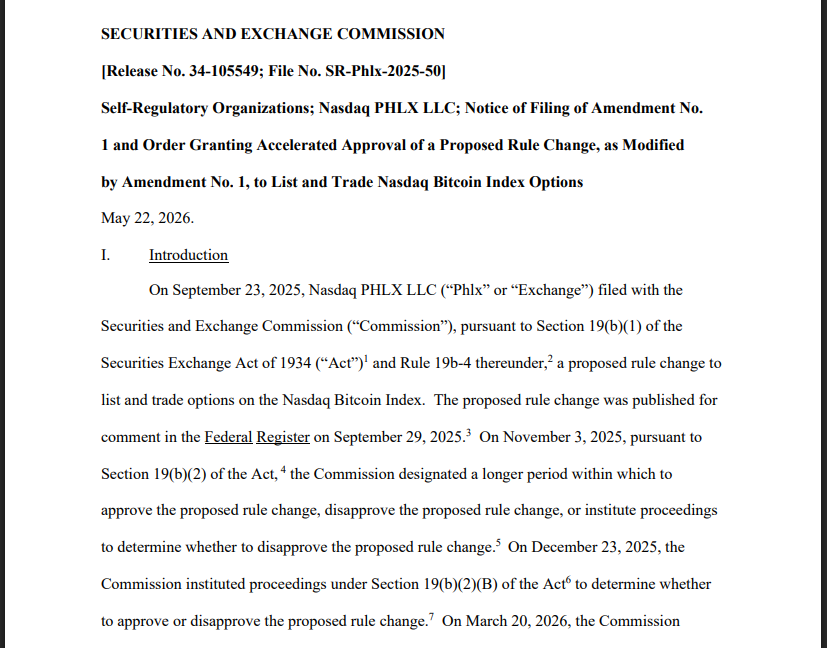
Source: SEC

The contracts will trade under the ticker QBTC, with a minimum price increment of one cent and a position limit of 24,000 contracts per side, which works out to roughly 0.12% of Bitcoin’s total outstanding supply.

They are tied to the Nasdaq Bitcoin Index, a benchmark that tracks one one-hundredth of the CME CF BTC Real Time Index, which pulls pricing data from major cryptocurrency exchanges every 200 milliseconds.

CME Group filed a comment letter last October arguing the new contracts fall under the CFTC’s exclusive authority. The SEC pushed back, writing in its order that shared jurisdiction between the two regulators is not new, citing mixed swaps and security futures as existing examples, and referencing Section 717 of the Dodd-Frank Act as the legal basis for concurrent oversight.

Bitcoin is now trading at $74,748. Chart: TradingView

A Shift In Tone At The SEC

The approval fits a broader shift underway at the SEC under Chairman Paul Atkins. The agency has moved to drop several enforcement cases against crypto firms that were launched under the previous administration, and Atkins has called publicly for clearer rules that support innovation.

Image: Economic Times

Reports indicate the SEC is also preparing what it calls an innovation exemption that would allow tokenized trading of public company shares on decentralized crypto platforms, even without consent from the companies involved.

The Philadelphia Stock Exchange will host the new QBTC contracts once both regulators have signed off, marking another step in Wall Street’s growing embrace of Bitcoin-linked financial products.

Featured image from Unsplash, chart from TradingView

相关问答

QWhat must happen before trading of the new Nasdaq Bitcoin index options can begin, despite SEC approval?

ABefore trading can begin, the Commodity Futures Trading Commission (CFTC) must grant its own exemptive relief. This is required because Bitcoin is classified as a commodity under the CFTC's jurisdiction.

QHow do the new Nasdaq Bitcoin index options differ from options tied to spot Bitcoin ETFs in terms of structure?

AThe new Nasdaq Bitcoin index options are European-style and cash-settled, meaning no actual Bitcoin changes hands. This structure removes the risk of early assignment, which sets them apart from options tied to spot Bitcoin ETFs.

QWhat is the ticker symbol and position limit for the new Bitcoin index options approved by the SEC?

AThe new Bitcoin index options will trade under the ticker symbol QBTC. They have a position limit of 24,000 contracts per side, which is roughly 0.12% of Bitcoin's total outstanding supply.

QWhat benchmark index will the new Nasdaq Bitcoin index options be tied to?

AThe new Nasdaq Bitcoin index options will be tied to the Nasdaq Bitcoin Index. This benchmark tracks one one-hundredth of the CME CF BTC Real Time Index, which pulls pricing data from major cryptocurrency exchanges every 200 milliseconds.

QAccording to the article, what broader shift is underway at the SEC under Chairman Paul Atkins?

AUnder Chairman Paul Atkins, the SEC is undergoing a broader shift. This includes dropping several enforcement cases against crypto firms from the previous administration and advocating for clearer rules to support innovation. The agency is also reportedly preparing an 'innovation exemption' for tokenized trading of public company shares.

你可能也喜欢

一文拆解“股神Serenity”投资方法论

本文拆解了网络投资者“股神Serenity”(@aleabitoreddit)的“瓶颈点投资法”。该方法论核心在于:先确认一个确定性的大趋势(如AI算力扩张),然后深入拆解其产业链,找出其中供给受限、难以替代且市场关注度低的上游环节(如InP衬底、特定激光器),在价格未被充分定价前提前布局。 该方法可拆解为五个关键因子: 1. **确定需求**:需求背景必须坚实,如巨头资本开支和明确的技术路线图。 2. **受限供给**:标的环节需具备“没它不行”、扩产慢、认证周期长等瓶颈特征。 3. **低关注度**:市场覆盖少、认知滞后,存在错误定价机会。 4. **价值捕获**:公司需具备定价权、高毛利、客户锁定等将瓶颈转化为利润的能力。 5. **催化剂**:需要财报、客户量产、政策等短期事件驱动价格重估。 文章以$AXTI、$RPI、$AAOI/$LITE为例,说明了如何应用此方法。并提出了六步实践路径: 1. 寻找已被验证的大趋势。 2. 绘制从终端到上游的完整产业链地图。 3. 识别其中真正的产能/技术瓶颈。 4. 搜集客户、订单、产能等证据链。 5. 做好风控,预先思考证伪点。 6. 使仓位大小与自身研究深度相匹配。 同时,文章指出了该方法的局限性:推断存在过拟合风险;早期标的缺乏估值锚;Serenity本人的影响力已成市场变量,可能影响赔率;其超高收益部分受益于AI牛市,存在幸存者偏差。该方法高度依赖专业判断、信息拼图和纪律性。 最终结论强调,应复制的不是其具体持仓,而是“走窄门”的研究顺序:从大趋势到产业链瓶颈,再通过证据和风控,用可承受的仓位进行非共识下注。

marsbit17分钟前

一文拆解“股神Serenity”投资方法论

marsbit17分钟前

一文拆解“股神Serenity”投资方法论

本文拆解了“股神Serenity”的核心投资方法论——瓶颈点投资法。该方法的核心是:在确定性强的大趋势(如AI数据中心扩张)中,深入产业链,寻找最难以被替代、供给受限的上游“瓶颈”环节(如特定材料、器件),并在市场尚未充分定价时提前布局。 瓶颈点投资法可拆解为五个关键因子: 1. **确定需求**:趋势需被验证且需求明确。 2. **受限供给**:目标环节需具备“没它不行”且短期难以复制的特性。 3. **低关注度**:市场认知滞后,股价未被充分反映。 4. **价值捕获**:公司能享有定价权、高毛利,并锁定客户。 5. **催化剂**:需要有财报、客户量产、政策等短期催化因素。 文章通过$AXTI(InP衬底)、$RPI(边缘硬件)等案例,说明该方法如何在小市值、冷门但关键的环节上获得超额收益。同时,文章提出了学习并运用此方法的六步流程:找大趋势、画产业链地图、识别真瓶颈、寻找证据链、做好风控、匹配仓位与研究深度。 最后,文章指出了该方法的局限性,包括推断易过拟合、早期估值难锚定、追随者效应带来的反身性风险,以及需要警惕幸存者偏差。其成功不仅依赖强大的分析能力,还需要深度信息获取能力和承受波动的心理素质。核心启示在于:真正的价值在于复制其“先趋势、再瓶颈、后证据、严风控”的研究路径,而非单纯跟随其持仓。

链捕手27分钟前

一文拆解“股神Serenity”投资方法论

链捕手27分钟前

Sharplink CEO:现在清仓ETH,就像互联网泡沫时卖掉亚马逊

本文是对Sharplink CEO Joseph Chalom文章《Ethereum Going Back on Offense》的编译与摘要。针对近期以太坊社区因Bankless联创清仓ETH引发的悲观情绪,Chalom以资深金融从业者(前贝莱德高管)和大型ETH持仓公司CEO的身份,试图提振市场信心,并提出不同视角。 Chalom的核心观点如下: 1. **以太坊基本面坚实**:他认为当前市场争议是噪音,以太坊在信任、安全和流动性上已遥遥领先,处理着全球主要稳定币结算和大部分代币化资产,这是以太坊基金会(EF)长期专注核心协议开发(如The Merge、EIP-1559等重大升级)的结果。 2. **去中心化是优势,非缺陷**:EF专注协议安全与去中心化,这正是机构信任的基础。以太坊的可信中立性是其成为未来金融结算层的核心,不应被视作弱点。 3. **将ETH类比互联网泡沫时的亚马逊**:他认为当前市场低估了ETH,就像当年市场只关注亚马逊亏损而忽视其重塑零售和云计算的愿景。以太坊的目标市场是全球金融体系,其价值将随网络处理稳定币、RWA、DeFi等交易量的爆发性增长而提升。 4. **建议逆向投资**:他指出市场极度恐惧时(恐惧与贪婪指数为证),正是纪律资本布局优质资产的良机,应学习巴菲特和贝莱德在危机中逆势投资的智慧。 5. **呼吁生态积极发声**:Chalom承认以太坊在市场推广层面存在领导力问题,并呼吁Sharplink等生态利益相关者更积极地构建叙事、推动机构采用。他透露Sharplink已质押数十亿美元ETH,并投资DeFi协议及成立相关基金。 文末,Chalom总结道:以太坊的未来正在此刻发生,EF正回归其核心职责(专注于CROPS框架,即审查阻力、开放性、隐私和安全),而生态需共同推动机构采用的超级周期。

marsbit3小时前

Sharplink CEO:现在清仓ETH,就像互联网泡沫时卖掉亚马逊

marsbit3小时前

交易

现货
合约

热门文章

加密市场宏观研报:《GENIUS Act》法案取得重大进展,BTC突破历史新高,后市全新展望

2025年5月22日,比特币价格正式突破11万美元大关,创下历史新高。在政策面、宏观经济、资金面与投资者结构共同作用下,一场结构性牛市浪潮正在展开。而此轮上涨背后的核心驱动,是美国《GENIUS稳定币法案》的实质性进展以及多项利好的叠加。本文将从政策端突破、宏观环境转向、链上与ETF资金结构、交易行为演化,以及重点受益赛道五大维度,全面解析此轮BTC再创新高的深层逻辑,并前瞻下半年市场的潜在趋势。

1.6k人学过发布于 2025.05.22更新于 2025.05.22

加密市场宏观研报:《GENIUS Act》法案取得重大进展,BTC突破历史新高,后市全新展望

相关讨论

欢迎来到HTX社区。在这里,您可以了解最新的平台发展动态并获得专业的市场意见。以下是用户对BTC(BTC)币价的意见。

活动图片