Author: Climber, CryptoPulse Labs
Recently, the TON token has experienced consecutive increases, rising approximately 120% over 4 days and approaching the $3 mark. The primary reason behind this surge is the public endorsement by Pavel Durov, the founder of Telegram.
He stated that Telegram will replace the TON Foundation, becoming the core driving force behind TON, and will serve as the largest validator for the TON network. Meanwhile, the TON network has also been continuously advancing technical upgrades, such as announcing a 10x increase in network speed performance and a 6x reduction in transaction fees.
On the surface, this appears to be a round of technical upgrades and narrative revival for TON. However, what the market is truly reassessing is not TON itself, but the fact that Telegram has begun, for the first time, to fully embark on a comprehensive on-chain transformation in a real sense.
I. Telegram Takes the Helm: TON's Valuation Logic Begins to Shift
Over the past few years, TON has occupied a very unique position. It is deeply intertwined with Telegram, yet the two have always maintained a certain distance.
The reason is quite simple. Early on, Telegram launched the Gram fundraising plan, which ultimately faced regulatory intervention from the U.S. SEC, forcing the project to be terminated. The community subsequently took over the project, gradually evolving into the current TON ecosystem.
Therefore, for a long time, although Telegram continued to support TON—including gradually integrating its wallet, bots, mini-apps, and advertising system with TON—it never truly assumed the role of the official driver of TON publicly.
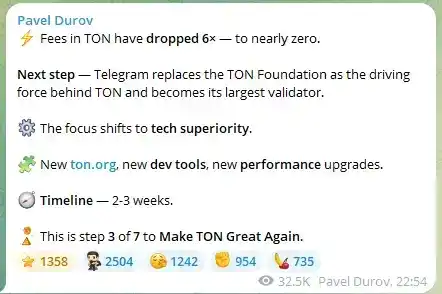
Pavel Durov's recent statements fundamentally alter market expectations. Particularly, the key points of Telegram replacing the TON Foundation and becoming the largest validator directly clarify that Telegram is now beginning to participate directly in the underlying governance and network operation of TON.
This is no longer just ecosystem support; it signifies Telegram formally reclaiming dominant control over TON's roadmap.
This shift is crucial because, in the past, the biggest question the market had about TON was not its technical capability but whether Telegram would truly go all-in on TON. Now, this question has a clear answer.
Simultaneously, this also means TON's valuation logic is changing. Previously, the market priced TON essentially as a public chain with Telegram's traffic support. But now, the market is beginning to reassess TON, as it is likely becoming the on-chain infrastructure within Telegram's future commercial ecosystem.
The difference between the two is significant. The former still belongs to the Crypto narrative, while the latter is beginning to enter the narrative of an internet-platform scale. This is also why TON's recent rise is not merely driven by sentiment but resembles a round of long-term expectation restructuring.
II. TON Reconstructs the Internet Payment Structure
Examining TON's recent rounds of upgrades closely reveals that its optimization direction is actually very clear: faster speed, lower fees, shorter confirmation times, and transaction fees approaching zero.
On the surface, these upgrades are optimizing chain performance, but what they are truly serving is not traditional DeFi but the large-scale payment application scenarios within Telegram.
Because Telegram itself has nearly 1 billion users, it inherently generates a vast amount of high-frequency, small-value transaction demand. Examples include content tipping, bot services, mini-app purchases, cross-border transfers, and digital goods consumption, among others.
These scenarios share a common need: users require extremely low costs and prioritize high speed.
If a payment takes tens of seconds to wait or incurs fees of several dollars, the entire user experience deteriorates significantly. Traditional blockchains have been particularly ill-suited for this type of scenario in the past.
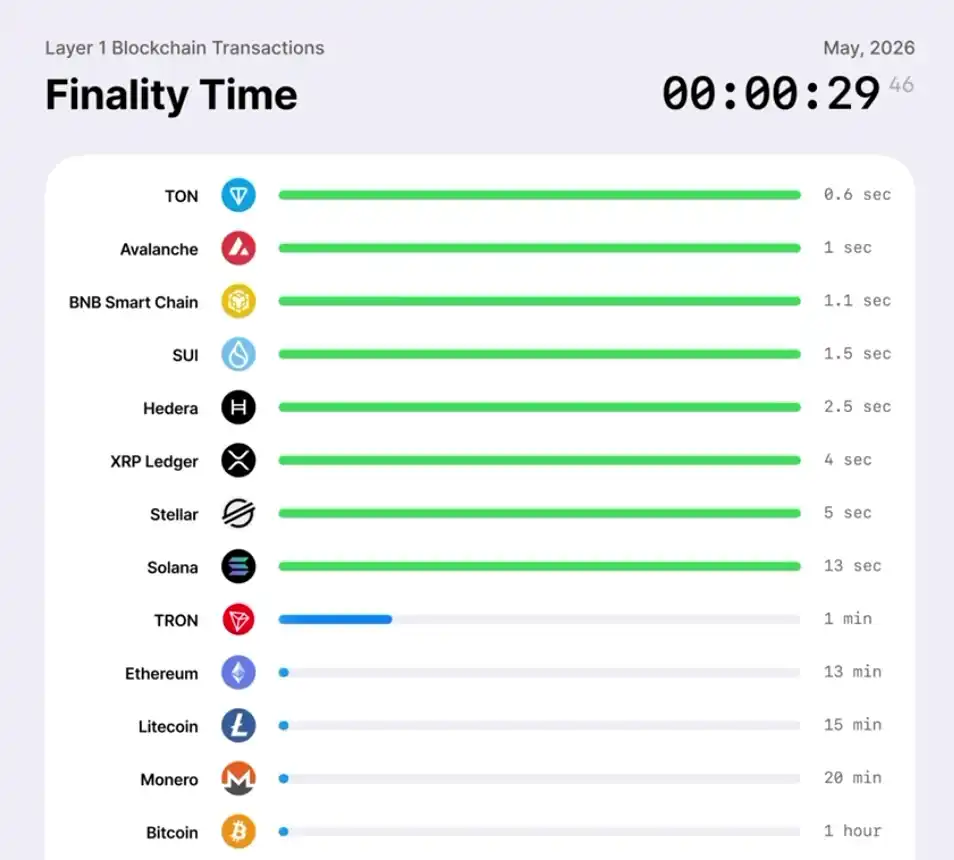
Therefore, TON's recent emphasis on fixed low fees and sub-second confirmations essentially revolves around redesigning blockchain for internet product experience. In other words, TON is attempting to solve a problem that Crypto has long failed to address: how to enable ordinary users to utilize on-chain systems almost imperceptibly.
This shift in logic is actually increasingly approaching the model of WeChat Pay.
Users don't need to understand blockchain, nor do they need to understand wallets, gas, or validation mechanisms. They only need to complete tipping, payments, purchases, transfers, and subscriptions, with all underlying settlements handled by TON.
This suggests that what TON truly aims to achieve may not be competition in the traditional L1 sense. What it is genuinely competing for is the global internet payment gateway.
Additionally, there is another crucial change. The logic of many public chains in the past has been: first build the infrastructure, then find users. But TON is the complete opposite. It first possesses a massive user base and then begins constructing the on-chain system.
Therefore, TON's challenge has never been how to get users into Web3, but rather how to enable users to complete on-chain actions without even realizing they are entering Web3. This represents a completely different development path.
III. TON's Future Blueprint: The On-Chain Transformation of Super Apps
Looking at all of TON's recent actions together, it becomes apparent that Telegram is gradually forming a complete closed loop. Functions that were originally separate—such as wallet, payments, bots, mini-apps, and on-chain settlements—are now gradually being integrated by TON.
This also signifies that TON is no longer just an independent public chain; it is becoming the infrastructure for value circulation within Telegram. The true significance of this lies in the fact that, for the first time, the crypto industry is approaching the on-chain transformation of super applications.
Because over the past decade, the crypto industry has always lacked a genuine mass-market entry point. Most public chains have been striving to attract users into the crypto world, but Telegram itself already possesses global-scale traffic.
Especially in markets like the Middle East, Russia, Eastern Europe, Southeast Asia, and Latin America, Telegram often functions not merely as a messaging tool but also as a community platform, commercial platform, payment tool, and more.
Therefore, TON's true strategic focus is not DeFi but rather global digital commercial scenarios.
Areas such as low-cost cross-border payments, the creator economy, on-chain micro-payments, and similar directions are likely the true sources of large-scale growth for TON in the future.
Of course, this path is not easy. TON's ecosystem remains in its early stages, with many applications still lingering in phases like mini-games, airdrops, and short-term traffic acquisition. Additionally, after Telegram's renewed deep involvement with TON, it may once again face regulatory pressure in the future.
Nevertheless, the market has now begun to realize one thing: TON's competitors may never have been traditional L1s, but rather the global internet payment systems.
Conclusion
This round of TON's rise is not essentially the market speculating on a simple upgrade. What truly drives the repricing of capital is the growing awareness that the world's first on-chain ecosystem with a genuine super-app entry point may have already begun to take shape.
And this time, Pavel Durov is no longer just an observer. Telegram is finally preparing to take the field itself.