Litecoin developers have disclosed that a critical validation flaw in the network’s Mimblewimble Extension Block implementation allowed an attacker to create an inflated pegout of 85,034.47285734 LTC in March 2026, before a coordinated emergency response recovered the funds and neutralized the accounting imbalance.
The incident, detailed in a postmortem published by Litecoin developer David Burkett on April 28, also set the stage for a second April event in which a later exploit attempt triggered a denial-of-service failure mode, disrupted upgraded mining nodes, and led to a 13-block invalid chain being reorged out.
A Critical Litecoin MWEB Validation Failure
According to the postmortem, the root issue was a missing validation check in Litecoin’s MWEB block connection path. MWEB inputs are supposed to reference previous MWEB outputs, while carrying metadata used by balance and spend validation logic. That metadata must match the actual MWEB UTXO being spent.
In normal mempool and block construction paths, that check existed. But it was not fully enforced during block connection. That gap allowed a malicious block producer to include an MWEB input whose supplied metadata did not match the real UTXO, making a small input appear capable of supporting a much larger pegout.
“The intended rule is simple: when an MWEB input spends a previous output, the metadata supplied by the input must match the actual MWEB UTXO identified by the input’s output ID,” the postmortem states. “That check existed in some paths, including normal mempool and block construction paths. But it was not fully enforced in the block connection path.”
The exploit occurred at block height 3,073,882. The attacker used an MWEB input with an actual value described as unknown, but “not more than 1.2084693 LTC,” while using fake commitment data to generate a pegout of 85,034.47285734 LTC. The inflated funds were initially sent to a transparent Litecoin address and later split into three transparent-chain outpoints.
Because exploitation required bypassing normal transaction relay and block-building checks, the attacker needed to mine a block or control a miner willing to include malformed MWEB data.
Miner Coordination, Frozen Outputs And Recovery
Once developers identified the vulnerability and confirmed it had already been exploited, they coordinated privately with major mining pools. The aim was to prevent further exploit blocks without immediately alerting the actor before the inflated outputs could be contained.
Litecoin Core 0.21.5 and 0.21.5.1 were deployed as emergency miner-focused releases. The latter added a historical exception for the already-accepted exploit block and temporarily rejected spends of the three attacker-controlled transparent outputs.
The attacker later attempted to spend at least one frozen output, but upgraded miners rejected the transaction. Developers then contacted the actor, who agreed to sign a recovery transaction returning the funds except for an 850 LTC bounty.
“The actor later signed a recovery transaction,” the postmortem says. “That transaction paid: 84,184.47278630 LTC total to the recovery address, split across two outputs. 850.00000000 LTC to an address controlled by the actor as the agreed bounty.”
The postmortem adds that Charlie purchased 850 LTC to cover the bounty gap. The full 85,034.47285734 LTC was then pegged back into MWEB at block height 3,078,098, and the resulting MWEB output was frozen. This was designed to restore MWEB’s internal supply balance while ensuring the rebalancing output could not be spent.
Litecoin developers said no confirmed user funds were ultimately lost in the March incident. Still, the response required emergency miner coordination, staged releases and special-case handling of historical exploit data.
April Attempt Triggered A 13-Block Invalid Chain
The second incident began on April 25 at block height 3,095,931, when another actor attempted to use the same original exploit path. Upgraded nodes rejected the malformed MWEB data, but the rejection exposed a separate mutated-block handling issue.
The postmortem explains that some serialized MWEB body data could be mutated without changing the canonical Litecoin block hash. When an upgraded node received such a mutated MWEB block over peer-to-peer channels, it could fail while applying the MWEB body, classify the failure as “BLOCK_MUTATED,” and retain the bad serialized data for that block hash. That could interfere with later valid block processing and mining RPC flows such as submitblock.
“During the April incident, this caused upgraded mining nodes to reject the bad block but also become unable to continue normal mining operations quickly enough,” the postmortem states. “Unupgraded miners, which did not enforce the MWEB fix, continued extending the invalid chain until upgraded miners coordinated and overtook it.”
The invalid chain ran through block height 3,095,943, producing 13 bad blocks in total before the valid chain overtook it. Litecoin developers emphasized that this was not a rollback of valid Litecoin history, but a reorg of an invalid chain produced by miners that had not upgraded or had not fully enforced the MWEB validation rules.
Third-Party Losses Remain A Key Open Issue
While the March exploit was recovered internally, the April reorg affected some external infrastructure. The postmortem says NEAR Intents processed a swap of 11,000 LTC for 7.78814476 BTC before those LTC were removed from the valid chain, resulting in what Litecoin described as a “large loss” for NEAR Intents. THORChain was also affected, with an attacker swapping 10 LTC for 0.00719957 BTC before the reorg invalidated the Litecoin side of the transaction.
Other attempted swaps were reportedly prevented in time, but exact third-party transaction IDs and final loss amounts were still being collected.
Litecoin Core 0.21.5.4 was released on April 25 to address the mutated-block DoS failure mode by erasing stored block data for blocks classified as mutated, allowing valid data for the same block hash to be accepted later. Users, miners, exchanges and services were urged to upgrade to Litecoin Core 0.21.5.4 or later and verify that nodes are syncing normally.
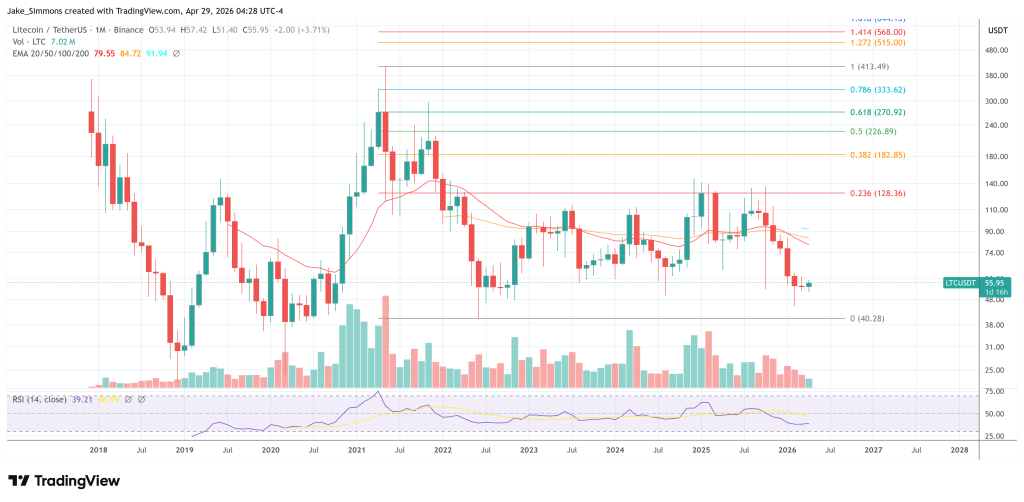
At press time, LTC traded at $55.95.